Arts & Culture
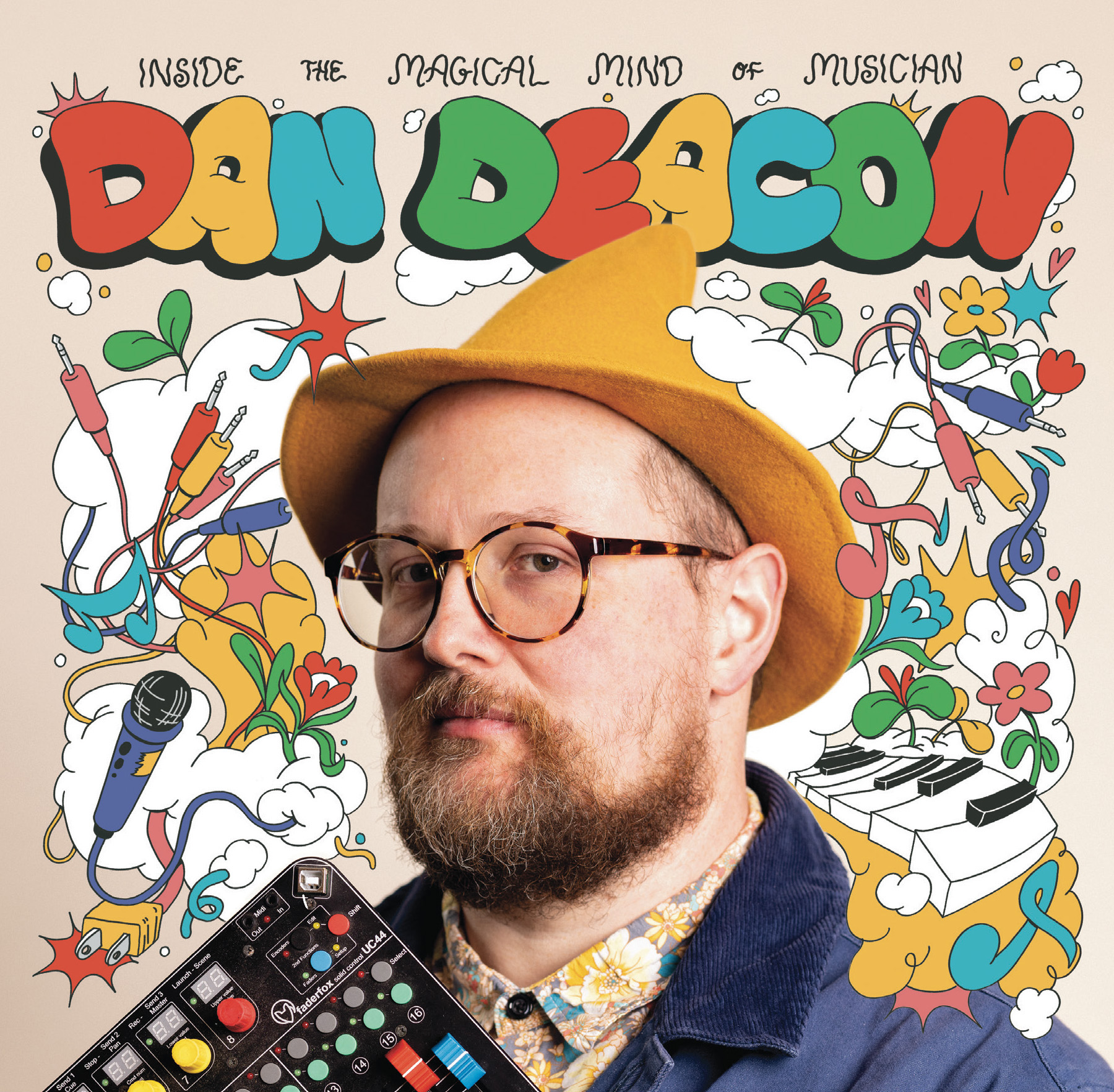
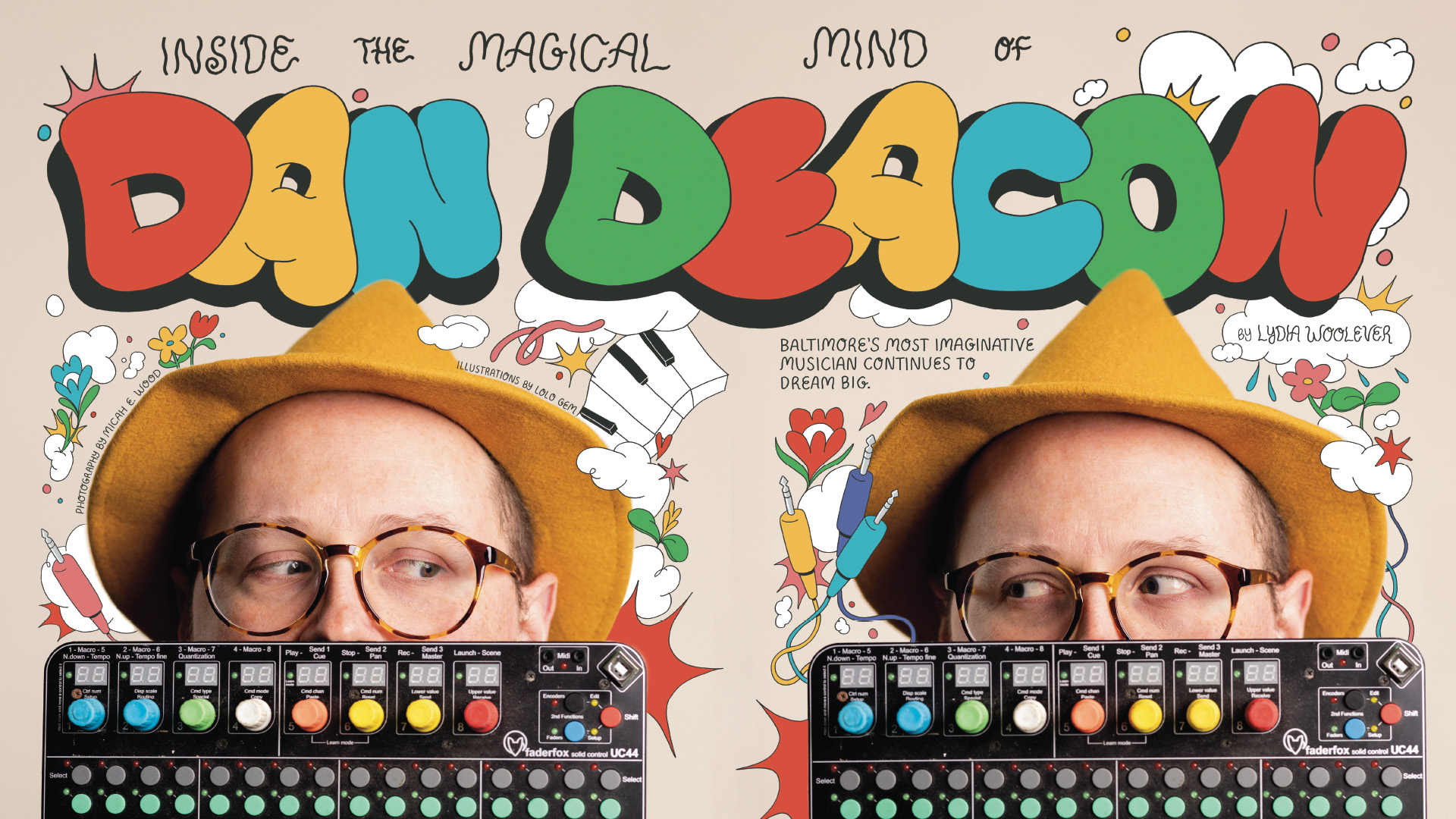
Baltimore's most imaginative musician continues to dream big.
By Lydia Woolever
Photography by Micah E. Wood
Illustrations by Lolo Gem
THE SOUNDS ARE EVERYWHERE. On an enclosed bridge over a man-made wetland, the first notes trickle out of the National Aquarium’s “Blue Wonders” wing—that iconic landmark topped with a glass pyramid on the edge of the Inner Harbor’s Pier 3.
Inside, one mysterious source sits in the center of the entrance: an upright player piano, plugged into a laptop, playing all by its lonesome, the sharks behind it swimming slowly in shallow pools of turquoise water.
Then other instruments come into focus, this time powered by real live humans. There is longtime radio host Sam Sessa with an accordion in the corner between tubes of blooming bubbles. And DJ Amy Reid sitting on the floor with a synthesizer near sitarist Ami Dang against a backdrop of gliding fish. Up the escalator, Patrick McMinn picks at a pedal steel guitar beside tanks of diamondback terrapins. And even further up, drummer Bashi Rose riffs on a kit, rapper Eze Jackson leans into a mic, while saxophonist Daoure Diongue jams in front of a bustling coral reef.
Across multiple floors, more than 40 musicians improvise in unison on this Thursday night in late November 2024. Each wears a shimmering cape and set of headphones, never straying from their post but frequently shifting their performance based on the hundreds of Baltimoreans who wander by and the unconventional cues coming into their ears from an elusive maestro. Over an ambient bassline, it all ebbs and flows into one swirling symphony—at times, sparse and eerie, at others sparkling and ethereal, morphing every minute for the next two hours.
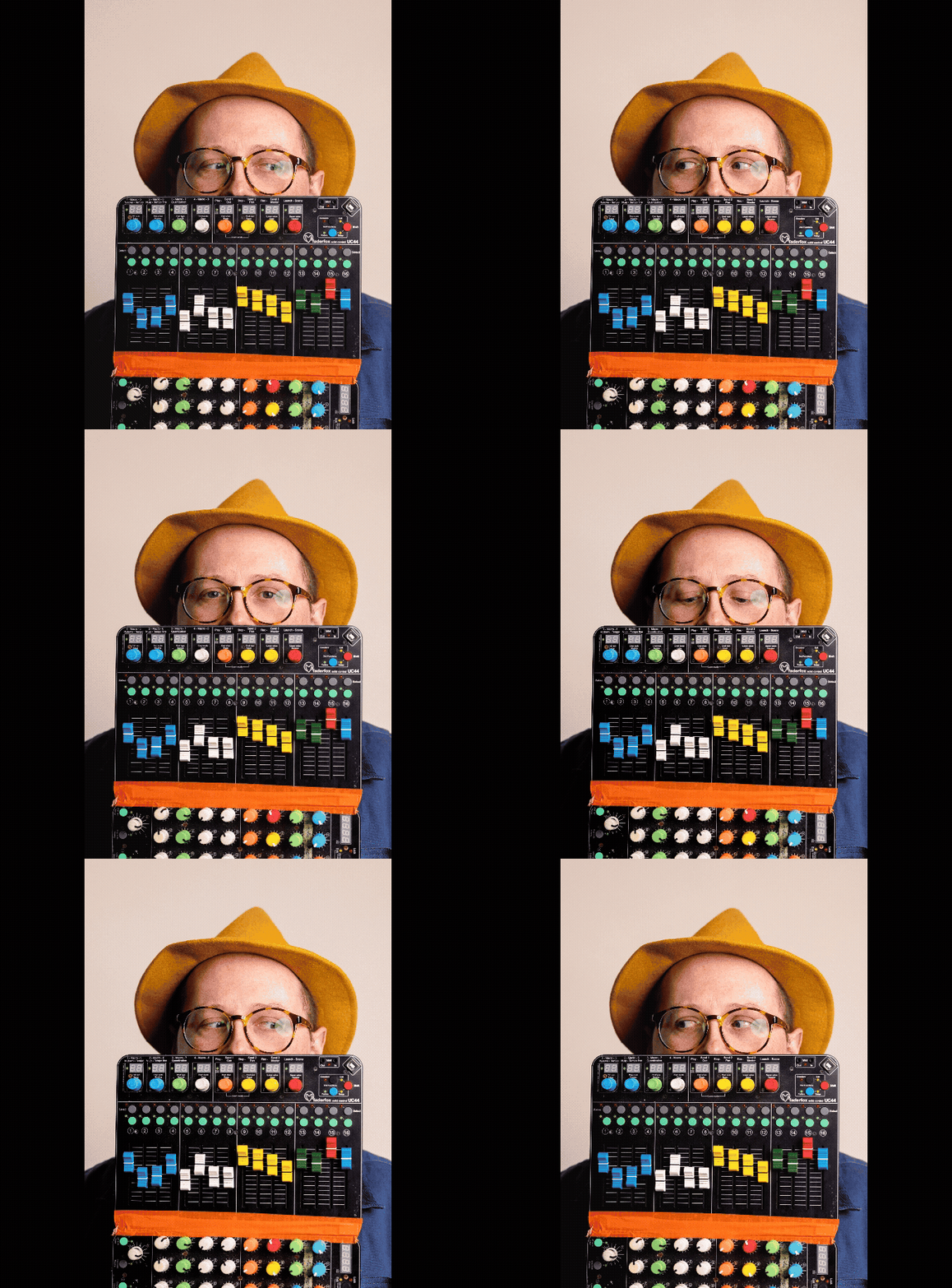
Somewhere in the midst hides Dan Deacon, the local composer who dreamed up this experimental evening. Part of the Aquarium’s immersive Voyages series, “Feedback Loop” was envisioned as an interactive meditation on our complex ecosystems and the constant exchanges taking place within them. Ice melts, rivers flow, oceans rise, temperatures warm, currents shift, ice melts again. And people, of course, create ripple effects. So as the crowd moves throughout the dispersed ensemble, the environment around them—physically, sonically, energetically even—transforms in real time, too.
After making their way around the building, everyone eventually convenes in the cafeteria. Then, two hours ’til midnight, a feet away from a wall of jellyfish, the man of the hour finally emerges.
In a floral button-up and Orioles-orange baseball cap, Deacon takes his place at a folding table, topped with various pieces of electronic equipment. With the push of buttons and twist of knobs, he launches into the opening keys of his song, “Become a Mountain.” Then into a microphone, he begins to sing. The music grows louder, more layered, exceedingly lush. “All of time . . . is right here . . . is right now,” he croons out into the audience—still a bit spellbound by all they’d just seen and heard.
It doesn’t take long for this encore to overflow into an all-out dance party. At Deacon’s invitation, dozens of strangers form a circle, in which a few brave souls jump in and flail their bodies, and later, a tunnel, up the stairs and around the balcony for an impromptu conga line, with the mastermind himself also running through.
It’s giddy, uninhibited, transcendent even.
But this is not the first time Deacon has incited such a sense of wonder. And it surely won’t be the last.
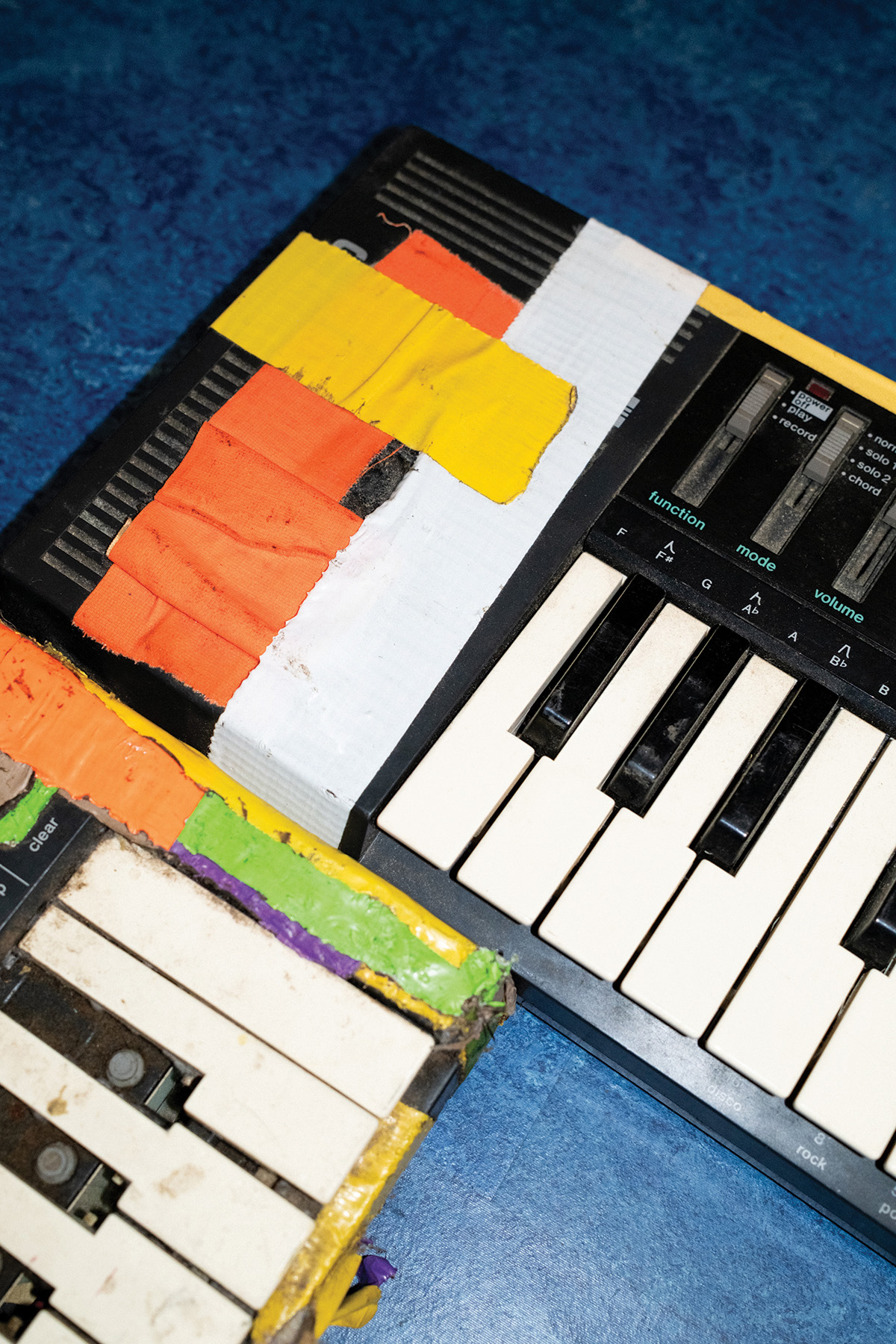
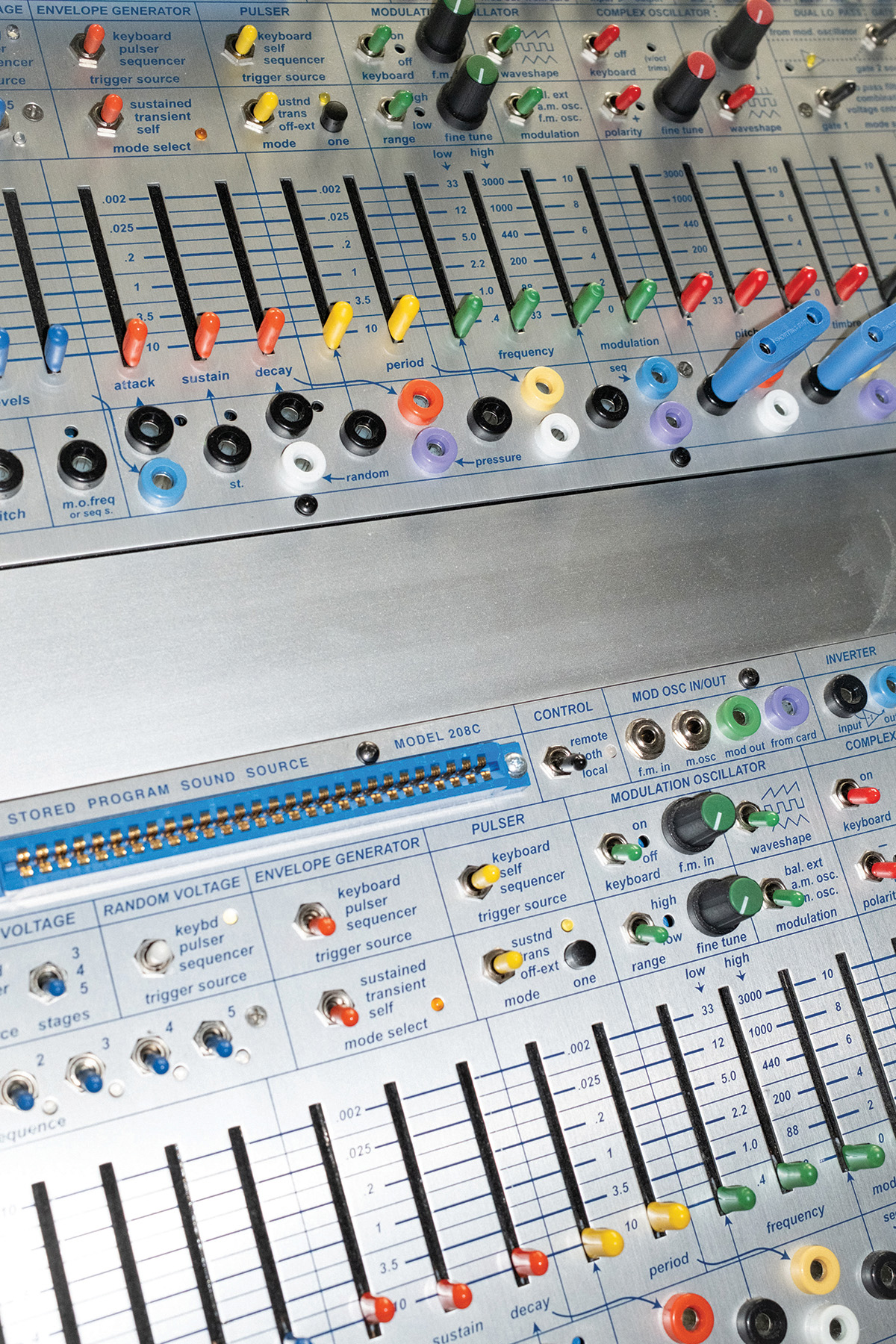
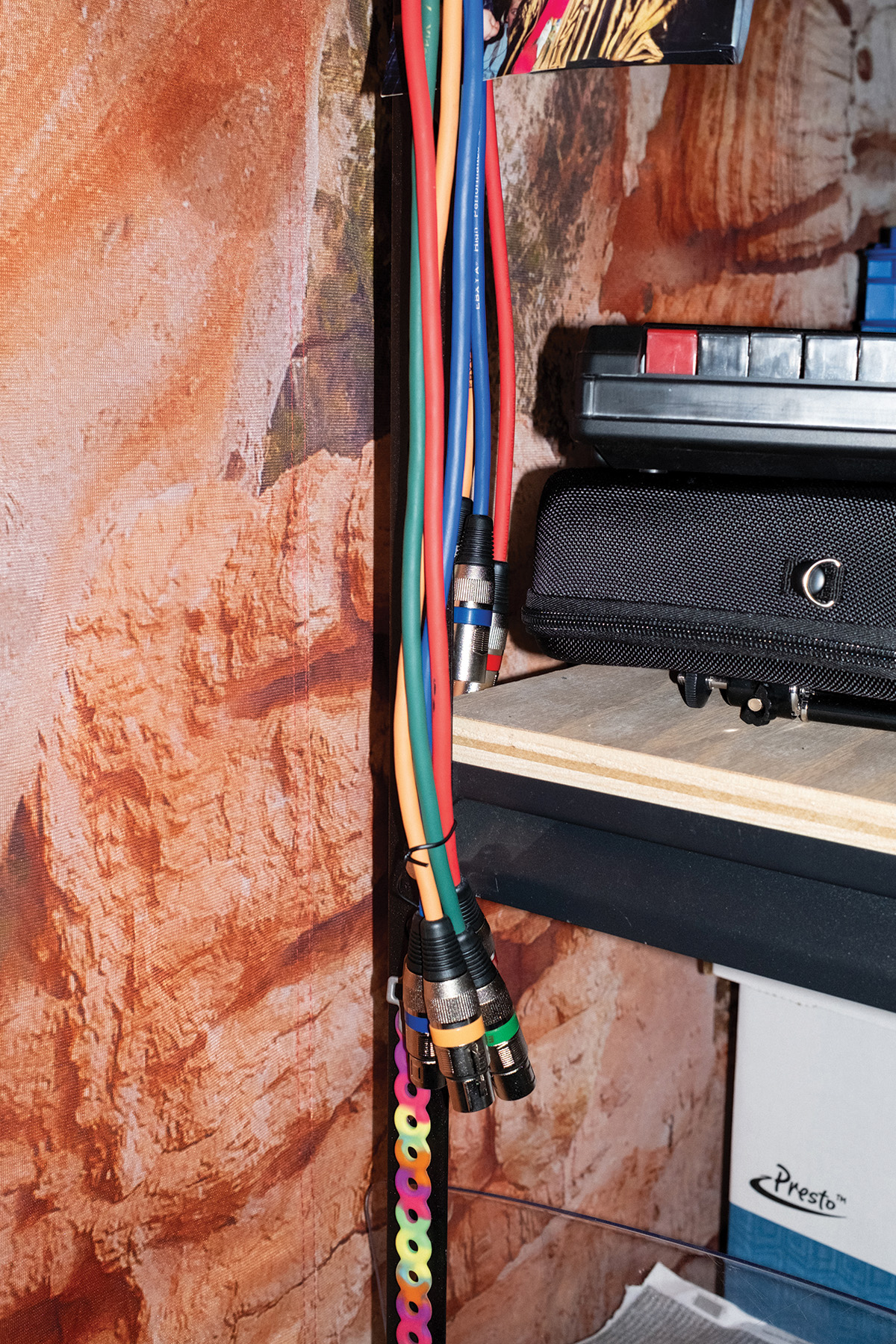
PAST AND PRESENT
MUSIC EQUIPMENT
SHOWS OFF DEACON’S
COLORFUL WORLD.
IN EARLY JULY, Deacon is sitting in his home studio. The brick garage behind his Bolton Hill home has recently been transformed into this new workspace, and it smells of fresh plywood. His equipment—an eclectic array of gadgets and gizmos—is still covered from the construction. Through a small window overlooking the back patio, the branches of a birch tree flutter in the summer breeze.
This is a rare moment of pause for the prolific composer. Personally, he’s now married and a father of two, the evidence of his two toddlers everywhere—an upside-down toy, a tiny sock. Meanwhile, professionally, he might be the busiest musician in Baltimore.
At any given time, he has at least three projects going. For instance, last month, he was in Philadelphia, performing his reinterpretation of Vivaldi’s The Four Seasons with the contemporary Ballet X. Right now, he’s starting the score for season two of HBO’s hit series, Task. And in the coming weeks, he’ll head out for some end-of-summer concerts up the East Coast, performing the popular electronic albums for which he’s best known.
“I’m in music constantly,” says Deacon, 45, wearing another floral button-up and tie-dye Crocs. In fact, both on and off the road, he writes up to an hour of the stuff each week. (Which is a lot.)
And even then, when he’s not writing, he’s thinking about writing—and myriad other things that inform his creative practice. His mind is always in motion, brimming with small details, big ideas, existential questions. And though he can be soft-spoken, even shy, it often spills out of him.
Like memories of train rides that moved him during early tour days. And metaphors about how music can be like gardens and oceans and cakes. In conversation, he drifts in and out of funny voices that mock his many inner critics. He follows tangents to their feverish end, impressively snapping back to the original topic, his response still deeply considered. These streams of consciousness are a dazzling window into his psyche.
“I remember my therapist being like, ‘So when did you realize you had ADHD?’ And I was like, ‘Um . . . right now, in this very moment—when you said that!’” exclaims Deacon.
At first, he felt surprised. Then his entire existence suddenly made sense. Making music, especially the way he does, with a maximalist gusto, “It fills all the buckets in my brain. I love getting lost in it.”
Which has been true for a long time. Since well before he moved to Baltimore two decades ago, changing the music scene forever.
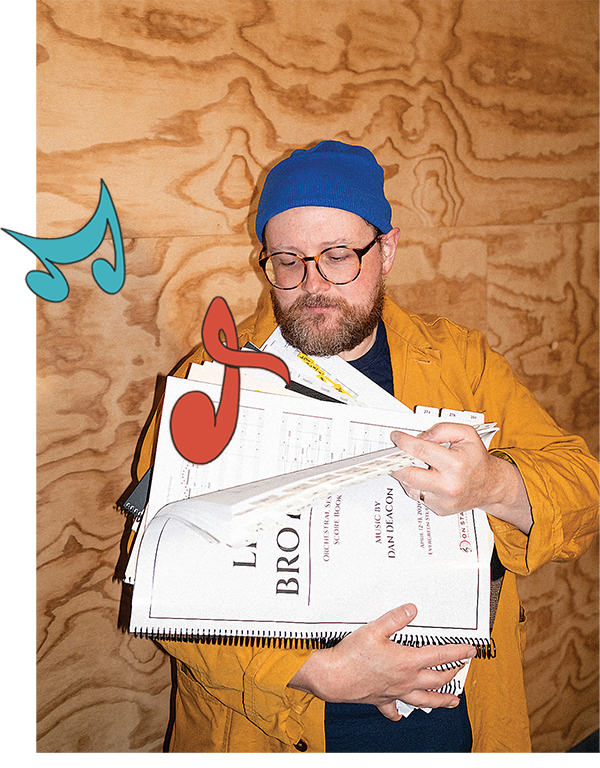
DEACON PAGING
THROUGH HIS SHEET
MUSIC
FOR THE FILM LITTLE
BROTHER.

IT SHOULDN’T BE A SURPRISE that Deacon came to music through the computer. In the early 1990s, his parents bought one of those blocky tan boxes running on Microsoft Windows, the kind that started up with the sound of an electronic brass salute. On it was Midisoft, a rudimentary software program for making digital music.
At this point, he already knew the basics. Growing up in Long Island, he played trombone (and later tuba) in the school band, recalling that first glimpse of the instrument as “a psychedelic experience.” But now, Deacon was teaching himself new things likes chords and clefs, with every free minute spent exploring what the computer could do. Out the window went his junior-high video games, having found another endless scroll to master. “I became totally obsessed.”
In fact, Deacon nearly dropped out of college as an undeclared sophomore at SUNY Purchase because his classes couldn’t hold his attention in the quite same way. Then friends turned him on to the school’s conservatory. “They were like, ‘Wait, if you’re not already in the music program,” he recalls, “then why the fuck are you writing MIDI files of fake trombones on your computer all day?’”
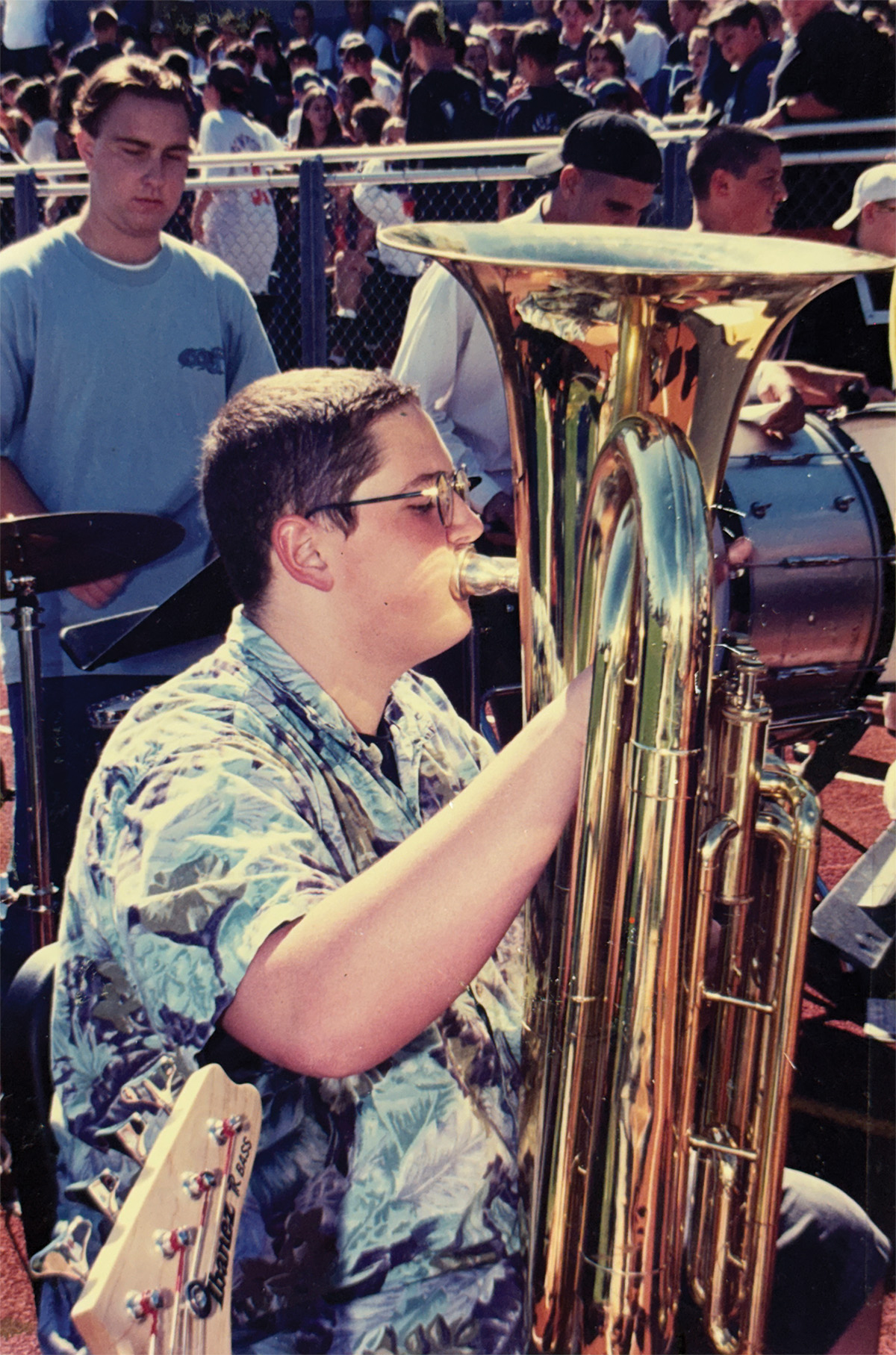
DEACON PLAYED TROMBONE IN ELEMENTARY SCHOOL AND TUBA IN HIGH SCHOOL.
In this formal setting, Deacon felt like an outsider. He had no background in classical music. His parents were former hippies who preferred Bob Dylan to Beethoven. But they’d always encouraged their son’s creativity, never giving him a curfew, even during his high-school ska-band stage. The self-described “straight-edge nerd” was the frontman. “I can’t really sing, especially couldn’t back then, but I knew how to work a crowd and keep the show going.”
Those social skills helped him find his footing on campus. He started booking an abundance of concerts, full of underground noise and punk bands. This was a formative experience for classmate Jimmy Joe Roche. “Dan and I bonded over a shared love of experimental music,” says the now-filmmaker and Johns Hopkins University professor. “We could sniff out another true weirdo.”
In short order, Deacon became a pied piper of sorts for other Purchase misfits. Their shared apartment was an incubator space from which all kinds of Dadaesque art emerged. That absurdism was a product of its time—one of good, old-fashioned, “post-9/11 George W. Bush nihilism,” says Deacon. But he and his friends were part of the student government, too, planning the school’s massive music festival and founding its television station that’s still on air today.
“Dan always had big ideas and big aspirations and was pushing to do something awesome, as big as he could, with as many people as possible,” says Roche. “But he was always really serious about his music.”
Working toward a master’s in studio composition, Deacon was expanding into new territory, finding inspiration in 20th-century pioneers, especially John Cage.
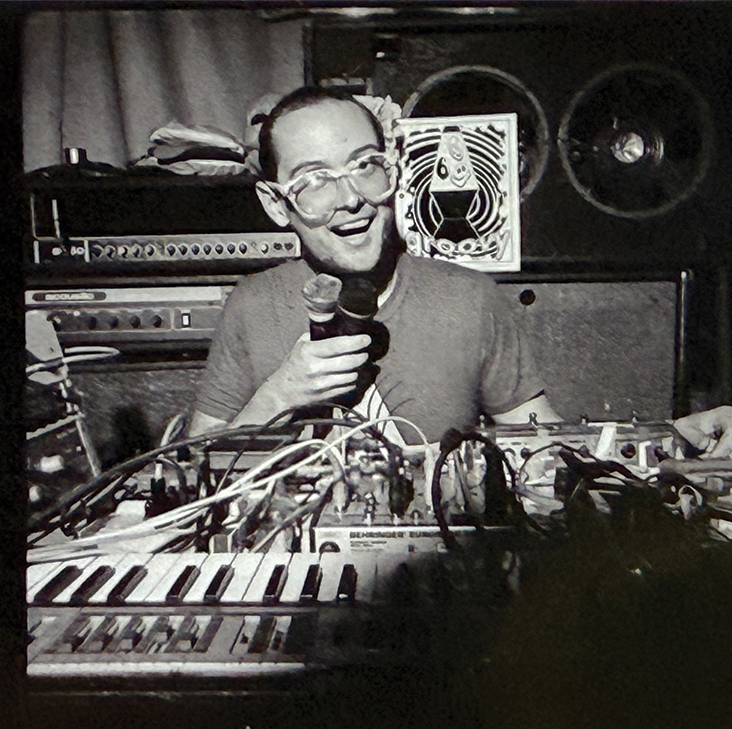
DEACON DURING COLLEGE DAYS.
“He started a revolution by proposing that composers could jettison the musical language that had evolved over the last seven centuries, and in doing so, he opened the door to minimalism, performance art, and virtually every other branch of the musical avant-garde,” wrote The New York Times in the composer’s 1992 obituary.
A big part of that was Cage’s novel “chance” method. Inspired by Eastern philosophy, this practice meant that all musical elements—pitch, duration, timbre, dynamics—were determined in the moment or at the toss of a coin, encouraging audiences to embrace the experience over the end result, ultimately becoming a part of it. At times also incorporating unexpected instruments like flowerpots and beer bottles, it was dismissed by traditionalists as impish, even anarchist.
Deacon could certainly have been described that way. Using hand-me-down keyboards, broken equipment dug out of the psychology department’s dumpster, and other doodads, his early music was all about pushing sonic limits.
What did that sound like? Imagine it something like this: “And then a billion kazoos, flying from an airplane!” he says gleefully with an evil-genius accent. Or, “‘Balloons filled with bees . . . let loose inside a cello!’”
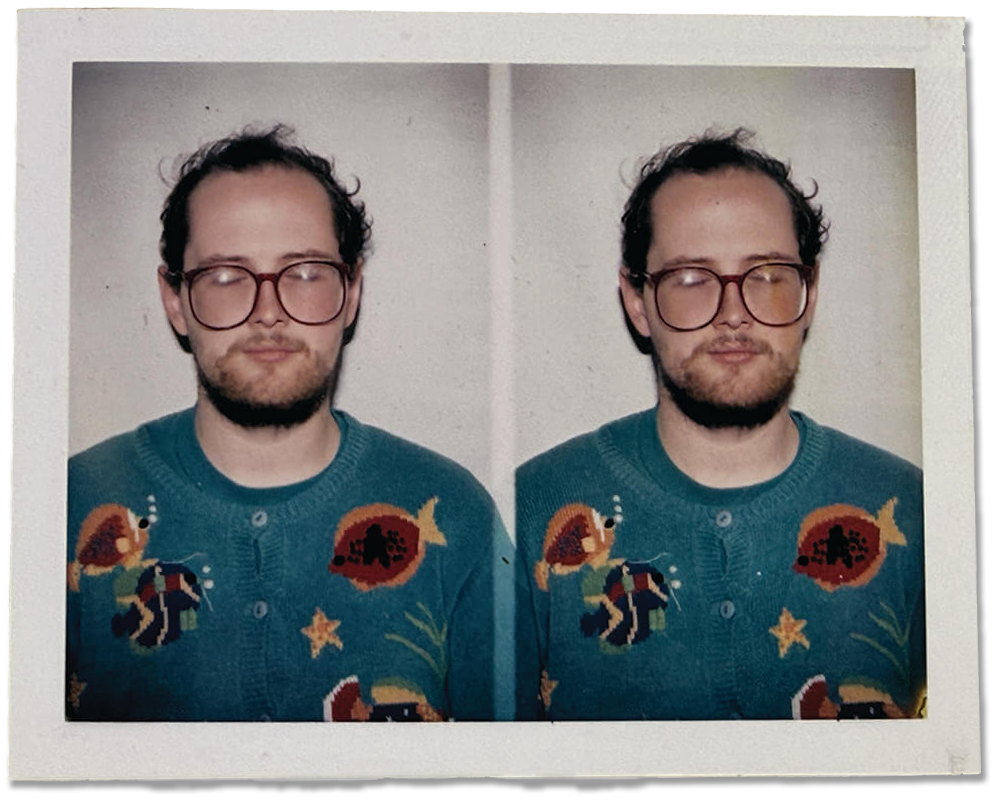
A COLLECTION OF
DEACON PORTRAITS
FROM EARLY DAYS.
Today, Deacon shudders at his youthful hubris. But excess was the point. He took great pleasure in filling a space to the brim with sound, looping and layering it, leaning into the repetition, hearing patterns emerge in the chaos. And he only continued to hone that mad science, especially as he started performing live.
The early aughts were an era of stone-faced electronic musicians staring into laptops on stage. That didn’t speak to Deacon. He had no instrument to perform, per se. But then his voice gave him that missing element. At first, it was just another sound to process.
“But then I started realizing, songs are cool! I don’t need everything to be a sound experiment, and I liked being in both worlds—too poppy to be noise, too noisy to be pop,” says Deacon. “It didn’t really fit any scene. But it definitely fit in Baltimore.”


“HAS THERE BEEN A MORE INFLUENTIAL figure in the Baltimore music scene these past 20 years than Dan Deacon?”
That’s the rhetorical question posed by Sessa, that Aquarium accordionist who started as a nightlife reporter at The Baltimore Sun a year after Deacon moved to this city. “He’s a big reason why so many cool things have happened here.”
And they almost never did. In 2004, during Deacon's last semester at Purchase, the obvious next stop was Brooklyn. Luckily, members of the band Oxes, who were from Baltimore, told Deacon about their hometown’s cheap warehouses. That winter, he came down for a show at the Talking Head Club and liked the vibe. By summer, his crew had moved into the Copycat Building, a bottlecap factory-turned-artists’ loft in Station North, where Wham City was born.
“You never knew what to expect, except that it would get shut down by the cops,” says Sessa of the art collective’s do-it-yourself programming: avant-garde art, fringe film screenings, oddball comedy shows, live music blasted through blown-out speakers. “No jerks,” their flyers read. The goal was still to just make art and have fun with their friends—as well as whoever else showed up, including swarms of students from the nearby Maryland Institute College of Art.
With no cell phone, no credit card, no driver’s license, Deacon woke up every morning and walked to the Enoch Pratt Free Library. There, he’d check his email and contact venues. Back at home, he’d write music on his roommate’s computer. At night, he barbacked at the Talking Head or played a show, only needing three a month to make his $180 rent.
“There was no backup plan,” says Deacon, who survived his first U.S. tour of house parties and adhoc performance spaces on cans of beans and the Greyhound bus. “I was determined to make music my whole life, and I don’t think I could have done it anywhere but Baltimore. We were in the right place at the right time.”
This was two years after the designation of Station North as one of Maryland’s first arts districts—in part an attempt to revitalize the gritty neighborhood. Back then, the scene was scattered throughout the city, with artists largely remaining in their own bubbles, isolated in part by our substandard transportation system. For experimental music, there was Maryland Art Place’s 14 Karat Cabaret on the west side, and Normals’ Red Room to the east. Deacon remembers thinking Hampden might as well have been Pennsylvania.
He finally got hip to other local happenings through artists and promoters who’d arrived earlier: Lexie Mountain, Cullen Enn, Jason Urick. With few legitimate venues, they were forging common ground in artist-run spaces, like the makeshift H&H Building, a military surplus store on Franklin Street. It was there that Deacon ended up on an early lineup alongside Baltimore Club DJ K-Swift—a foreshadowing of the city’s diverse cross-pollination that would come to embody the scene in the following decade.
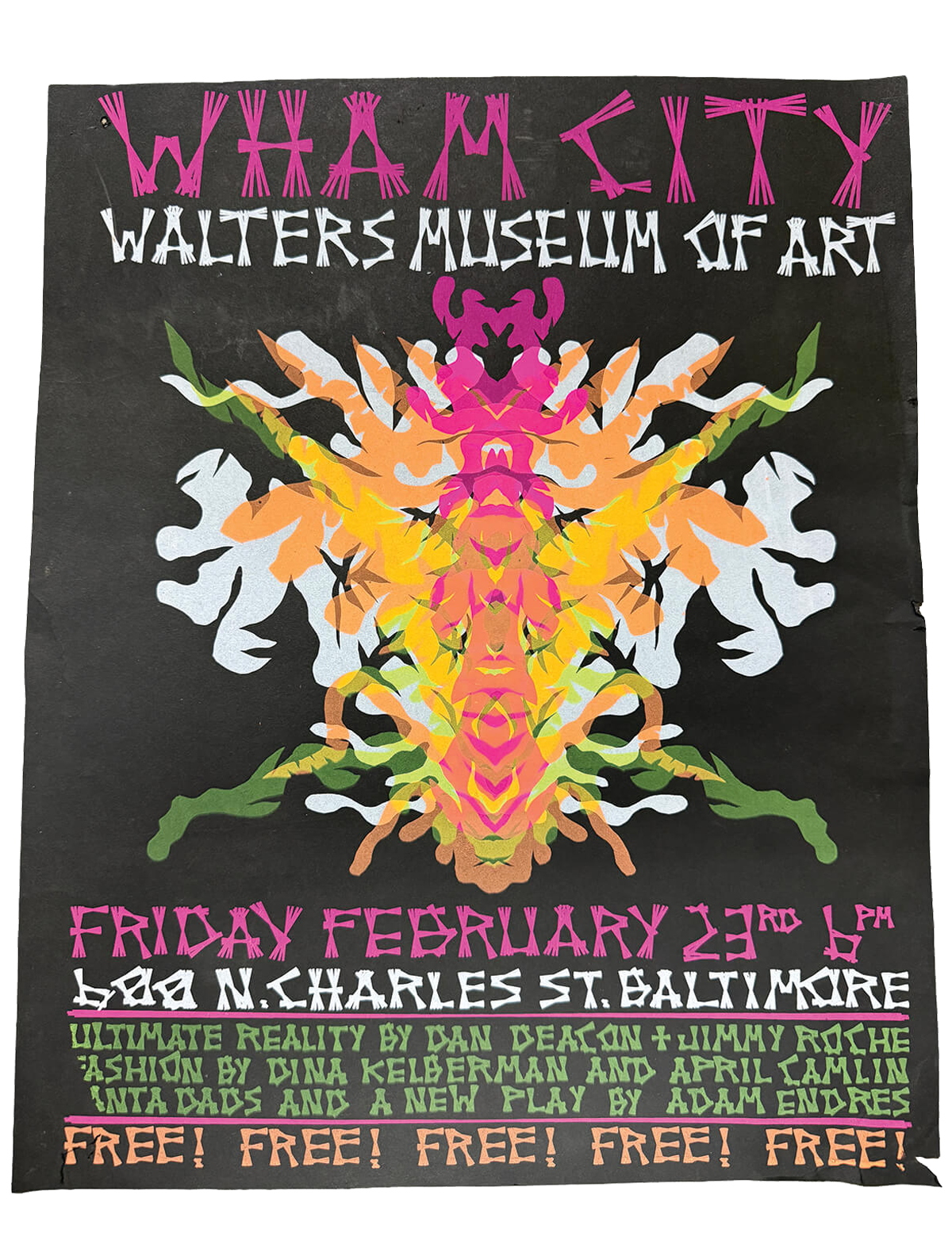
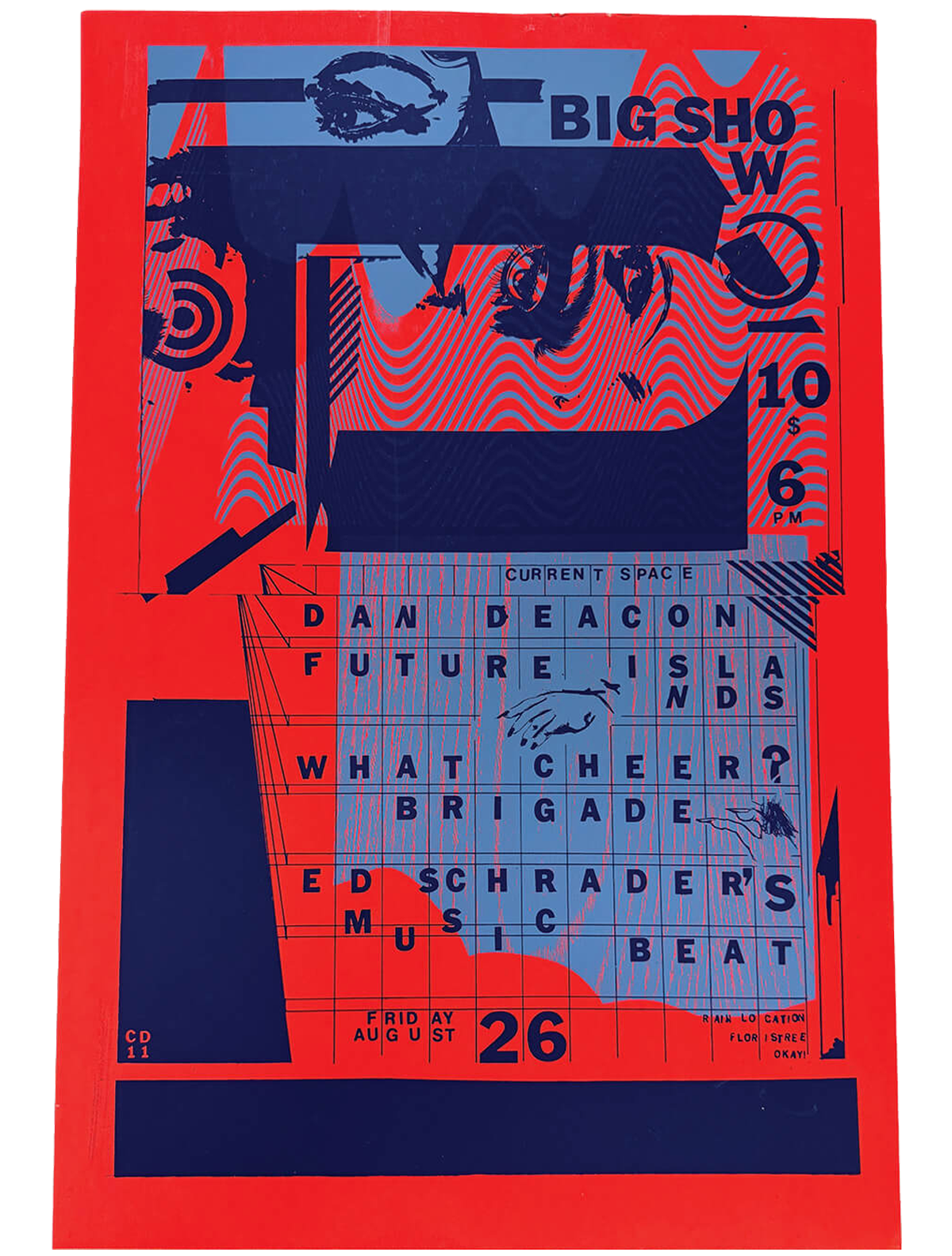
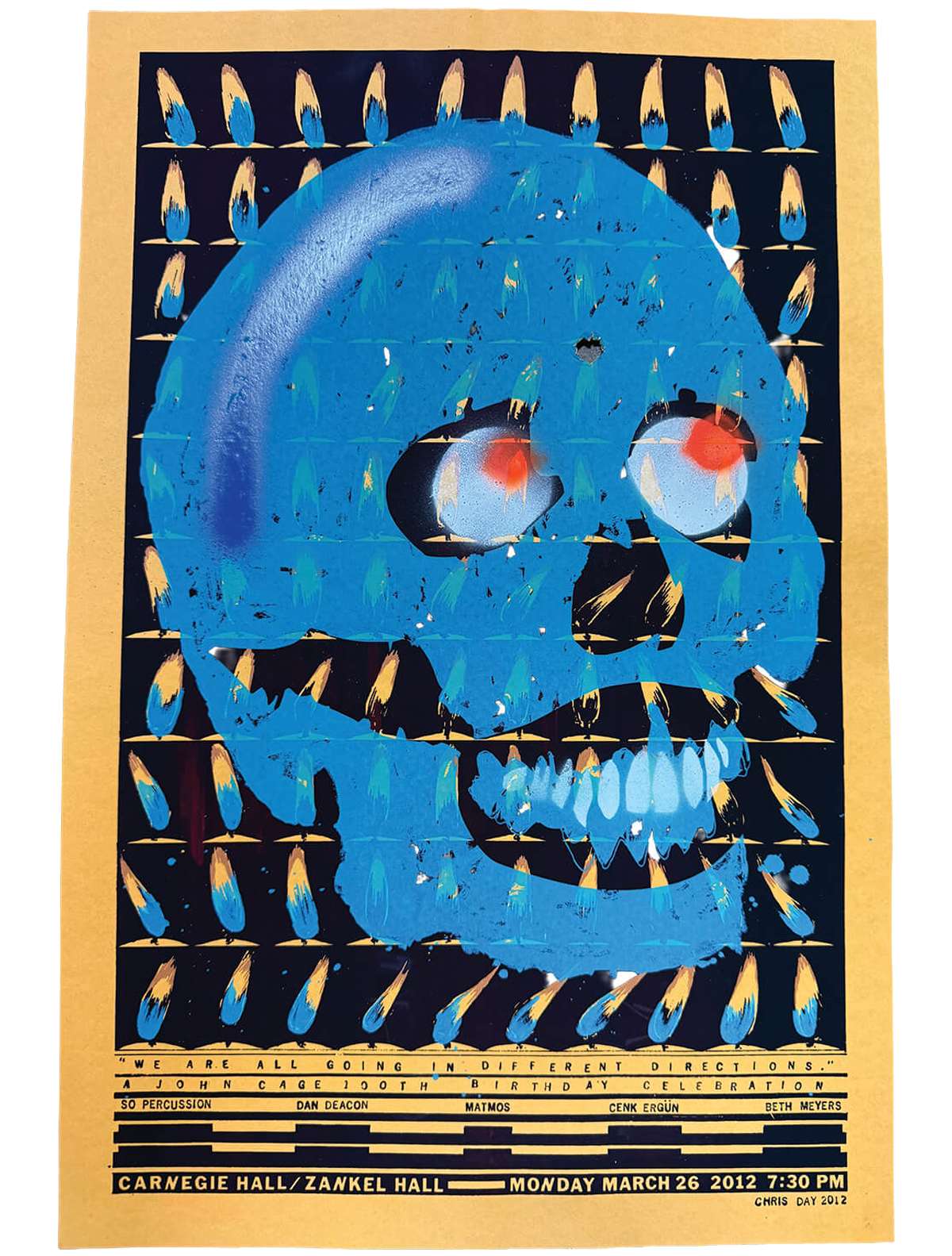
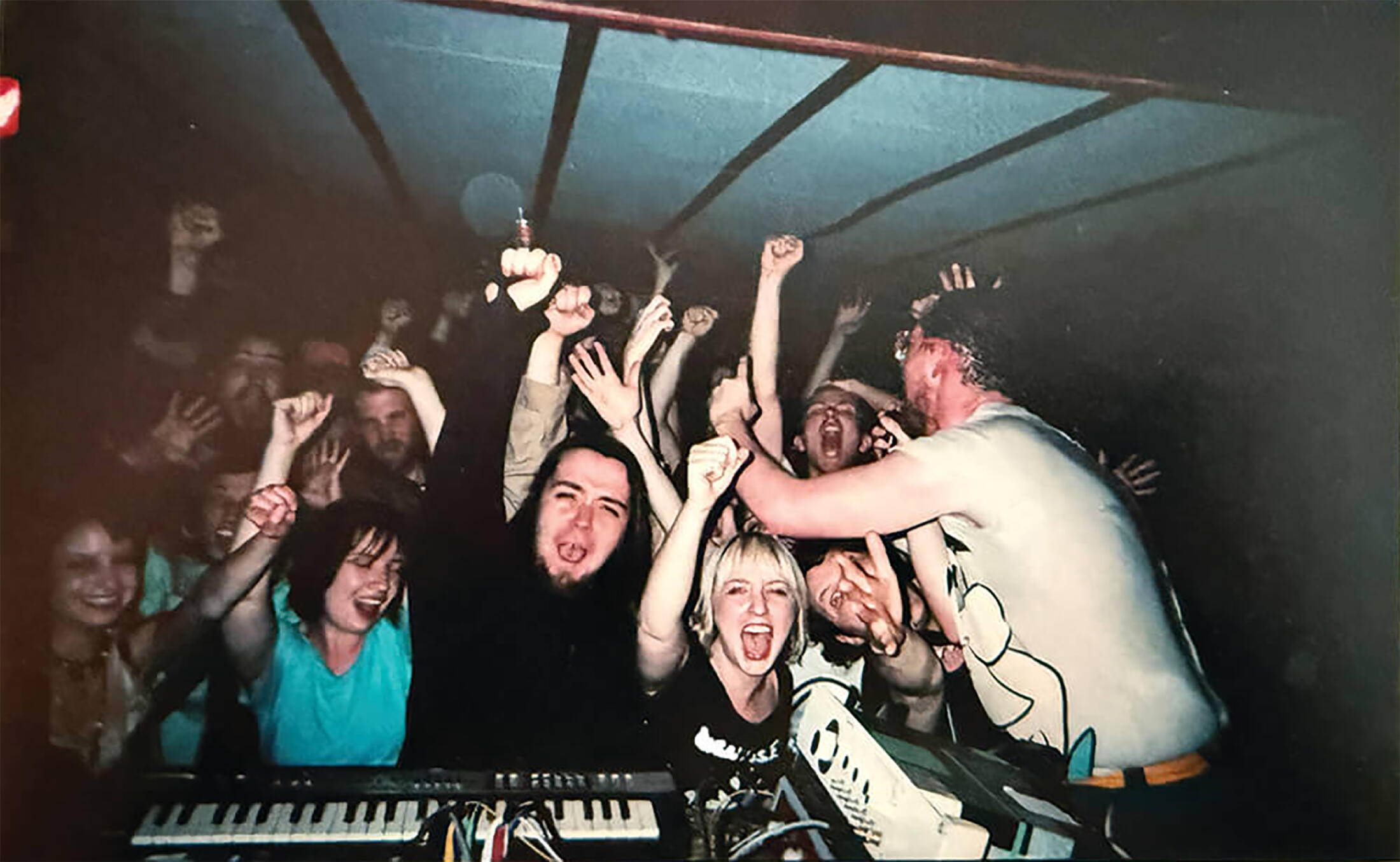
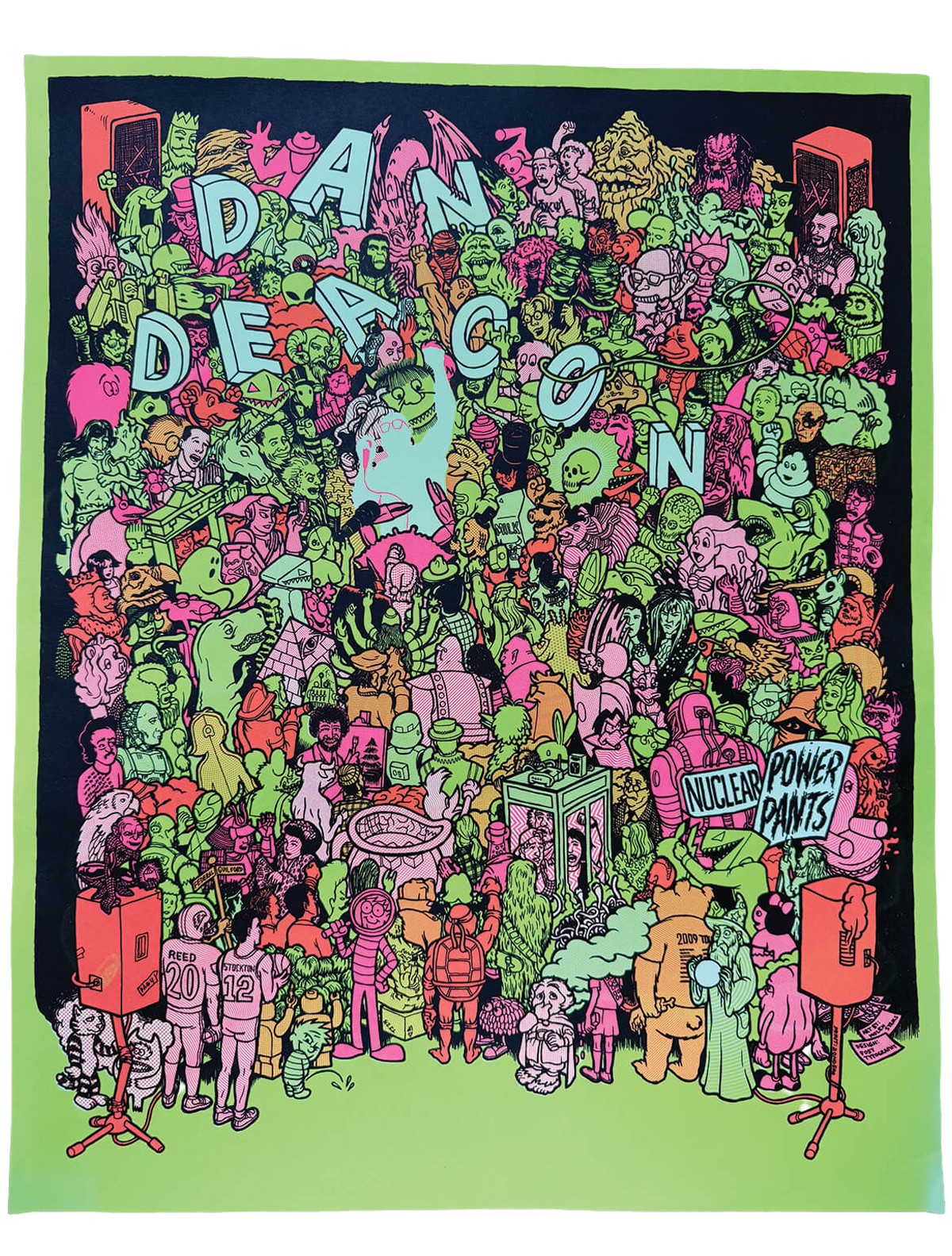
POSTERS AND PHOTOGRAPHS SAVED BY DEACON FROM PERFORMANCES OVER THE YEARS.
.
Festivals like High Zero and Transmodern worked to connect the scene, too. But Whartscape would do this double-time. In 2006, Wham City threw their first Artscape after-party—an early flex of their ringleader’s ability to orchestrate his audacious vision, featuring dozens of up-and-coming acts across multiple nights of sweat-covered, cloud-nine mayhem.
The festival became a tipping point. The next year, bands included Beach House and soon-to-be-Baltimoreans Future Islands (thanks to the insistence of Deacon). Pitchfork showed up, too, quoting wide-eyed partygoers and performers alike. “I saw a city show its stripes, and they were ridiculous,” said local rapper Spank Rock with pride. The year after that, Rolling Stone named Baltimore the best music scene in the country, citing Deacon.
“I caught the lore of that era,” says multidisciplinary artist Abdu Ali, who was in high school at the time and later started the genre-blending Kahlon parties at The Crown in 2013. “When I came into the underground scene, I was in awe by what existed in my own backyard. . . . The first time I saw Dan perform, my mind was blown.”
If you want to hear what this moment sounded like, listen to the 12-minute Wham City ode off Deacon’s first album, Spiderman of the Rings. With its gleeful dance anthems and technicolor earworms glitching with manic Woody Woodpeckers, NPR called the 2007 debut “brilliant and bonkers.” Overnight, he became a bona fide indie darling.
“I didn’t think it was going to be a thing,” says Deacon, who up until then recorded music just to avoid an empty merch table. “I’m very grateful that it was.”
He credits much of this to the Internet. All music is shaped by the emerging technology of its time. And these were the days of pixelated GIFs, of primitive YouTube, of gloriously simpler social networks like Myspace—a moment of interconnected and inquisitive optimism. That old worldwide web, he says, “I long for it.”
But what came next, in quick succession—his first European run; a two-week, seven-city “round robin” tour with 60-plus friends; lineups from Coachella to Bonnaroo, often traveling merry-prankster-style in a school bus that ran on cooking oil—was undeniably about Deacon IRL.
At live shows, he would set up right in the middle of the dance floor, shoulder to shoulder with his fans. They were now one and the same with the performance. The crowds swelled and stumbled into some collective euphoria, a shared catharsis. It was the stuff of legend. As one critic put it, this made “a fan for life.”

BY ALL ACCOUNTS, that’s the definition of making it for many artists. But Deacon is always dreaming bigger. And sometimes that comes with its growing pains.
As his star was rising, so was the genre of EDM. As an “electronic musician,” Deacon started getting lumped in with that entirely unrelatable DJ scene, a la the rave-ready, bass-heavy beats of Diplo and Skrillex. And all the while, his music was evolving in a different direction.
“It wasn’t exactly what the crowd wanted,” wrote The New York Times of a performance teasing his sophomore album, Bromst, which newly incorporated acoustic instruments—from that player piano to a 15-piece chamber ensemble of mostly Baltimore musicians—to create a more ambitious sound. “They had come to dance and get silly, not to experience minimalist meditations.”
Deacon only pushed this further on his follow-up, America, a sprawling ode to the beautiful cities and broad countryside he’d seen on tour, including an epic fourpart “USA.” It was classic Dan, gathering sounds from more than 20 musicians on everything from bassoon to tuba that he’d imaginatively stack into a maxed-out rush of sound. Even more contemplative, with nods to role models like Steve Reich, Terry Riley, and Baltimore’s own Philip Glass, he was clearly growing up.
“I started putting it out there,” says Deacon of his desire to make even more kinds of music.
In 2011, Canada’s Kitchener-Waterloo Symphony was the first orchestra to approach him, followed by esteemed ensembles like San Francisco’s Kronos Quartet and New York’s So Percussion, which landed him a gig at Carnegie Hall (for a Cage tribute, no less, encouraging the room to stomp, sing, and set off their smartphone alarms). And then there was Lincoln Center.
Deacon will never forget his first time in that room.
He was 20 years old. He took the train from Purchase to Manhattan, buying the cheapest seat in the upper balcony at New York City Ballet. That night, he soaked up dances by Cage’s life partner, choreographer Merce Cunningham, and a score by Cage’s student, composer Christian Wolff, who in 1950 introduced his teacher to the ancient Chinese texts that inspired his love of chance.
At the end of the show, Deacon waited for the audience to empty out. Then, as the house orchestra packed up, he worked up his courage and walked down to the pit, startling the maestro, who was not expecting a superfan.
Years later, “Setting up in that same spot,” says Deacon, choking up. “That was a dream. . . . When I was making experimental music in college, that’s what my brain wanted to do.”
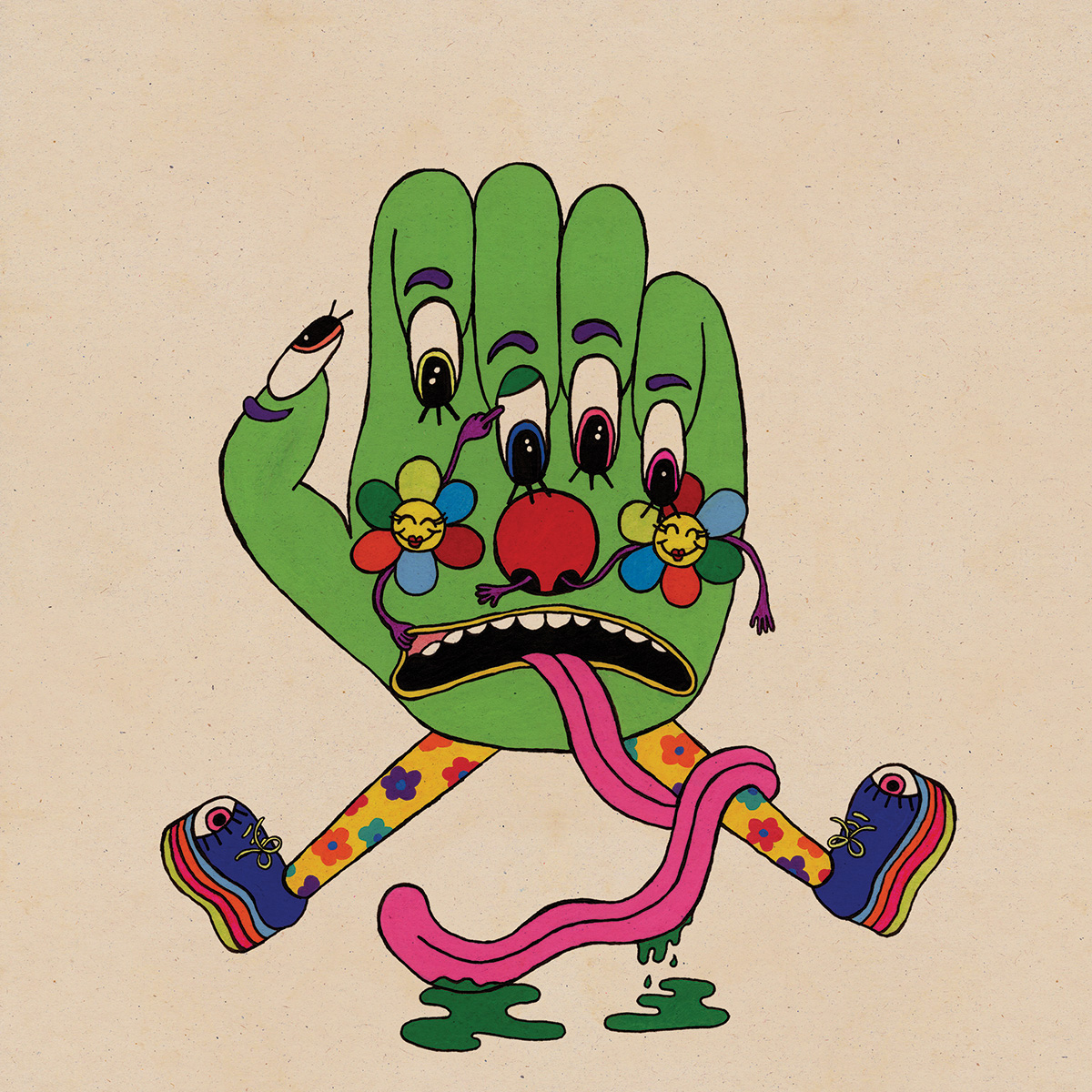
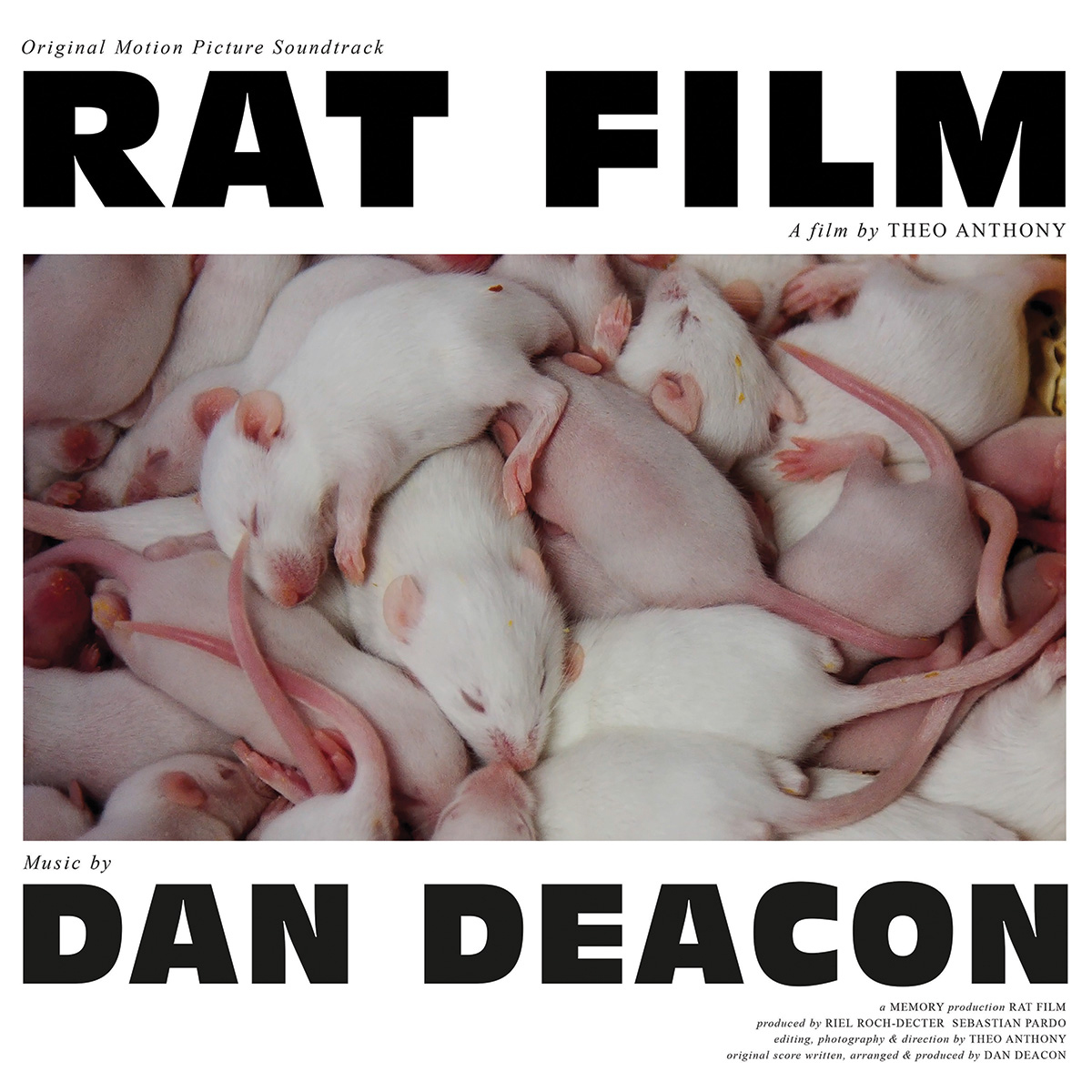
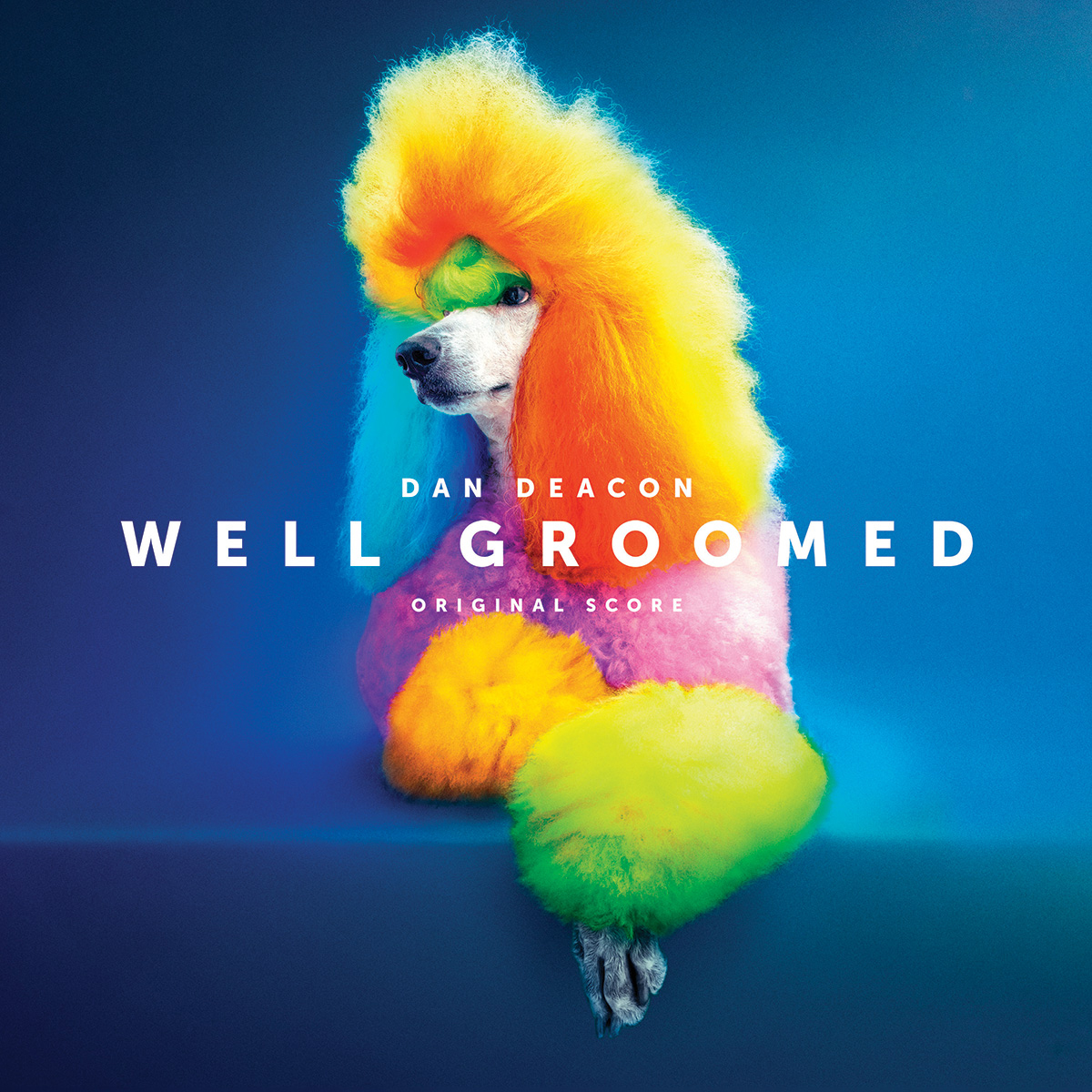
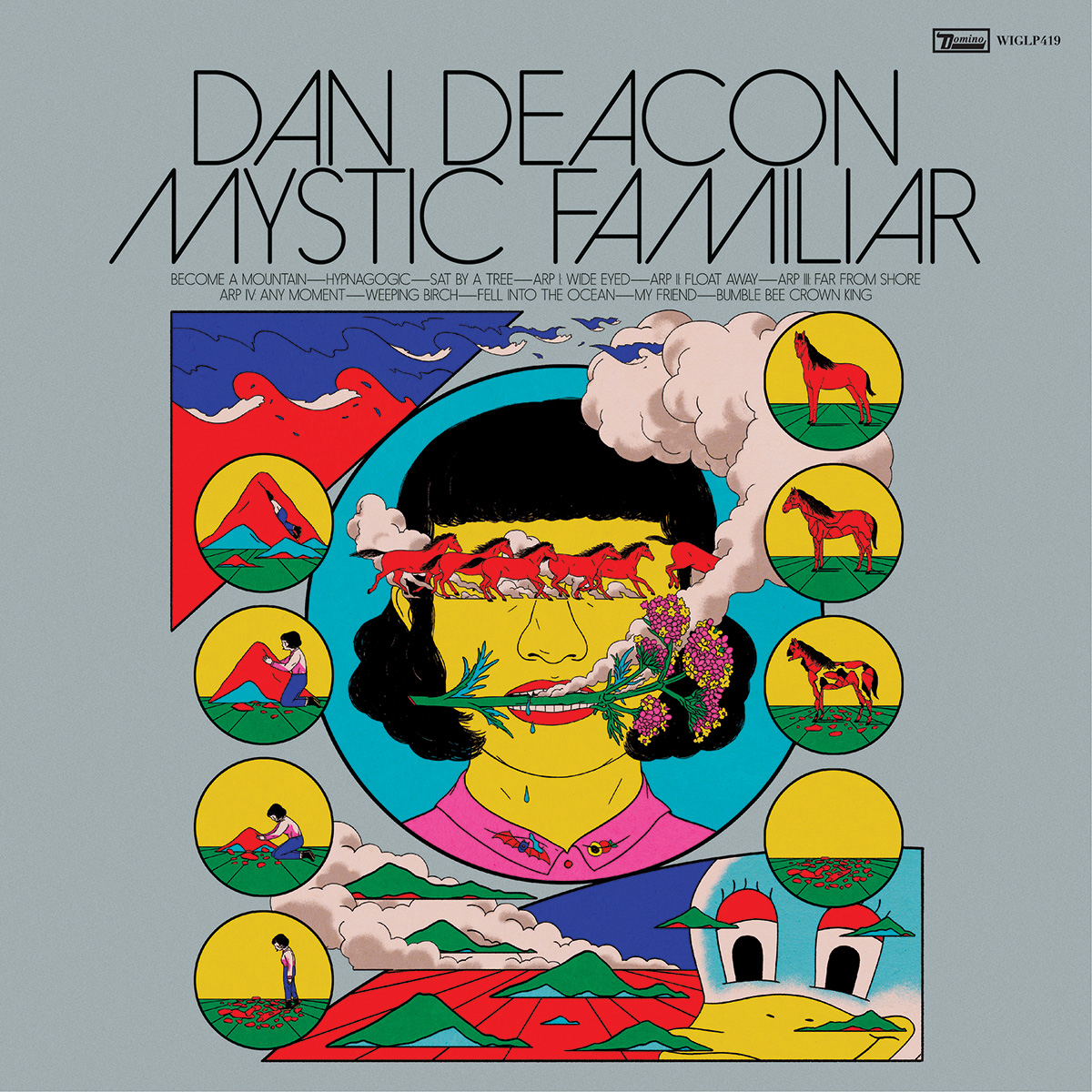
SOME OF DEACON’S ELECTRONIC MUSIC ALBUMS.
In 2017, the New York City Ballet set their new show, The Times Are Racing, to the sweeping suite at the end of Deacon’s third album. Last year, they debuted Mystic Familiar, featuring an original score inspired by his fifth album of the same name.
In this new world, “The music just comes to life,” says Deacon, who quickly became enchanted by all the sounds and textures a group of musicians could make. His computers had once seemed like some superhuman tool. But as he watched these live players, and factored in each person’s touch—their inflection, their emphasis, their nuance—the possibilities were suddenly infinite.
That is his greatest accomplishment, his “magnum opus,” if you will, says James Young, co-founder of the Mind On Fire collective and one of Deacon’s main collaborators—synthesizing those multitudes.
“Involving all these people, whether in the audience or on the stage, to come together, take whatever their experiences are, and be a part of the artwork,” says Young. “That takes a great artistic confidence.”
But truth be told, it can also be challenging.
Take this summer’s Vivaldi commission. Making records, booking shows, performing tours? That was familiar ground for Deacon. Now, he was in the uncomfortable unknown, up against his own limitations—staging 70 minutes of experimentation that completely reinvents one of the greatest hits of classical music, alongside the contemporary dance of four different choreographers, involving more than two dozen dancers and musicians.
“It was the hardest thing I’ve ever done,” says Deacon.
In moments like this, the composer is by no means easy on himself, working from a place of precision that at times borders on perfectionism. When music became his career, he started struggling with stress, anxiety, and in turn, self-doubt—themes openly explored on 2015’s Gliss Riffer, his first foray into lyrics, and 2020’s Mystic Familiar. A bad review or bumpy show could be devastating. Sometimes it was even hard to write.
That’s not an easy loop to break, especially for someone who gives his entire being to every project. But with the help of therapy, meditation, and Brian Eno’s Oblique Strategies, a card deck of creative prompts, he’s found ways to let go and once again embrace his own complexity.
After all, he has to.
“Music has been my entire life, and I hope it will be,” says Deacon. “It drives me absolutely insane, and I go insane if I don’t do it.”
He’s still interested in making sounds he’s never heard before. That’s what got him into it in the first place, he says. That little kid at the computer.
“That’s still me.”

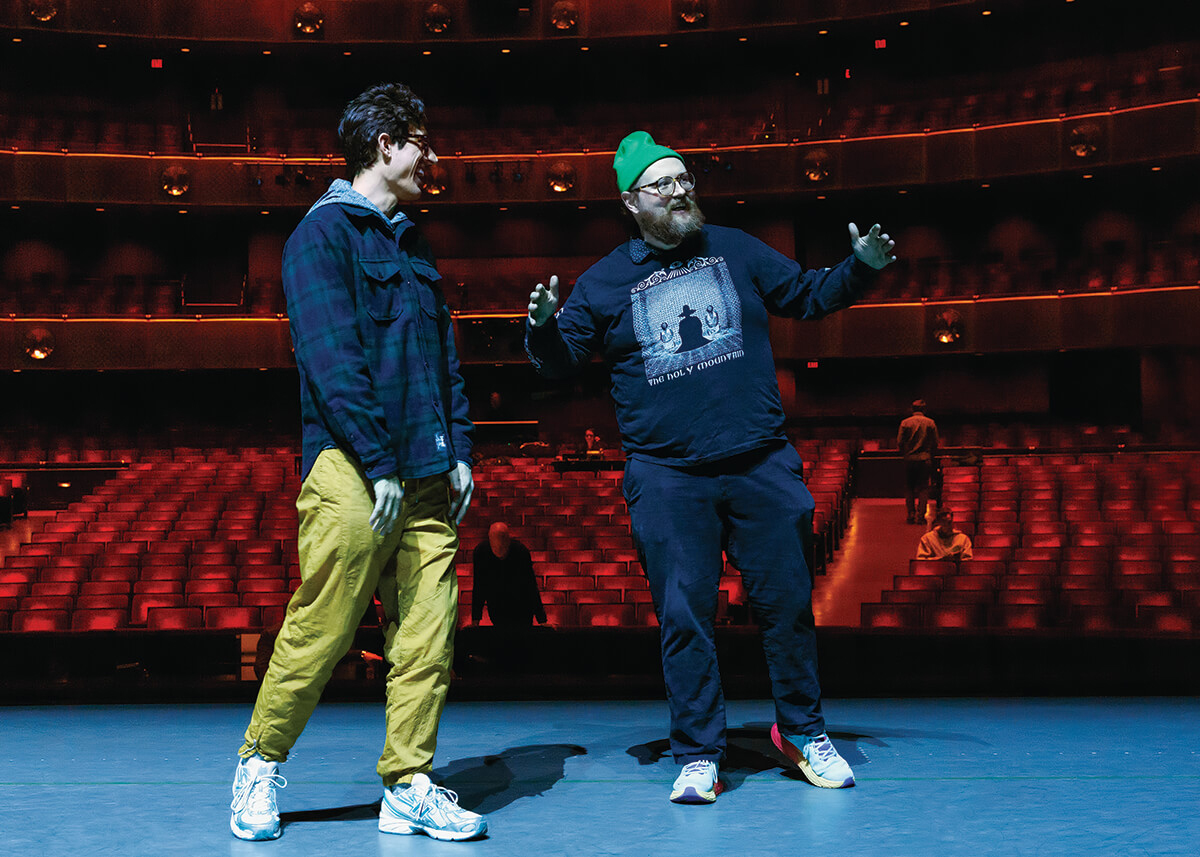
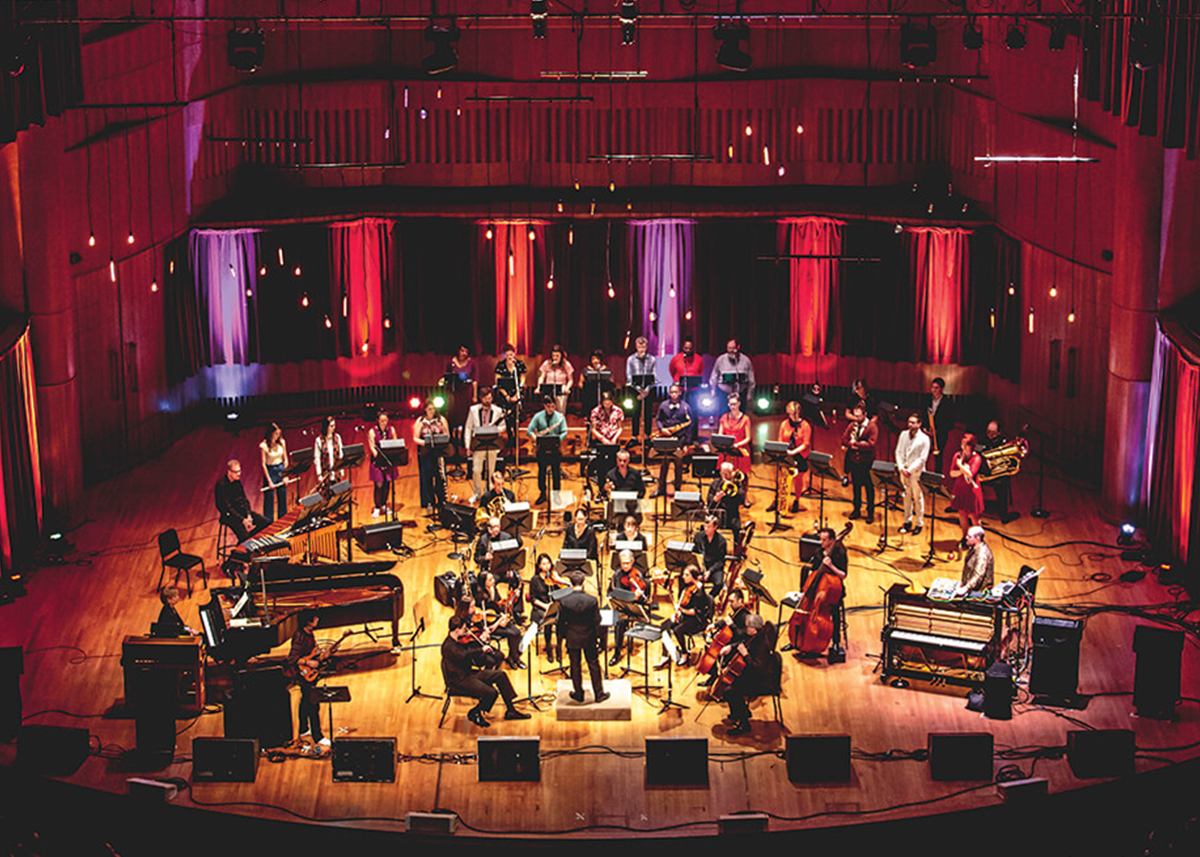
DEACON WITH NEW
YORK CITY BALLET
CHOREOGRAPHER
JUSTIN PECK AND
PERFORMING WITH
THE BALTIMORE
SYMPHONY ORCHESTRA
DURING 2019’S
PULSE CONCERT.
IT WAS JUST A MATTER OF TIME before Hollywood came calling.
Deacon’s introduction to film scoring was not through the minor leagues. At the end of the aughts, he got a strange email from someone claiming to be Francis Ford Coppola. He never responded, assuming it was a scam. Then came another, and another. Then the same message, this time sent from the Consulate of Belize. He’d heard the musician on NPR, it said. He’d like to fly him out California.
“Should I tell that story?” asks Deacon.
Well, it turns out Coppola is indeed an honorary Consulate of Belize. So the then-29-year-old took the six-hour flight to Napa Valley for a philosophical conversation about art at the Oscar-winning director’s home vineyard. At the end of their chat, the host turned to his guest with an important question:
“Do you want to watch Apocalypse Now?” recalls Deacon. The answer was obviously a resounding “fuck yes.”
A sommelier poured him a 1981 Bordeaux. He knew nothing about wine, but down it went. The lights dimmed. The screen flickered.
“Then I look over and realize Francis is gone. I text him, ‘Where did you go?’ And he’s like, ‘Oh, I never watch my films after the premiere—all I see are the things I would want to change.’”
After the credits rolled, Deacon stumbled out into the night, a bit drunk and baffled by his life’s circumstances, eventually finding his way back to Sofia’s guest cottage—yes, that Sofia—alone through a maze of grapevines.
In 2011, Coppola released Twixt, starring actor Val Kilmer, with a score co-composed by Deacon, which, beyond some experiments with Roche, was his very first film. It was a flop, but that didn’t matter.
“I had no idea what I was doing,” he says, explaining that scores were to songs and symphonies as biking is to swimming and hiking. “But I knew I wanted to do it again.”
Ask Deacon his favorite scores today, and he’ll insist he can’t think of any. But then his eyes light up. Oh, there’s Koyaanisqatsi. (“The Philip Glass score,” which he first saw in college.) And There Will Be Blood. (“Just like, fuck, how did you do that?”) All the Jonny Greenwood scores, really. The Master, Inherent Vice, the car chase in One Battle After Another. Plus, The Holy Mountain. Taxi Driver. Twin Peaks. Terminator 2. (“The chu-chu-chunk chu-chunk and bada-ba, bada-baaa.”) “Jaws is cool, too—don’t get me wrong!”
Many musicians daydream about the silver screen. Deacon was no different. But he was also by no means a cinephile. He’d spent years attending Sundance, only as the late-night entertainment. On tour, there were “Dan’s DVDays,” where they’d watch obscure titles purchased at gas stations between gigs. And when curator Eric Hatch asked him to present his own selection at the Maryland Film Festival in 2010, he chose, of all things, Total Recall. “One of the greatest films of all time.”
That spawned Gunky’s Basement. Run by Deacon, Roche, and Hatch, the revival series ran for several years between the Charles, MICA, and Parkway theaters—and got him thinking more seriously about film.
“I could see the fire burning under him,” says Hatch, now co-organizer, with Sessa, of the New/Next Film Festival (surprise, surprise, a Deacon idea). “But I think it’s telling that his first film score was kind of a false start with a more established Hollywood figure. And that the real genesis of this career was born out of the Baltimore DIY scene.”
A few years after Twixt, Theo Anthony reached out to Deacon. The budding filmmaker and Copycat regular wanted to make a documentary about the city’s most infamous pest. Rat Film turned out to be much more than that. The score was no archetype, either.
It started with a custom plexiglass cage. Live rats were placed inside. In each corner was a theremin, which electromagnetically produced a range of sounds based on the rodents’ slightest movements. All of this got captured on Deacon’s computer, which he then fed into his player piano and combined with flourishes from improvisation sessions that he led with local musicians. This speaks to one of his core philosophies: that if you let it, anything can be music. The final result speaks for itself: spacious, urgent, uplifting, at times quite beautiful.
“Dan creates these conditions for chaos and captures lightning in a bottle,” says Anthony, who’s since enlisted him for two other docs, with a third in the works. “I think of him as Mickey Mouse in Fantasia, with all his brooms.”
When it comes to movies and television, though, the music is not just the inner machinations of his own mind. Deacon calls Rat Film his crash course. Both men were cinematic beginners, collaborating closely and discovering this craft together. But every project is an entirely new universe, specific to each director’s vision, made with an army of other professionals.
“I started thinking about music as the eggs in a cake,” says Deacon. “They’re a vital part. They hold everything together. But no one wants to bite in and think, ‘I can really taste the eggs!’”
This helped relieve some of the pressure that had started to consume his own music. Here, nothing was precious. His work was part of something much bigger than him.
Deacon thinks a lot about the role of music. In film, it should keep you in this other world. And more often than not, he achieves this by making you feel something—which has always been his specialty. Gliss Riffer’s “When I Was Done Dying,” for example, has become a lifeline for fans and helped him process his own mother’s death. And across his oeuvre, he bottles and evokes all kinds of emotions.
But with motion pictures, that’s easier said than done. “Because it’s not always sad scene, sad music,” he says. “Sometimes a bunch of major chords that sound happy hit a lot harder. When I think about someone I’ve lost, I tend to think about the best parts of my time with them. It’s the absence of those things, not so much the tragedy. Like, oh, I don’t get any more of this.”
A score becomes a suggestion. A question mark. An ellipsis. An exclamation point. Part of the storytelling. And clearly what he’s writing is resonating.
Search Deacon on IMDb and you’ll find 59 composing credits. Indie films like Strawberry Mansion. Blockbusters like Marvel’s Venom. Netflix originals like the Adam Sandler sports drama Hustle and the Eric André/John Cena comedy, Little Brother. A plethora of docs from Apple TV to PBS. One of those scores just won an Emmy. For another, a few years ago, he got to go to the Oscars. (He wore a white tux and his signature yellow cap.)
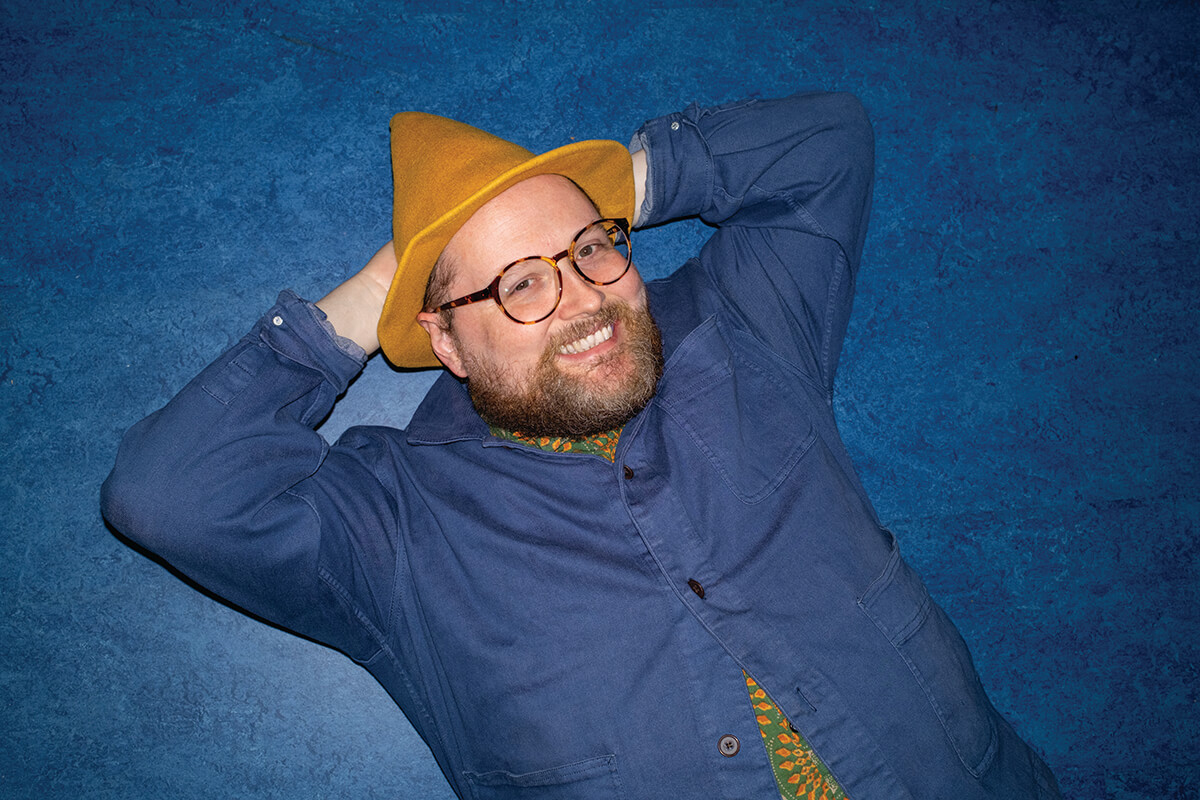
DEACON IN HIS BOLTON HILL STUDIO.
That means there’s always pressure to move to New York or L.A. But since leaving Purchase, Baltimore has always been home. His family’s here. His friends, too. Yes, he now has access to recording studios used by The Beatles or Barbra Streisand. Yet whenever possible, which is often, he’s right here, in his garage, at The Compound’s Tempo House, with his team of musicians, bringing them all along with him. This city shaped Deacon. Staying is important.
“That’s why John Waters is such a hero—not only did John stick around, but he reps it hard, and there’s something to be said about that: not only loving Baltimore, but helping form the scene, and most importantly being informed by it, too,” he says, also pointing to painter Derrick Adams, a fellow co-owner of the Mount Royal Tavern. In 2023, Deacon led a small group of artists to step in and save the beloved dive bar from the proverbial auction block. “I really do think there’s something in the water here.”
As a parent, his bedtime has changed, but Deacon still tries to be a part of it all. There was last year’s National Anthem at Camden Yards. (Baltimoreans loved it. People from out of town were . . . confused.) And his upcoming score for Roche’s first feature film. Not to mention, at some point, another album. There just aren’t enough hours in the day to do everything he wants to do. And for this, even after a lifetime of working with computers, he loathes the technology in his pocket.
“Time is my rarest resource,” says Deacon. “I don’t want to give it to the phone.”
Don’t even get him started on AI.
“You know what I’m excited about?” he says. “There’s going to be a real desire for humanity. Human achievement. Human innovation. . . . Seeing something happen in real life, right in front of your eyes.”
In a movie theater. At a concert hall. Somewhere in Baltimore.
Find the Best in Baltimore
You May Also Like

Arts & Culture
Towson Teen Heads Back Into the School Year Having Attended Prestigious GRAMMY Camp
Maisie Rehkemper reflects on the New York City program, her love of sound engineering, and her plans to amplify women in music production.
Arts & Culture
POV: Getting Lost in Time at the Maryland Renaissance Festival
Contributing photographer Lauren Castellana captures all of the magic and merriment of the Crownsville festival’s 50th season opener.
Arts & Culture
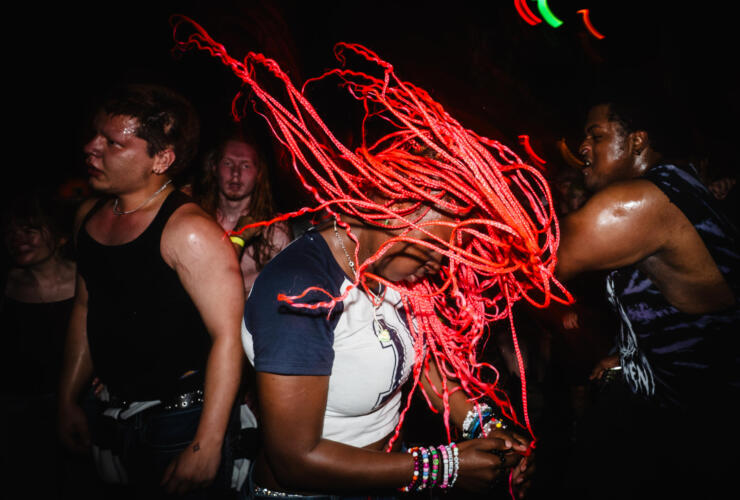
POV: In the Crowd at Subscape, Baltimore’s DIY Music Fest
Across three days and two venues, local photographer Josh Sisk captured the energy of the city's iconic underground scene.
Arts & Culture
Fifty Years Later, Alex Haley’s ‘Roots’ Maintains its Historical and Sociological Force
The influence of the groundbreaking book continues to unfold, in large part through the work of Haley's nephew at the Maryland State Archives.