Arts & Culture
What Does Maryland Smell Like? New Installation Explores the Scents of the State
From corn and cedar to seaweed and Old Bay, olfactory "spelunker" Laure Drogoul’s interactive exhibit at the MD Center for History and Culture explores how smell shapes individual responses.
Laure Drogoul was already an accomplished sculptor and performance artist when she moved her studio to Fells Point in the late ’90s—a relocation that unexpectedly changed the course of her career. In short, she discovered a fresh medium wafting in the air around her new neighborhood, compelling her to add “olfactory spelunker” to her interdisciplinary repertoire.
“My smell project started when I moved to Fleet Street because I was directly across from H&S Bakery,” she says with a smile. “Are you familiar with that bakery? Have you smelled it? It’s a very cozy, warm smell. There’s a lot of low notes to the smell of the bread, and it’s dense, the way it lingers. It’s amazing, isn’t it?”
For Drogoul, the morning whiff of the bakery opened the door, artistically, to what she believes is the least explored of the five senses. One reason the subject is so exciting to her, she explains, is that while smells live in the objective world, circulating among everyone, individual responses are framed by personal memories and context.
“Our senses are portals to understanding, not only to the universe but to ourselves, as well,” Drogoul says. “We’re so ‘eye focused’ that maybe we’re not paying enough attention to the nose. It’s good to stop and smell the roses, right? Or the bread in this case.”
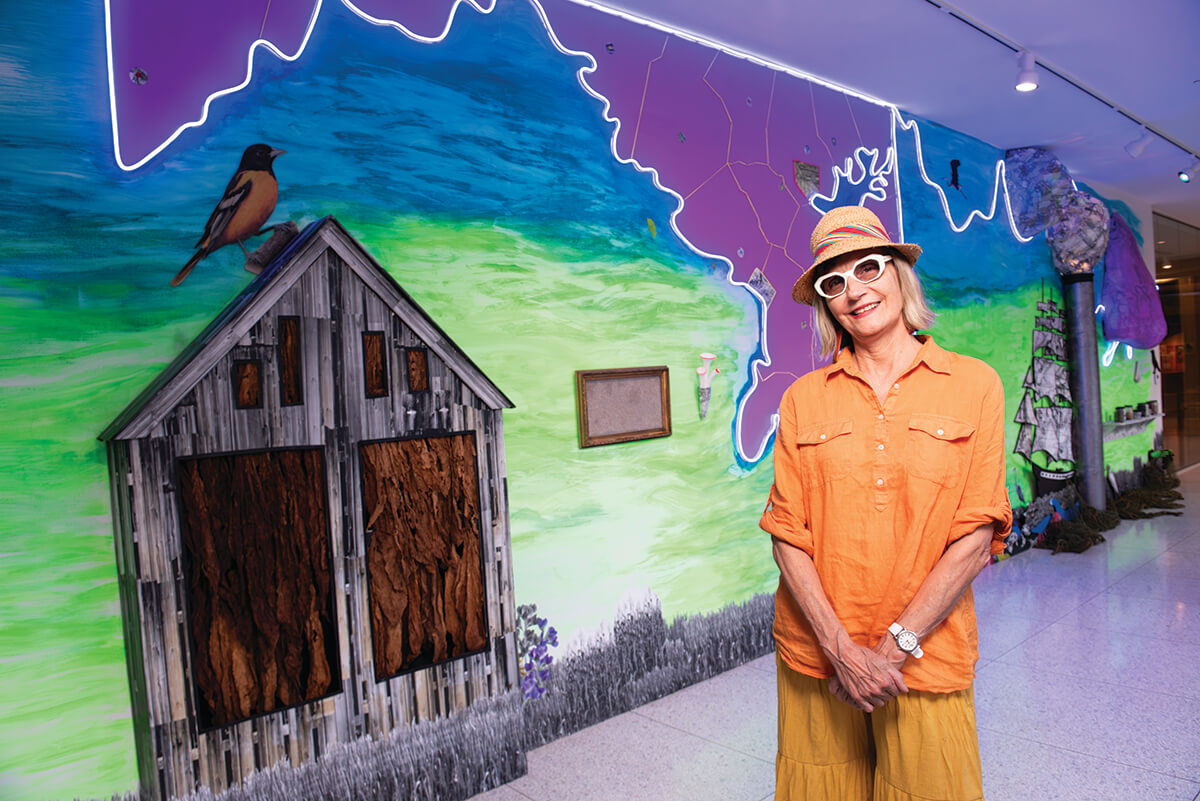
Drogoul’s recent installation at the Maryland Center for History and Culture—“Scents of Place (the sweet smells and stinks of Maryland’s past and present)”—builds on an interactive mapping project she began nearly 25 years ago.
Expected to be up through 2027 in the center’s new “Wayfinders” wing, the wood, paint, paper, and fabric installation includes everything from fishing nets and wind and tidal maps to a papier mâché cloud billowing from the Baltimore incinerator. And olfactory specimens from tobacco leaves to seaweed, cedar, corn, ginkgo leaves, the herb known as sweet annie, and Old Bay.
The work is intended to evoke how smells connect people to their environment—tobacco to southern Maryland; Old Bay to both the blue crabs of the Chesapeake Bay and the McCormick & Company plant, which once sat at the Inner Harbor.
Not surprisingly, Drogoul has toured the current McCormick plant in Timonium and the Utz potato chip factory in Hanover, Pennsylvania. The Domino Sugar facility is on her list.
“When the boats come in, when they’re unloading the sugar at Domino, oh my God, it’s pretty intense, there’s definitely a sweet smell in the air,” she says. “I’ve got to get into Domino.”
Drogoul, who teaches fabrication and assemblage and collage at the Maryland Institute College of Art, has exhibited and performed widely, including at the Corcoran Gallery of Art, Washington Project for the Arts, Baltimore Museum of Art, The Walters Art Museum, PS122, and The Center for Architecture in New York—and numerous street corners, vacant lots, alleys, and underutilized urban spaces.
Often, her participatory olfactory endeavors intentionally avoid local or other easily recognizable scents. But rather, she deploys unique smells or mixtures that she has concocted to spur greater reflection among participants.
“I usually want to move people into an abstract playing field,” she says. “I don’t want them to know what the smell is, because I want them to explore it and see if they can come up with a memory or a story. Memories are murky, aren’t they? Like you turn to your sibling and they tell you, ‘Oh no, no, no, no, no, that didn’t happen.’ Memories can be dicey things.”
To that end, Drogoul recalls the contrasting cultural responses when she presented in Russia and Japan. (She notes the use of scented oils, perfumes, and aromas are an ancient tradition in many cultures. Frankincense and myrrh, for example, have deep ties to various religious and funeral practices.)
In Russia, she says, people seemed to prefer fragrances that blended with the body’s natural odors but didn’t entirely mask them. In Japan, however, most did not wish to smell another person and tended to be more accepting of synthetic smells. “They have a different sense of privacy, trust, and smell. They prefer a buffer.”
Once in Japan, in fact, a woman called the police after one of Drogoul’s blindfolded smell “tests.”
“I put a smell in front of a woman and she stood up and literally freaked out,” she recalls. “She accused me of trying to kill her. It was a benign smell. I’d [already] learned to lower the palate in Japan because they are so sensitive to smell. The gallerist came out and tried to calm her down, but she got more and more agitated and then called the police.
“I wasn’t cavalier. I have always been careful. But now when I do shows where I blindfold people, I give a little primer. I always tell people there’s nothing in here that will harm you.”