
Off a winding road in suburban Arbutus, in a tiny shopping mall between a 7-Eleven and a little an Asian market, is Asian Burmese Kitchen—one of the few Burmese restaurants in the greater Baltimore area. Despite the giant “Grand Opening” sign over the doorway, ABK opened about six months ago, when a Burmese family took over the lease of a longstanding Chinese restaurant.
The menu is large, with the first page devoted to Burmese specialties followed by Thai, Japanese, and Chinese dishes—as many of the old clientele keep coming back for the plates they ordered from the building’s previous inhabitant in years past. So there is egg foo young, chow mein, drunken noodles, tom yum soup, General Tso’s chicken, pad Thai, and a whole list of sushi and rolls and teriyaki. In other words, the name is pretty accurate.
But you’re here for the Burmese specialties cooked by the matriarch of the family, an experienced home cook branching out into her first restaurant. (The market next door, which opened about two years ago, is also owned by family members.)
Burmese cuisine, unsurprisingly, shares commonalities with the food of neighboring countries such as India, Thailand, and China, with lots of curries, rice dishes, noodle soups, and fritters. The exceedingly friendly staff will be happy to guide you through all of this, if you’re interested, and you should be, as Burmese cuisine is marvelous stuff.
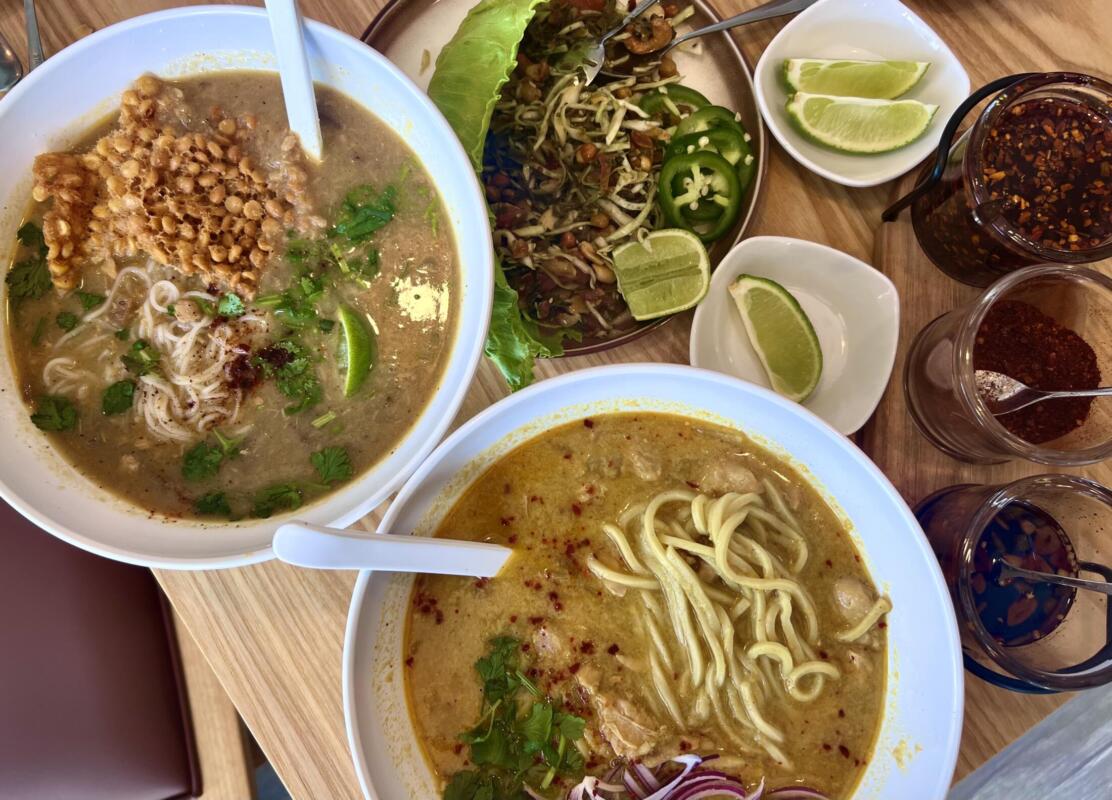
Among the dishes coming out of the kitchen are traditional laphet thoke, or tea leaf salad, made with tea leaves fermented in-house; the pickled young ginger salad called gin thoke; and a short list of amazing noodle soups, including mote hin kharr, a variant spelling of mohinga, the national dish of Myanmar (the current name of Burma). Mote hin kharr is a remarkable bowl of fish, noodles, lemongrass, egg, cilantro, lime, and a golden thatch of crackers made with whole chickpeas.
There’s also a version of the chicken-curry-noodle soup laksa, and a stellar bowl of ohn-no khao swe, the Burmese version of the famous Thai curry noodle soup khao soi. And don’t miss the Burmese eggplant—slow-braised, slim purple eggplants topped with a sauce of shrimp paste, fermented soy beans, ginger, and shallots.
Additionally, there are gyozas, wontons, satays, dumplings, spring rolls, and superb crispy, flakey samosas, as well as harder-to-find dishes like goat curry. There’s no liquor license, rather a lengthy tea menu featuring ginseng tea, Thai tea, bubble teas, and Burmese tea, which is similar to Thai tea but frothed, traditionally by pouring the drink from a high height, but here more conveniently made with a handy frother.
With tidy blonde-wood furniture, paintings of Burmese landscapes, and a floor-to-ceiling mural of Mandalay Palace on the back wall, ABK is a serene space with remarkable food—tucked away in an unexpected place.