Arts & Culture
Angel Du$t Helped Shape Baltimore Hardcore—And Is Pioneering Its Future
As the band releases its sixth album, ‘Cold 2 The Touch,’ we chat with frontman Justice Tripp about growing up in Baltimore and hardcore music as an A.I. antidote.
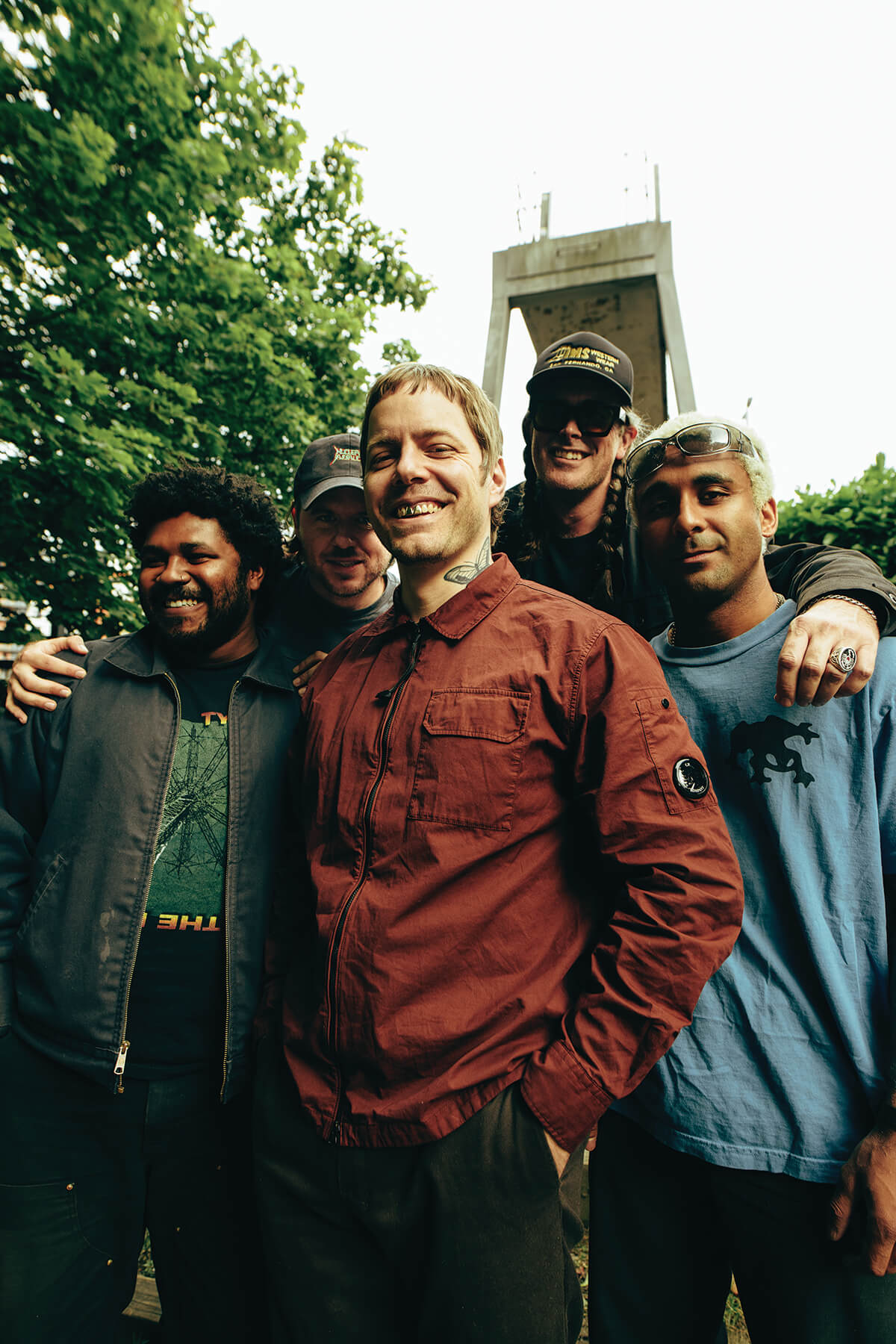
Unless you’ve been living under the proverbial rock lately (or not reading this magazine), you’ve probably heard that hardcore music is the biggest genre in Baltimore right now. And thanks to this city, it might be the most up-and-coming genre across the country, too.
Justice Tripp has a lot to do with that. The Essex native came to punk rock as a little kid, after his brother stole a car and gifted him the CDs left inside. Within a few years, he got his first guitar as a gift from his biker uncle, formed his first band around the age of 10, and by his young teens, was attending hardcore shows at the likes of the rough-and-tumble Sidebar. With his own youthful fervor, it didn’t take long for him to make his mark on this mosh-pitting scene.
Inspired by genre pioneers like D.C.’s Bad Brains, he started experimenting with that hard-driving, Mid-Atlantic-bred sound, adding catchy rhythms and groovy melodies to create his own signature style. His first band, the seminal Trapped Under Ice, is a cult-followed stalwart that still plays the occasional show, while his follow-up, the kaleidoscopic Angel Du$t, has gained its own loyal following. (Over the years, he was also an early mentor for future members of Turnstile, who played in both of Tripp’s groups before becoming arguably the biggest hardcore band in the world).
Whether you’re a new fan or a longtime follower, the sixth Angel Du$t record, Cold 2 the Touch, shows off the best of Baltimore hardcore—its unbridled energy, its to-the-bone authenticity, its refusal to be boxed in. As ever, it’s bursting with Tripp’s one-of-a-kind vision. Play it loud, but more importantly, make sure to see it live. If you can find tickets, that is. (Their Soundstage release party on Feb. 26 sold out quickly.)
Below, we chat with Tripp about the new album, growing up in Baltimore, and hardcore music as an A.I. antidote.
Tell me about your first hardcore show.
It was at The Sidebar. I was 13 years old. It was all East Coast bands—Hatebreed, Death Threat, and Out To Win. I was like, oh, this is what I want to do with my life. I’m all in.
What hooked you?
I was a kid with undiagnosed ADHD and a lot of energy. And every way I let that out was considered quote-unquote “bad.” It was like, sit down, shut up, you’re being too much. And then I go to a hardcore show, and I’m allowed to jump on people and kick around the room and sing along and hang with the band. I thought these were the coolest people on earth. And they were nice to me when nobody was nice to me—you know?
From the outside, hardcore can seem intimidating. But folks on the inside say it’s actually deeply open-armed.
I’m not going to say it’s perfect, and it’s changed over the years, but the bottom line is acceptance. There’s a zero-tolerance policy for acting up or views that don’t welcome people…In our community, nobody cares if you’re autistic, queer, whatever race or religion. It’s all celebrated. Your value is in being uniquely you.
How do you define hardcore?
It’s an ideology and a sonic territory. The origins of hardcore come from punk rock, which was rock and roll music played dirty, with an attitude, and people physically reacted to that. But how do we take that to another level? How do we make people jump off the stage? How do we influence people’s mentality? How do we change the world? It’s about being your most authentic self, and creating an energy that makes people want to move.
“In our community, nobody cares if you’re autistic, queer, whatever race or religion. It’s all celebrated. Your value is in being uniquely you.”
There’s a lot of discussion about why hardcore is so relevant right now. In these algorithmic times, when we’re so desperate for genuine human connection, it seems that might have something to do with the community’s ethos of authenticity.
It is so mandatory to what we do. You can’t come to hardcore and do a character. That’s why Turnstile’s Never Enough [which just won a Grammy for Best Rock Album] was everybody’s record of the year. I’ve known that band a long time and I’ve never seen something so authentically them. And it’s why people resonate with Trapped Under Ice’s Big Kiss Goodnight. Because not one thing was phoned in. And what will people love about Cold 2 the Touch? It’s 100 percent me…I think that’s something we’re all looking for as our society and government funnels money into A.I. The whole world is running from authenticity, and we have a place where it’s just demanded.
It’s interesting you bring up A.I., because given how rooted hardcore is in authenticity and the live show, it feels like it might be the one form of music that’s ultimately A.I.-proof.
I feel like A.I. is gonna find a way to take everything authentic off the planet…But on the sinking Titanic, the last music you hear might be a hardcore band.
“A.I. is gonna find a way to take everything authentic off the planet, but on the sinking Titanic, the last music you hear might be a hardcore band.”
How do you think about the live show when writing an album?
It’s everything. When we were doing Trapped Under Ice, there was a lot of movement at the shows, but it was more violent than I had ever anticipated. And with this music, there is an inherent element of what appears to be violence. But there can come a point when it’s unwanted or goes beyond expression and becomes more of a selfish desire to let your anger out in a way that isn’t positive or welcome…With Angel Du$t, we were thinking, how do we incite movement in a way that contributes to the group setting rather than takes away from it? Not to say that Angel Du$t was the first band to do so, but I do think we were a major tool in creating the hardcore environment we see today, which is less dangerous and more inclusive.
How did you foster that evolution?
Conversations with the crowd usually don’t go well. You can’t tell people what to do at a hardcore show, nobody likes that. But you can through your art, through the way you communicate with the world….I often refer to the Bad Brains show at CBGB in 1982—it’s everybody’s favorite live video. When I think about what a show should look like, that’s it. But what were they doing sonically that made people behave this way? What was their message? What were the lyrics? Then it becomes a point of sitting down with the team and just kind of trying new things and asking, what does that make me want to do?
Most of the time, you are writing to make the best song. Hardcore might be the only genre where you exclusively say, alright, what are people going to do to this live? It’s defined by what is going to create movement, and then afterwards, I can sprinkle in ear candy that makes you want to listen to it over and over.
Thinking of that CBGB crowd, how would you describe Baltimore audiences?
I remember a time when I wanted to know why I couldn’t create such diverse and dynamic audiences. Like, how do we introduce more types of people into this world? This was right around the time that the Charm City Art Space closed. I hung it up and moved to Atlanta. But then Che [Figueroa of Flatspot Records] was one of the first dudes to pop up. And then Paris Roberts [of the band No Idols] started booking stuff.
When I came back to Baltimore, it was a whole different scene. To me, the right people stepped up and made it what I’d always dreamed of. I guess my takeaway was that I couldn’t be the one, and sometimes it’s about creating space for somebody else. Baltimore is like Bad Brains at CBGB in 1982—but on steroids. It’s just the coolest thing to see.
“Baltimore is like Bad Brains at CBGB in 1982—but on steroids. It’s just the coolest thing to see.”
What makes sets Baltimore hardcore apart?
Baltimore hardcore is really defined by high-level creativity in context of hardcore. We got our own way about it…The earliest hardcore bands were defined by pushing the envelope, pushing the boundaries of what punk rock music could be. I think that’s still mandatory if you’re making hardcore music. And a lot of bands lose sight of that. We love the traditions, but to me, hardcore is about challenging the norm.
You did that big time in your transition from Trapped Under Ice to Angel Du$t, which has been an even broader sound, especially on this new record.
It was just liberating. We’d been touring and making music for a long time, and we all had the desire to explore. It was a way to make a big statement, as far as being willing to try something new and learn new tools and just experiment. … I think part of what defines Angel Du$t is trying new things. And Cold 2 The Touch is really an all-encompassing moment creatively for me, where I get to explore everything I’ve learned making aggressive music over the years.
There’ve been various iterations of this band over the years, with your bandmates now residing in other cities. How does Baltimore still show up in this music?
I have been very fortunate to play a role in this community for a very long time, and I’ve been very fortunate to have a team around me that helped me to build something special here. And people that are far more impressive than me have taken it and ran with it and done so much with it. I think anything I touch is going to be Baltimore hardcore music. And my band has all spent a lot of time here. The team flies out regularly and stays with me and we’ll go to a show or two. I think we all feel the same, that Baltimore is home for Angel Du$t. When we play here, it feels like the hometown show for everybody…I’ve always felt like an artist first, part of a like-minded team, and a frontman afterwards. When we started the band, I wasn’t even support to sing. It’s shared vision, a collective output. The lineup has changed, but it’s always been the same team. a lot of the guys that play with Angel Du$t now have been a part of Angel Du$t all along.
What’s it like for you to see this moment—for Baltimore, for hardcore?
I’ve always believed in hardcore. Some people want to keep it their little secret, and they’re offended when people want to share it with the world. But it’s a powerful tool for young people. If it saved my life, why shouldn’t it save everybody who wants it?
On that note, most shows are all-ages, which is a core tenant of hardcore.
It’s so important. It’s life changing. It absolutely was for me and everybody around me. I didn’t really have the best male figures in my life. All my best friends to this day come from the hardcore community, and I know them well enough to say how much of a piece of shit we were all destined to become if it wasn’t for getting into some little room and beating the shit out of each other and having people around us set boundaries and teach us lessons. I don’t know where we would be without the Charm City Art Space—a space where young kids could book shows and we had the right people looking out for us. Shout out, Mike Riley, in particular. So much of today’s hardcore scene is inspired by that era and what came out of that place. I carry that with me in everything I do.