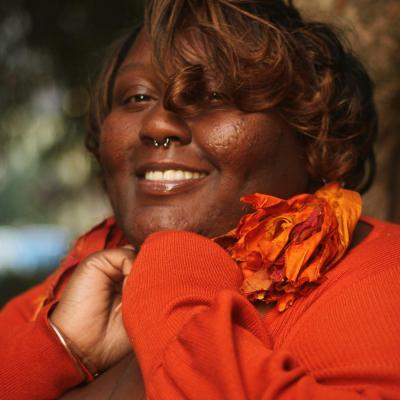
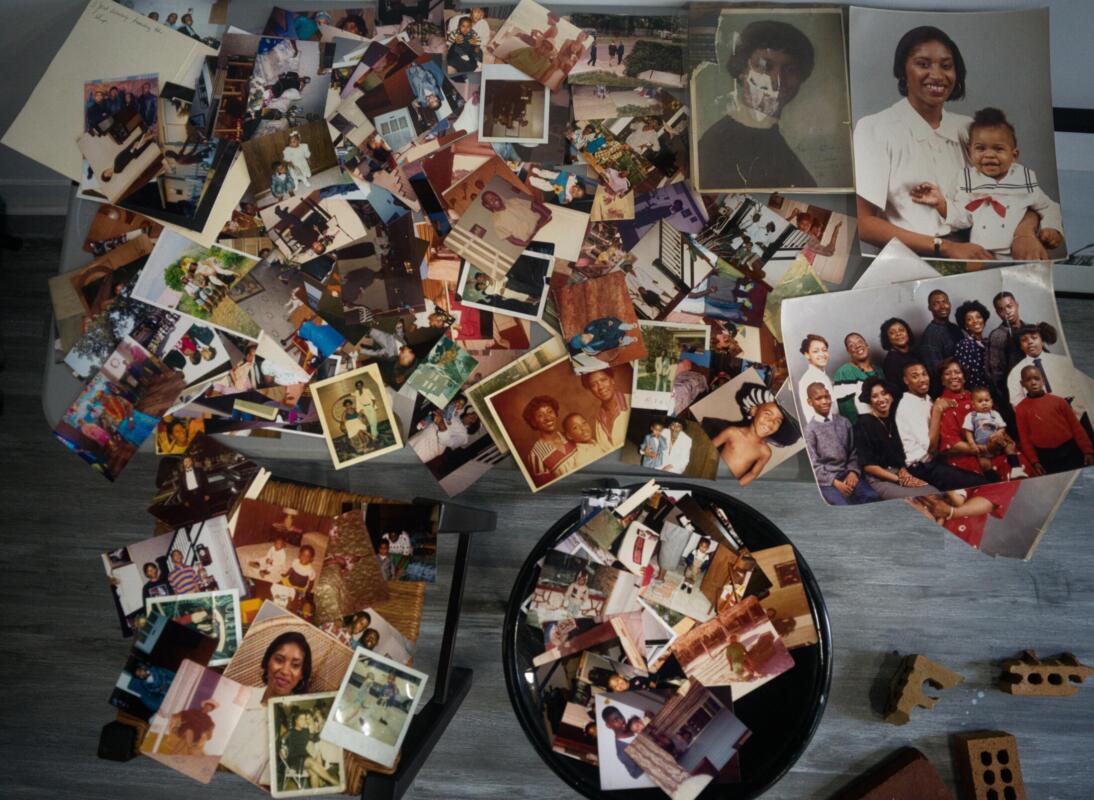
Before social media and shortened attention spans, it was more common to lay out a photo album for visitors in the family home. That ritual is rarer now that we post everything online, which is partly why the latest show by Baltimore-based photojournalist, educator, and activist Devin Allen is so unique. It’s a tribute to his upbringing and the photography he’s always been surrounded by.
Allen inherited many of his firsts from his maternal grandmother—Dorothy Marie Kearney, lovingly known as “Dawt”—including his first car and camera, which he bought using her Best Buy credit card. (He paid her back with interest.) She also gave him his first house.
That house came out of loss. Allen’s grandfather worked for Bethlehem Steel and died of lung cancer. In 1976, his grandmother used the insurance money, along with the last of her savings, to buy a house in Liberty Heights. It became the family home, where everyone lived or stayed at some point—the hub for Christmas, Thanksgiving, Easter, and summer cookouts.
That house is where Allen found the hundreds of photos that would become the heart of his latest exhibition, She Saw Me Coming, on view at the Charm City Cultural Cultivation (CCCC) HQ in Waverly through Dec. 4. He was encouraged by CCCC founder Derrick Adams’ Black Baltimore Digital Database, which safeguards archival material documenting local Black history and culture. The show features roughly 24 images from the family album, spanning the late 1970s through the late 1980s.
In honor of the opening, we interviewed Allen about grieving, healing, the importance of a Black domestic archive, and his lesser known—but very Baltimore—talent.
Tell us about the title She Saw Me Coming.
I wanted to rewrite my origin story. Usually, when I talk about how I got into photography, I say I found poetry, then I found [legendary Black photographer, composer, and filmmaker] Gordon Parks, and then I became a photographer. As I went through my grandmother’s stuff, I started understanding that yo, she’s a photographer in her own right, and I don’t think that she ever looked at herself as one. But she loved our family, and she would document and take pictures all the time.
I found hundreds of images of my grandmother either taking pictures or making someone take pictures of her. She used to carry a camera with her, like a disposable or something, and then I was like, oh snap, I grew up with photography, and maybe she laid the foundation for me becoming a photographer unknowingly. So that’s why the show is called She Saw Me Coming.
You mentioned poetry. Expand on that journey a bit. Were you good at it? How did it serve as a springboard into photography?
I was a horrible poet. I started doing poetry because I was a party promoter, and my homeboy said women love poets. I was writing stuff to make people laugh, and I could never memorize the words. It was an interesting time in Baltimore where I felt like everybody around me was changing or trying to find themselves.
My friend Josh Austin, who I went to high school and played basketball with, was an amazing poet, you know, and he was the one who was like, “Let’s do events together.” We started doing poetry on Tuesdays. You had Kleon, who was doing comedy shows on Wednesdays in the same space down South Baltimore. Then I had a friend, Gee Songzz, he was doing skits. DJ No ID started DJing, but we were all doing stuff in the same space in the same area and trying to figure it out. And I was trying to figure out what I wanted to do, so poetry was the segue to me becoming a photographer.
What themes does this show grapple with that you maybe haven’t explored in the past?
This show is something totally different. I don’t care if anyone likes it. I don’t care if anyone comes to see it. It’s me trying to cope with the fact that I lost my mother, Gail Allen, in January. I told her I was going to do this. She was excited about it. I wanted to honor that. I won a grant for the show from the Working Assumptions Project in Berklee, California, which focuses on people that work with family photography and historical scans—stuff like that. This show was also to honor my grandmother, who has dementia. So even in doing the show, she doesn’t know who I am. I’m coming to terms with becoming the patriarch now.
I want people to understand that our stories are important. No story is too small. I think that’s what helps people heal. That’s what you do when you have a platform. So it’s like, alright, your mother dies. What do you do with that? My mother is dead, and I want to create something I know she’d be proud of. I have images of her going to graduation, her standing in the living room, and my grandmother dancing before she goes out. I’m grieving, I’m coping, but also, I’m healing, too.
“This show is something totally different. I don’t care if anyone likes it. I don’t care if anyone comes to see it…This is me coming to terms with becoming the patriarch now.”
Outside of being your mother, who was Gail Allen?
Gail Denise Allen, the woman who changed the spelling of her own name. The woman who transferred schools without her mother knowing so she could graduate early. A woman who worked for the FBI in forensics. She was an anomaly coming out of the hood, coming from Park Heights, and from a grandmother from North Carolina.
She changed what it is to be a Black woman for me. She set the tone. I think she was a superhero. She was the epitome of what it is to be a Black woman. She wore her natural hair—never had any fake hair in her head. She rocked a feather wrap or a short cut, a bumper curl. She was that girl. She dated some of the biggest drug dealers, and she lived her truth. She made mistakes, and understood them. My father was one of the biggest mistakes. She talked about it all the time. She was a mother. She was a daughter. She was an aunt. She took care of all of us. Up until her last day, she took care of my grandmother. That’s why the show is so important. Gail was an anomaly, a girl from West Baltimore who beat the odds.
Are there any specific pieces in the show that honor your mom?
I’m showing self-portraits that I was meant to take with my mother, but she passed before I could get the images that I wanted—inspired by Carrie Mae Weems’ Kitchen Table Series. I’m using negative light to show spaces she would sit in her house.
Can you share more about the inspiration for the show from the Black Baltimore Digital Database? Why does it matter that these everyday family photos are preserved and on display?
When it comes to the world of Black photography, I’ve been blessed to meet some of my predecessors that are idolized. When I watched [the 2014 documentary] Through a Lens Darkly, recommended to me by Aaron Bryant, a curator at the Smithsonian who used to work at Morgan, I learned about how Black history has never been a part of the American story, even though it is very American. White people’s history is heavily documented, but no one cared to think that we were part of those stories.
We have documented ourselves for so long, but have not been privileged enough to show [work] in our own spaces, even to this day. I think growing up in the hood and in Black spaces, sometimes we minimize or shrink ourselves. Our stories are so verbal that we leave it up to the next generation to pass those down. But our work should be in museums. Our stories should go beyond sitting at the dining room table. Even the most mundane things, from Thanksgiving or your aunt making deviled eggs. That photograph, whether it’s on an old 35 millimeter or on your phone, is a part of American history, and it cannot be unwritten. Because being Black in America is a form of activism. I think we should show that.
“Growing up in Black spaces, sometimes we shrink ourselves. Our stories are so verbal that we leave it to the next generation to pass them down. But our work should be in museums. Our stories should go beyond the dining room table.”
You’re known for your iconic photography of the Baltimore Uprising and local Black joy and resistance. But this show is obviously a more personal story about your ancestry and legacy. Is there anything else you want people to understand about you that they might not already?
A lot of people don’t know that, generationally, I’m a dancer. [In Baltimore], we say “Oh he a cutter,” which means he can cut a rug or he is cutting up. So me? A dancer. Grandma? A dancer. Before her dementia, we used to hand dance. I used to hand dance with my mom all the time, too. My mom was a dancer. I got it from her. My mom was a DJ. She loved music. So a lot of people who grew up with me know that I can dance. I used to hit backflips in the club and crazy leg and SpongeBob and everything. My dad? He used to be down Melbas on Greenmount Avenue cutting up to some good music. I’m a clubber, a dancer. I love music.
What else is currently on view or coming up for you?
Devin Allen and D. Watkins: Baltimore at the Gordon Parks Foundation Gallery in New York is coming down soon. I worked with BmoreArt on their photography art book that’s coming out, alongside Joe Giordano, Cara Ober, and their amazing team. The BMA also has its first photography show coming up, Flashback: Two Centuries of Baltimore Photography, which I have a couple of images in. That’s big, finally getting Baltimore photographers and artists seen collectively in the museum. It opens Oct. 4. [More on the exhibit can be found in our October 2026 issue.]