News & Community

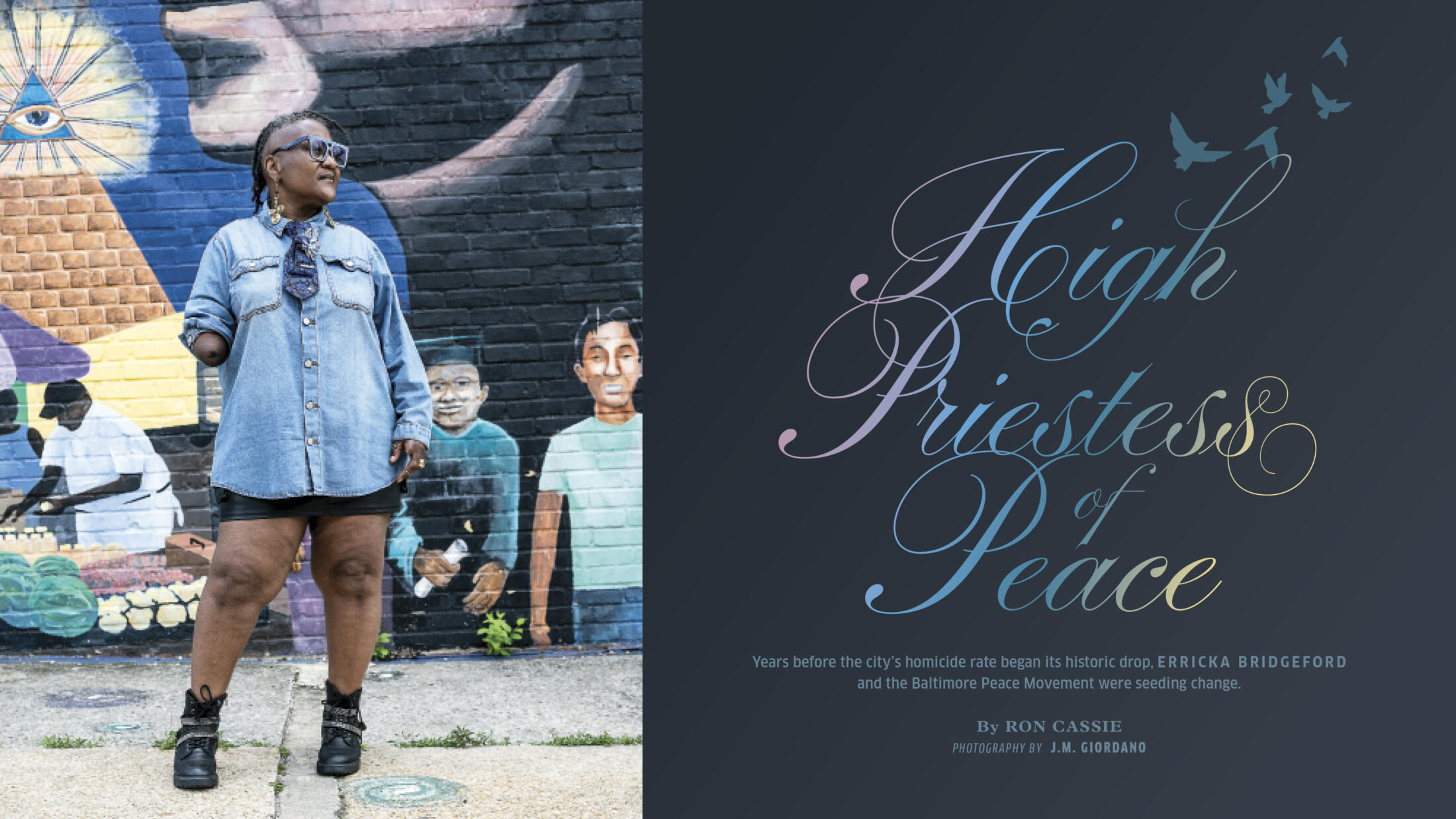
ERRICKA BRIDGEFORD parks her bright blue Acura in an East Baltimore alley and spends a moment getting organized. As she steps out, she zips up her fanny pack with her left hand. Born without a right hand, she has become adept at balancing her iPhone on her arm as she moves around the car to pop its hatch. “I brought extra sage,” she says, tucking fist-sized bundles of the dried herb into her waistband. There are no signs of life on this back street, but she adds, presciently, “Someone always asks if I have more.”
One week earlier, a 26-year-old man was shot to death here. Baltimore Peace Movement supporters often participate in these “sacred space” rituals, occasionally accompanied by the family of the deceased. It’s not unusual for candles to be lit and tears shed. But Bridgeford expects she’ll be alone today. “It’s the middle of the week, people work,” she says with a shrug and smile. She holds the sage against her chest with the crevice of the arm she affectionately calls “my nub” and lights the grayish green leaves, which have been used for thousands of years for spiritual, medicinal, and energetic purification, with roots in Indigenous North American and ancient Egyptian, Roman, and Greek cultures.
“Gun violence is a sickness. It needs healing,” she explains, stepping across the cracked pavement. “Grief and trauma need healing, too.”
Describing Bridgeford and her presence is almost impossible. She is somehow both playful and contemplative. The 53-year-old interfaith minister wears eyebrow piercings, hoop earrings, braided hair, and Ray-Ban sunglasses. She swears causally, laughs easily, and hugs frequently. She also prays daily, meditates, practices Buddhist chant, and today, she is walking through this blighted alley in a flowered, pink Baltimore Peace Movement T-shirt and sparkling pink tennis shoes—as she offers blessings for the departed man, his loved ones, and the community.
She has performed these cleansing rituals after nearly every murder since the fall of 2017—a staggering, heartbreaking, 2,000-plus times. Even on the city’s toughest streets, her warm vibrations draw people to her and, as she reaches North Avenue, two drivers waiting for the signal to change recognize her and honk their horn.
“Hi! how are you?” she shouts back in a surprisingly booming voice. Her spiritual appeals may be quiet. She, however, is not.
As she returns to her car, an inquisitive mom with an infant opens the backdoor of her rowhouse. “I smelled the smoke and wondered what’s going on,” the young woman says. Bridgeford introduces herself and mentions a man recently had been killed nearby. “I heard about it from neighbors,” the woman says, accepting a Peace Movement flyer. “We weren’t home, thankfully.”
“And that’s sage you’re burning?” the woman asks, lifting her baby girl, dressed in all pink like Bridgeford, including a pink bow in her hair. “Sage is her name,” she says, smiling at the coincidence. “She’s six months old today.”
Later, in West Baltimore, a young man with gold fronts crosses paths with Bridgeford during her third sacred space ritual of the afternoon. Outside a small convenience store, the kind with bulletproof glass protecting the cashier, he tells her burning rituals bring bad karma. After a brief conversation, however, his body language softens and he reaches forward to thank and hug Bridgeford before heading down the street. On the stoop next door, an older woman, sitting alone, puts on her glasses and looks over to Bridgeford, inquiring about her doings. Soon, they are in an embrace.
“You feel like spring,” the woman says, not willing to let go, yet. “You don’t know how much I needed this.”
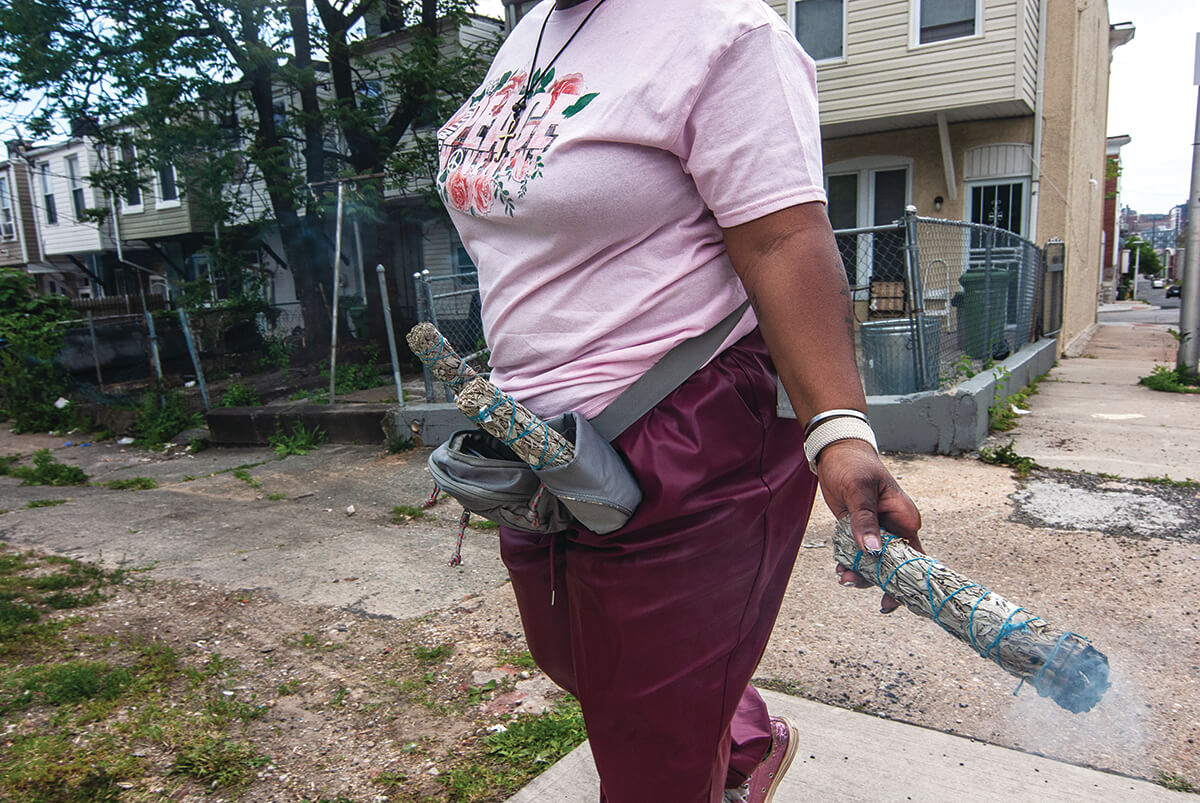
SINCE THE
FALL OF 2017,
BRIDGEFORD WALKS
THE STREETS
BURNING SAGE AS
A CLEANSING RITUAL
AFTER MURDERS DUE
TO GUN VIOLENCE.
YEARS BEFORE THE CITY’S HISTORIC 60-percent drop in homicides began in 2023, Erricka Bridgeford was seeding transformation.
Originally founded as Baltimore Ceasefire by Bridgeford, and former rapper and activist Kevin “Ogun” Beasley, with community volunteers Letrice Gant, Jakia Jason, Michelle Shellers, and Darnyle Wharton, the since-renamed Baltimore Peace Movement began as an urgent call to action to stop the spiraling bloodshed in the years following the death of Freddie Gray.
The first “Ceasefire Weekend” in August 2017 challenged every corner and block of Baltimore to put down its weapons for 72 hours. Bridgeford and her team rallied communities with grassroots participation over three days, including sidewalk peace demonstrations, cookouts, concerts, basketball tournaments, and vigils to honor victims of violence and support grieving families—some 50 events in all. Pop-up hubs provided expungement clinics, child support information, and mental health professionals in neighborhoods heavily impacted by crime.
The message was painfully simple: “Nobody kill anybody.” (When corner boys and local gang members scoffed at the idea of a citywide, violence-free weekend, Bridgeford, who understands the male ego, turned it around on them. “Are you saying you can’t keep your area, your ’hood safe?” Their answer, without fail: “Oh, don’t worry about it, it’ll be safe around here.”)
The hope was simple, too. To create room for Baltimoreans to breathe amid the barrage of shootings and homicides, which had reached nearly a killing a day. That initial Ceasefire Weekend, which garnered international attention, lasted 41 hours before a homicide was recorded. In response, Bridgeford and Ceasefire volunteers gathered at the site of the killing, pouring intentional prayer, song, sage, and flowers into the location, transfiguring it from a place of trauma into “sacred ground”—the start of the practice Bridgeford continues to this day.
That November, an off-duty D.C. police officer was murdered a few hours into the second Ceasefire Weekend, which then remained homicide-free the next two days. On their third try, in February 2018, the city went a remarkable 11 days without a homicide. It was the first such stretch since Gray’s death from injuries suffered while in police custody led to mass protests and later, rioting.
Determining causation in any spike in homicides is murky business, as is the reverse—pinning down the reason for the now steepest decline in homicides of any U.S. city. The ongoing four-year drop to a 50-year-low correlates with the election of Mayor Brandon Scott, who took office in 2021, and the implementation of his Group Violence Reduction Strategy (GVRS). Undoubtedly, the combination of its focused deterrence, intensive support for individuals at the highest risk of violence, and a commitment to community messengers—for example, the Safe Streets program, which utilizes formerly incarcerated individuals to mitigate beefs and prevent harm—has been a major factor.
Baltimore police are also clearing more cases under Commissioner Richard Worley, and City State’s Attorney Ivan Bates has highlighted prosecutors’ improved partnership with the BPD. Bates defeated controversial incumbent Marilyn Mosby in the 2022 Democratic primary and took over in January 2023. Scott named Worley in June 2023.
That said, Bridgeford and the Baltimore Peace Movement’s role has proven to be anything but pie-in-the-sky as skeptics initially asserted. (Check the comments following her 2017 TED Talk on YouTube, if you enjoy seeing racists and misogynists proven wrong.) Research published in the American Journal of Public Health in 2020 estimated a 52-percent reduction in gun violence during quarterly Ceasefire weekends, with no evidence of additional violence postponed to the following days.
“I’m not the guy to say we’re responsible for changing the culture,” says Beasley, who is also the founder of Beats Not Bullets, which works with middle and high school students, and does outreach to incarcerated young men.
“I just know how the energy works on the street. When a conflict is resolved or terrible wrongs are avoided, those things don’t necessarily get talked about. No one on the outside sees it and it’s not publicized. But organizations such as us [the Baltimore Peace Movement], Youth Advocate Programs, We Are Us, Safe Streets, Roca—all the big organizations in the city, including those out of the Mayor’s Office—have been putting in years of that work. Naturally some type of harvest is going to come. The current numbers are the definition of a shift, right?”
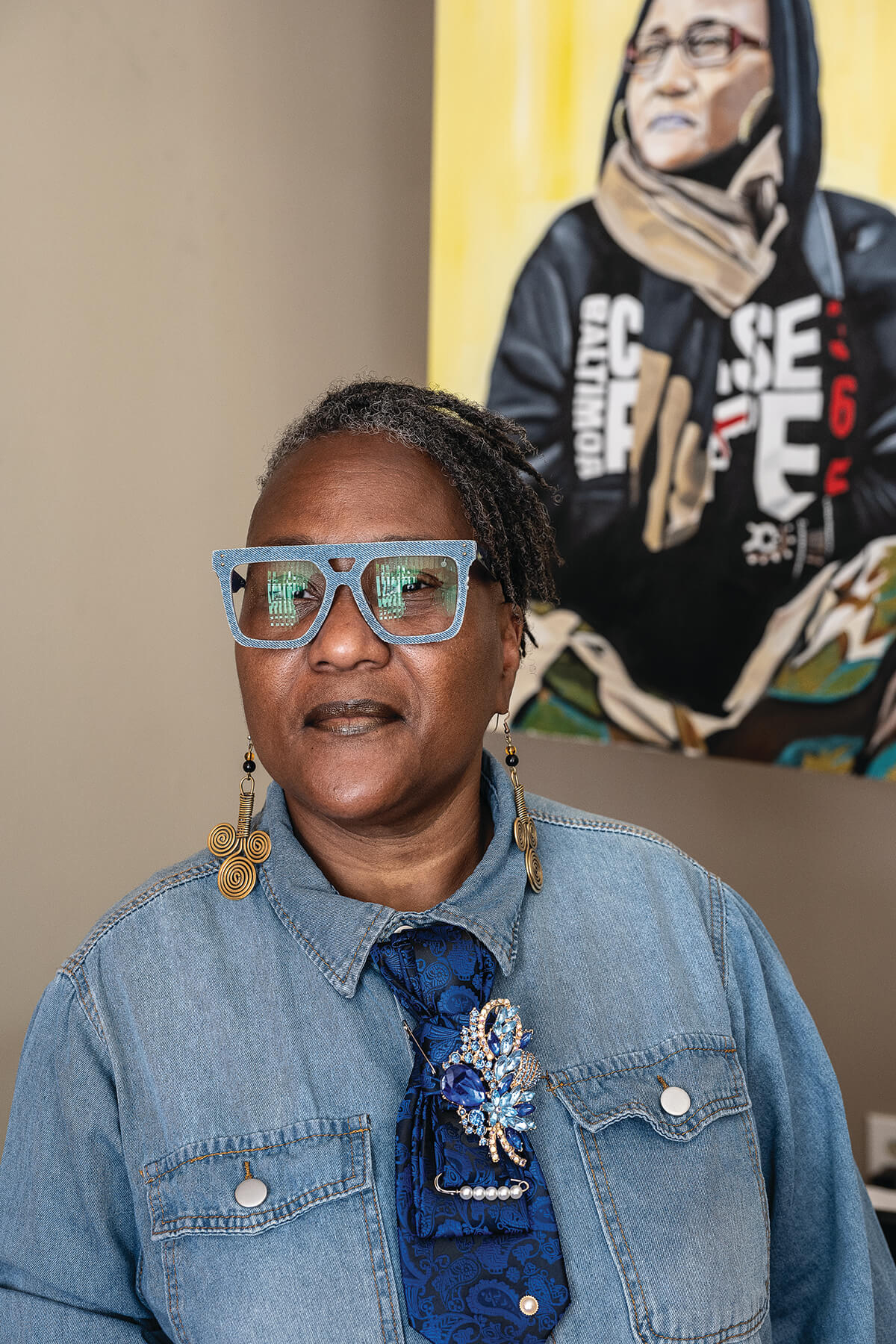
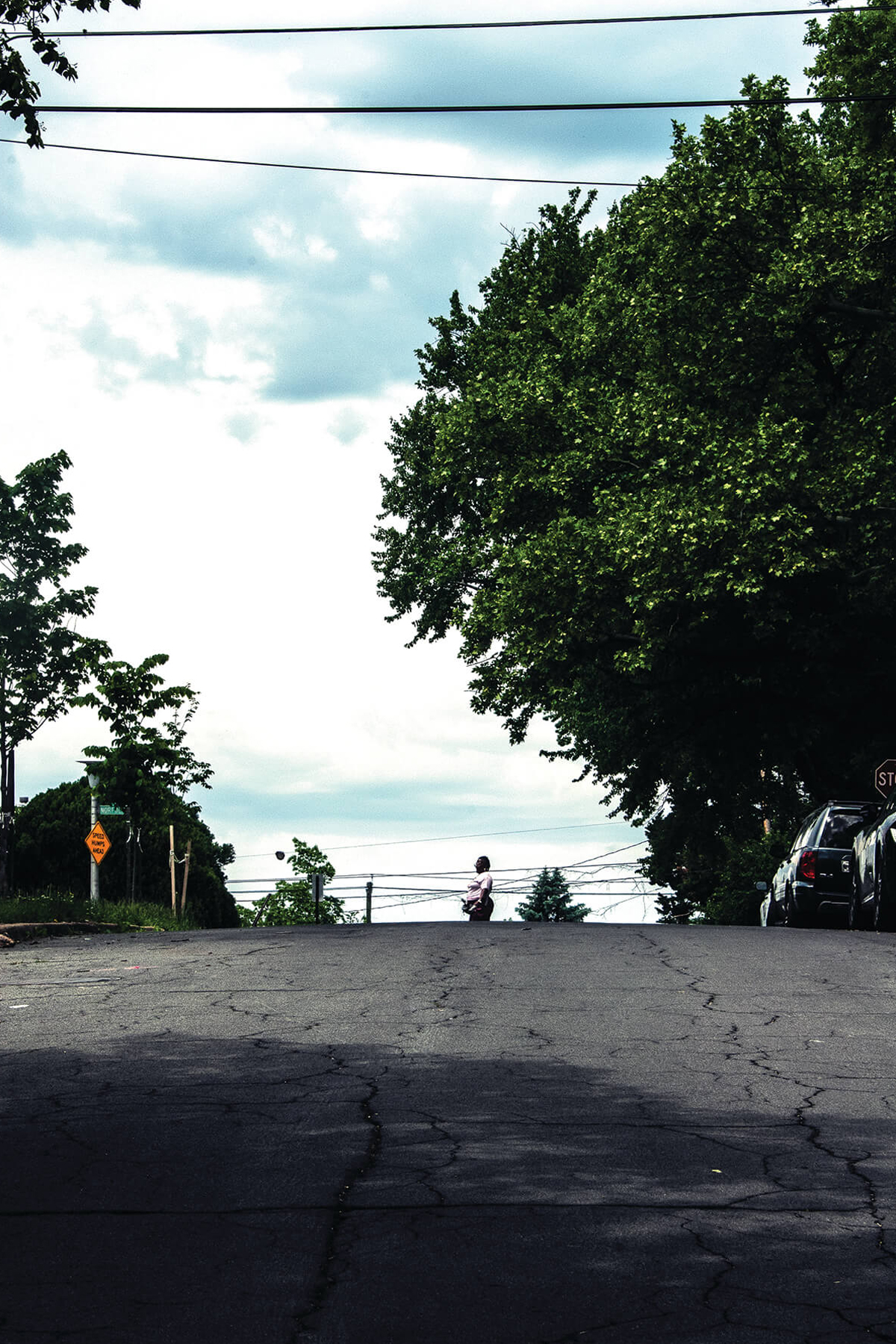
BRIDGEFORD IN FRONT OF A PAINTING OF HER BY ANSON ASAKA THAT HANDS IN HER BALTIMORE COMMUNITY MEDIATION CENTER OFFICE; BRIDGEFORD CLEANSING THE STREETS.
BRIDGEFORD WAS 12 YEARS OLD the first time she saw a person killed. She was in her Rosemont bedroom and should have been asleep when she heard gunfire. She looked out her window, and watched her friend, Mike, an older boy from the neighborhood, running and knocking on doors for help and then falling on the pavement. She heard him cry, “God, please don’t let me die,” while being placed into an ambulance. She was too scared to tell her parents what she’d witnessed.
Ever since, she says, she has been attending funerals. There have been times she’s been to two in one day. In 2001, one of her three brothers survived getting shot during an argument with a family friend in broad daylight. In 2007, she lost her brother David to gun violence. He was the 21st murder victim on the 22nd day that year. Two of her aunt’s sons have been murdered. And these are just the family members that spring to mind before a Saturday community resource walk not far from where she grew up.
With a cadre of volunteers in Peace Movement T-shirts beside her, Bridgeford engages individuals and small groups of neighborhood residents who are either running errands or merely finding some shade on a hot day. She says hi to everyone and passes out information about a variety of available support systems for low-income individuals, seniors, and families, including the free conflict resolution services at the Community Mediation Center, where she has served as executive director since 2020.
At one point, while Bridgeford is speaking with a half-dozen young guys, an older man from the community interrupts and begins preaching about the dangers of street life to the teenagers, who are simply drinking iced tea outside a mini-mart. Bridgeford explains the man is not with her or the Peace Movement and then she leaves several flyers and gently walks away. The young men nod toward her, appreciatively, and tell him to get off his soapbox, not in so many words.
Even before she became the face of the Ceasefire weekends and the Peace Movement, Bridgeford, who is maybe all of 5-foot-3, stood out. A prenatal condition caused her to lose her right arm from the below the elbow and the index finger on her left hand. The rare birth injury, known as Amniotic Band Syndrome, occurs when fibrous tissue strands from the inner membrane of the placenta tangle around a developing fetus—in her case, her arm and finger, requiring doctors to remove both. She was told she was born screaming in the birth canal from the pain.
“A cool superhero origin story,” she says jokingly of her tortuous entry into the world. “I've thought about that a lot.
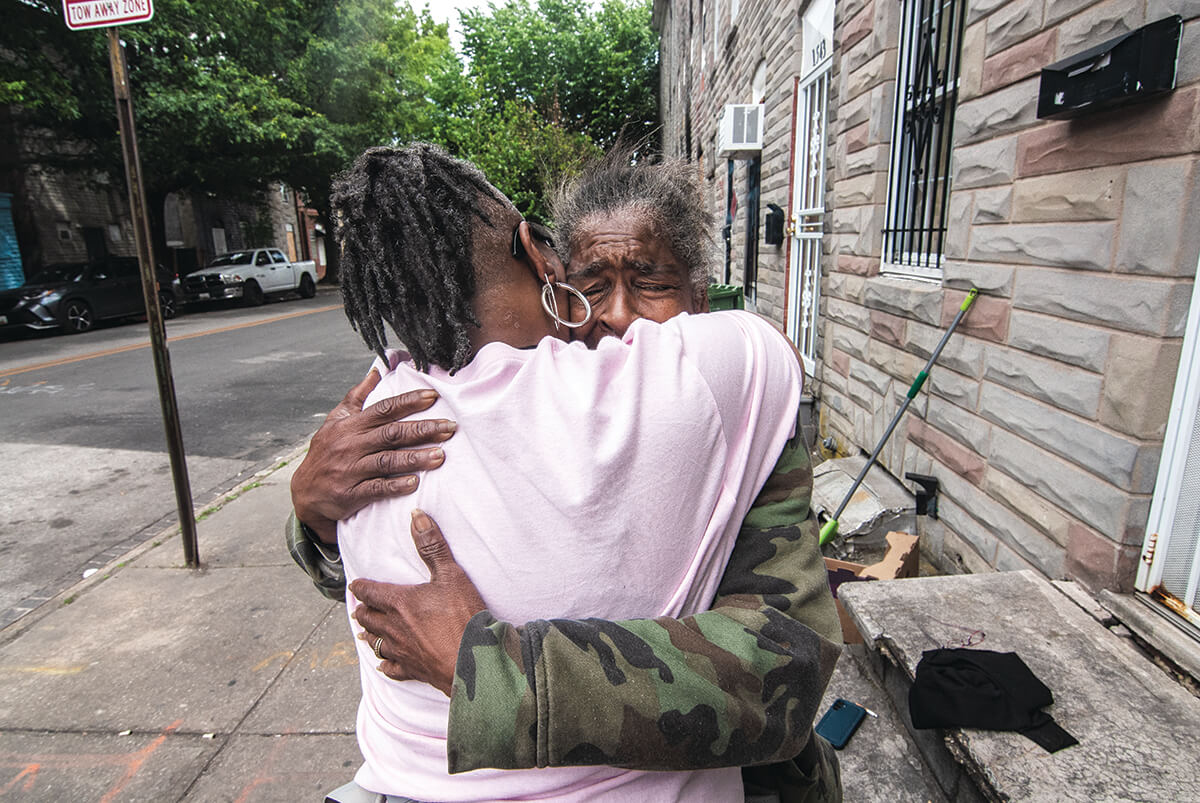
IN HER WORK TO HELP HEAL COMMUNITIES IMPACTED BY GUN VIOLENCE, BRIDGEFORD
HUGS FREQUENTLY.
When I was born, my arm was already dead. I was in the most pain a person can experience.”
Bridgeford was also born chatty and smart, talking at a very young age, and possessed of a preternatural appreciation of people and life in general. (During another sacred space ritual, she strikes up a conversation with a feral cat—“Hello, Mr. Cat!”—explaining she has spoken to animals, trees, stones, mailboxes, well, everything, since she was small.) But it took her time to embrace her physical differences, made more challenging by the fact that she was a Black girl, born to teenage parents. She was bullied about her arm and got into schoolyard fights. After every altercation, which she says she always won (there is little doubt about her toughness and courage), she cried when she got home, appalled by the punches she’d thrown. Her parents had raised her to be respectful and rise above such behavior.
Bridgeford also credits her parents for encouraging her and not letting her limit herself despite her early obstacles.
“We were poor, we lived in low-income Baltimore public housing, but me and my brothers didn’t know we were poor,” she says.
Her mother and father were the parents that all the children in the neighborhood came and talked to. Her mom socialized with other moms, her father played jacks with the kids on their porch, and they coached football together. At some point when she was in middle school, they got a piano.
“There were a lot of families in my neighborhood, several anyway, that were two-parent households, but then in the ’80s, you noticed some of those families broke up,” she says. “Or when families moved out, single-parent households moved in. Over time, a two-parent household became an anomaly.”
Her father, a former Black Panther, car mechanic, and pastor, would later earn a college degree from Coppin State in his mid-40s. He taught her to tie her shoes with one hand. Her mom made sure she could read before she started kindergarten. Her mother—a similarly sized ball of energy—works with Bridgeford today as a mediation case manager.
“My parents had me intentionally when they were teenagers and wanted all their children to believe they could change the world,” she says. “They knew I needed to be strong and capable of taking care of myself.”
Two years after her brother was killed—his soft heart and kindness were a model for Bridgeford even as he struggled with substance abuse—she became an activist against the death penalty. She testified as a murder victim’s family member in front of the General Assembly, helping lead to the repeal of Maryland’s death penalty in 2013. Later, she became an advocate for state support for survivors of homicide victims. Forgiveness, not revenge, has been the key to her family’s healing.
“I am not naïve, I’m from West Baltimore,” she says. “I’m speaking from experience, not something I’ve read or researched, and I’m not saying those things aren’t important.” They are, she continues, adding she has been raped, lost a brother, a stepson, and cousins. “I just describe my optimism as spiritually gangster.”
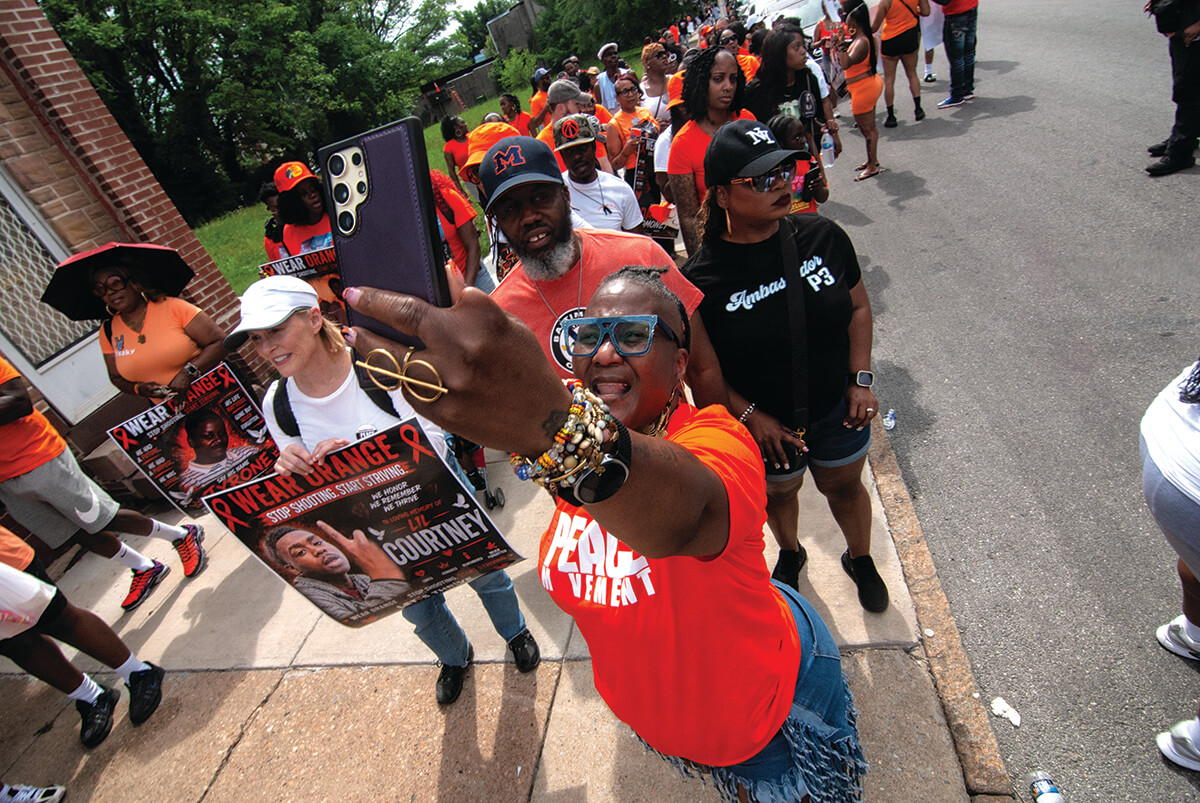
BRIDGEFORD
LEADING A PEACE WALK IN MAY OF THIS YEAR, WALKING PARTS OF NORTH AVENUE, ROSEDALE, BLOOMINGDALE, AND POPLAR AVENUE.
BORROWING INSPIRATION FROM WAR-TORN areas around the globe, Beasley had pitched the idea of organizing a ceasefire to Bridgeford when shootings began multiplying in 2015. She was involved with the 300 Men March, a nonviolence project co-founded two years earlier by activist Munir Bahar and then-City Councilman Scott, 130 and he had just attended a community support meeting.
He told her of his concept of establishing a period of time when people would commit themselves to peace.
For whatever reason—work, family, distraction—they played phone tag for awhile and the idea fell by the wayside. Two years later, however, with no end to the murders in sight, her 19-year-old son, Paul, turned to her as she was driving one day and told her the homicide rate had become the highest in the city’s history. It was also the worst of any large city in the country. What could be done? What could they do? The next day she called Beasley (they have since become a couple), and told him she was in.
Thousands of people showed up to the first Ceasefire weekend to pray, talk, and rally for nonviolence. Bridgeford recalls that one of them, a 23-year-old man named Devrone McKnight, had been shot in the face the day before. McKnight was heading home from the hospital that Friday evening with his face bandaged when he drove past a Ceasefire demonstration in Edmonson Village—10 blocks from where he’d been shot. He’d been on his way to work at Maryland Shock Trauma when someone pulled up and shot him. He was still dressed in green hospital scrubs and slippers when he joined the group (she has kept photos of them together on her phone). He became an animated presence, holding up signs and screaming at cars, “‘Honk your horns for peace!’” says Bridgeford.
In retrospect, it is not surprising that Bridgeford, who began working at the Community Mediation Center after her brother was shot by a friend in 2001, would eventually see the potential in Beasley’s ceasefire proposal.
The Baltimore center typically handles neighborhood, business, landlord-tenant, and family and interpersonal disputes, but they have also worked with more than 3,000 incarcerated and formerly incarcerated individuals and their families. Montgomery County state delegate Lorig Charkoudian co-founded the nonprofit—one of 17 across the state—after earning a doctorate in economics from Johns Hopkins University, where her research focused on conflict mediation and policing. (Reducing conflicts through mediation, she found, can lower the cost of policing by cutting down repeat calls to police, repeat court appearances, and even incarceration.)
For the past dozen years, Charkoudian, a dedicated marathoner, has led a two-day, 70-mile, Hagerstown-to-Baltimore “Run for Re-entry” to highlight the plight of and build support for returning citizens. For several years after the 2015 uprising, the organization led local teenagers and Baltimore police in “dialogue circles” to improve relations between the BPD and at-risk youth.
They way Charkoudian sees it, Baltimore, with its commitment to violence interruption, mentoring programs, addiction recovery services, and other efforts, has developed an ecosystem of healing, connection, and community.
“The Peace Movement, in particular, is a very community-building thing and it happens with people being together in the same space,” Charkoudian says. “We’ve become used to phoning it in, literally. Relationship-building, which is where healing from trauma comes from, is not something you can phone in.”
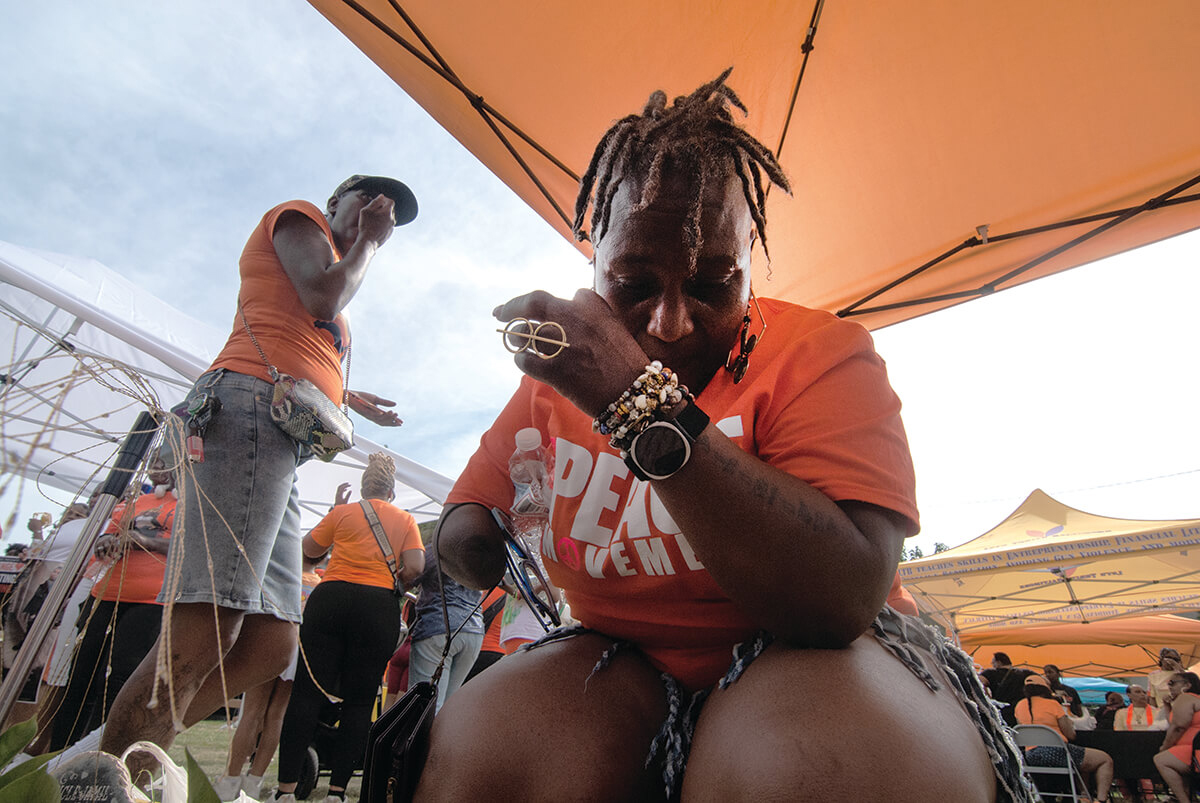
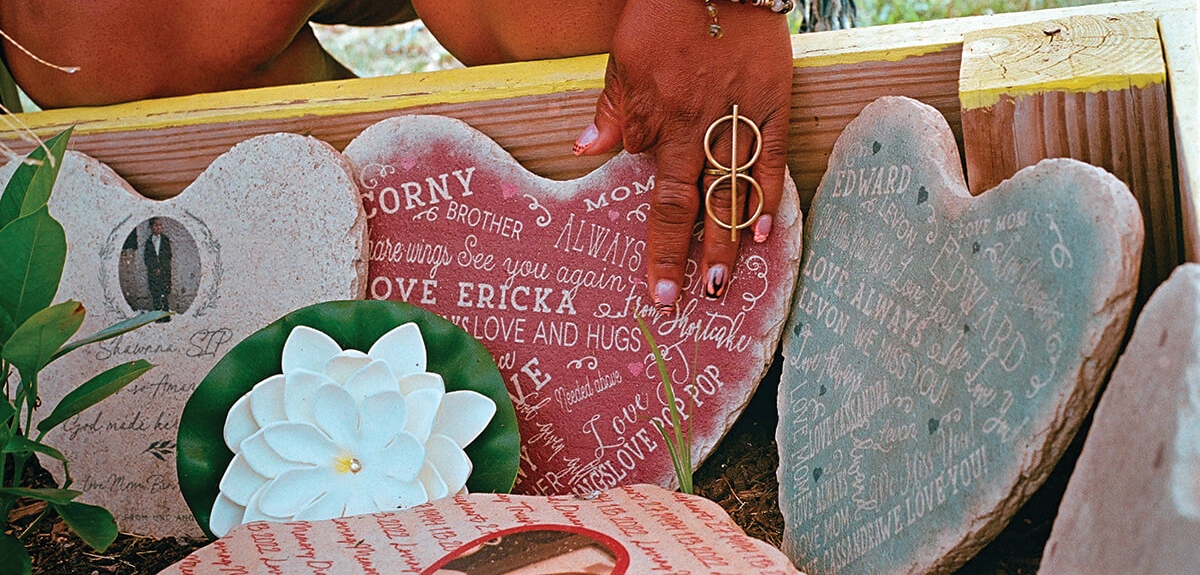
BRIDGEFORD
TAKES A BREAK AT THE PEACE WALK; PLACING A HAND ON THE MEMORIAL STONE FOR HER BROTHER, DAVID, WHOM SHE LOST TO GUN VIOLENCE IN 2007.
BRIDGEFORD WAS featured in the Emmy-nominated documentary The Body Politic, which highlighted Scott’s 2020 mayoral candidacy and his promise of a collaborative, community-driven approach to tackling gun violence. After his election, he named Bridgeford co-chair of his transition’s public health and safety committee. She is the first to say there are too many factors that drive gun violence to point to any single solution. If there was, it would be an easy fix. And she is also the first to say more work needs to be done and more help is needed to keep pushing the homicide rate down.
“Most Safe Street locations do incredible work,” she says. “But they still don’t have enough workers, just the bodies that they need to cover their whole catchment area.” The Community Mediation Center, where Scott briefly served as board chair before becoming City Council president and mayor, still struggles with funding every year, she notes.
For several years, the Peace Movement has collaborated with other nonviolence advocates and organizations to promote shared events, but it, too, struggles with waning support from time to time. In July, as the movement approached its 10th year, she hosted a citywide engagement meeting to gather input to further grow the Peace Movement and attract additional partners.
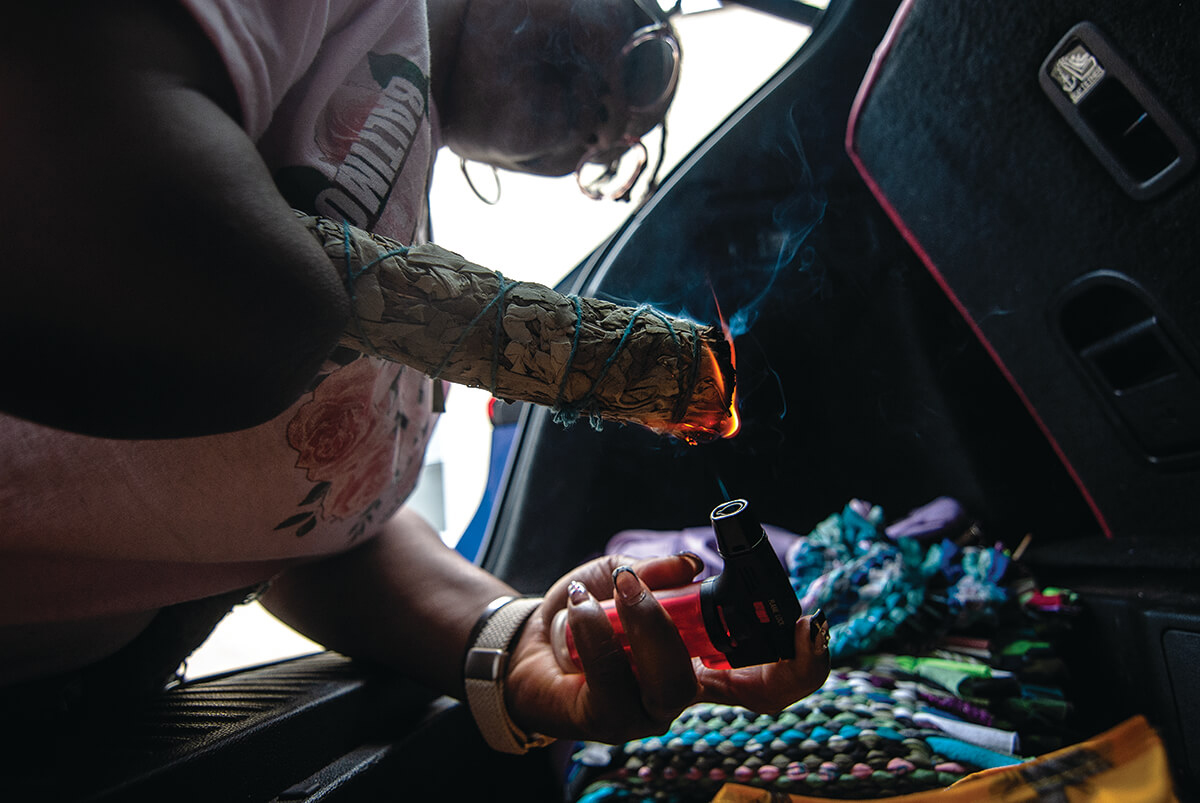
BRIDGEFORD
LIGHTING A STICK
OF SAGE IN THE
BACK OF HER CAR
TO USE AT THE
CLEANSING RITUAL
“I do think the culture around violence has changed,” Bridgeford continues. “I can’t go to the grocery store without people coming up to me and thanking me for my work. I can’t pull up at a red light without a bunch of young boys on the corner being like, ‘That’s the Ceasefire bitch, yo. Keep doing what you’re doing, shorty.’ I can’t walk through the streets without somebody coming up to me saying, ‘Oh, I’ve been in jail. I saw you on the news all the time and couldn’t wait to come home and get back to my community because I kept seeing people like you out there.’
“However, we finally have a mayor,” she says, alluding to Scott, a longtime friend as well as an ally, “who is firmly committed to and investing in anti-violence programs. That is probably the biggest thing. It is a change.”
Scott handily won reelection two years ago, largely on the basis of the dramatic drop in homicides. But like Bridgeford, he believes that the city’s approach and commitment to preventing gun violence need to move forward.
“We still have not expanded the Group Violence Reduction Strategy to every district,” he says. “We also have to sustain our investment in this work. There is concern about federal funding cuts [to local criminal justice programs], but our congressional delegation has been always been great in that regard.”
The rebuilding of hope and public trust in recent years—the block-by-block work performed by Bridgeford, the Peace Movement, and other grassroots groups—also needs to continue, he says. In no small part, because hope and public trust are critical to effective community policing. “You don’t improve the clearance rate from 37 percent to 62 percent without restoring trust,” Scott says.
Several things about the decline in gun deaths in Baltimore are certain. One, it has not occurred because police have been arresting more people. The BPD arrests a fraction of the number of individuals in its mass incarceration heyday, a practice, if anything, that was likely counterproductive, producing more trauma, more family separation, and more individuals with criminal records who then struggle to get back on their feet, says Daniel Webster, a professor at the Hopkins’ Bloomberg School of Public Health, who has studied gun violence here for 30 years.
Two, a deluge of crises—the uprising following the death of Freddie Gray, BPD’s frightening Gun Trace Task Force scandal, and the federal indictments of former Mayor Catherine Pugh, former Police Commissioner Darryl De Sousa, and former City State’s Attorney Marilyn Mosby—had broken trust in the city’s major institutions. That dysfunction fueled distrust between city leaders and agencies—and between the members of the public more broadly.
“There’s work on the ground necessary to preventing gun violence, there are systems that need to function, and there is a cultural component to preventing gun violence,” Webster says. “When things were really bad, nobody trusted anyone,” he says. “Everybody was pessimistic. The police were very cynical, and I think the same with the community. Over a long period of time, police have gotten a lot better. The city has a clearer anti-gun-violence strategy.”
Webster also feels compelled to underscore something fundamental to urban gun violence, which most people don’t recognize, he says. It acts as a social contagion. As shootings go up, they feed on one another because there’s more retaliation, there’s more pain, there’s more trauma. Everybody is scared and therefore they’re carrying the guns. “It’s easy to imagine this contagion process when things are going up,” Webster says. “But it works in reverse as well, so when you can get things going in the other direction, that makes it easier to sustain the progress.
“We need to help the people and places that have suffered loss and trauma, and I also agree that we have much better capacity to do that than we once did. Erricka, and particularly some of the things that she does, is important. The healing aspect of this is important. She is a unique leader.”
Bridgeford is unique. Charkoudian, who as an accomplished legislator and Ph.D. is not normally prone to hyperbole, calls her “an embodiment of love.” “A prophet,” she says, who sees a world that doesn’t yet exist, a better world, and starts to manifest that world.”
It is undoubtedly true that, for several reasons, people do respond differently to Bridgeford, which she says, “If we’re going to be 100 percent honest,” she is aware of.
“I don’t remember the impact that my having one arm has on other people,” she says. “Most of the time, I’m not thinking about it.
However, I do know that if I walk up to a group of people on the corner and I start talking, they’ve seen me coming. They’re like, ‘Oh, it’s a handicapped lady’ and people in general treat disabled people differently. We get more grace, for a minute. ‘What is she about to say?’ I’m kind of cute, too,” she continues with a laugh, adding that if she has her thighs showing, the Safe Street guys will tell her, “You look good today.”
But it is also apparent that she’s from Baltimore, she’s of this city. “I look like a Baltimore girl, I act like a Baltimore girl, I talk like a Baltimore girl, right? I am approachable, and if somebody like me came up to you and started talking to you about people getting killed, and your attitude is, ‘Yeah, yo, that shit is fucked up,’ that all works in my favor.”
Her physical appearance, in other words, may open the door a crack in some tough places, but something else happens next.
“People see my missing arm and think, at first, that I’m broken, like some people look at Baltimore as broken,” she says. “But then they realize, I’m actually whole. And that Baltimore, which has this magic and this love for itself, can be whole, too.”
She says this after she has twice returned to her car after the sacred space rituals to grab a pair of scissors. She brings scissors with her to remove the harsh yellow crime scene tape that police too often leave behind after they find a body.
At one location, crime tape was left wrapped around a light pole and a street sign. At the other spot, yellow tape was tied through a stoop handrailing in front of a vacant rowhouse where a man, who had been shot, was found dead. “A lot of people run to a house when they get shot, vacant or otherwise,” she says. “They’re desperate. They’re looking for help, somewhere safe.”
With no one around, she cut and removed the tell-tale tape at both locations, depositing it in the nearest trash can.
It is someone’s job to put the crime scene tape up, and it is someone’s job to take it down, she explains, but often it just gets snatched away.
The twisted ends remain on display.
“I remember the blood on the sidewalk that didn’t get cleaned up after my brother was killed,” she says. “Everyone in these communities knows what happened. No one needs to see reminders every day.”