News & Community
At Savage Fencing Club, An Ancient Sport Sharpens the Senses
Meet the couple behind the Howard County club—the largest of its kind in Maryland—where about 150 members come to learn, train, and compete.
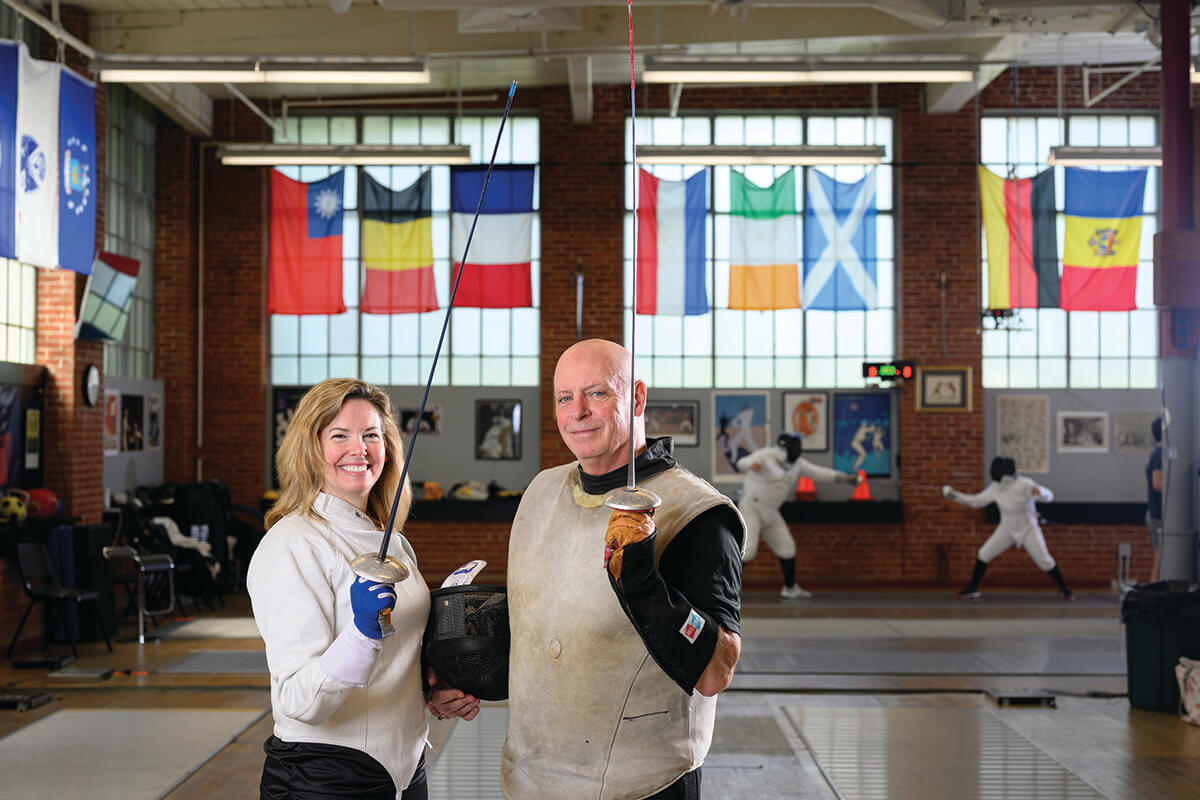
Amidst the serenity of a clock store, chocolatier, and other similarly cutesy shops, the clanging of steel rings out through Savage Mill in Howard County. At one end of the historical mill-turned-mall, there are men and women of all ages, wearing lightweight Kevlar jackets and masks reinforced by strong wire mesh, partaking in a sport with origins that date back thousands of years.
Since 2022, Bruce and Lauren Milligan have built the Savage Fencing Club into the largest of its kind in Maryland, where about 150 members come to learn, train, and compete. And the married co-owners are not only enthusiasts but coaches and competitors here themselves.
“We love the sport—we see it as our path to self-discovery, or self-enlightenment,” says Bruce, 75, who’s been fencing since he was 14.
He’s coached high school and college teams and won two U.S. Veterans National Championships in foil, one of the sport’s three sword-like, flat-tipped “weapons,” in addition to the epeé and sabre.
Born out of battles in ancient Egypt, then later distinguished during the Renaissance era of Italy and France, fencing is now a non-lethal sport that combines physical prowess, hand-eye coordination, and intellect. Participants face one another on a roughly 50-foot metallic grounded strip called a “piste.”
When the referee says “en garde, prêts, allez!” (French for “on guard, ready, fence!”), they attempt to score points by hitting their opponent’s target area with their weapon. The objective is to outduel their opponent. When a touch is registered, a buzzer and light go off. Most bouts are over in either nine minutes or 15 touches—whichever comes first.
“You have three primary weapons when you’re fencing…,” Bruce says. “Your brain comes first, then your feet, then the weapon itself. It’s a game, like chess in motion.”
Lauren, 50, started fencing in college. She wanted an activity in which she could compete with her scrappy brothers, at first considering the martial arts. “But I kind of like my face,” she says, smiling wryly. “So I put on the mask and thought, ‘This can work.’”
The Milligans take an inclusive approach to fencing, one of only five sports that have been contested at every Olympics since the first modern games in 1896. Every Saturday, they offer free half-hour lessons (by appointment) to anyone who’s interested. Many then join the club.
At first, “They’re shy, they’re a little bit nervous,” Lauren says. “But then they get on guard…and there’s this glint in their eyes, and they’re like, ‘Oh, wow. I can hit you.’ It’s a beautiful moment.”
The Milligans plan to sell the club to its head coach Robert Suchorski in the coming months, but they will remain actively involved with it. After all these years, fencing is in their blood.