Food & Drink
How a Catholic Church Became Ministry of Brewing in Upper Fells Point
The community taproom is one of the leading examples of what Baltimore’s historic churches, many of which have increasingly become vacant or outright abandoned, can transform into, as part of what’s called “adaptive reuse."
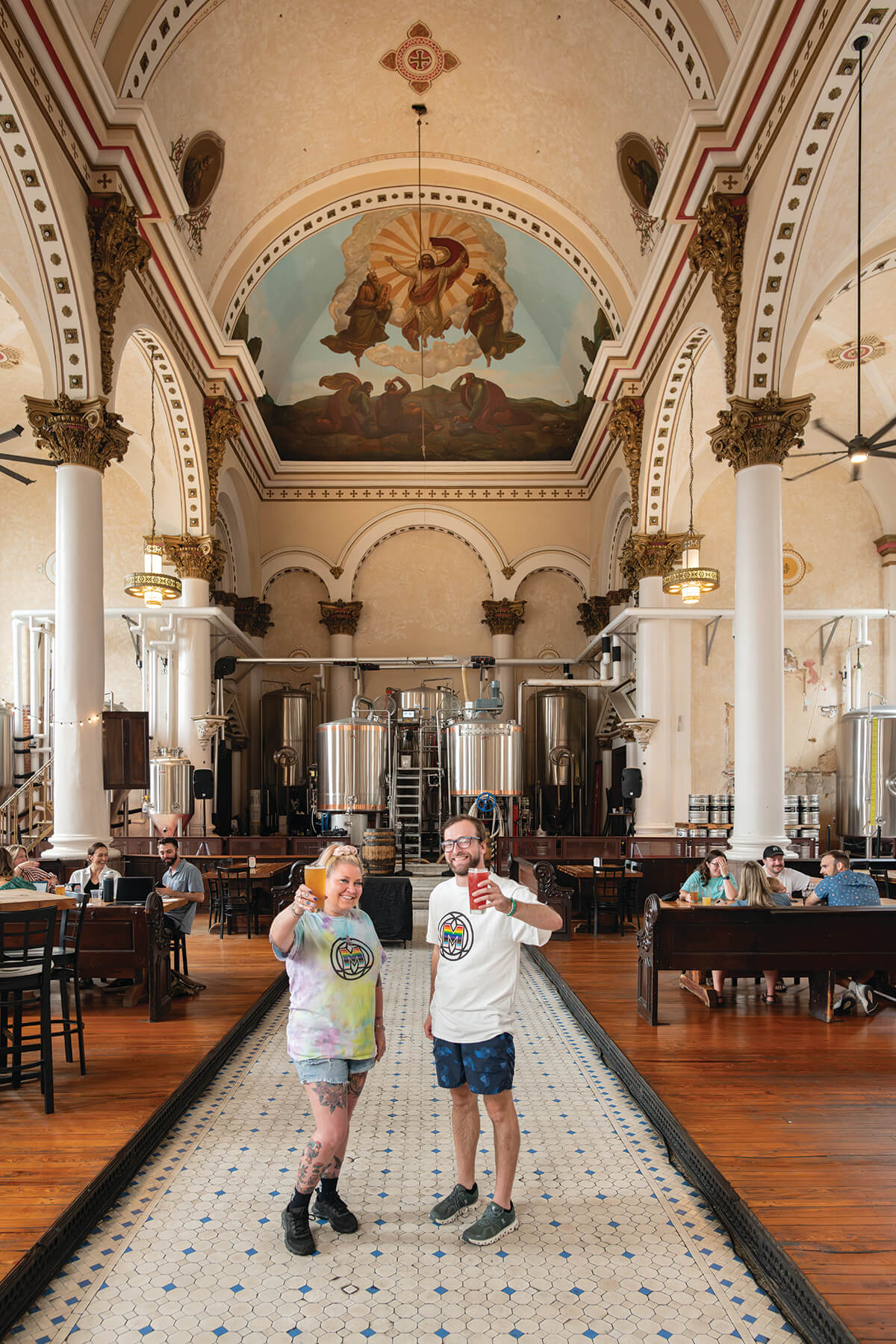
Walk into Ministry of Brewing in Upper Fells Point and you’ll pass by an old wooden confessional, situated just under the towering pipes of an ecclesiastical organ, and into a vaulted, light-driven space where Corinthian columns rise above worn wooden pews. This is no longer a Catholic church, but a desanctified historical building—and a brewery.
So instead of communion, there are flights of craft beers. Specifically, house brews pulled from 32 taps located directly beneath the stations of the cross—the 14-step Christian prayer devotion. And in the risen space where the altar once was, and where generations of priests celebrated Mass, there are now nine massive steel vats for brewing beer, a metal-and-hose-and pipe configuration where, well, another kind of transfiguration once took place.
Ministry is not just a brewery, but a community space. They host book clubs and fairs, Ted Lasso trivia nights, Pilates, tarot clubs, open-mic nights, “Beer & Ballet,” flea markets, and book signings. They also provide a welcoming location for food trucks in the lot behind the building.
It’s one of the leading examples of what Baltimore’s historic churches, many of which have increasingly become vacant or outright abandoned, can transform into, as part of what’s called “adaptive reuse”—with a little creativity, some dedicated people, and, in this case, a lot of hops.
Until 2020, the Ministry of Brewing was St. Michael the Archangel, a Catholic church built in 1857 to serve Baltimore’s German immigrants, that had closed its doors in 2011. After years of declining attendance and the increasing need for expensive repairs, its parishioners were redirected to a church in Highlandtown while St. Michael, then owned by the Redemptorist religious order, looked for a buyer.
Once one of the largest Catholic churches in the country’s oldest diocese, St. Michael had been closed for six years before a group of partners—Jeff Hunt, Mike Powell, Ernst Valery, and David Wendell—bought it in 2017. Wendell and Vallery, friends since college together at Cornell, are now Ministry’s two managing partners. Valery is now a New York property developer, while Wendell is a professor of environmental engineering at the University of Cincinnati. The pair had been looking to buy a church for a few years before St. Michael became available.
“It was sort of like a neighborhood nuisance,” says Valery, who lived down the street from St. Michael when it was vacant. “Your car would absolutely be broken into next to the church.”
Because the Ministry group bought not only the church but the adjacent rectory and school, they were able to divide that space up into apartments (now called the Ministry Lofts) to help make the project more viable. It’s also particularly handy for their head brewer, Dave Macala—his proper title is Minister of Malt and Hops—who now lives conveniently next-door to his tanks.
By the time the brewery came to be, the church had been abandoned for years “and getting worse every day; it was bad,” says Macala, who heard tales of people squatting inside. Fortunately, the barrel ceilings and plasterwork on the central columns were still fairly intact, although most everything below that, including the exterior walls, was badly damaged.
When the Ministry folks bought the building, though, it had been desanctified as a condition of selling. “We’re very careful not to tread on anyone’s religion,” says Macala “We don’t make Jesus puns in the beer names.”
Instead, the pints are called things like Mind the Gap, an English ESB; Old Maude, a brown ale; and 7:54, a West Coast-style IPA named for the time permanently shown on the clock in the clocktower above the building. But, as the brewmaster concedes, pointing above the vats, “At the end of the day, there is a giant picture of Jesus up there.”
“Church is where people come together,” says Valery. “And a brewery is where people come together. It’s not heavy alcohol, so no one’s ever walking out piss-drunk from the place. I think it’s sort of like what church was meant to do. You could just sit there and be in awe of it,” he continues, referencing the vaulted ceilings and restored art. “And then just hang out and have a couple of beers.”
“One thing that we did with the space was preserve something that was nationally historic,” says Wendell, noting that the project took well over a year to accomplish, using state and federal historic tax credits. Having the building listed on the historic register dictated what they could do to repair and rebuild the space.
They had to keep the crosses above the stations of the cross, for example, which they had considered removing to make the place more welcoming for non-Christians. And then there was the relic. “They came from Rome to take the relic back,” says Wendell of the bone that was retrieved from St. Michael. (Relics are actual physical remains or effects of saints, martyrs, or venerated persons that are housed in churches, historically under altars.)
“The building was abandoned and there were people stealing marble out of it. The roof was caving in,” continues Wendell. “One of the things that’s really important to recognize is that we saved this building.”
“We’re all preservationists,” adds Valery, noting that the religious items that they didn’t have to keep were given to a church recycling business. They repurposed as much as they were able: The wood used for the brewpub’s tables, for example, came from both the rectory flooring and the former altar, which had to be removed to make room for the brew system. “We really did try and save everything we could.”
“We could have gone in a ton of different directions…like a bunch of fermenters along the wall,” says Macala. “But ultimately we decided to center everything: It’s impressive to walk in the front door.”
Though none of the three men are particularly religious, Wendell says his parents are, and they have no issues with their son’s project. “I was explaining this to my mom, who invested in this. I just said, ‘Well, you know Jesus turned water into wine; we’re just turning water into beer.’”
It’s also worth noting that not only have churches been closing at a steady rate, but breweries have, too. The Brewer’s Art, the beloved Mt. Vernon brewpub, closed its doors in February after more than three decades in business. And two miles east from Ministry, the Brewer’s Hill neighborhood—once home to so many breweries that it was named for them—is down to only Mobtown Brewing Company.
“‘…JESUS TURNED WATER INTO WINE; WE’RE JUST TURNING WATER INTO BEER.’”
Baltimore has long been home to a remarkable number of churches, many historic, many gorgeous, and many now in poor repair and often vacant. Maryland was founded in part as a place for Catholics to worship freely, but church attendance has declined over the years, so much so that in 2024, the Archdiocese of Baltimore notified area Catholics of its intention to shutter 31 parishes effective that year, with the 61 remaining parishes to be merged into 30 area sites.
“It certainly is not what the church was built for,” Father T. Austin Murphy, pastor of Christ the King Church in Glen Burnie, told the Catholic Review in 2020, on the brewpub’s opening. “And certainly, it’s not what the church had served over the hundred-some-odd years that it was operational. But also, what were they going to do with the building?”
It’s a question many others have tried to answer over the years, often coming up with creative solutions. St. Stanislaus Church in Fells Point became Sanctuary Body, a fitness and bodywork facility, in 2012, twelve years after the Catholic parish permanently closed. St. Elizabeth of Hungary church in Patterson Park, which closed in 2024, merging its congregation with Canton’s St. Casimir church, was recently bought by Patterson Park Public School, which is next door and needing to expand.
Many other churches have been converted into condos or lofts, but those kinds of rebuilds tend to keep the exterior of the buildings intact, but completely modernize and rebuild the interiors, removing most of the ecclesiastical structure, identifying features, and art.
And then there is Mt. Vernon Place United Methodist Church, the sublimely beautiful church across the street from the Washington Monument and the Peabody, which, after a long time in limbo, was finally bought by the neighborhood-based nonprofit UNITE Mt. Vernon.
Built in 1872 with locally-sourced green serpentine stone and designed by Thomas Dixon in the Norman Gothic style of Paris’ Notre-Dame cathedral, the church—unlike most others being sold and reconfigured—is still being used by its parishioners. But it’s also now being used for something more than basement AA meetings and food banks—functions that are essential but don’t tend to keep the lights on.
The Ivy Bookshop has held popular holiday pop-ups in the church, with bookshelves in the pews and lines of books stacked like velvet museum ropes across off-limit staircases.
“I really admire the Ministry of Brewing project,” says Emma Snyder, owner of The Ivy, and also a UNITE board member, “because it’s like a historical preservation project. It preserved the space, but it also retained it as an accessible place that invites in all sorts of community uses.”
“I REALLY ADMIRE MINISTRY OF BREWING…IT’S LIKE A HISTORICAL PRESERVATION PROJECT.”
This is one of the central tenants of what Ministry, Mt. Vernon, and others are trying to do with their versions of adaptive reuse: recreate, albeit in a secular fashion, the community spaces that churches have historically been.
“It speaks to the lineage and the history of what churches were,” says Snyder, “which is like infrastructure for the human spirit, and to the degree congregations have dwindled, it’s meant that we’ve lost these civic spaces at the heart of our neighborhoods that weren’t one thing; they were everything.”
There are still some stained-glass windows at Ministry, in the back, behind the organ pipes, but there are also Ministry and state of Maryland and Orioles flags where there were once liturgical banners. If this all can seem a bit heretical, it’s perhaps worth noting that brewing beer has been a timeworn vocation for monks, the craft often helping to sustain monasteries and produce revenue. And there is still a palpable kind of reverence, if you look for it, in the care of the building, the attention paid to its history, even the lock on the confessional doors.
“People had some strong feelings about it,” says Megan Elcrat, of Present Company, the Baltimore-based architecture firm that did Ministry’s renovation. “Some people were like, you shouldn’t put something in a church.”
Like a brewery. “Think about when beer was basically how people hydrated, and that families would brew their own beer to drink,” says Elcrat, whose firm first learned about the Ministry property when it was deconsecrated. One of the challenges of transitioning St. Michael into a brewery was architectural. But it turns out, a lot of churches get turned into breweries, says Elcrat, and the firm went on road trips to look at them.
“All beautiful, all different, like a real range. But what became evident immediately was that they were all brewing it in a different physical part of the building,” says Elcrat. “Every other brewery was using the basement, parish hall, offsite facility, shed. We had to not only fit the actual brewing into the sanctuary building, but we also had to do it in a way that was historically appropriate.”
And not only historically appropriate, but aesthetically on point—or on tap, if you will. Ministry hosts its neighborhood events (crab food trucks, live music, art classes) nearly every day. And this year, they’ve brought a stall to the Baltimore Farmers Market and Bazaar, the largest farmers market in Maryland, selling beer and offering tastings and conversation.
“We really did want to make a statement about Baltimore, you know, being a nice place,” says Valery. “We wanted to say something positive about the city.”
In other words, he wanted a space that represented the city he sees—which is strikingly different from Baltimore’s national reputation—that has a vibrant arts scene, great neighbors, and an appreciation for beauty. Because there are few things as glorious as lifting a pint of ale made only a few feet away from a carved wooden pew, with St. Paul looking down from above, a long wooden table peopled with neighbors playing cards, folks bringing bags of Trinidadian food down the stairs from a new food truck.
If only the organ worked again.