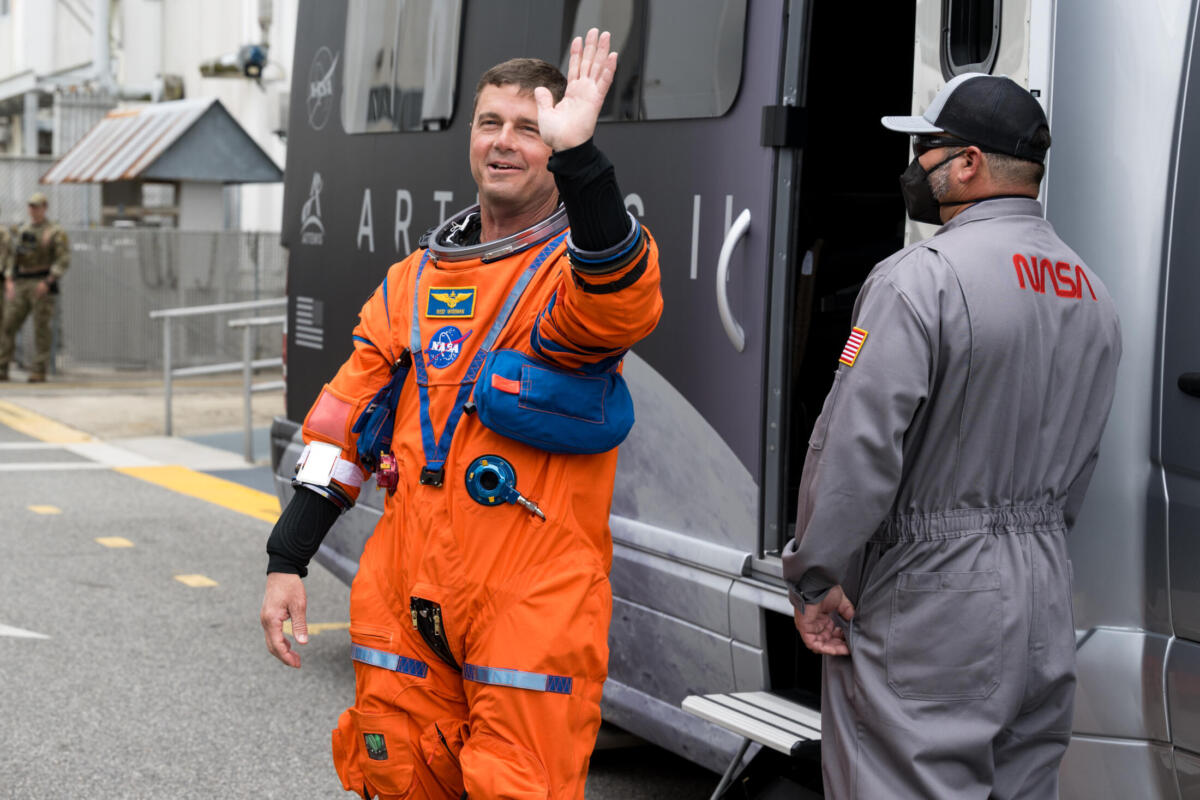
At 11:03 a.m. last Sunday, NASA commander Reid Wiseman popped into his group chat with the Artemis II crew, acknowledging that it had been five months since they flew around the moon together. He said he still couldn’t believe it. Neither could they. “Disbelief.” “It was nuts.” “Can’t believe we did it,” the team responded.
As Wiseman recounts the exchange, he’s back on solid—and more familiar—ground, calling from a hotel off of I-83. “It’s great to be home,” he says. For the 50-year-old, home is Cockeysville’s Springdale neighborhood, where he launched model rockets over the Loch Raven Reservoir as a kid, and where his older brother cut the grass at the homes of Orioles players. As a student at Warren Elementary, Wiseman watched the Challenger disaster on TV, which first made him wonder about space.
After graduating from Dulaney High in Timonium in 1993, his trajectory ran through Navy ROTC at Rensselaer Polytechnic Institute, a commission in the Navy flying fighter jets, and test pilot duty at Naval Air Station Patuxent River starting in 2004. He earned a master’s in systems engineering from Johns Hopkins in 2006. Then he applied to NASA. In 2009, they called.
Wiseman rocketed from Kazakhstan in 2014 and spent 165 days on the International Space Station, where his photos from orbit drew a big following. But he truly gained star status this April, when the world watched as the father of two commanded the first crewed moon mission since 1972, flying farther from Earth than any humans before on a nearly 10-day voyage.
Like any good Baltimorean, Wiseman is also a big Orioles and Ravens fan. This weekend, his hometown teams are set to give him a hero’s welcome: a ceremonial first pitch at Camden Yards on Saturday afternoon and a turn as the first “Leader of The Uprising” in the Ravens’ revamped pregame show on Sunday.
Ahead of the big weekend, we caught up with Wiseman about his love of local sports, what it was like reaching the far side of the moon (including the moment that made so many of us choke up), and the biggest lesson he brought back from a quarter-million miles away. Spoiler: It’s a good one.
A BALTIMORE FAN
What does all of this mean to you, to be recognized in such a big way by your hometown?
I would use the word proud, but it’s not necessarily pride in myself. It’s pride in Baltimore, in Maryland, my hometown—all the people having something to cheer for. And to get to do it at Camden Yards, I have a lot of childhood memories there. Memorial Stadium first, and then Camden Yards. Coming into Baltimore last Sunday, I saw the entire city walking around in purple. It’s going to be phenomenal to be on the field for kickoff at the Ravens home opener. I just can’t believe it.
You mentioned Memorial Stadium. Were you ever a Colts fan, or were you too young?
I knew of the Colts because my dad was a huge Colts fan, and I remember the Mayflower moving trucks. I didn’t understand what was really going on, but I just remember my dad being heartbroken. Memorial Stadium for me is primarily Eddie Murray and Cal Ripken cutting their teeth, welcoming them home as World Series champions in 1983, that sort of thing. I definitely remember sitting in the outfield pounding on the bleachers with my hands. I remember the [21] losses in a row [to start the 1988 season], and then when we redid Opening Day out at Memorial Stadium. I went to that game.
What are some other Ravens and Orioles memories that stand out for you?
When the Ravens came here, my dad and his friends all bought a little Volkswagen minibus and painted it purple. Around the neighborhood everybody was hanging Ravens flags, and we all had the Raven call that we would yell to each other across the street.
After I flew to the space station in 2014, the Ravens played the Texans in Houston [where Wiseman has lived for years, near NASA headquarters] and I met the team. I gave them what was titled a pep talk, and then they lost. So I told Harbaugh, “Never bring me to another game.” But they’re such a great organization. I did a podcast with Ray Lewis once, and he invited me out to lunch. I still haven’t taken him up on that. I got to get on that.
As far as the Orioles go, my brother [Bill] used to mow Cal Ripken’s lawn, and we used to drive by his house. He lived pretty close to us after he moved into his larger house. As a kid, you would just stand at the gates with the cursive R on them and drool, like “God, I’d love to be a baseball legend.” I got a Topps Traded set to get the Cal Ripken rookie card. All that stuff is tied to my childhood.
Wait, your brother cut Cal’s lawn?
Cal Ripken lived in a little complex, Warren Common, that was embedded in Springdale, near where we lived, and that is where my brother says he mowed his lawn. He says he mowed Cal, Eddie Murray, and Scott McGregor’s lawns when he was in high school.
Who’s in town with you? Are your daughters, Katey and Ellie, coming to the games?
They’re at college. There’s no way I was going to get them out of Texas A&M for this weekend. But my brother’s flying in. I’ll have my dad. My girlfriend is coming in. For the Orioles game, last I heard, 150 of my high school acquaintances—I can’t even say friends—have seats in the outfield, so that should be pretty epic.
You famously wore a Chris Davis shirt on the space station back in 2014. Did any local sports apparel or memorabilia make it into the capsule this time?
Artemis II is a very small spacecraft, so only a few little odds and ends made it, but I took no sports paraphernalia. I did take some Maryland flags, but no shirts.
AROUND THE MOON
Looking back on the Artemis II mission, now five months after splashdown, how do you process it all?
It was more impactful than any of us expected. Just the sense of awe and wonder. There’s so much blackness in space, and yet there’s this little tiny Earth that’s smaller than your thumb when you’re a quarter million miles away, and it’s the only thing we know that can support life in this entire system. You get this feeling of yearning to be back there and to be reintegrated as a part of it. It was very overwhelming.
Feeling the wind on my face back on Earth was…a beautiful thing. Watching a tulip come up out of the ground in New York City stopped me in my tracks. And then getting to see your family. When we came around the far side of the moon, the thing that was most on my mind was, “I hope I get to see my kids again.” When we got back—I saw it in all the crew members—it was just a total euphoria, and it lasted for a few weeks. There was just nothing that I could be upset about. I think we still carry a lot of that with us. We know what it’s like to have been completely extricated from the planet.
Somebody just sent me an article about how “crisis is the ultimate editor.” When people are on a plane and they’re scared, they never text their loved one, “I hate you.” They only text, “I love you.” When you’re completely removed from the planet, the only thing that fills your body is joy, hope, peace, love. It’s the only thing. The Apollo astronauts said the same sorts of things. We just had so much hope for humanity. There was no other emotion out there at all. No frustration, no anger.
How do you describe what the launch and the sensations of being in space felt like?
This rocket was 8.8 million pounds of fuel and metal. We expected it to really vibrate, a lot of shaking, a lot of lateral oscillations. But in the end, the launch was just powerful and smooth. You’re under about three times Earth’s gravity at about two minutes into the flight, so you have a really good sense of being pushed back in your seat. You’re also upside down and you’re accelerating down range, so your head is down towards the Earth, your feet are up towards space. And when the solid rocket motors came off, that relaxed our G-force down to about a half a G, and I actually felt like I was almost hanging upside down on a jungle gym, but we were still accelerating into space.
When we got above the atmosphere, you could see the curvature of the Earth and the black of space. A few moments later, the moon rose completely unexpectedly, and we were pointed straight at it. It was unreal. It’s only a nine-minute ride into space, and I just did not expect to see the moonrise, and neither did my pilot Victor Glover. We were just like, “You got to be kidding me.”
When you went around the far side of the moon, you lost contact with Earth, as expected, for about 40 minutes. Were the emotions in those moments what you anticipated?
Everyone on Earth wants that to be a dramatic moment. But for the crew, that is the period when we were closest to the moon, so that is when our science objectives were at their absolute peak. Just like watching a sunset on a beach, it’s really hard to take your eyes away from watching the Earth set behind the moon. It was beautiful.
When the Earth was fully set behind the moon, we broke into some maple cookies [supplied by Canadian crewmember Jeremy Hansen], honored the moment for a second, and then Victor and Christina [Koch] went right back into science. We knew that Mission Control couldn’t call us, so we were keeping a close eye on the status of the vehicle, but honestly, it was very peaceful.
One of the most talked-about moments of the entire mission was when the crew proposed naming a crater after your late wife, Carroll, who passed away from cancer in 2020. Did you know that was coming?
It was Christina’s idea, and Jeremy and I had talked about it a few days prior to launch. When he proposed it to me, I said, “That is an extremely noble idea, and I am all for that. I just can’t make the speech.”
Jeremy’s speech was so well done. He and my late wife were so close. Jeremy and his wife, Catherine, hung out with me and Carroll all the time. When he started spelling out her name—I’m getting goosebumps right now—that was the moment that defined that whole event for me. For the crew, it brought us together in a truly emotional way for the first time. We had been very kind to each other. We’d been giving each other a ton of grace, but this was the first time we were emotionally bonded on the mission.
And it really connected with people on Earth. I do want people to know life goes on. Life is for the living. My life is about honoring my loved ones, honoring the past, honoring everybody that I see on a daily basis, just trying to be a good person. There is grieving, then there’s moving on, and then there’s living.
That was an enormous human moment to watch. My son is also named Reid. While we were watching the Artemis coverage I told him, “There’s a guy named Reid from Baltimore going around the moon.” What do you hope that kids growing up in Baltimore, or anywhere, take away from what you guys accomplished?
For the youth right now, stay curious about the world around you, and if you live in Maryland, you’re in a great place to be curious. You can do anything you want in Maryland. You can go hiking in beautiful hills. You can watch the leaves change. You can go to the Chesapeake Bay. You can go fishing. You can go down the beach. You can bodyboard or surf some waves. This is a pretty special place, and as a kid, sometimes you lose sight of that because you just haven’t seen the world yet.
The other thing I would say to kids right now is, don’t be afraid to fail. Everybody right now wants to find success quickly and easily. That’s just not reality. If you want to be successful, it takes a lot of hard work. My crew was successful, but we weren’t lucky. This mission was successful because NASA put in a lot of hard work with our international community.
COMING BACK DOWN TO EARTH
We have so many things happening down here on Earth that can stress us out. How did you manage anxiety when you were heading to the moon?
There’s two ways I want to answer this. First, there’s the visible anxiety. I still sometimes get anxious on a commercial airliner flying from Baltimore back to Houston. I don’t love that of loss of control. We do a lot of outdoor training where we’re hiking for 10 days without any food and we’re just trying to live off the land. We do a lot of scuba diving. We’re always out doing things. When you do that, you start to get a little more accustomed to that level of stress. As an astronaut, we call it “stress inoculation.” You get over anxiety by doing things, by putting yourself in uncomfortable positions and understanding, “I just went this far. I can go a little farther.”
The other side of that is, as a human, the way that I got to this state of peace while on the mission was I tried to close every open question mark in my brain, at every level. I talked to all of my friends, told them what they meant to me. Everyone in my life knew where they stood. It was like a living wake. My kids knew exactly who their caretakers would be if I didn’t come back. They knew where the trust documents were. It’s not a comfortable thing to talk about, but it is required. And we did all of that.
And the four of us also talked as a crew, “Hey, how are we going to handle it if we know we’re going to die, but we have a couple of days before the event is actually going to happen?” Like if there’s a failure, and we know the parachutes aren’t going to open, and it’s going to be a horrible ending. We talked through all of that, and we decided we would just try to handle it with dignity and give each other grace because we don’t know how we’re going to respond in that moment. But closing all those unknowns in our minds allowed us to launch ready for, and be at peace with, truly any outcome.
That’s so very powerful.
That’s the message that I’ll carry forward from this mission, what I most learned from it.
What’s next for you? Will you go back to the moon? Mars?
I wrestled with this a lot. And it’s the question of, “What is one more thing?” If I’m doing it, I’m taking it from someone else. At 50 years old, I’ve flown in the Navy, I’ve been around the world many times, and I flew two missions, one to the space station and one to the moon. I’m very content right now. It’s not an easy job. It’s not easy on family. It’s not easy on the human body. So I’m good right now. I want to watch other people go do this, and I’ll be rooting them on. I don’t expect to fly in space again.
Is there anything you want people in Baltimore to know that we haven’t talked about?
I would ask everybody to just think through their lives. Some people are going to be happy, some are going to be sad, some are going to be having tough days, and some are going to be having good days. But in all of that, everyone should think of one thing here, in this town, that they’re savoring right now.
It could be the fall weather, it could be sports teams, it could be their family, or just the fact that they have a place to go walk around. I don’t know. But you can pull one thing out every day that you’re savoring, and if you just do that, it makes your life a lot happier. There’s always something to savor.