Food & Drink
These Baltimore Restaurants Went Viral. Was it a Blessing or a Curse?
While a social media blow-up might feel like a dream come true, sudden fame can be something of a double-edged sword.
Even before the crab dip bagel made its way onto the lineup at Café Dear Leon, the Canton bakery had legions of fans who needed no extra encouragement. Since its opening in the summer of 2020, the micro-sized Canton cafe has consistently drawn a line along O’Donnell Street, with customers willing to wait for its Japanese-style tamago egg sandwiches, marvelous muffins, pain au chocolat, and various Japanese-Korean-French fusion pastries.
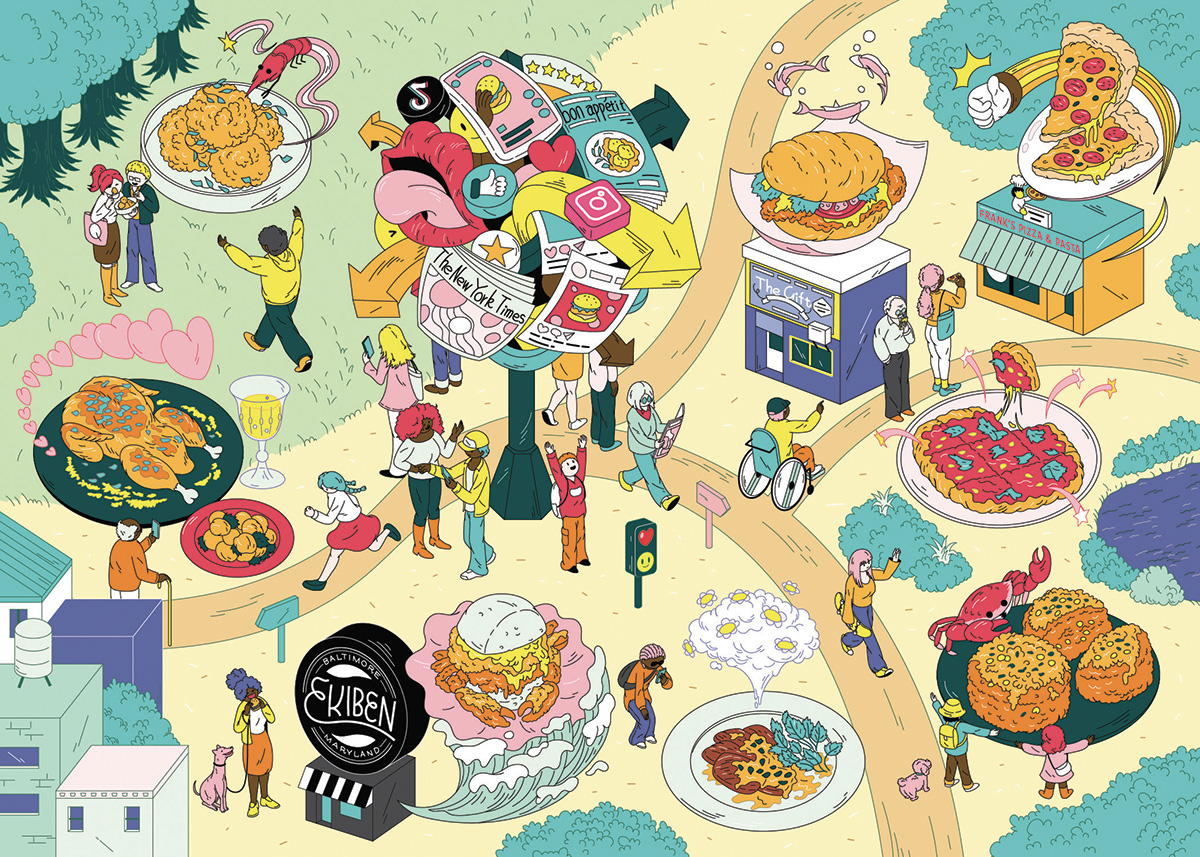
But thanks to local food influencer Giovanna Poscé, who made a video praising the bagel’s “creamy crabby goodness” and named it one of the best things she’s eaten in Baltimore, the item—stuffed with crab dip mixed with sweet corn, Cajun butter, and Old Bay went viral and has since been featured in Bon Appétit and People.
It’s also tipped the bakery’s scales from popular to off the charts. To date, Poscé’s post on Feb. 1, 2025, has garnered more than 52 million views, solidifying it as a must-eat item in Charm City.
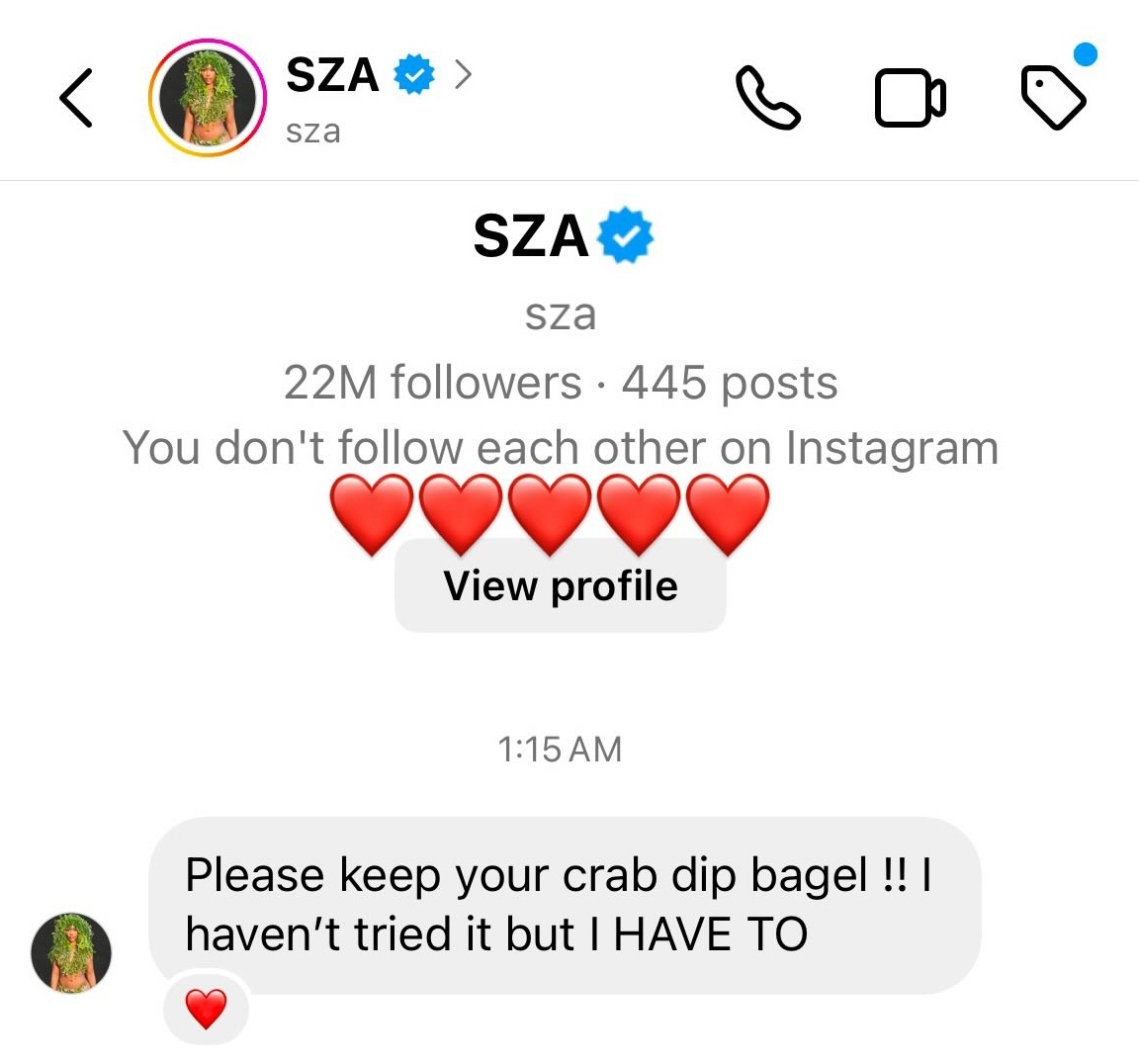
It’s even on the radar of superstar artist SZA, who DMed the bakery to ask them to keep the bagel on the ever-changing monthly menu until the next time she’s in town.
Poscé says she never meant to create a social media storm—she was simply sharing her love of food.
“I have fun eating and I have even more fun sharing my feedback on food, so I’m always tickled when anyone is listening,” she says. “Whether it’s one person or a million people, I am still surprised when anyone goes out of their way to try a spot just because I said so.”
In an age of social media, food influencers chasing the next viral post—and users perpetually hungry for food content—can propel an unsuspecting eatery to overnight fame. Charm City boasts countless examples of items that have become phenoms thanks to exposure from Instagram videos, TikTok reels, and national press.
There’s Frank’s Pizza & Pasta in Hamilton, which got a major bump in business when Barstool reviewer Dave Portnoy stopped by for a cheese pie. There’s the double-fried haddock fish sandwiches at the small, family-run restaurant The Gift in Northeast Baltimore, which went viral thanks to a TikTok video. And the shrimp and corn patties—named by The New York Times as one of the “Best Dishes Across the United States”—at Hampden’s The Duchess, which led to an uptick in sales.
Ironically, the crab dip bagel was created as a one-off specialty item and was never meant to be part of the regular rotation of offerings. Dear Leon co-owner Min Kim was getting ready to take the bagel off the menu permanently when lightning struck.
“It was our manager’s birthday and they asked us to make crab pretzels,” says Kim, explaining the bagel’s origin story. “We don’t make pretzels, so we put the crab dip on top of our new bagels and combined the idea with this cheese garlic bread they make in Korean bakeries—all of these things met in a perfect place and became the crap dip bagel.”
While a viral moment might feel like a dream come true, sudden fame can be something of a double-edged sword. At Dear Leon, the lines ballooned from 20 minutes to a whopping hour and a half after the video blew up on social media.
“Some people were getting in line without even knowing what it was for,” says Kim, laughing. “When Saturday Night Live came out with their song, ‘Big Dumb Line,’ it felt very personal. It was very challenging—we have limited baked goods, and we follow a baking schedule to keep everything as fresh as possible, so once we’re out of an item, we can’t make more.”
Even so, says Kim, the need was so pressing that he and his staff decided to meet demand. “At the end of the day, we are in a hospitality business,” says Kim. “Everyone, including our chefs and front-of-the-house managers, understood—we wanted to deliver to our guests what they want. If there’s a clear need for our guests, we’re going to do everything in our power without sacrificing quality, so that’s what we did.”
“SOME PEOPLE WERE GETTING IN LINE WITHOUT EVEN KNOWING WHAT IT WAS FOR.”
To ramp up production from some 100 to 1,000 bagels a week meant more work for the entire staff. “All the chefs spent extra hours and extra days to up the production,” says Kim. “And all the front-of-the-house staff went above and beyond to communicate when the bagels would be available. We have them at 6 a.m. now because the line for them would start even before that.”
In fact, the crab dip bagel was largely the catalyst for the bakery’s expansion to Remington with sister spot La Maison. (Call it the House that Bagels Built.) And while it’s hard to say for sure, the bagel might even have had something to do with their recent James Beard nomination for Outstanding Bakery, which helped get the sweets shop, and hence James Beard judges, national attention.
“We always talked about growing and expanding,” says Kim, “but that has really accelerated the process, because we needed a bigger team to produce all the crab dip bagels. We had to hire more people and more chefs to work at our tiny Canton location.”
Going viral on social media is a different experience than getting national press, notes Ekiben co-owner Steve Chu, whose Asian-fusion restaurant has had more than its share of both.
When Ekiben opened a decade ago in Fells Point, the speck of a spot, which got its start as a hot dog cart, soon became a bold-face name in Travel & Leisure, Food & Wine, and Bon Appétit through word of mouth. “The press attention always gives you a small boost in business but it’s your job to keep it up and maintain,” says Chu.
But going viral is a whole different story, says Chu, whose own recent crabby creation for his Locust Point location, the Maryland Softie sandwich—an Old Bay-dusted soft-shell crab on a bao bun topped with a crab cake, melted cheddar, and remoulade—had almost 10 million views across social media.
“With magazines and newspapers, there’s a paywall, but with social media it just shows up in your feed—whether you asked for it or not,” he says. “There’s no paywall—everyone has access. It’s a million times more in your face.”
Little Donna’s owner-chef Robbie Tutlewski has also experienced what 15 minutes of fame feels like, especially for such a small operation. When The New York Times reached out to speak with him about his Fells Point restaurant in 2023, “I thought it was something bad like, ‘the worst of,’” he says now, laughing at the memory. “That’s just my personality. I always think something bad is going to happen.”
Of course, it was exactly the opposite. Only a year or so after opening, Tutlewski soon learned that the restaurant had landed on the list as one of America’s 50 Best Restaurants in 2023; the following year, it was named one of the best pizza places in the country. The unassuming chef wasn’t seeking the limelight. “We didn’t want it but we needed it,” says Tutlewski.
As much as sudden celebrity can boost a business, it can also come with its own pressures and challenges, says Martha Lucius, a veteran restaurant consultant and former owner of Chesapeake Bagel Bakery and Boheme Cafe.
“As a restaurant owner, you theoretically wish for this, right? But you only have a capacity for a certain number of staff members and you can’t go beyond that size because you literally only have seven days a week and so many seats. You’re going to have to turn people away. The key is to make your place strong and good in that moment.”
That’s exactly what Tutlewski did when the first New York Times list came out. “I was like, ‘We have to do a really good job—if we work harder the next six months, it will help us in the future,’” he recalls saying at the time. “It forced me to ask myself if I wanted to expand the menu or keep it as it was. I was also like, ‘We can’t run out of pierogies.’”
When the second list came out, the pizza oven broke the day before the article was published. “People were calling to order all these pizzas and we couldn’t even serve pizza,” says Tutlewski. (The restaurant contacted patrons via email and phone calls to avoid disappointment, likely impressing them even more.)
The Wren owners Will Mester and Millie Powell had a particularly banner week last fall when they were named one of America’s Best Restaurants of 2025 by both The New York Times and Bon Appétit, all within days. After that, they were understandably inundated. It was somewhat of a mixed blessing given that the tiny Irish pub in Fells Point has some 20 barstools and just a few tables in a back dining room. Still, the couple is more than grateful for all the attention.
“If those pieces didn’t come out, we just wouldn’t have made it,” admits Mester looking back, especially since the food he serves is somewhat idiosyncratic. “It’s not for everyone,” he says of his elevated pub fare such as ox tongue, blood cake, or a whole roast pigeon. “But when The New York Times decides that it’s for everybody, suddenly it is. And people just get comfortable, because they walk in and the place is pretty busy and that gives them confidence and curiosity beyond having to navigate it entirely on their own.”
Business is now booming, necessitating the need for Mester and Powell to work longer hours. They’ve also had to pivot from their initial mission of having a humble pub that emphasized drinks over food. “We’re no longer stressing that we’re going to have to shut the door,” says Mester, so he’s not complaining. “But we had hoped that we could be a little bit more of a bar and that it wouldn’t be so food-centric.”
Having to switch gears is not uncommon, says Lucius, and finding your identity as a restaurant takes time.
“You don’t know your own brand for a while,” she says. “You think you do—you craft it a certain way, but then those sneaky customers come in and they make you realize it in a slightly different way than you thought it would be.”
Hospitality experts emphasize that getting unexpected press or going viral is not something you can plan for—and it should never be a business plan, says veteran consultant Dave Seel of Blue Fork Marketing.
“People latch onto something and get excited about it—and it goes gangbusters,” says Seel. “But you can’t be shooting for that. You’re not going to sustain your business with a viral hit. You have to be a well-rounded, all-encompassing business that has more than just one viral thing.”
“PEOPLE LATCH ONTO SOMETHING AND GET EXCITED ABOUT IT—AND IT GOES GANGBUSTERS.”
When Rooted Rotisserie’s chicken went viral, it was, in part, because owners Joe and Amanda Burton invited influencer Keith Lee to visit their restaurant in historic Hollins Market.
“I had heard about him through friends and started following him on TikTok,” says Amanda. “His account aligned with the same values that our business aligned with, as far as faith, family, community, and hospitality. He seemed like a genuine connector, and it felt like he really wanted to give exposure to the businesses he visited.”
At the time, Amanda knew that Lee was visiting the D.C. area, which increased the likelihood that he just might stop by. She was also aware that a visit from Lee, which almost always leads to increased exposure, often came with a be-careful-what-you-wish-for caveat:
“He tells people, ‘You have to know what you’re getting into when you ask me to come,’” says Amanda.
Before reaching out, she made sure that her husband, Joe, who is the restaurant’s chef, was ready for the inevitable onslaught of customers who would follow. “Joe, who is a go-by-faith kind of guy, said, ‘Yes, tell him to come,’” recalls Amanda.
So, Amanda reached out to Lee to plead her case. “I said, ‘We’re a small business. We’re not backed by some venture capital. We’re not some big restaurant group—we’re completely independent. Those types of businesses are the types of businesses that deserve exposure.’”
Her pitch worked. Lee did, in fact, drop by unannounced, calling the restaurant “one of my favorite restaurants I’ve visited in a while,” in his review. He was so impressed, he left a $4,000 tip and paid for the other customers.
“He dropped his review on a day we were closed, which we were so grateful for because we watched the reservations pop up in real time—they were going up and up and up,” says Amanda. “That gave us some time to prepare for what he already said was going to happen.”
Sure enough, on the week the review was posted, the restaurant ran out of chicken two hours before closing and there were lines down the block with orders to-go, forcing them to temporarily stop doing to-go orders. “And we went from seven to 10 reservations to 25 reservations, which is pushing 75 to 80 covers a night.”
Now that business has leveled out after several months, the restaurant has started doing to-go orders again. For his part, Joe feels the exposure worked in their favor. “It was a lot of pressure to keep up with the hype, but my motto is, ‘If you stay ready, you don’t have to get ready.’”
Before Lee’s visit, Joe made some eight to 10 rotisserie chickens a night. “But after Keith Lee came, we had to reload our rotisserie, maybe two or three times a night, about 30 chickens, to keep up with the rush. I was really happy to receive this new influx in business because it meant product wasn’t sitting around—the faster I can move the product, the fresher the product is in the end.”
And while their business has increased, the important things have stayed the same.
“We’ve stayed true to who we put ourselves out to be when we originally opened,” says Joe, though Amanda admits that sudden success has also had its downside. “There’s this expectation from some customers that it’s going to be the food of their dreams,” she says, “but we are one restaurant that makes one type of food. It’s not going to satisfy everyone.”
While gaining surprise positive press or social media virality can be a mixed bag—both thrilling and stressful—those we interviewed say it’s worth it.
“The food and beverage world is full of rocky seas,” says Dave Seel. “You just try to set yourself up in the best way possible and rely on your skills and your community. Be grateful for those highs because the lows are definitely going to come.”