Food & Drink

IT’S LABOR DAY LAST SEPTEMBER, but that’s of no concern to Drew Baker, who’s been up since before the sun. The cool nights of autumn have started slipping in, and with only a few more weeks of warm weather in Maryland, that means it’s finally go time at Burnt Hill Farm. By 7 a.m., he’s out the door and off to work, soon standing wide-eyed before a rolling expanse of ripening grapevines, now ready to be picked.
As light breaks over the horizon, his six-man crew is setting the morning in motion. They dart about the vineyard, dropping stacks of yellow crates at the bottom of thousand-foot rows, each to be filled with inky fruit before lunchtime—about four tons in total.
“That’s my back-of-the-napkin math,” says Drew, his hands tucked into his Patagonia pockets, as the current 50 degrees feels downright cold after the dog days of August. He looks around approvingly. “We’ve got a lot to pick.”
By all measures, at Burnt Hill, it’s been an extraordinary year. Not every season is great for growing, which the 38-year-old has learned the hard way on his two farms. First, at Old Westminster Winery in Carroll County, where he broke ground with his sisters Lisa Hinton and Ashli Johnson in 2011. And now with this promising plot 25 miles south in Montgomery County, sitting on a high stretch of Appalachian foothills halfway between Baltimore and Washington, D.C. He knows that sometimes in the Mid-Atlantic, a late spring frost will stunt an entire crop before it’s even had the chance to get started. And that often, our wet summers make a hotbed for pests and disease. And of course, come autumn, hurricanes can wreak havoc on harvest.
So far, so good, though, on this almost-fall day in Clarksburg. A few May rains tapered into months of sunshine, helping his fruit reach its full potential. And now once again, there are blue skies, meaning they can take their time with this acre of Cabernet Dorsa, a European hybrid perfectly suited for growing here.
“A big honking cluster,” says Drew with a chuckle, using a pair of heavy-duty clippers to pick a cartoonishly plump bunch of grapes, casually dropping it into the crate at his feet with a thud. “The only rule is don’t cut your fingers.”
Which is good advice, even for him, given all the excitement. He’s been chomping at the bit for weeks now, ripping up and down the grassy rows on his mini dirt bike, scouting the vines for their potential first picks. Each plant reveals a series of clues, which he rattles off with encyclopedic detail.
For starters, there’s color, when the grapes begin changing from green to gold or purple. Then, there’s the trunk, which a swift kick, as Drew demonstrates, should knock a few berries loose. A woody stem means you’re almost there, as does a slight shrivel to the fruit’s skin—less water, more flavor, on its way to wine.
“And then we can taste,” says Drew, popping a marble-sized grape into his mouth. “Nice and sweet, the acidity’s dropping.” He crushes another between his thumb and forefinger, noting the maroon juices, nearly staining his skin. The small dark seeds that speckle the flesh are another indicator. But if they’re still green, like the Cabernet Franc a block over, “they’ve got another month to go.”
Within the hour, his son, Jeffrey, has arrived—the first of three Baker children out of bed that morning. The 5-year-old wandered up the hill from their farmhouse to find his dad, who tenderly peppers him with “dudes” and “bros.” Before long, they’re squeezed into an orange Kubota together, tearing down the dirt lane, then whipping onto the county road, off to check out the other hundred-some acres of this dream property, more than a decade in the making.
In that time, the Old Westminster siblings have become the cool kids of Maryland wine, not to mention one of the most buzzed about winemakers on the East Coast. This next chapter at Burnt Hill is bound to only amplify that enthusiasm. They’ve envisioned this land as a sanctuary of sorts, something much more than just a winery, something that “outlives me,” says Drew. Which is especially poignant, given not that long ago, no one was sure he’d be alive to see it.
“Not a day goes by that I don’t walk around and look at all of this and think to myself, wow, I’m so grateful, I’m so blessed,” says Drew. “Sometimes it’s a bit overwhelming—to think about how we got here. There were months and months when nobody was betting on me. Including myself.”
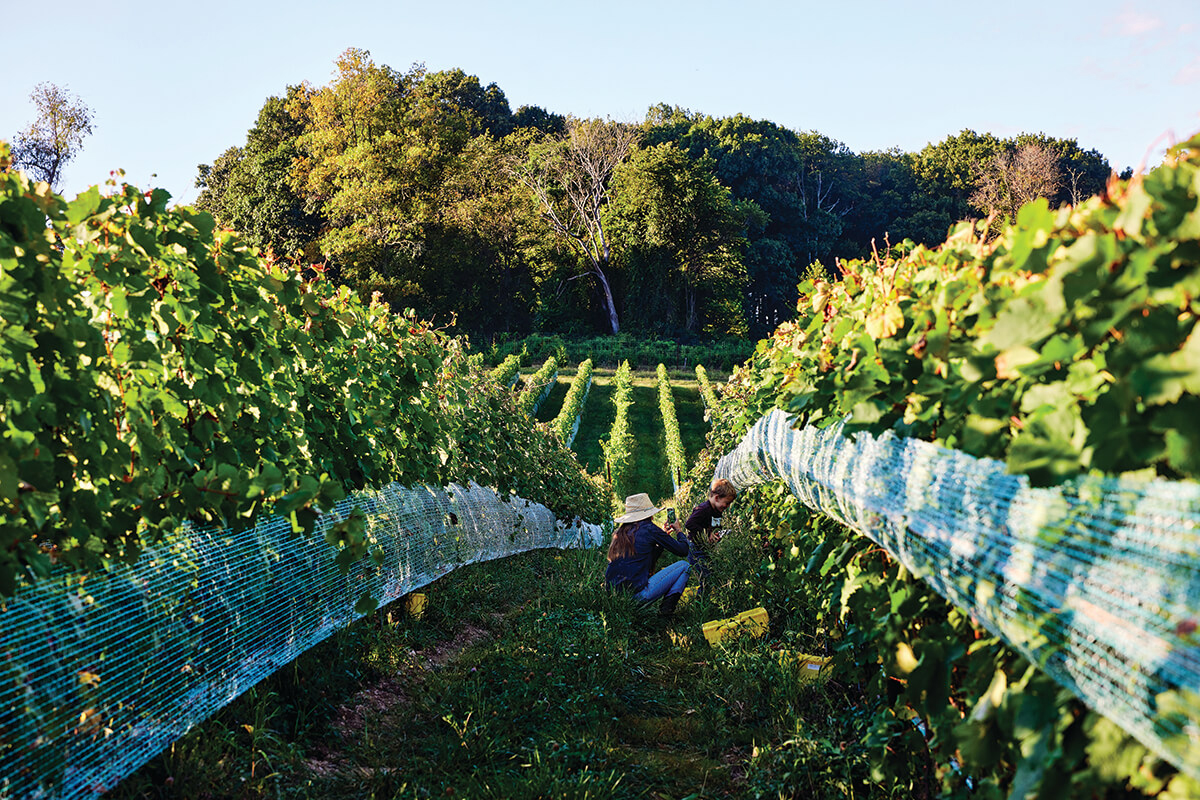
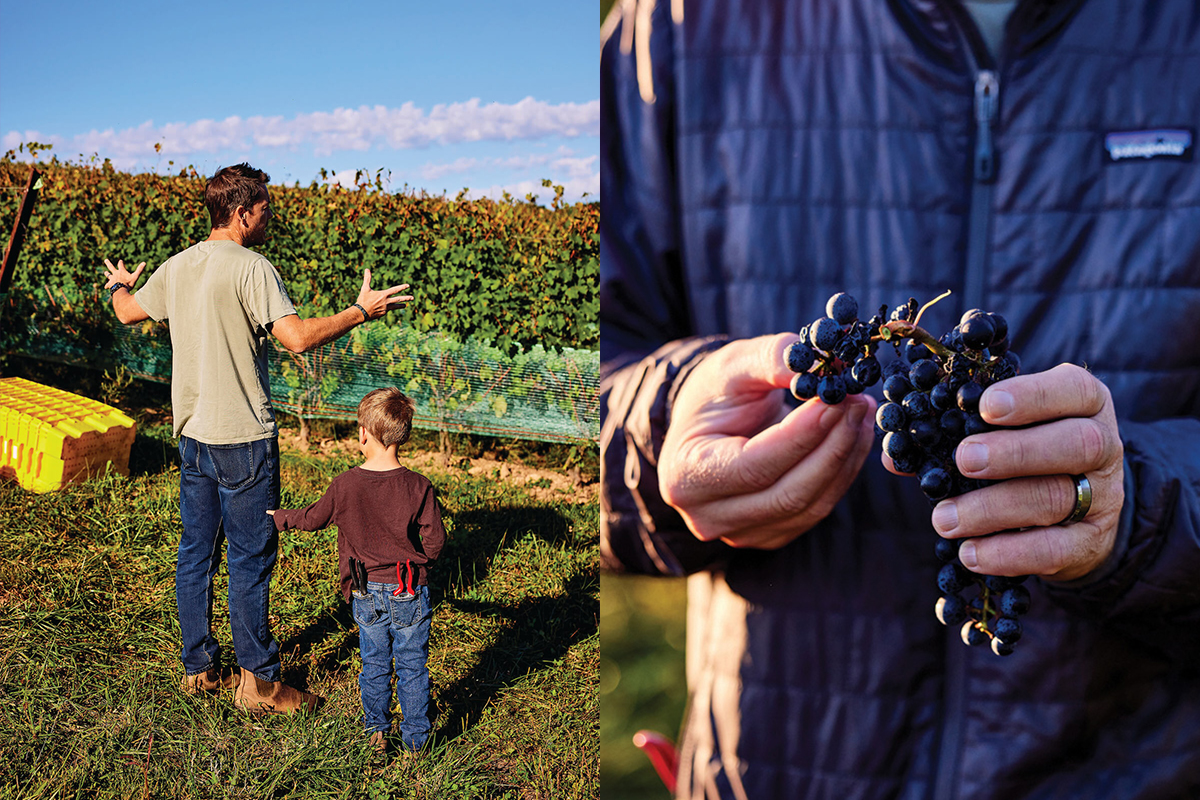
ABOVE: CLOCKWISE, HARVEST TIME AT
BURNT HILL; RIPE
GRAPES; DREW AND
HIS SON JEFFREY
SURVEY THE LAND.

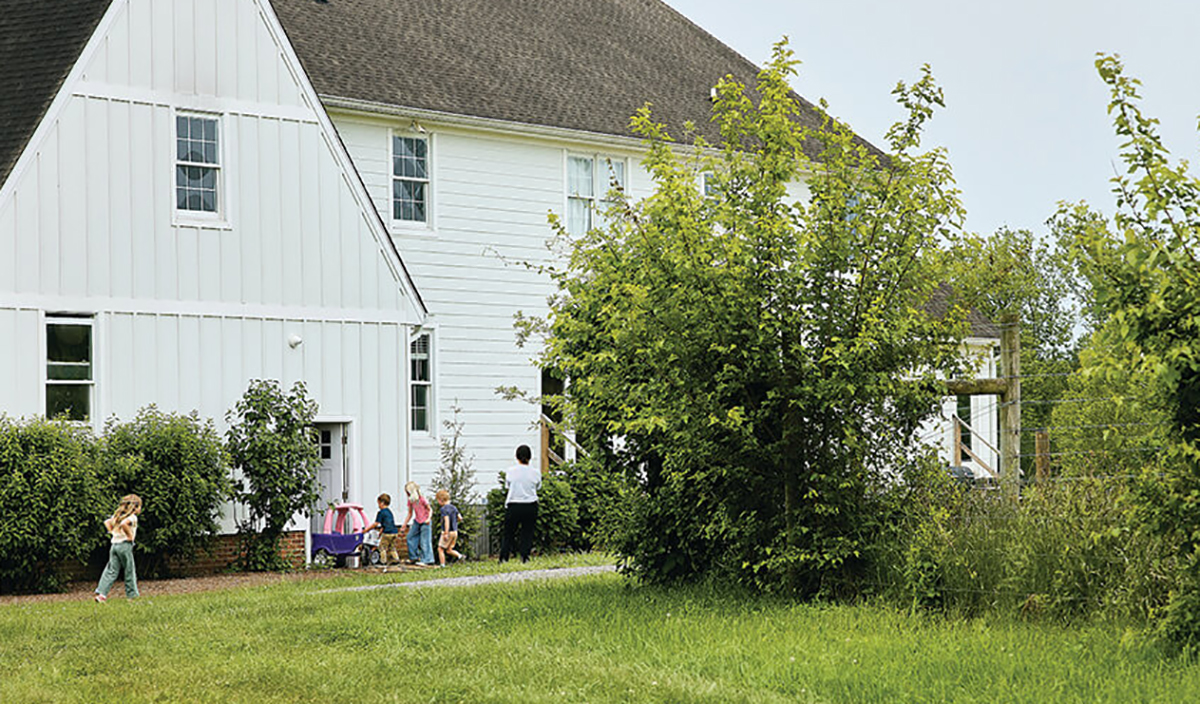
few months earlier, the family gathered up the road at Old Westminster. Jeffrey was once again in tow, along with his siblings and cousins—a pack of nine sandy-haired children all under age seven, who ran about the industrial winery as if they owned the place. They romped through the grass. They climbed up the forklift. They carried teetering towers of cardboard boxes to their very pregnant aunt Lisa.
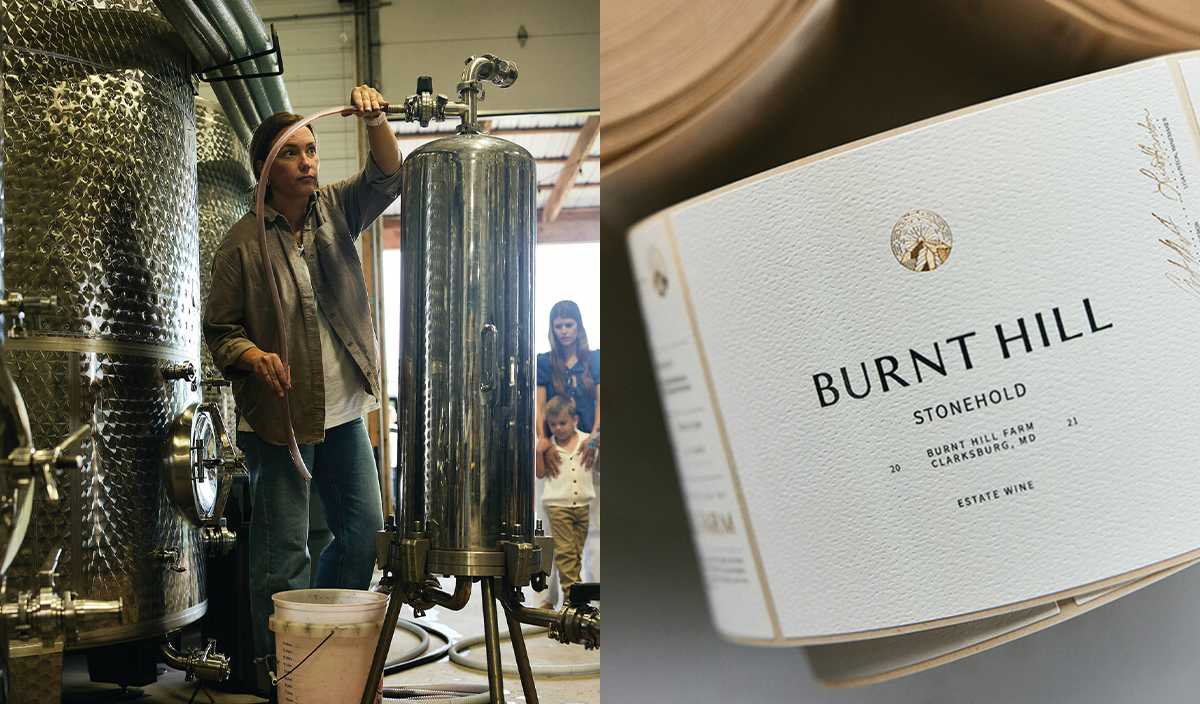
“I just kept praying that I wouldn’t go into labor before this,” said the 36-year-old middle sibling, dragging thick hoses between ceiling-high fermentation tanks and the rented bottling rig that was parked outside.
While Drew handles farming and Ashli oversees operations, Lisa is the one who actually makes the wine. That late May afternoon, she moved with an intense focus to bottle some 600 cases. There were blends, with names like Dreamscape and Earthsong, as well as single- barrel selections, highlighting a specific grape, like Cabernet or Merlot. She’d been watching those wines for years, making a thousand deliberate decisions to help draw out their singular magic.
It’s an alchemy—or really, an art form, learning to capture that transformation at just the right moment. There are always extensive notes and myriad tests. But Lisa paid extra close attention to this batch—Burnt Hill’s very first vintage, hence the entourage. Her main goal each time, she says with a nervous smile: “Just don’t screw it up.”
In all honesty, Lisa’s a total pro by now, having made more than a million bottles of wine since turning 21 years old. But all this started before that, when the siblings were still in college, then pursuing what turned out to be serendipitous degrees. Business for Drew. Marketing for Ashli. Chemistry for Lisa. In 2008, the financial collapse put their dad, Jay—a carpenter—out of work, forcing the family to either sell their home, aka this 17-acre former plant nursery, or find a way to save it. After reading about the rise of regional wine, their mom, Virginia—a nurse—threw out the idea of growing grapes. After much deliberation, it was “if you’re in, I’m in,” says Ashli, at the time only a sophomore.
And all in they were. The Baker parents lent their life savings to launch the winery, while the kids juggled classes and exams with planning and permits. In 2011, they hand-planted 10,000 vines, built a simple pole barn, and in it, soon enough, with the help of fruit from other Maryland vineyards, started making wine. Within two years, they sold their first bottle. “And it was like, okay, this is actually pretty good,” says Drew.
The Mid-Atlantic is no Napa Valley, long struggling to become a bona fide wine region. Here, a few vineyards strive for serious recognition, while even more sling sweet sips for a good-time crowd. From the beginning, the Baker siblings set out to change that, initially inspired by those successful West Coast styles, winning them the Governor’s Cup for best white wine in 2014. But that winter, on his honeymoon in France’s Loire Valley, Drew discovered an age-old practice—and soon-to-be buzzword—that would upend their entire approach.
Natural winemaking has a simple philosophy: less is more, work with the land, let the wines do their thing. For instance, instead of buying lab-cultured yeast, grapes ferment with the native spores that naturally grow right in their vineyard. And sometimes, as with pétillant naturels, the juice turns into wine right in the bottle, imparting a rustic effervescence unlike anything Drew had ever tasted.
“You maintain your own sense of place,” he remembers realizing. So from then on, they’d lean into their own Maryland terroir—the French concept for a region’s unique character, based on its soil, geography, and climate. Their wines might no longer be as precise or predictable. But they’d also be one-of-a-kind.
In short order, Old Westminster shifted gears: cranking out their own pét-nats, opening a tasting room, expanding production, finally able to pay themselves. National press applauded their efforts. Phone calls poured in from their bicoastal distributors. They threw it all at the wall, like experimenting with canned wines, and navigated the accompanying curveballs, like when those started exploding on store shelves—still making them shake their heads today. But back then, it all only encouraged them.
ABOVE: CLOCKWISE, SCENES FROM
OLD WESTMINSTER WINERY:
THEIR CHILDHOOD HOME;
LABELS; LISA AT WORK.
Burnt Hill would be an even grander vision—for growing next-level wines, and reds in particular, which happen to be a unique challenge in these parts. In 2016, the siblings purchased the second property. Slowly, they started preparing the land. Drew moved in. His kids were born. But a year after their first harvest, before those wines could be finished, that high-spirited, ever-hustling young father suddenly got sick.
“Everything happened so fast,” recalls Ashli. “Nothing can prepare you.”
In 2022, Drew was diagnosed with acute myeloid leukemia. By the end of the following year, he’d spend 450 days at The Johns Hopkins Hospital. It was a painful slog: rounds of intensive chemotherapy, full-body radiation, brand-new drugs, endless tests. One brain surgery. Two bone-marrow transplants—first from Ashli, then from Lisa. Prayers, more than anything.
“There were a lot of conversations about what we should do if he doesn’t make it,” says Casey, Drew’s wife and longtime sweetheart.
After all, the odds weren’t good. It’s a rare, fast, complex cancer, accounting for about one percent of all new cases in the U.S., with the five-year relative survival rate around 30 percent. And due to a genetic mutation, Drew’s had spread into his central nervous system, further complicating treatment. In other words, “shit luck,” as his doctor put it.
While he was stuck at Hopkins, his family kept moving, juggling fighting this disease with running the business, often providing candid updates to their community on social media. And all the while, the vines kept growing, and those first Burnt Hill wines sat in the cellar, waiting. “It doesn’t always work out, you know?” Drew says today.
He is now in his second year of remission.
Which is why last spring’s bottling was so special—and nerve-racking. Outside that day in Old Westminster, lush lime-green vines climbed to the top of their trellises, marking the start of a new season. Inside the winery, after nearly four years in casks made from Clarksburg ash trees, the first taste of Burnt Hill was finally heading out into the world.
“These wines are very precious,” said Lisa.
“It almost feels like there’s not enough,” agreed Ashli.
With some clinking and clanking, the dark-glass bottles rolled around the bottling rig and down a conveyor. At the bottom, the kids all stretched their tiny arms out to catch them, including Nelly, Drew’s eldest, who was born just before the grapes were planted. Hopefully one day, they’ll drink this wine together.
“That would be, like, the best moment of my life,” said Drew.
He’s always been a bit sentimental. Even more so now, after all he’s been through. It’s made him a bit of an anomaly—both a youthful livewire and a beyond-his-years wise man, someone who’s hyper-consciously manifesting his own destiny but also deeply moved by the mysterious unknown.
“I’m a spiritual person—you know, walk out into the middle of a field, and feel just how small I am, and how big everything else is,” he says. “People call that different things, but for me, you’re not alone in that moment. At the end of the day, we’re making alcohol. But that is not the point of all this. It’s an extension of our farm, of our efforts...”
And that’s why, cancer be damned, he’s still at it. Because Drew knows their wine is only as good as the care given to its land.
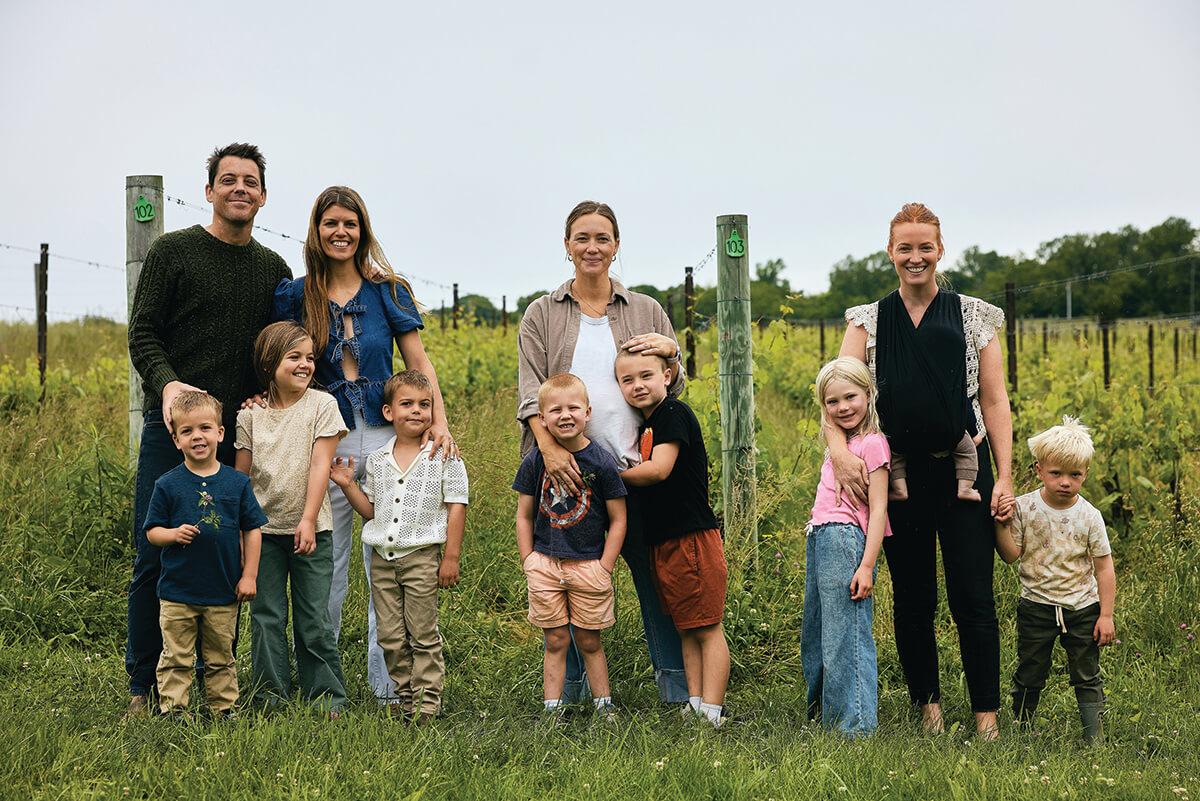
ABOVE: DREW
AND CASEY BAKER WITH
JAMES, NELLY, AND JEFFREY;
LISA HINTON WITH JED AND
HUCK; ASHLI JOHNSON WITH
MACI, CLAY, AND KODI; A FLOCK OF SHEEP GRAZING IN THE FIELD AT BURNT HILL.

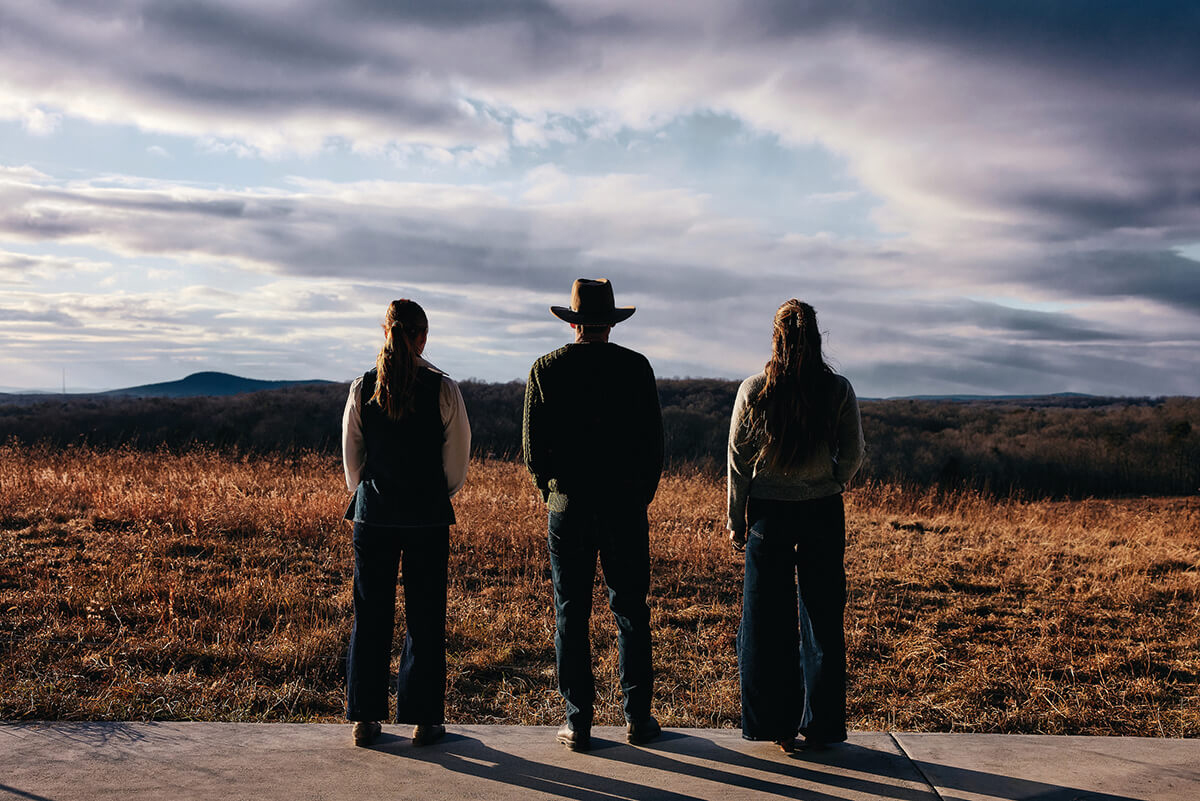
o get to Burnt Hill from Baltimore, head out of the city and hop on I-70, due west. Eventually you’ll pull off into suburbia, then onto a country road, riding past farmland, climbing over creeks and through forest, until you come to a broad clearing. You’ll know it when you’ve found it—this soaring hillside, perched high atop the Piedmont Plateau, covered in almost 30,000 grapevines. Way up there is a rare view, overlooking the vast splendor of the Mid-Atlantic.
To the north, in the valley, sits the city of Frederick, and beyond that, there’s the low blue ridge of Maryland’s Catoctin Mountain. Right out in front is Little Bennett Park, a 3,700-acre protected woodland, past which Sugarloaf Mountain gently slopes into the horizon like a slumbering giant. Further still, if you squint hard enough, you might even see where Virginia and West Virginia meet in Harpers Ferry, their mighty rivers flowing south from there to the Chesapeake Bay.
It was an exhaustive search, finding this exact property. Ten years ago, Old Westminster was cruising along, making their own wines, processing grapes for other vineyards, and Drew felt an itch for something bigger. This time, instead of working with the land they had, he’d go looking for precisely what they wanted—the perfect blank canvas for starting their own grand-cru vineyard. It took the better part of a year, working closely with a geologist and analyzing each new prospect across an array of parameters: soil type, topography, elevation, temperature, sun exposure, rainfall, among many others.
Then one Sunday morning, Drew and Casey were lying in bed when he got a notification for a new listing. They hopped in the car and hauled ass to Burnt Hill Road. “I remember it distinctly,” he says, feeling right away that this might be it.
The next week, they were out there with a Bobcat and backhoe, digging holes around the then-fallow field to confirm those suspicions. The site proved promising—steep and rocky earth, littered with quartzite like Sugarloaf. They put in an offer, got outbid, then the seller had a change of heart. While it could’ve felt like fate, Drew was quick to stay grounded. Besides, they had plenty of work ahead.
Conventional farming is an extractive process. You take from the land and return just enough so that you can take from the land again. But meeting other growers, visiting other vineyards, consulting with experts and elders, Drew eventually learned another way, again.
Soil is the foundation of any farm, and regenerative agriculture works to not only sustain but improve it. This yields more biodiverse, dynamic, and resilient farms, impacting everything that lives and grows in them. And to this first-generation farmer, it just made sense. “For me, it’s about stewardship—you help build healthy soil and, over time, you become a net benefit to the land.”
Not to mention, you can also make better wine. Healthier soil means healthier plants means higher quality grapes with more robust flavor. Think of it like an heirloom tomato, which out of a thriving garden in summer’s peak needs nothing but a pinch of salt. One from a hot house in the middle of winter will just never taste the same, no matter the amount of seasoning.
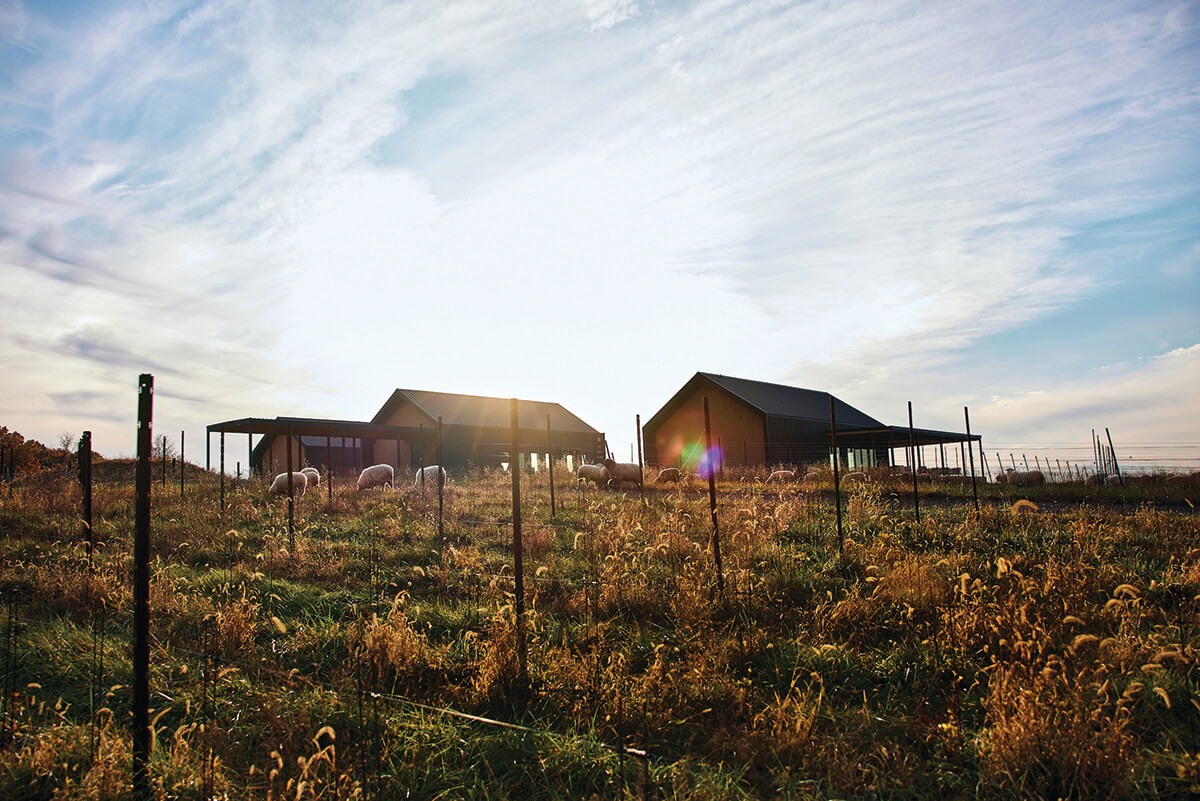
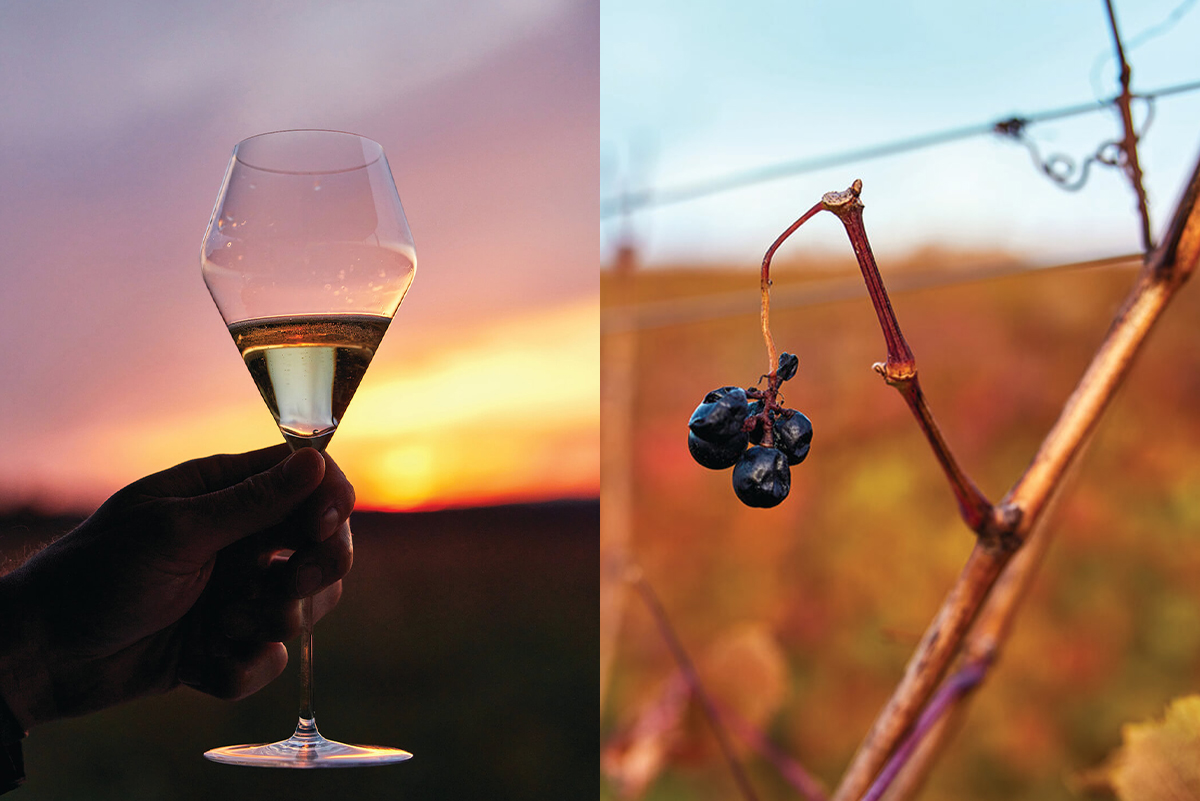
ABOVE: CLOCKWISE, THE BUILDINGS AT BURNT HILL, A GRAPE STILL ON THE VINE IN AUTUMN, A GLASS OF SPARKLING WINE TO TOAST.
For this, the Burnt Hill crew set their sights beneath the surface. For two years, they added biodynamic preparations to enhance the soil, like manure that’s been packed into cow horns and buried underground over winter. (“People think it’s witchcraft, but whatever, dude—anecdotally, I think there’s power in it,” says Drew.) They also rotated cover crops, like daikon radishes and hard red wheats, helping loosen the ground without disruptive tilling.
When it came time to plant in 2019, they abided by those same nature-forward principles. Rows were positioned to follow the sunlight in the east and protect against winds from the west. So, too, were plots of both old-world European varieties and modern American hybrids, each having different needs and tolerances, with many also chosen for their climate-change adaptability.
Still, out there, it’s tough terrain, with no irrigation beyond Mother Nature, forcing the grapes to work harder. But that’s actually a good thing, says Drew. “The best wines are made from vines that fear a little for their own existence.”
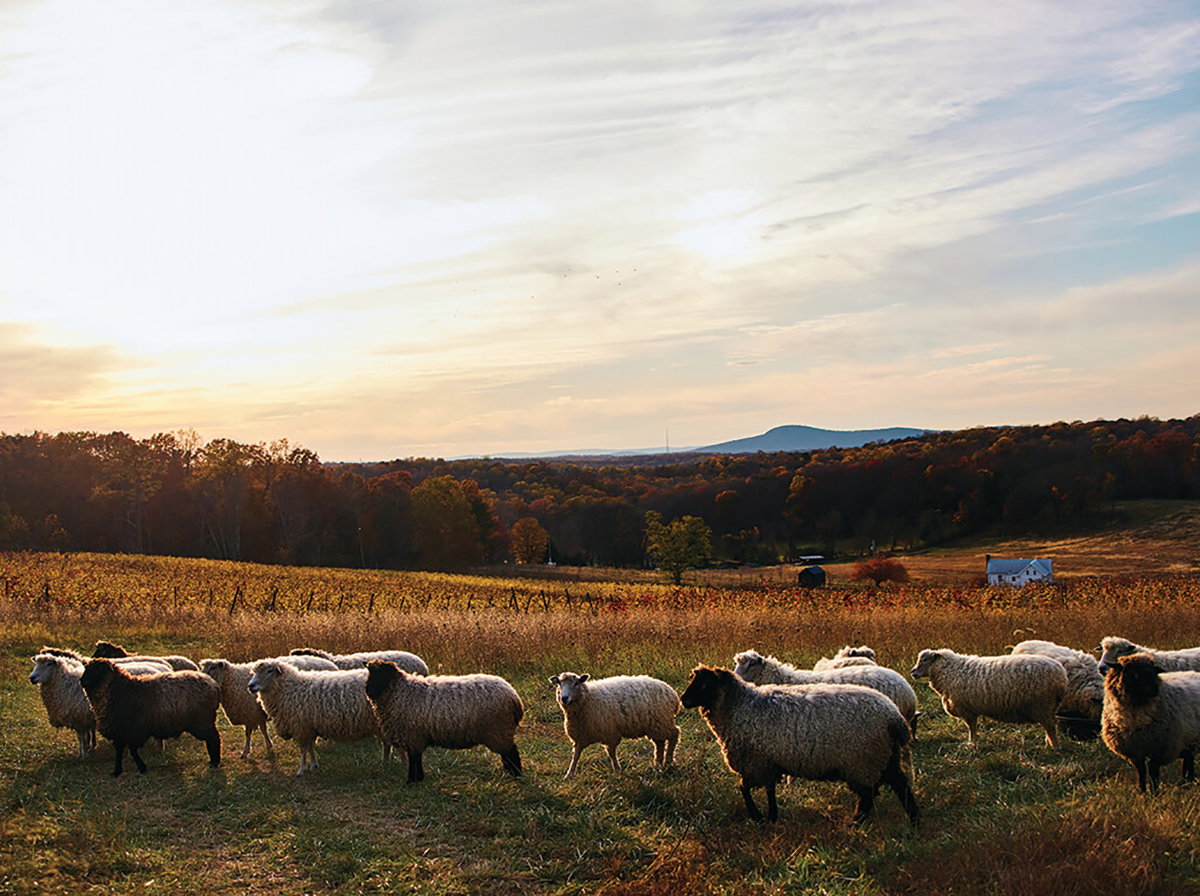
Meanwhile, the grass grows freely, only cut twice a year. No herbicides have ever been sprayed here, with the weeds beneath each plant cultivated by hand with the help of their H2A workers. Then after each harvest, a flock of sheep arrives, their hooves and hindquarters also working to aerate and enrich the land.
Altogether, it’s a uniquely controlled chaos. “A nice, manicured, Roundup-sprayed, golf-course-style vineyard is the recipe for an out-of-balance ecosystem,” says Drew. “Nature wants to express itself.”
That’s what they want for Burnt Hill wines, too—to be wild, vibrant, alive. No two vintages will taste exactly the same. And with more than 30 varieties planted, there are endless possibilities, from delicate Pinot Noirs and Gamays to the big, bold Bordeaux: Cabernet Franc, Petit Verdot, Merlot. Barbera, Syrah, Tannat. A block of up-and-coming Trousseau. Sprawling swaths of Regent, which Drew declares is the largest of its kind in the United States, at least “until proven otherwise.” That summer’s Cabernet Dorsa.
Old Westminster will continue to be the trendsetter, crafting the sort of fresh, fun wines currently sought out by younger drinkers. But Burnt Hill is an old soul, its deep, dark, meditative palate probably more familiar to a boomer. With these, they’re thinking about longevity.
“Once you plant, it’s several years before you have a wine to show, and then you’ll have those vines in the ground, if all goes well, 30, 40, 50 years,” says Drew. “Probably longer than I’ll be here.”
He’s been feeling pretty good lately, still taking chemo every day, getting knocked back when his kids bring a cold home, making the occasional trip to the hospital with a spiked temperature. “My immune system just sucks,” sighs Drew. “But I felt as good as nine out of 10 at moments this summer, which was awesome—just remembering what it’s like to wake up in the morning, ready to kick some ass.”
At the bottom of the hill, back in the middle of that September harvest, he’s revving his utility vehicle across the road and up a path through their native wildflower meadow. Those scrappy blooms—rudbeckia, echinacea, mullein, chicory—support a host of pollinators, including Drew’s apiary at the wood’s edge. While there were 30 hives before his diagnosis, only one survived when they checked again in early 2025. With the help of a master beekeeper, he’s now back up to six, which meant some 60 pounds of honey that year.
A few hundred yards away, his pack of Mangalica pigs roots deeper into the forest. Sometimes they escape their pen, stopping all farm work until they’re caught, sparking wild-boar lore on the neighborhood Facebook. Under a grove of oaks, they munch on acorns and itch their butts against firewood, both of which will soon be used in their forthcoming restaurant on Burnt Hill’s summit.
“They’re the Wagyu of pork,” says Drew, waxing rhapsodic about their fat-to-muscle ratio. “Six of their kin just went to the butcher and chef put them on the menu last weekend. This next chapter will really be his. We’re just helping set the table for him.”
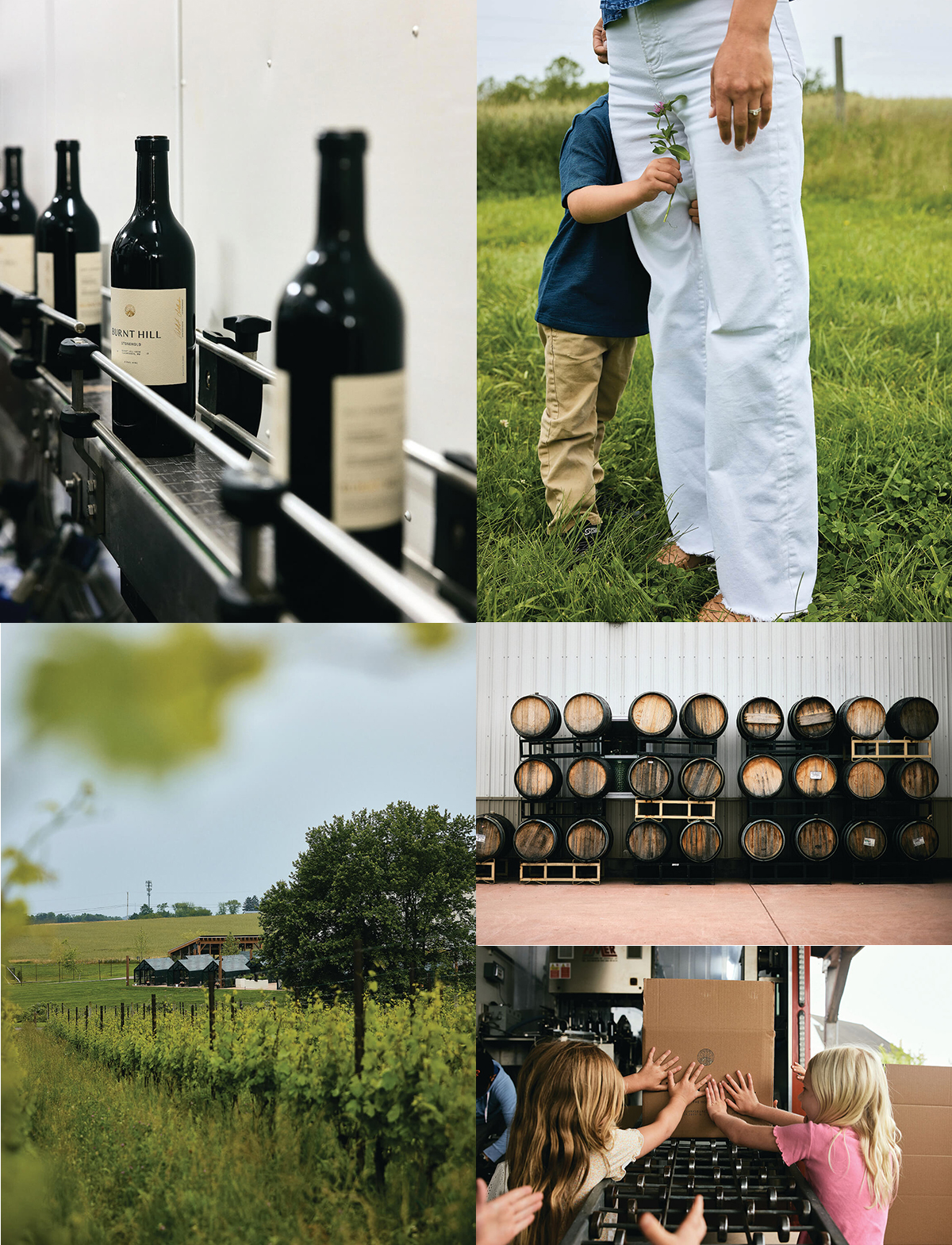
ABOVE: CLOCKWISE FROM TOP LEFT, SCENES FROM OLD WESTMINSTER: WINE ROLLS DOWN THE LINE, JAMES CLINGS TO CASEY, STACKED BARRELS IN THE WINERY, PACKING BOXES, THE VINEYARD AT SPRINGTIME.

hen Drew talks, he often speaks in the collective. We do this, we do that. Not every family can go into business together, but the Baker siblings sure make it look easy. They’re genuinely friends, spending most waking hours together—in fact, after that Labor Day harvest, their families spent the evening picking crabs by Lisa’s pool. Drew’s cancer surely strengthened that bond. But it’s also a labor of love they work on constantly.
For one, there are the routine check-ins. Like every Monday, when the three of them sit down with coffee and plan the week ahead. Or every Wednesday, when they also meet with their managers, who help supervise a now-100-plus-person team. Then, just after the holidays, they do an annual review, giving and receiving constructive feedback about the business—which they bought from their parents in late 2024—as well as about one another.
“It’s not for the faint of heart,” says Lisa with a laugh. “It takes a lot of time and trust and intention. You can’t just set it and forget it.”
Through all that reflection, she calls Drew a visionary, “always learning and growing and looking for ways to push us.” He thinks of her as the executor—smart, observant, problem-solving. “I always trust her judgement, because she’s always right.” “Our steady center,” adds Ashli about Lisa, while her older siblings agree that their youngest is the listener, the caretaker, the community-builder. “She has high emotional intelligence,” says her brother. “Full of life,” says Ashli about him these days.
Meanwhile, Casey—titled both “chief of staff” and “mother of the farm,” for obvious reasons—keeps everyone in line. But like iron sharpening iron, they all balance out and build up each other, with family always coming first.
And so it was a big deal when they brought in a fourth party—who they’re not even related to.
“The missing piece in our team was a talented culinary partner,” says Drew—someone who could bring this vision full circle, and also have their own skin in the game. “And without hesitation, our sommelier, Joey, was like, ‘You have to meet Tae Strain.’”
In early January, the 42-year-old Korea-born, Howard County-bred chef sits down in the lounge at sunset. He rests his forearms on the family-style table, showing off a pair of Celtic tattoos. Adopted from Seoul as a child, he was raised nearby in a large Irish family, where he quickly learned to cook for himself and, in the process, discovered he loved doing so for others.
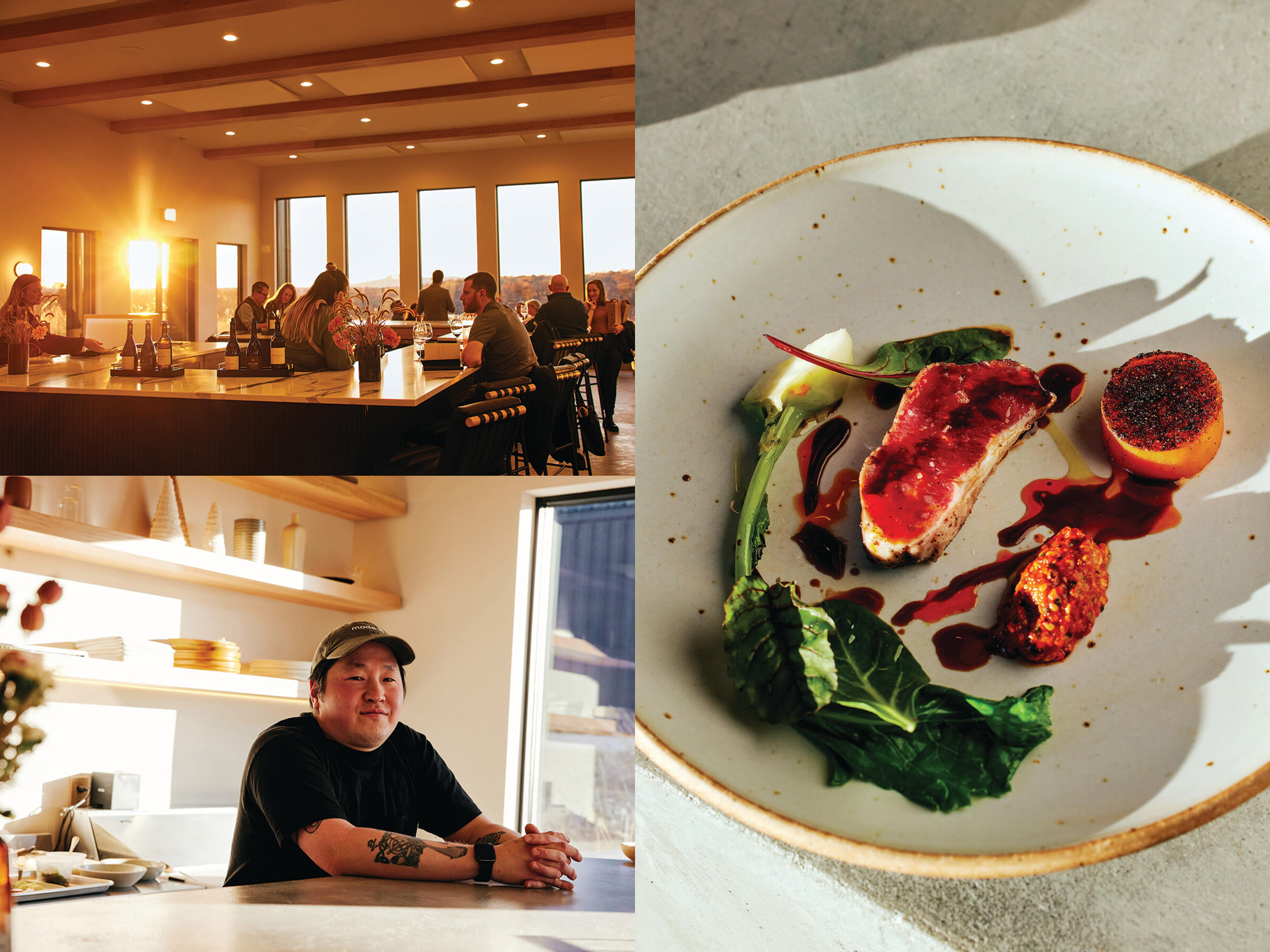
ABOVE: CLOCKWISE, THE
DINING SCENE AT BURNT
HILL; CHILI OIL ROASTED
LAMB WITH SAMBAL,
SWEET POTATO, AND
KOHLRABI; CHEF-PARTNER TAE STRAIN.
First, he got a job at Pizza Hut. Later, he opened his own restaurant, the beloved Demi in Belvedere Square, for which Baltimore named him “Best New Chef” in 2011. After that, he hit the big leagues, from chef de cuisine at the Michelin-starred Progress in San Francisco, where he discovered the value of local ingredients, to executive chef at David Chang’s Momofuku in D.C., where he started to culinarily connect with his Asian-American identity. He met the Old Westminster crew back in Baltimore, during his more recent Ggoma Supper Club pop ups. Then, just over a year ago, Drew slid into his DMs.
“There was a little courting process,” says Strain. After years in the industry, he wasn’t looking for a boss, which was good, because Drew wasn’t looking for an employee. In the end, it was the right fit for everyone.
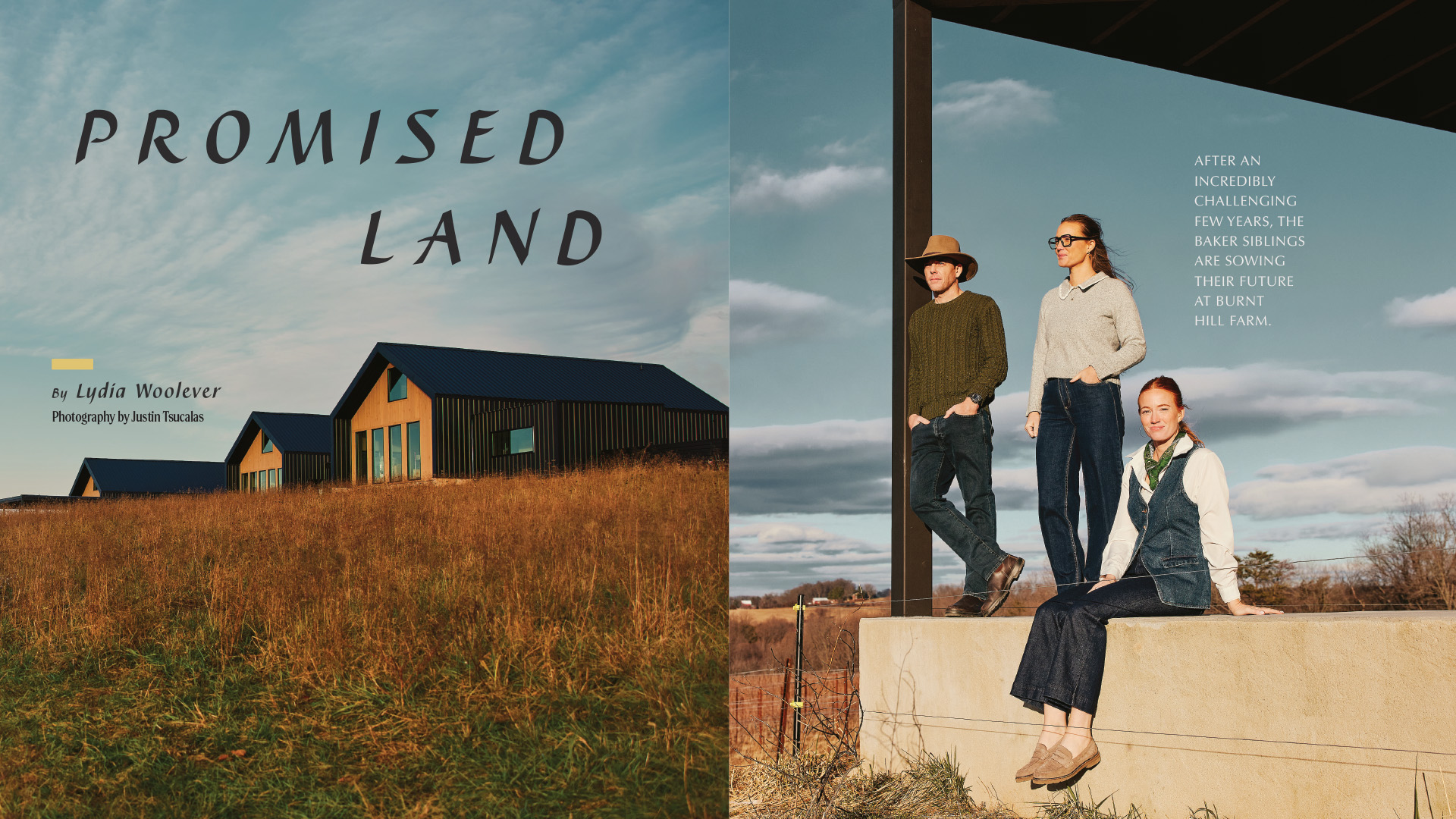
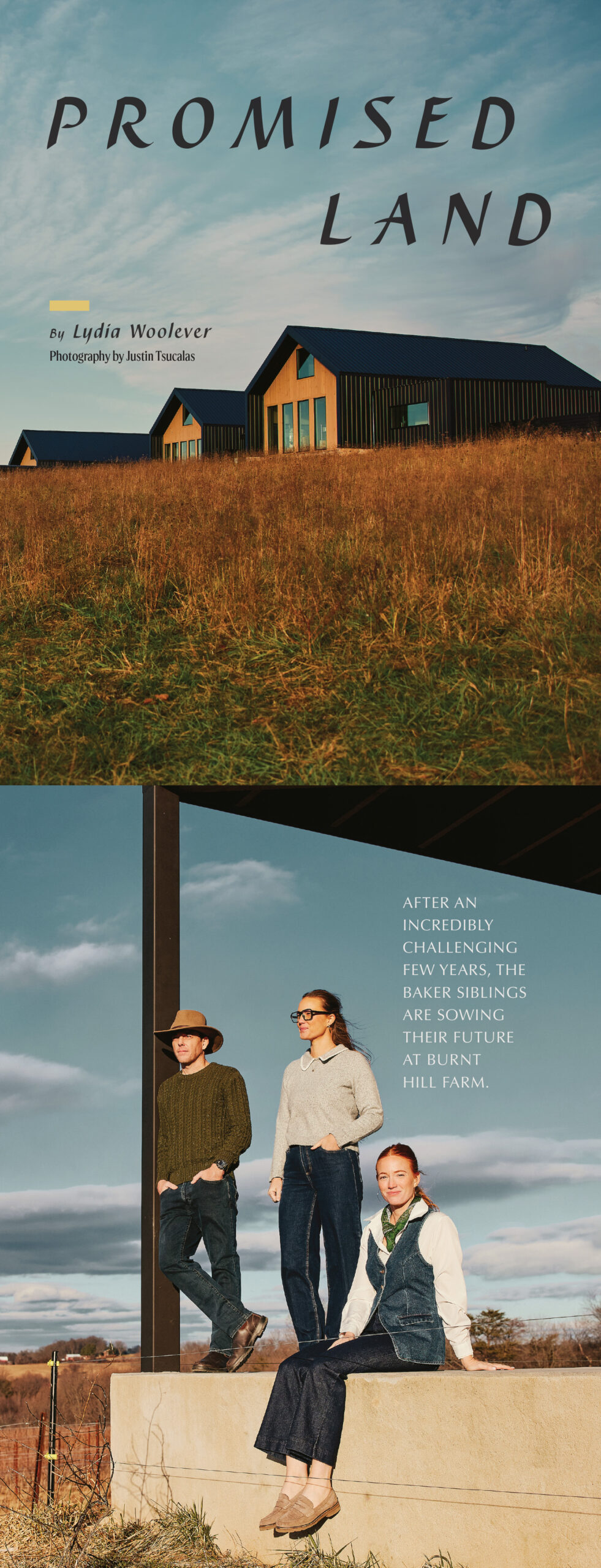
Last fall, Burnt Hill officially opened to the public, a cherry on top of what Lisa calls their “year of extravagant blessing.” At the top of the hill, above the vineyard, guests are now welcomed into one of three Scandinavian-style structures, their stark black lines cutting against the sky, contrasting the curves of this Andrew Wyeth-esque landscape.
In the middle tasting room, the vineyard’s inaugural wines are the star of the show, and everything from the decanters—made from glass that Ashli found behind the beehives—to the dishes—fired with clay from the local soil—all help tell their story. Next door, to the north, the lounge has equally epic views and a more casual vibe (where Gov. Wes Moore had this 47th birthday party). But in many ways, the pièce de résistance will be that restaurant, on the south side.
Slated to open later this month, the 12-seat chef’s counter won’t be the standard farm-to-table fare one might easily expect here. And thank goodness for that, says Drew, calling such cuisine “at high risk of being boring.” Instead, the multi-course menu will emphasize their shared ethos—simple, regional, seasonal—and also explore Strain’s own roots.
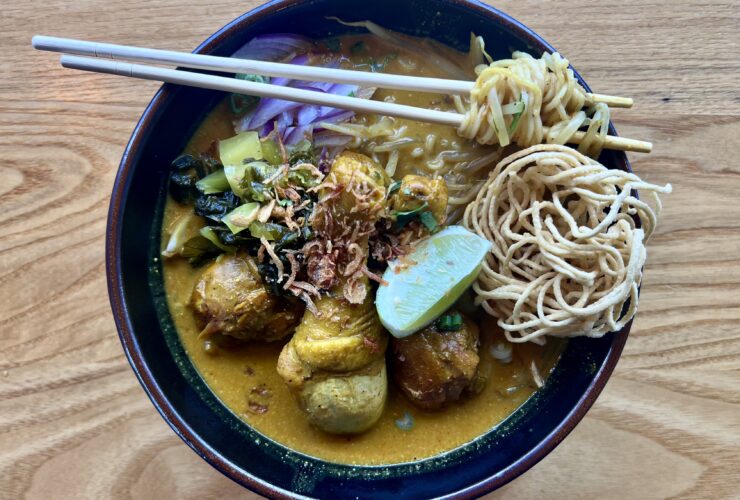
“At the end of the day, it will be soulful food,” says the chef. Think a big bowl of spicy noodles, made from local heritage grain ground in their in-house stone mill. Or Chesapeake rockfish, slow-cooked over curried congee, with herbs from the on-farm garden. Then there’s the Mangalica pork neck with fermented chile, Virginia peanuts, and Drew’s honey that he trialed last spring. And the dry-aged duck plucked from the farmhouse yard, served at the James Beard House in New York last summer.
Strain is dreaming about what to do with the orchard’s peaches, or the shiitakes that Drew started in the woods across the street, before he got sick. Plus ingredients like ginger and lemongrass, purchased from other regenerative growers throughout the watershed. To the space’s serenity, his plates will add a splash of color, somewhere between “fancy pants” and “fucking rustic.” He, like the rest of them, wants to show off what this land can do.
On this winter evening, they’re in the home stretch. The concrete cures on the counter. A wood-fired oven waits in the back corner. Through the floor-to-ceiling windows, Burnt Hill is now barren, speckled with sheep, about to be blanketed in snow. In a week, it’ll be a top-notch sledding spot for the Baker kids, including their youngest, James, who, like his siblings, looks just like his dad.
“This place is so special to me, it’s just such a privilege to be able to share it,” says Drew in the early new year. “I’m so proud of where we are, and where we’re going. Because I’m always reminded from whence we came.”
That brush with his own mortality has brought out a profound urgency, a sense of obligation. As a father. As a husband. As a brother. As a farmer. To live and do his work well.
“And there’s so much left to do.”