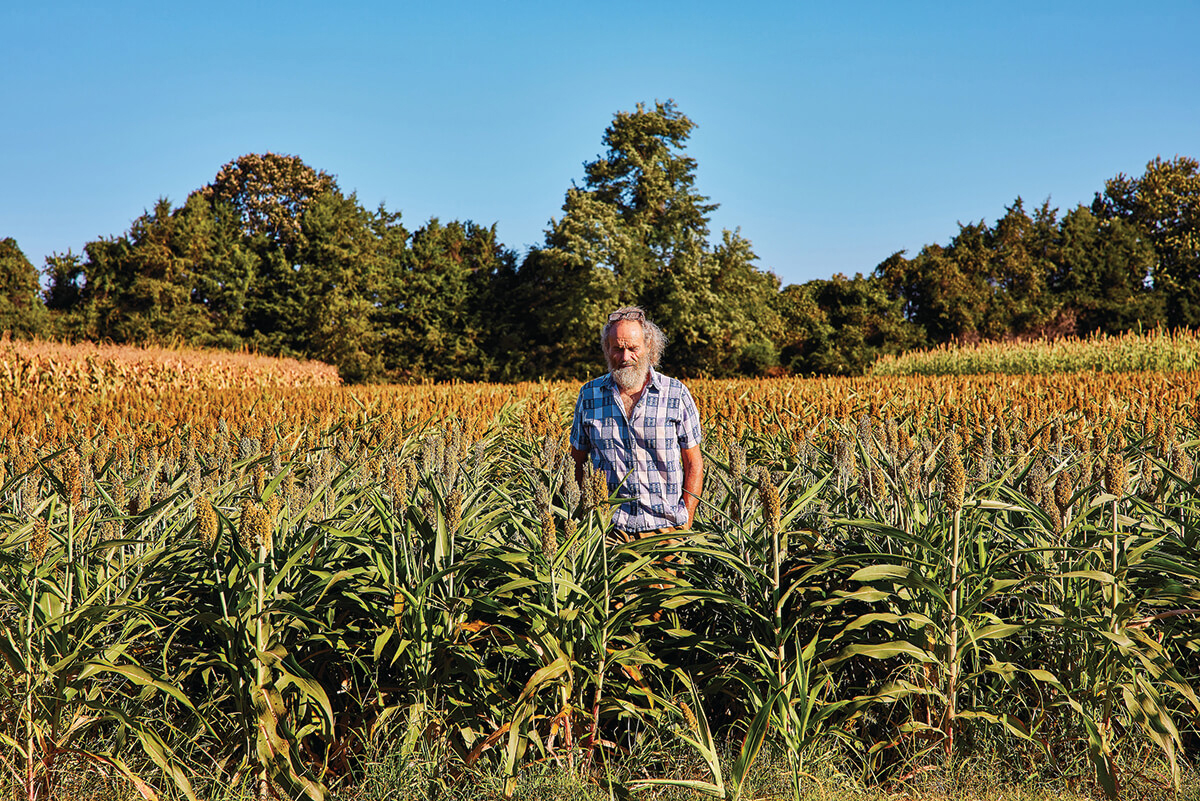
It’s only a few weeks into spring and Shane Hughes already has a suntan. Just before lunchtime on an early April weekday, he whips down his farm lane on a John Deere utility vehicle, wearing muck boots, faded blue jeans, and a bright green T-shirt that reads “how to pick up chicks,” showing stick figures scooping up baby chickens. He shifts into park, leans over the steering wheel, and belts out in an almost Southern drawl, “So, you wanna see some cows?”
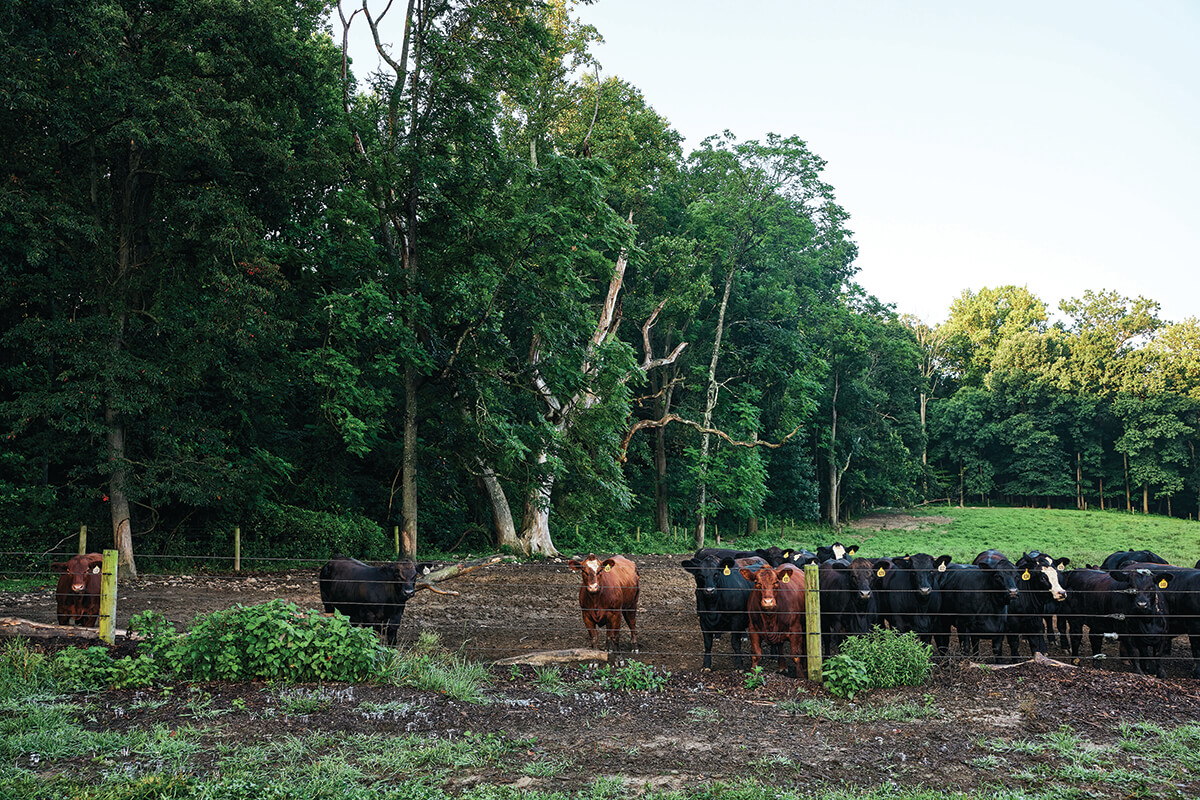
Heading back up the hill, the 58-year-old farmer cuts across Liberty Delight Farm, his 100-acre rolling pasture in Reisterstown, speckled with white barns he built himself and surrounded by woods that abut the Soldiers Delight nature preserve. Through a gate, he revs his ride over a grassy field, then finally spots the herd, grazing in the shade of an oak grove, a few brand-new calves at their heels.
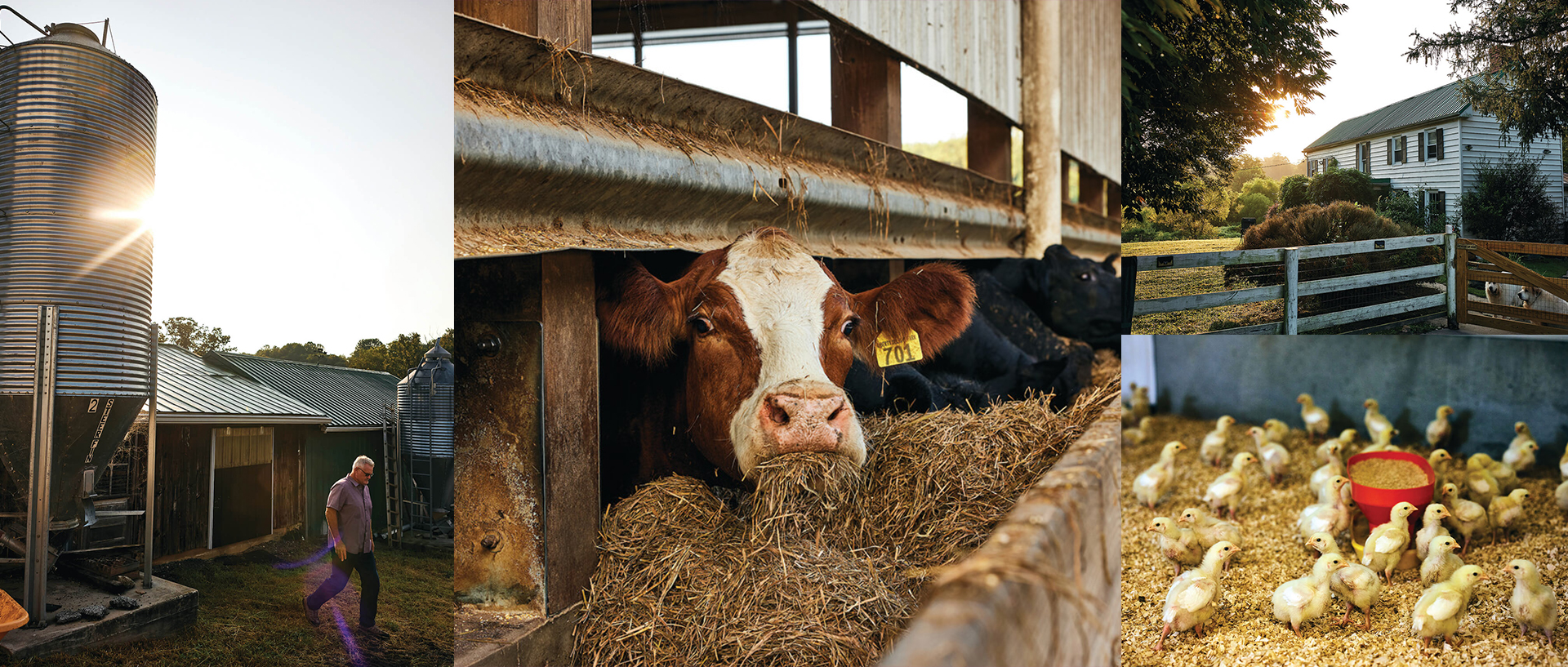
ABOVE: Shane Hughes
walking the farm; cows,
the farmhouse, and chicks
at Liberty Delight.
“These little guys here are about a week to two weeks old,” says Hughes, pointing out the males by white tags pierced into their left ears. One curious heifer ambles up for an itch, rubbing its butt against the tailgate. This Swiss breed of Simmental cattle is known for its leisurely temperament, but their care is still an around-the-clock job, especially this time of year, when spring births can keep the owner up all night. “I’m not afraid of hard work,” he says, matter-of-factly, which shows.
And yet as much as he looks, sounds, and acts the part, Hughes did not always intend on being a farmer. Sure, he was raised just up the road in rural Carroll County, where tractors and animals were a fascination. And this particular property has been in his family for generations. But college got him out of Dodge, earning an accounting degree, then a finance career in Balitmore City. That is, until the early-2000s economic collapse left him at a crossroads. He thought about picking up and moving to New York. Instead, he gave up the rat race and, as he puts it, “came home.”
“You can take the boy out of the country,” says Hughes, “but you can’t take the country out of the boy.”
In 2009, Liberty Delight got off the ground with 10 cattle. That quickly grew to include about 300 cows a year. He started selling beef at a few farmers markets, still setting up in Waverly on Saturdays and Catonsville on Sundays today. To expand his customer base, he also began knocking on restaurant doors, earning the lasting loyalty of Woodberry Kitchen’s Spike Gjerde, along with chefs at Atwater’s and Gunther & Co.
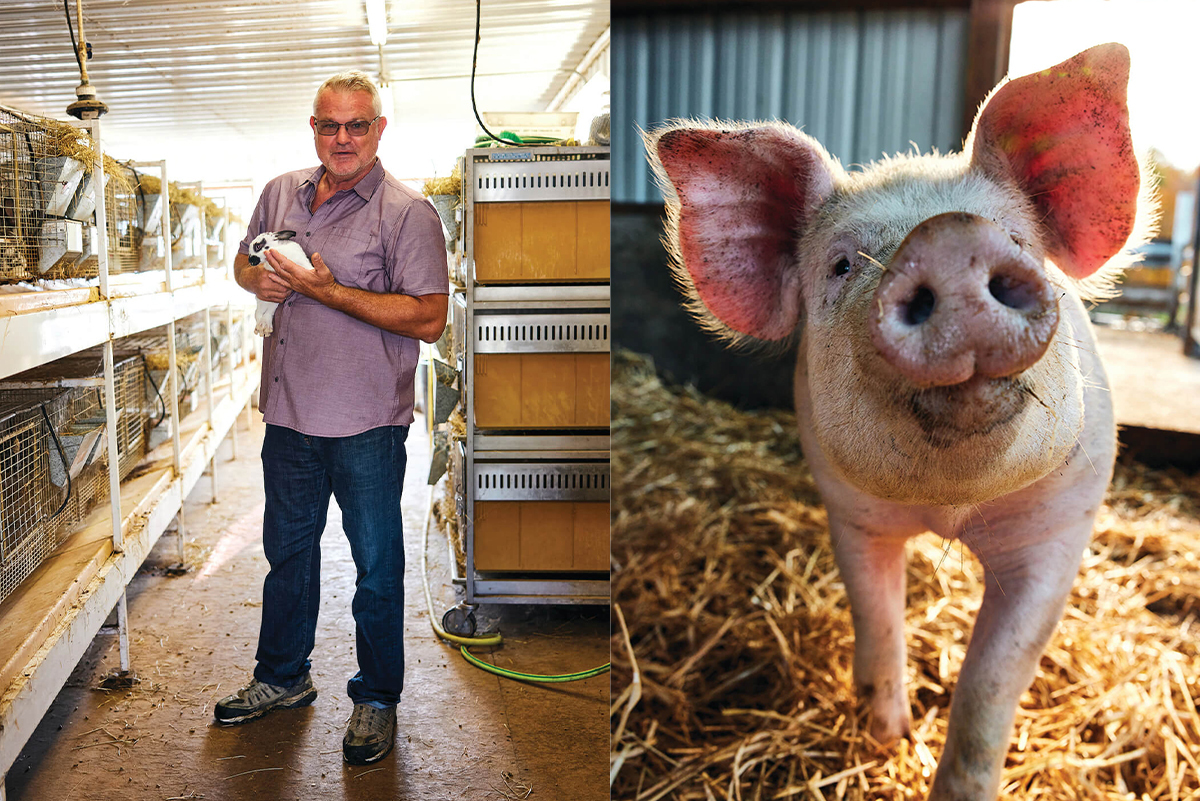
The
farmer in his rabbit pen; a piglet
greets the morning.
“At the time, people were just beginning to hear about ‘know your farmer,’ ‘buy local,’ ‘raised right,’” says Hughes. “Back when I first started, I’d tell people, you just have to taste it for yourself.”
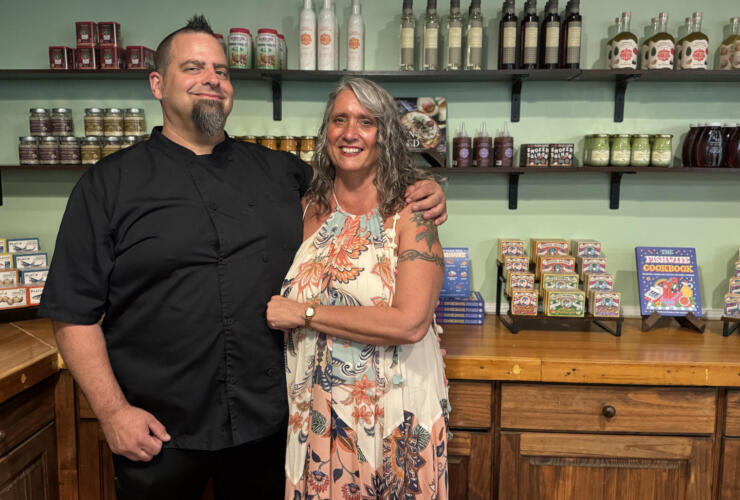
Demand spurred him to diversify his offerings, adding pigs, chickens, and rabbits to the farm, as well as lamb and turkey to his lineup that he buys from fellow local farmers. His wife, Lauren, joined the team, too, pivoting from a career at The Washington Post to handling their marketing, customer relations, and retail store, located just down the road from the farm, about a half-hour drive from the Inner Harbor.
“Farming is a labor of love,” she says. “It takes an entrepreneurial spirit. It is seven days a week. It is what you live and breathe.”
Day-to-day, Hughes oversees animal husbandry and field chores with one or two helpers. And one big part of that workload includes growing their own feed.
While most of the cows’ diet is grass from their immediate pasture, this crew also farms some 600 nearby acres, using their own manure to fertilize that land and later fermenting its hay harvests to create an even more nutritious source of food. They add in a little locally grown cracked corn for extra fat and flavor, especially during winter months.
“Garbage in, garbage out,” says Hughes. “If you have healthy soil, and are able to grow feed there for your animals to flourish on, then that turns into a healthier and happier cow, and makes a better product. It’s important to us that they live a natural life.”
You can see that in their living quarters, too. Unlike the cramped enclosed pens of the industrial-scale factory farms whose beef is sold at grocery stores, those at Liberty Delight live in the open air every day of their lives (though they have the option of using the run-in barns for cover during inclement weather). In addition, they drink water from the farm’s naturally flowing streams that feed into the Liberty Reservoir, which Hughes has worked to protect from erosion and runoff with the Maryland Department of Agriculture.
And while it takes longer and, in turn, costs more than what has become the conventional process to feed the masses, Hughes’ cows live this way for two full years before heading to slaughter, about twice the time of commercial-grade cattle. Simmentals yield a higher quality beef, and that slower pace adds even more flavor, resulting in tender, well-marbled cuts. Additionally, knowing that stress leads to tougher meat, Hughes is careful to treat his animals with respect. He’s even been known to give them the occasional backrub. As he points out, it is indeed a difference that you can taste.
“Oh, it’s totally night and day,” says Hughes, also adding that factory farms use steroids, growth hormones, and antibiotics to grow fat cows quickly—he only uses the latter when the animals are sick—and that grocery-store beef is often stuffed with water to add moisture and in turn weight, as well as preservatives to retain its red color. “A lot of people don’t realize this. There’s none of that here. It’s all natural. It is what it is. And that’s the same with everything we raise and sell.”
Of course, the difficult truth is that most of Hughes’ animals are eventually bound for what he calls “freezer camp.” Every Wednesday, he loads two cows onto a trailer that will head to the family-owned Stoney Point Farm Market butcher shop just over the Pennsylvania line. For him, this the hardest part of the job.
“Loading up animals that you’ve been with for two years, that are perfectly healthy, knowing that they’re going to leave this world, it’s sad, because I feel like I’m deceiving them,” he says. “But I know they lived a good life, much better than they might’ve elsewhere. So when I unload them, I give them a little pat on the back, scratch their head, and say, ‘Thank you.’ Then they go off to greener pastures...”
All in all, it’s one bad day in an otherwise not-so-bad life—for both man and beast.
After following the cows downhill this spring morning, Hughes parks his vehicle halfway and looks out over his verdant farmland, taking it all in before suddenly realizing that he left the gate open. He starts the engine and rips across the undulating terrain. Luckily, at the bottom, by the roadside, no one has escaped, and he pauses to say goodbye to the herd.
As he approaches his sixth decade, he’s started to scale back the business ever so slightly. And he’s even begun daydreaming about what life might look like when he’s no longer working seven days a week. But this morning, there are still plenty of tasks to tackle on the day’s to-do list, not to mention orders to be filled.
“As the old saying goes, you gotta make hay while the sun shines,” says Hughes, before heading off again.
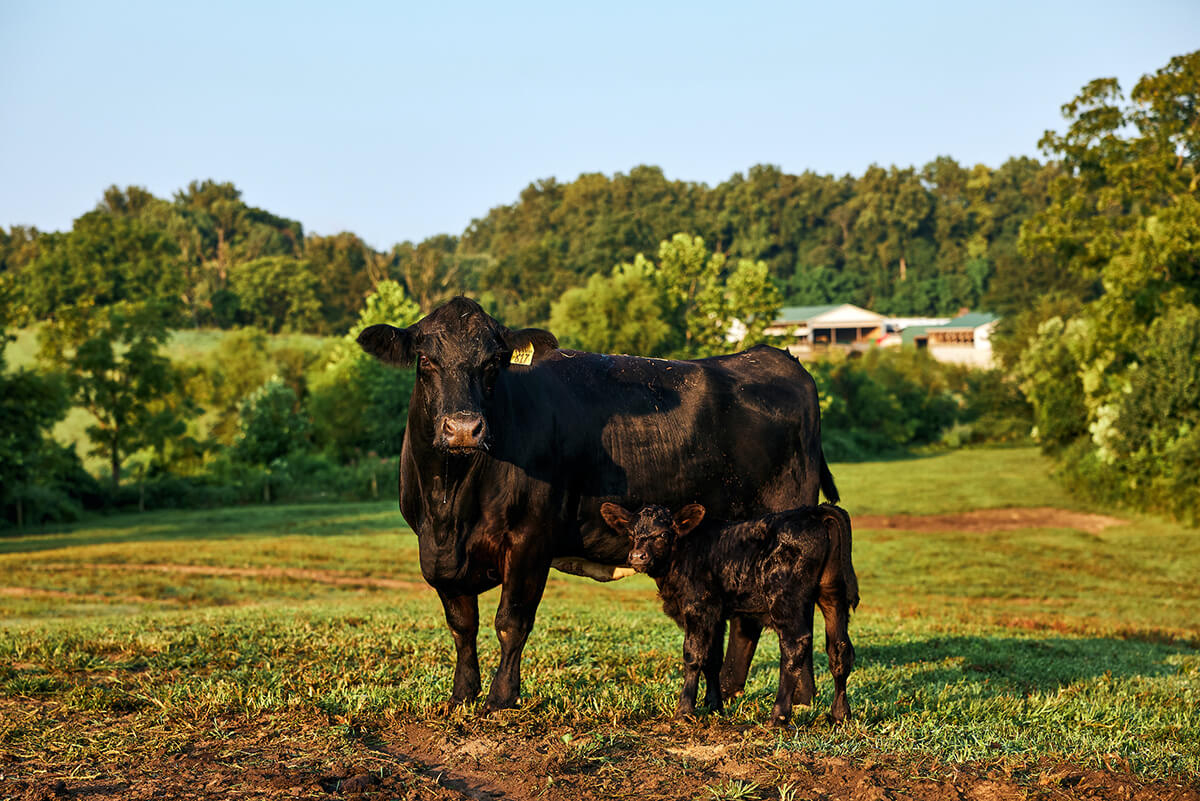
A cow with her calf at Liberty Delight Farm.