Home Grown
The Kingdom of Fungi
JOSE PRIETO-FIGUEROA & BIANCA SOTO
The Bay Mushrooms
BY AMY SCATTERGOOD
At the end of a gravel-and-dirt road in Federalsburg, in Caroline County on the Eastern Shore, sits a 20-acre jigsaw of planted and overgrown fields, just-built and ramshackle sheds, a greenhouse, and the circa-1800s farmhouse that is the headquarters of The Bay Mushrooms.
A small, family-owned and -operated mushroom farm, Bay is the brainchild of Jose Prieto-Figueroa and Bianca Soto, a married couple who also grow fungi at their home in nearby Cambridge. Inside the main house, which Prieto-Figueroa and Soto bought in 2016 after it sat abandoned for years, is an unfinished commercial kitchen, where Prieto-Figueroa initiates the first stages of mushroom cultivation. It’s also a test kitchen, where he’s testing mushroom soups, dried mushrooms, mushroom jerky, and mushroom tinctures.
A tall man with salt-and-pepper hair, glasses, and a scruffy beard, he’s wearing mushroom merch in the form of a T-shirt featuring a skull with red cap mushrooms growing out of it that presents like a mash-up of Dia de los Muertos and The Last of Us.
“I’m a metalhead, so I like Halloween stuff,” he says with a contagious smile before launching into a riff on the science of mushroom farming.
Prieto-Figueroa, it quickly becomes clear, is an academic at heart, as well as a serious mushroom geek. He and his wife met in their native Puerto Rico, where they were students at the University of Puerto Rico studying agriculture. Soto studied animal husbandry, while Prieto-Figueroa got a degree in plant pathology.
“We worked with fungi all the time, but it was [the kind of] fungi that destroys crops and causes famine. But the techniques are the same; I mean, it’s just different species,” he says of the difference between inedible and edible fungi.
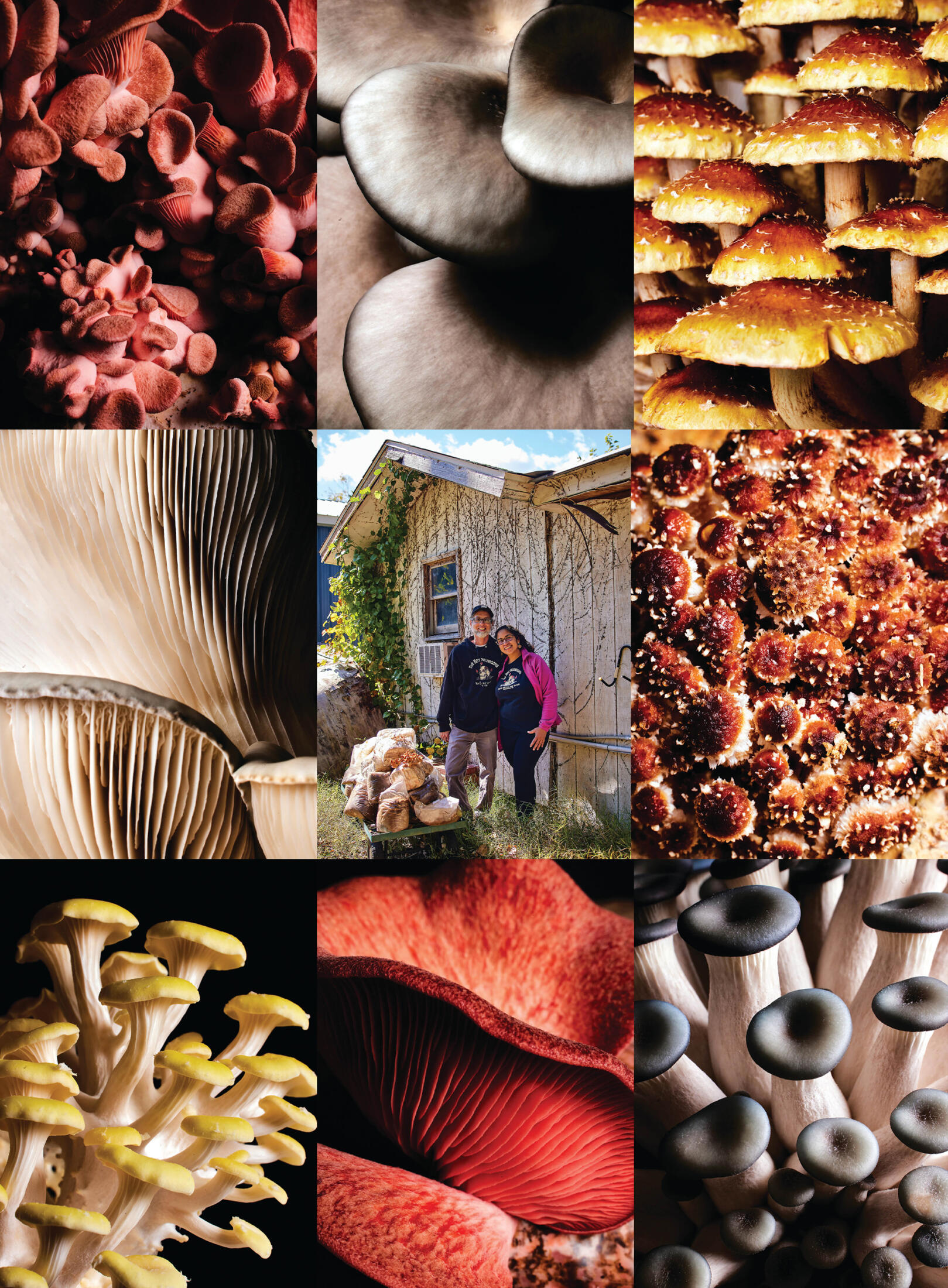
Above: Row
1: Pink oyster, blue
oyster, chestnut. Row
2: Blue oyster, Jose
Prieto-Figueroa and
Bianca Soto at their
farm, chestnut. Row
3: Yellow oyster, pink
oyster, blue oyster.
The thing that really launched his interest in growing edible fungi was an experiment they did growing oyster mushrooms in agricultural waste, specifically the byproducts of Puerto Rico’s sugar cane industry. Pretty soon Prieto-Figueroa was growing mushrooms for his own consumption.
After graduation, the couple landed jobs at the Natural Resource Conservation Service in Maine, then settled in Maryland, eventually growing mushrooms and selling them first to friends and colleagues, then to the public. Though Soto still works for NRCS, Prieto-Figueroa quit his job at the University of Maryland—where he was writing nutrient management plans for farmers—when the couple started a family a dozen years ago. He is now a stay-at-home dad and grows mushrooms full-time.
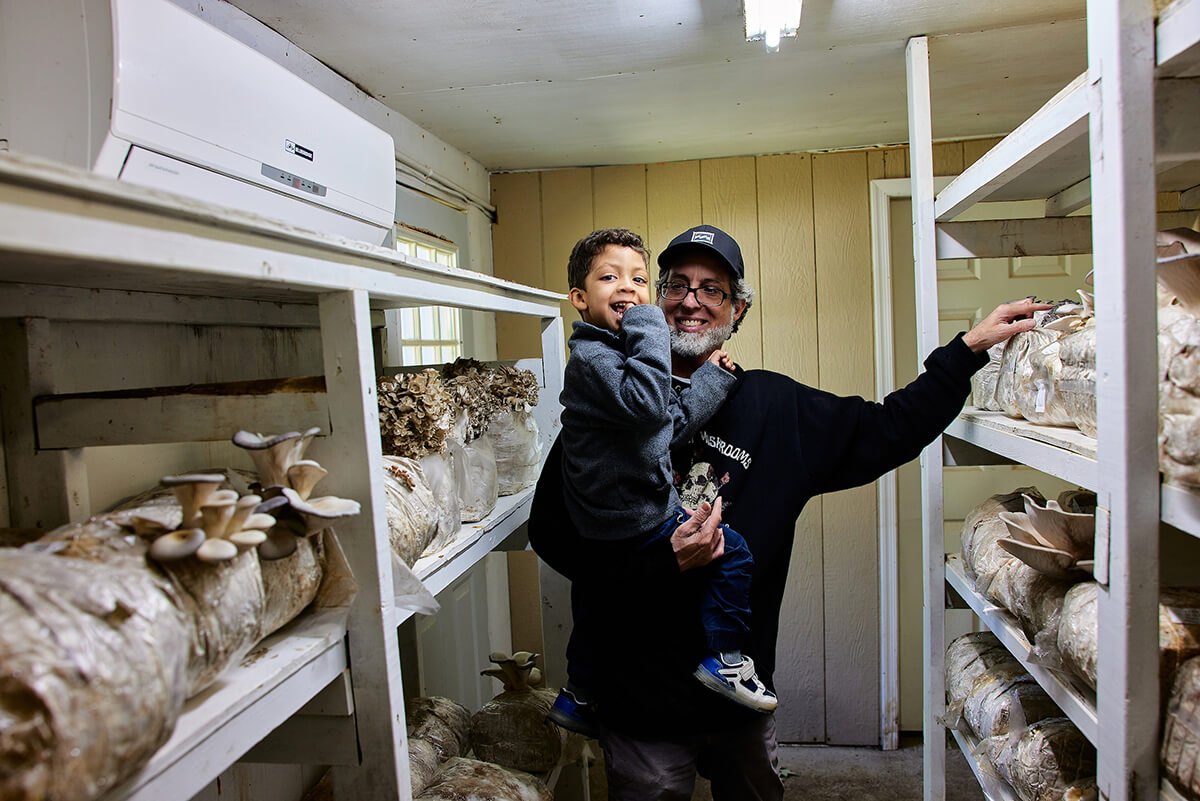
Mushroom cultivation is a strange and marvelous process: part apothecary, part terrarium, part magic show. Behind the old farmhouse, a few sheds house different grow rooms where Prieto- Figueroa inoculates a liquid culture of the mushrooms in petri dishes and sterilizes various local grains like millet and wheat that will be put into plastic bags then mixed with mycelium, the filaments of the fungus. These bags are shelved in a controlled environment, where the mushrooms begin to grow. The mixture is then blended with sawdust and taken to the “fruiting room” to continue its progress.
It all feels like a kind of eccentric, secret lab: a wine cellar crossed with a sourdough library. Scribbled notebooks. Temperatures taken with barbecue probes. And then there are the mushrooms themselves. Astonishingly beautiful, they look like South Pacific coral or pale violet bouquets.
“People thought, can you eat that? Is that a sea creature?”
Bay’s production is now divided between the couple’s Cambridge home and their Federalsburg farm, where they grow six different species, including grey, yellow, and pink oyster mushrooms; king oyster mushrooms; maitake; lion’s mane; chestnut; and reishi, a fungi used in traditional Eastern medicine. All these are grown year-round, then sold to area restaurants and in five local farmers markets.
“I’ve always loved mushrooms, ever since I was a kid,” says Prieto-Figueroa fondly, tilting a petri dish of spores in the sunlight. “It’s how I met my wife. I said, ‘I’m going to cook you something you’ve never had.’”
The rest is mushroom history.
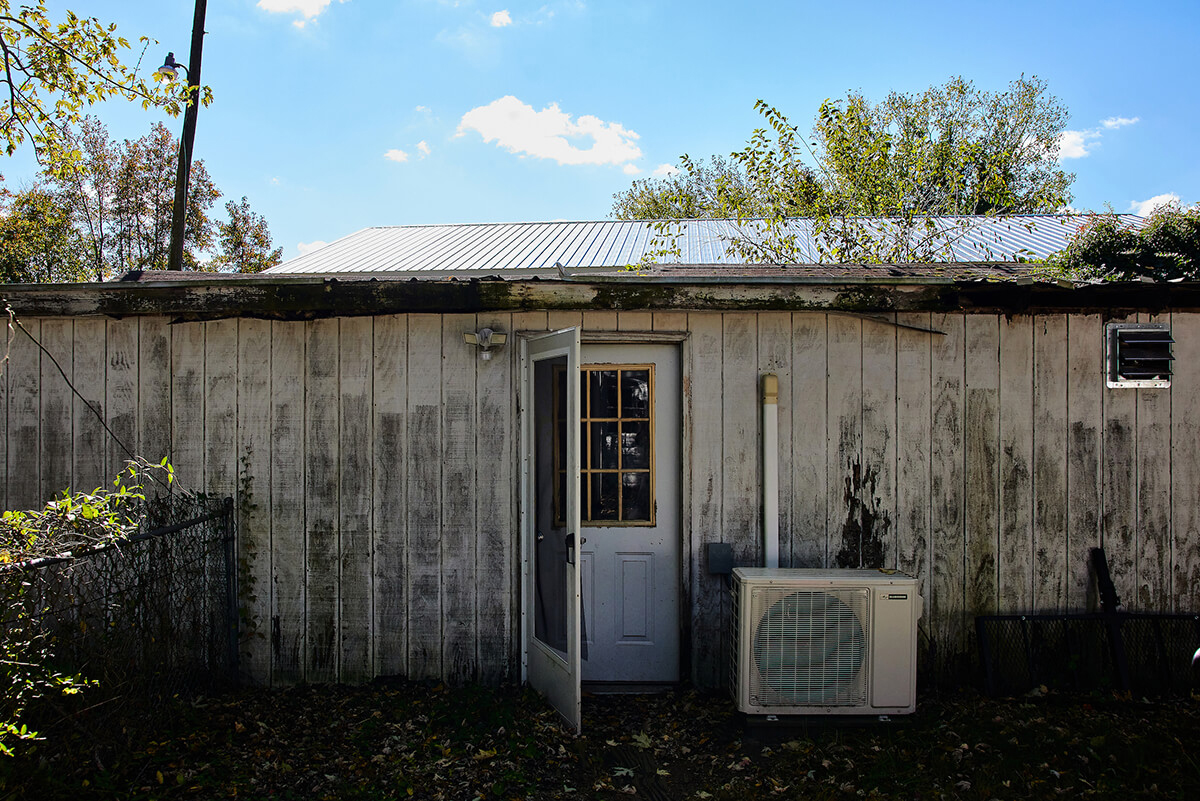
One of the many sheds on the 20-acre Eastern Shore property.