
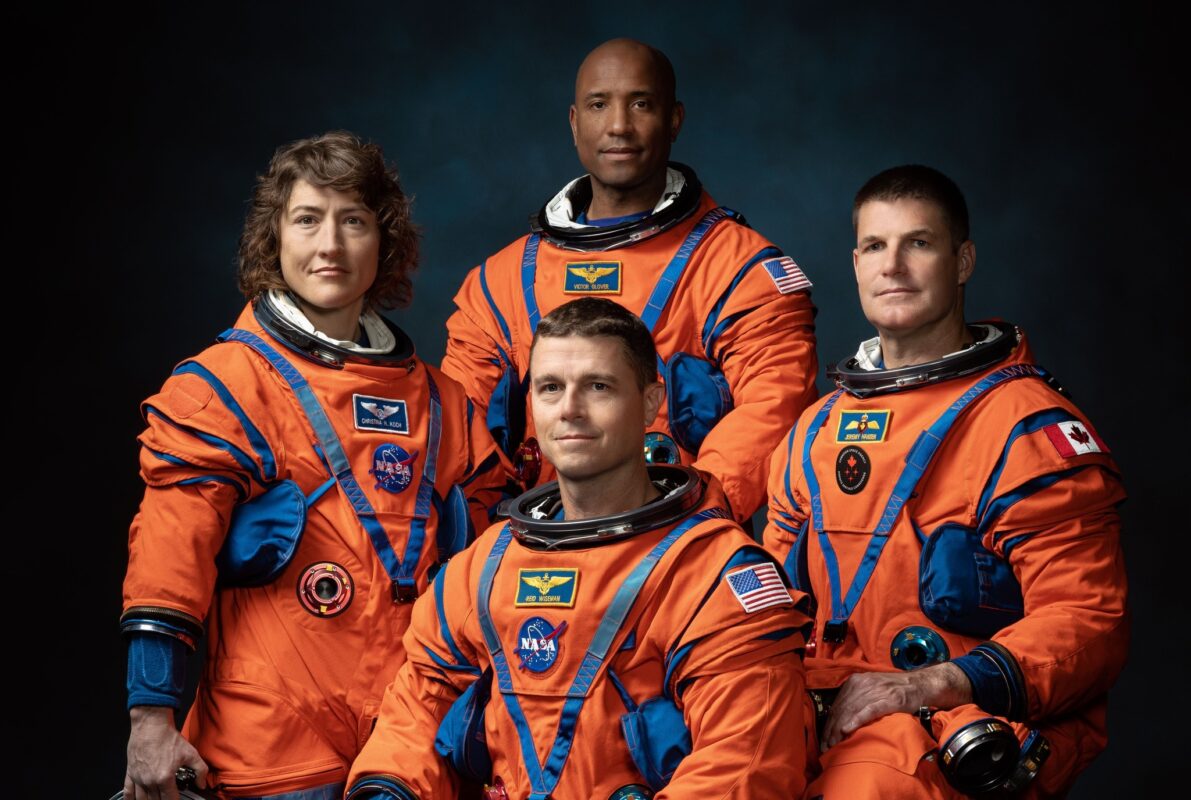
For astronaut Reid Wiseman, talking about the beauty of the earth as seen from space “is like trying to describe a dream to someone,” he says. “In my six months on the [International] Space Station [in 2014], my tiny crew of just three people on the United States side took 300,000 photos. And of that 300,000, zero were part of our job. It’s just when you look out the window, the earth is so beautiful, you can’t stop.”
Soon, Wiseman will have a new perspective from which to view earth—from about 230,000 miles away. As the commander of NASA’s Artemis II test flight, which may launch as soon as Feb. 6, Wiseman will lead his crew on the first manned mission to the moon in 50 years, marking a significant return to the exploration of deep space.
At maximum distance, the crew will fly approximately 4,600 miles beyond the moon before turning and returning home. When he’s experienced that view in a simulator, the earth was about the size of a golf ball.
“It just stopped me in my tracks,” he says. “I can’t imagine what that feeling will be like. It could induce almost a panic feeling that you’re so far away. Or it could be the most awe-inspiring image you’ve ever seen in your life.”
The success of their journey, which will go around the moon, will set the stage for the next mission to the moon’s surface and, ultimately, the creation of a sustainable human presence there. A presence that could be foundational to humans reaching Mars.
Wiseman, 50, is preparing to make a trip many dream of, yet as a kid growing up in Cockeysville, he was more enamored of trains than rockets.
His family’s home in the Springdale neighborhood abutted the Loch Raven Reservoir. Wiseman recalls a happy childhood “riding the coattails” of his older brother, hiking and biking the watershed trails, and exploring the woods. Their house was also close enough that when Wiseman heard the whistle of the trains pulling out of the quarry in Texas, near Hunt Valley, “If [my dad] was home from work, we would jump in his car and we would drive down and I would just watch the freight trains come in and out of the quarry.”
Seeing A-10s flying from Martin State Airport sparked his interest in flying. And watching the 1986 Challenger disaster as a student at Warren Elementary was something he describes as “hugely formative.”
He graduated from Dulaney High School and Rensselaer Polytechnic Institute in New York, and has a master’s degree from Johns Hopkins. A veteran who has received numerous service medals, he was a lieutenant commander in the U.S. Navy deployed in the Middle East when he was selected for astronaut training.
It was his experience as a Navy test pilot that cemented his future in the air. He can still remember the first time a flight instructor put the controls of a plane in his hands.
“It’s just like, when you go to the Baltimore Symphony Orchestra, and the first chair violin starts playing and it makes you cry,” he explains. “That person is gifted and we’re so fortunate that someone put a violin in their hand. Somehow, somebody put an airplane in my hands.”
“It’s like when you go to the Baltimore Symphony Orchestra, and the first chair violin starts playing and it makes you cry. That person is gifted, and we’re so fortunate that someone put a violin in their hand. Somehow, somebody put an airplane in my hands.”
Wiseman—who currently lives in Houston, Texas, where he’s based out of the Johnson Space Center—spent six months as a flight engineer on the International Space Station for Expedition 40/41 in 2014. So, the real pressing question is: What’s it like to be in space?
“Immediately after launching, I felt horrible for four days,” he says. “Everything is floating inside you—we call it fluid shift.” He explains that things that would be impossible on earth—”You can move a refrigerator with your pinky”—are easy, while something as simple as eating trail mix becomes complicated. “And you never get to sit down at the end of the day on a couch and just sigh a breath of relief,” he says with a smile.
Wiseman’s background as a test pilot makes him well-suited to the Artemis II mission. Unlike the Space Station, which has been around for long enough that it has a level of familiarity to it, Wiseman and fellow astronauts Victor Glover, Christina Koch, and Jeremy Hansen (of the Canadian Space Agency) will be the first to fly the Orion spacecraft. He explains that the crew will do a tremendous amount of manual operations to ensure the craft’s systems work.
The success of their journey, which will go around the moon, will set the stage for the next mission to the moon’s surface and, ultimately, the creation of a sustainable human presence there. A presence that could be foundational to humans reaching Mars.
He notes the many international partners who have contributed to the mission, as well as the Artemis Accords—a set of principals meant to guide civil space exploration—which have been signed by 61 nations as of January 2026.
“This is really an international effort and an international team setting the stage for what we can do as humanity going forward,” says Wiseman.
Preparation for the launch has been long and extensive. On any given day, Wiseman could be in training for the crew’s splashdown in the Pacific Ocean, in a Russian language class, or even at a hospital learning how to do basic first aid and procedures like how to run an IV. Wiseman has shared his experience through his popular mission updates on Instagram, @astro-reid.
When the Artemis II launches, Wiseman will leave two teenage daughters on earth. While he says he has some hobbies—golf, racing go-carts—his main passion outside of space is being a dad. Wiseman’s wife, Carol, died of cancer in 2020, and he acknowledges that him going to space is “a selfish ask” of his kids.
“There’s a very real reason that we still live in Houston,” he says. “When my wife started getting sick, I wanted to move towards family. But she said, ‘No, this is where you work and you love your job. And we should not give that up for this.’ Also, I want my kids to know that you can still achieve and go on and pick yourself up. I think when I said, “This is something that I want to go do, it’s important to me, and I think I can do a good job at this,’ they were aligned very quickly.”
Still, he says one of the hardest things about being away from his hometown is the distance from his support network, including his brother and dad (who still lives in that idyllic Cockeysville home), his friends, and his wife’s extended family.
He gets back frequently for Ravens games, high school reunions, and occasionally speaks to students at Dulaney. Mostly, he hangs out with his dad and enjoys being in nature, walking the same woods and paths he did as a kid, which he will soon be viewing from thousands of miles of away.
It’s not a trip he takes lightly.
“I’m most scared about what I call ‘the arrogance of humanity,’ to think that we could throw some hydrogen and oxygen in a giant tank, light it on fire, and send us to the moon,” he explains. “We’re trying to contain a tremendous amount of energy right there. And when we come back and hit first atmosphere on the way home, we hit the atmosphere at about Mach 39—39 times the speed of sound. And dissipating all of that energy to come back under parachutes alone in the water. There’s not tons of room for error there.”
“I’m most scared about what I call ‘the arrogance of humanity,’ to think that we could throw some hydrogen and oxygen in a giant tank, light it on fire, and send us to the moon.”
But for someone who has several thousand personal photos of the earth from outer space in his family albums, it is worth it to advance the international partnership of scientific exploration—and, most importantly, to share the experience with his team.
“Jeremy [Hansen] has never flown in space; I cannot wait to hear his gasp when he sees earth for the first time and sees how beautiful it is,” he says.
“Then the image in my mind that I most want to see is Christina or Victor, or both of them, looking out the windows and the only thing illuminating their faces is the glow of the moon as we’re going around the far side of the moon. And just knowing that they will view the moon differently than I’ll view the moon. And differently than you would view the moon. I just want to be there to watch their reaction as they look out the window at that view, because it will be very special.”