
Partner Content
According to the American Cancer Society, one in three women will develop cancer (including skin cancers) at some point in their lifetime. For women with certain cancers, including breast and gynecologic cancers, there is a unique treatment option conveniently available in Baltimore: Proton therapy. The Maryland Proton Treatment Center (MPTC) is the only proton center in the state, has treated over 6,000 patients, and just celebrated 10 years of service to the community.
Here, Baltimore speaks to Dr. Nichols from MPTC’s Women’s Health Team about cancers affecting women, the treatment options available, and when proton therapy may be a viable option:
What can you share with us about cancers affecting women?
While cancer rates are generally declining in men, cancer cases continue to rise among women. For the first time, women under 50 are diagnosed with cancer more often than men in the same age group. Breast cancer remains the most commonly diagnosed cancer in women. Uterine cancer is also prevalent, and cases are increasing, especially among non-white women. Racial disparities persist in cancer incidence and mortality for both men and women; Black and American Indian/Alaska Native women face higher rates of specific cancers and lower survival rates, according to the American Cancer Society.
Let’s turn now to screening. What are your recommendations when it comes to screening for cancers such as breast cancer or gynecologic cancers?
For women, cancer screening recommendations vary by age and individual risk factors. It’s crucial to talk with your OB-GYN or primary care provider for personalized advice tailored to your individual circumstances, including genetics, family history, race, lifestyle, and environment. But in general, the American Cancer Society recommends these screening milestones for women at average risk with no significant family history:
- Between 40-45 patients have the option to begin mammographic screening annually
- Between 45 and 54 to have an annual mammogram
- 55+ to obtain mammograms annually or can transition to every other year.
- Mammographic screening should continue as long as a woman is in good health and has a life expectancy of 10 years. Following this, it can be an individual conversation with a patient and their doctor.
- For women who have a family history of breast cancer or other high-risk factors, screening recommendations may differ and may occur at a younger age. The initiation of screening should be discussed between a patient and their physician.
- Guidelines for cervical cancer screening have recently changed.
For cervical cancer, screening generally begins in the adolescent/young adult range. However, cervical cancer guidelines have recently changed! It is outside the scope of this article to include full details, however screening has now been changed to be based on HPV testing for average-risk patients. Self-swabs are also now available. Please speak with your doctor to determine which screening tool is best for you.
If someone is diagnosed with breast or gynecologic cancer, what advanced treatment options are available?
Because every cancer case is unique, it’s critical to understand all your options. It’s common for patients to require multiple types of treatment depending on the type of cancer and its location in the body. Fortunately, there is a range of advanced treatment options available, such as proton therapy, that allow patients to get back to their lives sooner. Proton therapy can be combined with treatments like chemotherapy and surgery. MPTC is affiliated with the University of Maryland School of Medicine and can ensure seamless care with any additional treatments, including but not limited to chemotherapy, surgery, brachytherapy, GammaPod, and stereotactic radiation treatments. As University of Maryland School of Medicine radiation oncologists, our Women’s Health Team works as part of a multidisciplinary oncology team, collaborating to provide the best type of treatment for each and every patient.
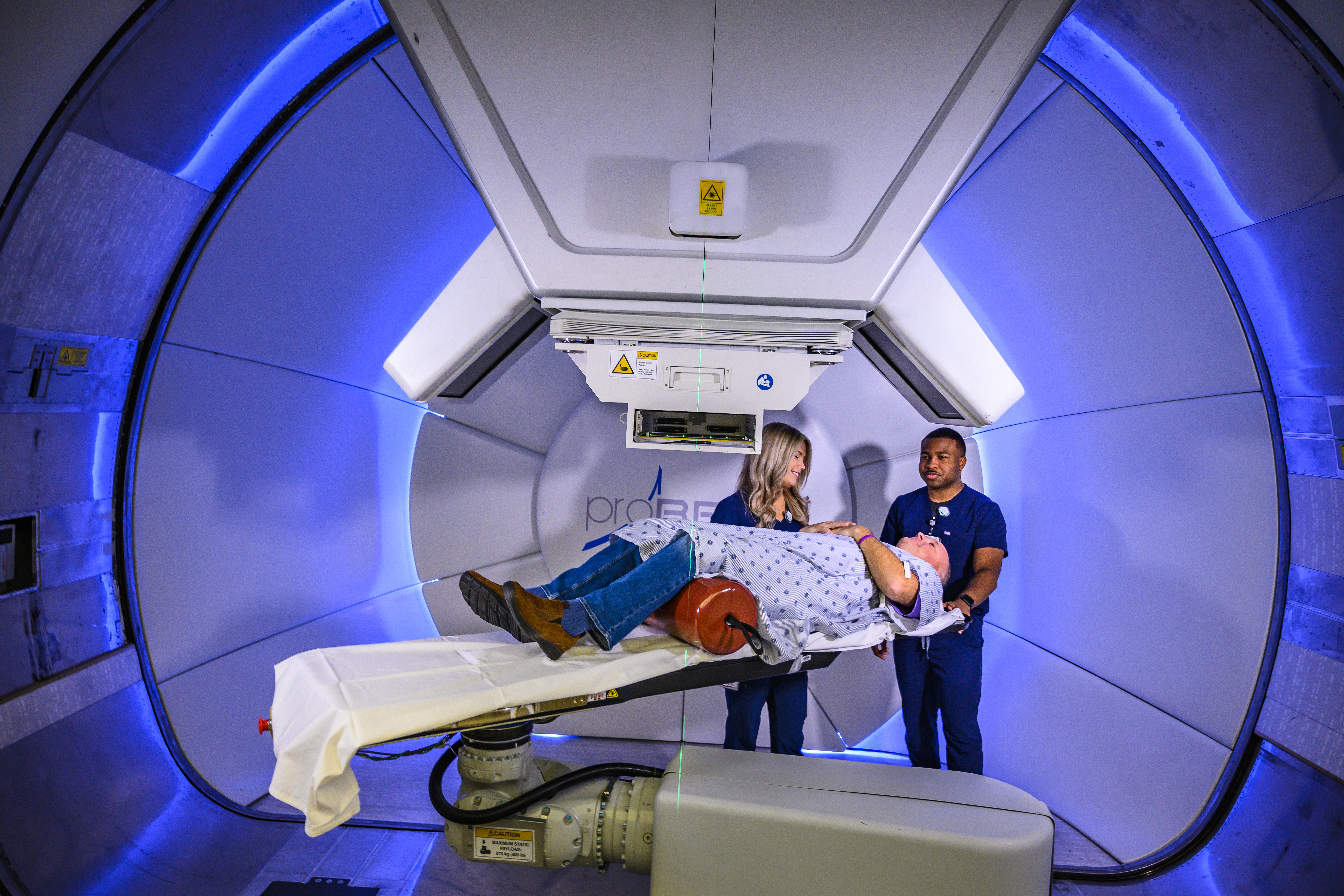
What is proton therapy, and how is it different from other forms of radiation?
Proton therapy is a specialized form of radiation therapy, but it uses a proton particle to deliver treatment compared to traditional or photon radiation.Protons can enter the body and stop on a dime, while most other types of radiation are unable to do that. Photons, on the other hand, pass through the body like an X-ray, exposing normal organs to radiation as they exit the other side. Protons can lead to less radiation exposure of normal organs, which can translate into fewer issues both during and after treatment.
What makes proton therapy different from traditional radiation when it comes to treating cancers affecting women?
When treating cancer, it is important to balance eliminating the cancer with the downsides of treatment side effects. As mentioned before, proton therapy releases energy within the cancerous tumor or in the area at risk of recurrence, delivering a maximum dose that stops directly at the target site. When treating breast cancer, this results in less radiation to surrounding healthy organs, which significantly lowers a woman’s chance of developing long term side effects to the heart or lung or a second cancer diagnosis. For gynecologic cancers, this means treatment may have less impact on important nearby structures, such as the kidneys, pelvic bone, intestines, rectum, and bladder. As a result, women often experience fewer short- and long-term urinary and bowel side effects compared to traditional radiation.
For women with co-morbidities such as cardiovascular disease, COPD, diabetes, or obesity, proton therapy helps prevent worsening of these conditions and reduces the risk of second cancers.
Looking ahead, is proton therapy a good option for recurrent cancer?
Yes, proton therapy is a great option for recurrent cancer. In fact, it has become the standard of care. If you have had radiation to treat a specific area of the body in the past, it may be difficult to treat that area again with traditional radiation. That is not the case with protons. In most cases, we can safely re-irradiate a previously treated area. This makes proton therapy a critical tool in the cancer-fighting toolchest.
Lastly, many patients wonder about affordability. What about cost? I’ve heard that proton therapy can cost more than traditional radiation.
At MPTC, we’re committed to providing excellent care and making proton therapy an affordable option for our patients. While proton therapy has a reputation for being an expensive treatment in other parts of the country, at MPTC, the cost of proton therapy is similar to the cost of traditional radiation therapy. This pricing is based on a cost-neutral model that ensures patients have access to the best radiation treatment for their cancer right here in Maryland. MPTC has a 90%+ insurance approval rate and accepts most insurances, including Medicare and Medicaid.
Every woman is unique, and so is their health. Please consult with your physician for personalized guidance for cancer screening and cancer risk.
To learn more about proton therapy and request a consultation, visit MDProton.com.