
Timothée Chalamet has been acting a bit strangely lately. It started last year, when he won the SAG Award for A Complete Unknown and said in his acceptance speech that he wasn’t just aiming to be good, but wanted to be one of the all-time greats. This behavior continued during his press tour for Josh Safdie’s ping pong odyssey, Marty Supreme. “I’m doing top-level shit,” he said during one interview. “It’s been seven, eight years I’ve been handing in top-of-the-line performances.”
There is something off-putting about this level of bravado and ambition especially when it’s applied to an art form which isn’t—or at least shouldn’t be—about scoring wins and besting your competition. On the other hand, I’d be lying if I didn’t admit it was kind of refreshing, too. False humility is as bad—hell, it’s worse—than Chalamet’s WWE-style boasting. The actors who pretend to rise above it all, the ones who say, “Oh gosh, I didn’t even realize I got an Oscar nomination; I was in my garden when I got the call from my manager”—truly work my nerves. (Girl, please. You were glued to your TV surrounded by your publicist, your dietician, and your glam squad.)
That said, at some point, I began to wonder if what Chalamet was doing was merely schtick. He’s proven himself to be an incredible self-promoter—remember when he turned up to the Timothée Chalamet Look-a-Like Contest? (He lost.) Could all of this bragging and grandstanding be some sort of meta promotion for the film? Might he be the first actor to take The Method all the way through the press tour?
I think the answer is yes and no—which is possibly what makes Chalamet the perfect actor to depict Josh Safdie’s patented brand of manic New York city hustler.
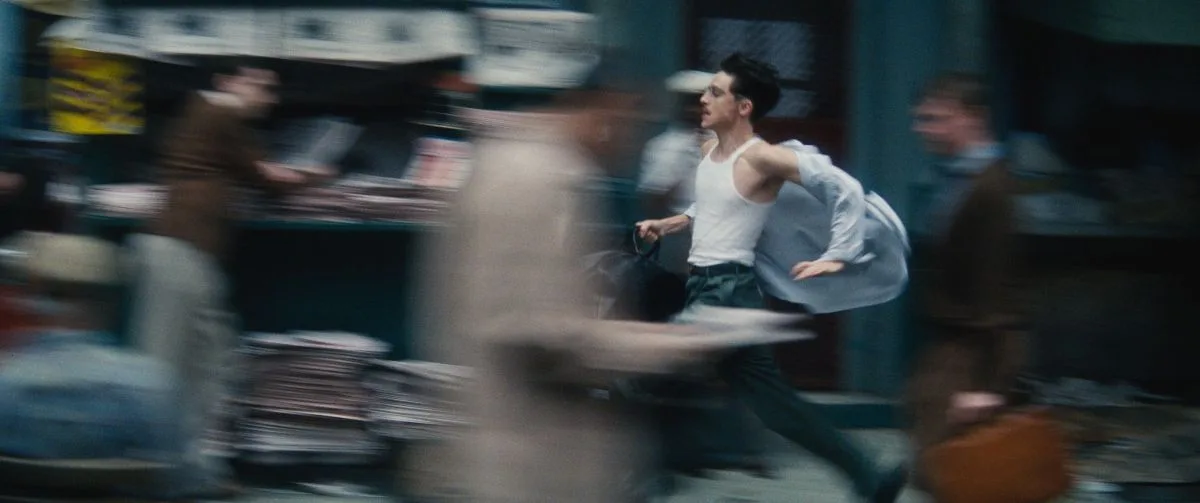
In a way, Chalamet has always been this nervy, hopped up kid from Manhattan. He’s street smart, like all New York kids (yes, even the privileged ones) and he absorbed a lot of New York hustle culture, which is all about perpetual motion and grandstanding and faking it till you make it.
This is Josh Safdie’s first film made separately from his brother, Benny (who made some waves of his own this year with the more conventional sports biopic, The Smashing Machine) but it feels exactly like the brothers’ early work, Good Time and Uncut Gems.
Those films were about strivers and con artists who were also kind of losers. In my capsule review of Uncut Gems, in which Adam Sandler plays a diamond broker who is addicted to gambling, I said: “It’s honestly a nightmare—a nervous breakdown of a movie that never allows you to catch your breath….The Safdie brothers film [Sandler] like a shark that needs to keep moving to survive.”
I honestly could have cut and pasted that review for Marty Supreme, but there are a couple of key differences. For one, it takes place in post-war Manhattan, beautifully and painstakingly recreated by master production designer Jack Fisk. And Marty Mauser (loosely based on real ping-pong legend, Marty Reisman) actually is talented. He is one of the best ping pong players in the world, if not the very best, as he’ll tell anyone within earshot.
When the film starts, he’s peddling loafers and pumps at his uncle’s shoe store. Of course, he’s a good sales person, too—he knows how to lay on the charm. His uncle just wants to promote Marty to manager and be done with it, but Marty explains that he’s only working there to raise money to compete in the upcoming British Open. Marty’s mother (Fran Drescher) also wants him to stop pursuing this ridiculous table tennis dream and settle down like a normal Jewish son. She keeps faking a debilitating illness over the phone in an attempt to get him to come home from whatever tournament he’s playing in. (You can’t con a conman—he never buys it.)
Marty has a girlfriend, of sorts, named Rachel (Odessa A’zion), who is married to a dullard named Ira (Emory Cohen). In the first scene, she and Marty have a quickie in the supply closet and she gets pregnant—a detail that will animate much of the film.
Marty never has enough money to get where he wants, he’s always scheming and stealing and hustling—but he’s monomaniacal. It’s all about ping pong. Even sex and love are secondary to the game he’s obsessed with. (When Rachel tells him she’s pregnant he makes it clear he wants no part of raising a kid.)
I never thought I’d be writing this phrase, but I wish the film had even more ping-pong scenes. Whether he’s at a tournament or hustling some backroom players in a bowling alley with his buddy Wally (Tyler the Creator)—it’s a joy to watch Marty play. Ping-pong players are marvels of speed, hand-eye coordination, and leaping ability and when Marty’s on his game, it’s electrifying. (After months of rigorous training, Chalamet performed all the table tennis scenes himself, without a body double. Top level shit, you might say.) Marty is obnoxious, of course, when he plays—shouting, cursing, crowing—but he’s gracious when he wins, which is most of the time, wrapping his opponent in a bear hug. However, at the London Open, he finally meets his match, a steely-eyed Japanese player named Koto Endo (Koto Kowaguchi) who surprises Marty with his thickly foamed paddle and lightning fast reflexes. (Unsurprisingly, Marty is also a menace when he loses, cursing at the refs and falsely calling out Endo for cheating.)
While in London, staying at a fancy hotel he can’t afford (he charged it to the International Tennis Table Federation, against their express objections), he lays eyes on aging movie star Kay Stone (Gwyneth Paltrow) who’s in town to do a play, and decides to pursue her, just because. He does so with the same dogged determination and unearned confidence with which he does everything else. Somehow it works and they become lovers.
Kay is married to a wealthy businessman named Milton Rockwell, played by Kevin O’Leary of Shark Tank fame. (I confess I spent the entire film trying to figure out what movies I’d seen this excellent actor in before—was he in The Irishman? A season of The White Lotus? It was a bit of a head slapper when I finally googled him.) Rockwell offers to sponsor Marty but he’s the kind of man who likes to lord his wealth and privilege over the little guy—and he’s a sadist, as he proves in one particularly memorable scene.
One of the other major plot points involves a gangster’s German Shepherd that Marty has somehow managed to lose—and it’s not clear who will kill Marty first, the dog, the dog’s new gun-toting farmer owner (Penn Jillette, in an amusing cameo), or the gangster himself.
Some have argued that Marty is an asshole and that his quasi-redemption at the end of the film is unearned, but I don’t see it that way. I think Marty is part asshole, part mensch (classic example: He steals a chunk of an Egyptian pyramid…to give to his mother as a gift). His Jewish family, still traumatized by the Holocaust, has lots of love and lots of tsuris—just like Marty himself. Note how Marty always offers a sincere “I love you,” as he rushes out of any room.
In case I wasn’t clear above, Chalamet is fantastic in this role. It may very well be his best work yet, in a career filled with excellent performances. You could make the case that Safdie’s film allowed him to evolve into his purest form—the antsy, quicksilver street hustler who was in there all along.
“I feel like the gift of my life is to focus on this acting thing the way Marty Mauser is locked in on ping pong,” he recently told Vanity Fair.
Mission accomplished, Timothée. Mission accomplished.