Arts & Culture
The BMA’s ‘Turn Again to Earth’ Series Digs Deep Into the Realities of Climate Change
Chief curator Kevin Tervala discusses three new exhibitions and how they align with the series' environmental focus.
Born in part from the climate-change protests at museums here and abroad, the Baltimore Museum of Art launched an ambitious collection of environmentally driven initiatives in 2024. Taking its title, Turn Again to the Earth, from the writing of environmental activist Rachel Carson, the ongoing series finds it themes in “the realities and repercussions of climate change [that] have become part of our daily discourse and experiences,” as BMA director Asma Naeem explained in announcing the effort.
Among the highlights to date was The New York Times-acclaimed Black Earth Rising exhibition, guest curated by London-born writer Ekow Eshun, which explored the relationship between race, colonialism, and the climate crisis.
Opening recently and running through early 2026 are three new exhibitions that are a part of the Turn Again to the Earth series— “Deconstructing Nature: Environmental Transformation in the Lucas Collection,” “Engaging the Elements: Poetry in Nature,” and “The Way of Nature: Art from Japan, China, and Korea.”
As Carson writes in her titular work: “In these troubled times it is a wholesome and necessary thing for us to turn again to the earth and in the contemplation of her beauties to know the sense of wonder and humility.”
We recently caught up with BMA chief curator Kevin Tervala to explore the series’ highlights and its overall mission.
One thing I’ve come to appreciate over the past year is the challenging nature of these exhibitions—and the realization that art can be beautiful, powerful, and disconcerting at the same time.
There is an experience [of art] that is just beauty. There is so much depth in Matisse when we look for it, but his work is also pleasing to the eye. Beautiful colors. A great sense of composition. You may find his work rich and beautiful and stunning, but his paintings are not meant to make you a bit “scared,” which is what [you’re talking about].
There is this concept art historians talk about regarding landscape and nature representations called “the sublime,” which is that feeling you get when you stand on the edge of the Grand Canyon, and it’s beautiful, it’s awe-inspiring, and it’s a little terrifying.
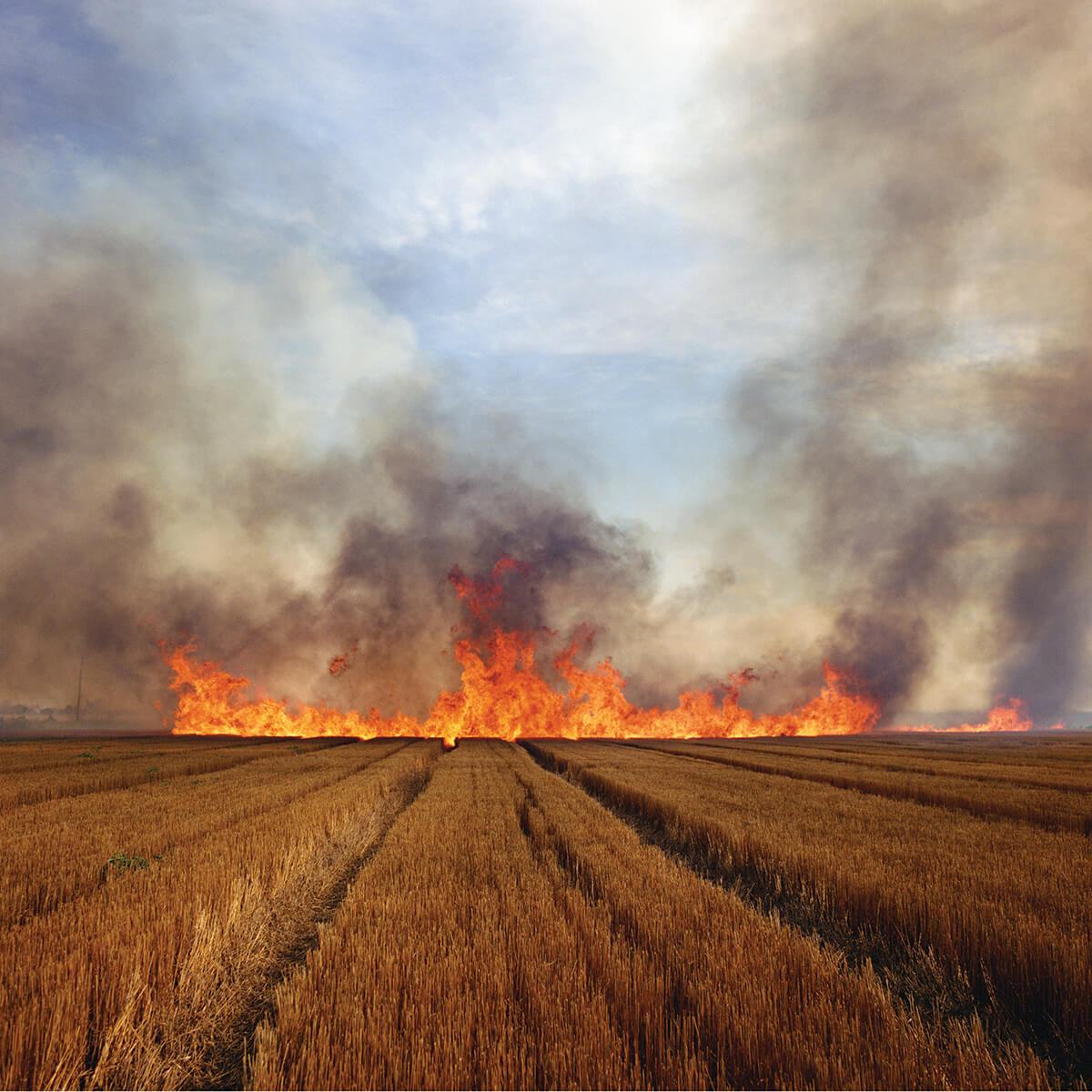
That’s a perfect description of the wheatfield burn photograph (above) by Larry Schwarm in the “Engaging the Elements: Poetry in Nature” exhibition.
I think that photo is so alluring precisely because it hits that right note of beauty and terror at the same time.
Somewhat similarly, I like Richard Misrach’s stunning, all-blue image of California’s strange Salton Sea, which went from resort area to health hazard to ghost town. What is one of your highlights?
I love the pairing of contemporary artist Stacy Lynn Waddell, whose work we acquired for the collection, and an artist’s work who inspired her, Winslow Homer. They’re both depicting, separated by a century, the after-effect of a hurricane. This beautiful watercolor from Homer is showing the brilliance you get after a storm goes through, the sun is shining. But there’s destruction. She’s thinking about the perspective of enslaved folks living in the Caribbean during this time, the impact of the hurricane [on their lives], and the transformation of the land. They’re thinking about the same things and depicting them in very different ways.
On a different note, the renderings of the Seine River and River Thames at the start of 19th-century industrialization in the accompanying “Deconstructing Nature” show are timely. Those long-polluted waterways are now being reclaimed and made possible for swimming.
In every chart about pollution or the Industrial Revolution, you have a line on a graph that’s hovering toward the bottom and then, at the late part of the 19th century, spikes up. So do urban populations. It’s the rise of cities. It’s a pivotal moment in European history, in world history, and artists are capturing that.
Let’s discuss the third, new show, “The Way of Nature: Art from Japan, China, and Korea.” It’s a centuries-spanning exhibition of ceramics, textiles, wood-cuts, watercolors—even large-scale photographs—but everything seems to communicate an intrinsically human, one might say spiritual, connection to the earth.
The intro text for the exhibition starts, if I’m remembering correctly, with a quote from a 4th-century landscape painter from China who is saying, to understand and to depict the natural world, you must fuse your mind into it. You must become one with the landscape you’re representing.
It’s what we wanted to do with this exhibition. We wanted to showcase other alternatives, ways of being [in the world]. The society we live in right now, it doesn’t have to be the world we live in, in the future. You can imagine new possibilities or you can look elsewhere and see how other places and other people have done it.