Arts & Culture
With the Arts Under Fire, D.C.’s Loss Has Been Baltimore’s Gain. How Do We Sustain the Growth?
Amy Sherald, Phillip Glass, The Washington National Opera, and more artists and audiences are sheltering here—and it's raising our cultural profile.
In January, famed composer Philip Glass announced he would no longer debut his new symphony, Lincoln, at The John F. Kennedy Center for the Performing Arts, noting that the institution’s leadership was misaligned with the premise of a work about Lincoln’s views on American democracy.
The decision was one of protest, even before President Donald Trump’s February announcement that he would close the center (a move later blocked by a federal court order). But already the ill wind of a culture war was blowing through Washington, D.C., a battle that started within weeks of Trump’s return to the White House after he fired the board of the Kennedy Center and appointed himself chairman.
In Baltimore, the town of Glass’ birth, the news hit a decidedly more pleasant chord.
“The BSO tries to be intentional and opportunistic to provide whatever we can to our audiences,” says Mark C. Hanson, president and CEO of the Baltimore Symphony Orchestra (BSO), “so when we learned that Philip Glass’ new symphony, his 15th, would not premiere at The Kennedy Center, we immediately reached out and made the case that it might be entirely appropriate for it to receive its Mid-Atlantic premiere in Baltimore, given the fact that he had been raised here.”
Hanson says Glass’ team welcomed the opportunity to shift the performance, which will take place in June 2027 at both the Meyerhoff and Strathmore, the BSO’s home in Montgomery County.
“It’s a fitting way to make sure that audiences in both markets have the opportunity to experience what will be a major artistic statement that Baltimore’s own Philip Glass will be making at this interesting point in history,” says Hanson.
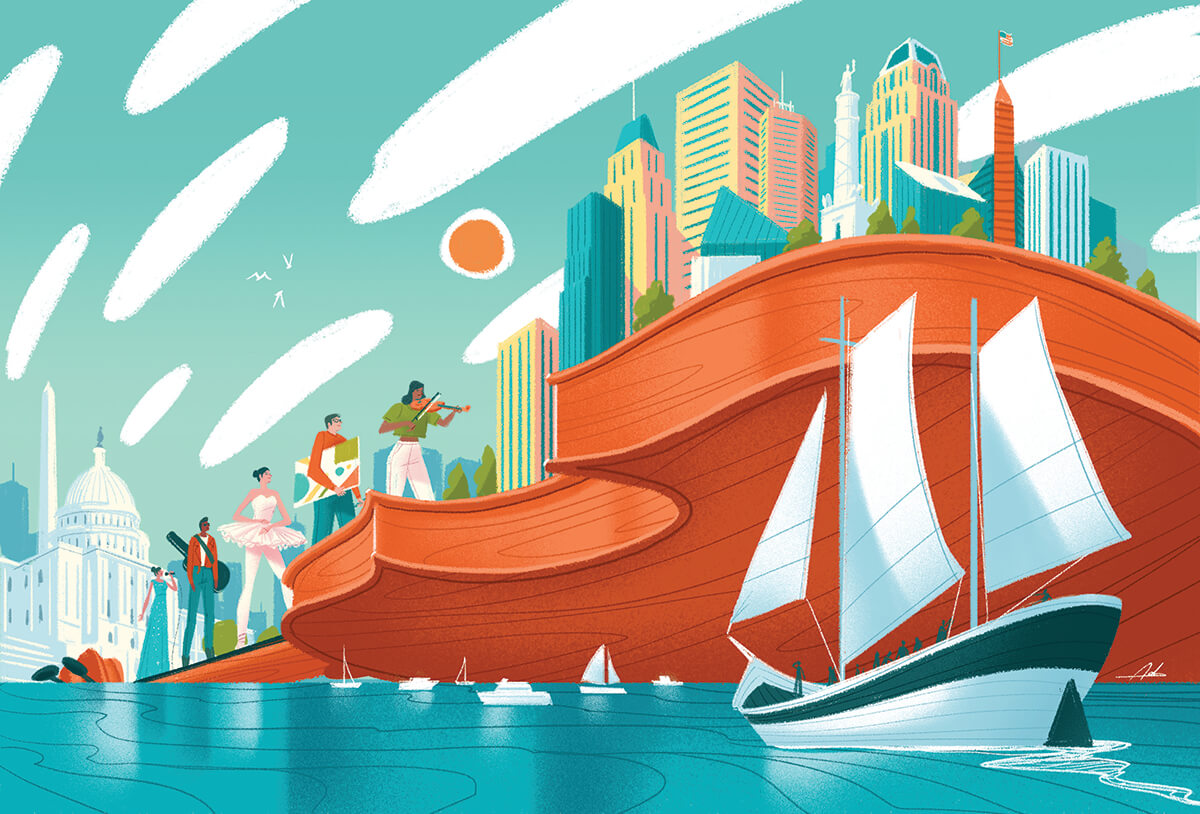
When the Glass performance moved, it joined a growing list of arts refugees from D.C. who have found a welcome home in Charm City. Baltimore is known as a creative’s town, but with more artists and audiences sheltering here, its cultural profile is on the rise—and we’re already reaping the benefits.
Amy Sherald chose to move her much-celebrated exhibit, American Sublime, from the beleaguered National Portrait Gallery to the Baltimore Museum of Art (BMA), where it broke attendance records—84,000 visitors over its 22-week run, more than double the museum’s projections. The Washington National Opera, under the baton of Marin Alsop, shifted performances of West Side Story to The Lyric away from the troubled Kennedy Center.
When Lena Waithe’s playwriting debut of trinity at Baltimore Center Stage (BCS) coincided with Issa Rae, the creator and star of HBO’s Insecure canceled her planned appearance at The Kennedy Center due to “an infringement of values.” Rae instead joined Waithe for a post-performance talkback on stage in Baltimore. The event sold out.
D.C.’s loss appears to be Baltimore’s gain. The BMA reports an increased interest from arts donors and supporters in Washington, including a 275-percent increase in membership from D.C. residents over the previous year. The BSO has seen average capacity for its core classical and pops programs grow at both its venues over the last several seasons from an impressive 51 to 66 percent at the Meyerhoff and a marked 45 to 74 percent at Strathmore.
Hanson is careful not to draw a direct line between the actions of any administration or institution when looking at those statistics. He explains that it is just Baltimore—and its arts institutions—doing what they’ve always done.
“Baltimore has always punched above its weight when it comes to arts and culture, and we’ve had to be gritty in our efforts to make sure that Baltimoreans and those outside of Baltimore know about the quality and the quantity of arts and culture in the city,” he says. “Over the last year or so, we have certainly gotten wonderful feedback from our audiences at Strathmore that they deeply appreciate the BSO’s almost-weekly presence there, the intentional, relevant, and compelling programming, and just the institutional embrace of audiences of all backgrounds,” he adds.
“We are a place that cares deeply about artists as human beings, and people are really seeing that.”
Aside from the movement of actual exhibits and performances, it is hard to state cause and effect between the events in D.C. and their impact on Baltimore. But Robyn Murphy, CEO of Create Baltimore, the nonprofit city arts council, is not shy about sharing what she sees.
“I will tell you for sure—everything is up. Attendance, visitorship, applications for arts programming—all up and significantly, it’s not even by a little bit.”
Murphy says Baltimore is in nothing short of a “cultural renaissance.” “The intentionality of rebuilding the cultural ecology in Baltimore post-COVID combined with the political tensions that are running through Washington and other parts of the country for arts and artists have converged into people really seeing this very beautiful thing that happens in our city,” she says.
While Baltimore has long been a far more affordable place for artists to live and work than its neighbors—D.C., Philadelphia, New York—the draw now goes beyond the cost of rent.
“Artists are choosing Baltimore because of the safety and creativity that exists here that doesn’t exist in other places,” says Murphy. “Sure, you can go to Atlanta, where they have five gazillion [arts] tax credits, but last I checked, Atlanta was in the state of Georgia, which, for all intents and purposes, is not a place that an artist could find safety and friendliness.
“Women’s rights are being assaulted there, whereas my state codified them in its constitution. LGBTQ people do not feel comfortable in that state. My state has provided protections for them. Not only is there a culture of creativity here, but as an artist and as people who are working behind the scenes on arts productions, we are a place that cares deeply about artists as human beings, and people are really seeing that.”
Murphy points to the fact that in May, Maryland became the third state in the union to sign the Protecting Artists’ Creative Expression (PACE) Act into law. PACE restricts the use of a defendant’s creative works—such as song lyrics and poetry—as evidence in criminal trials, putting significant guardrails around First Amendment rights.
“Baltimore’s artistic scene is weird, it’s funky, it’s off the beaten path, and it’s proud of that, and it’s always been that. It’s what drew me here from New York,” says Stevie Walker-Webb, artistic director at Baltimore Center Stage (BCS).
He explains that it’s gotten so expensive to make theater that institutions don’t want to take risks for fear they won’t recoup their investment. But in Baltimore, you can still “take a big swing at a new work” he says. One example is the play Mexodus, a hip-hop musical that premiered at BCS in 2024. It’s gone on to enormous success Off-Broadway and is now embarking on a national tour.
Instead of dialing back representation of women and minorities in the theater, BCS has doubled down “in opposition to the foolishness that’s coming out of the White House,” says Walker-Webb.
To wit, the theater steadfastly refused to accept federal money that came with the stipulation that they eradicate their DEI (Diversity, Equity and Inclusion) programming.
“We’re an inclusive space where we believe that diversity makes us interesting, that too much homogenization—in any direction—is not a good thing,” says Walker-Webb. “That makes us better artists, and when we’re better artists, we’re better citizens.”
Asma Naeem, the director at the BMA, is of a similar mind. “Baltimore’s greatest advantage is its independence—its ability to define itself on its own terms,” she explains. “Without the gravitational pull of the federal government, there is more room here for experimentation, for risk, for authenticity.”
She explains that the success of American Sublime indicates a heightened awareness around civic institutions and the role they play in public discourse, adding “We’re seeing audiences seeking experiences that feel more authentic and unmediated by the federal environment. Baltimore offers a different kind of cultural engagement—one that is deeply connected to community and lived experience, and in this moment, that distinction feels especially resonant.”
It’s not just audiences and exhibits moving to the area, but artists as well. “Our show that just closed, Holes, was almost a 100-percent local cast, which was really exciting for us—and rare,” says BCS’s executive director, Ken Matt Martin. “A big part of that was that these great actors from the DMV area…when we reached out to them, every single one of them was excited and available—that has not always been the case.”
This is not to say that Baltimore is immune to the negative impacts of a Trump White House that wants to rewrite the cultural narrative away from “wokeness.” Institutions and artists are finding that restrictive language in grant applications, for example, is making it harder to get funding.
“Baltimore is facing the same exact climate as D.C., it’s just D.C. is more public and loud,” says Kenneth Something. Something is a spoken-word artist, three-time national poetry slam champion, and founder and director of Charm City Slam.
He is also program director for the Black Arts District in West Baltimore, manages a number of artists, and has been very active in the production of large festivals, including AFRAM and Baltimore Pride. He’s seen corporate sponsors opt out of supporting events or ask to remain anonymous for fear of pushback, and large grant-giving entities are being scrutinized for their funding choices.
Also, many organizations were able to “whitewash” their identities in order to conform to federal mandates against DEI so as to remain eligible for funding. The Black Arts District literally has DEI hardcoded into its name, making the group ineligible to apply for some federal funds. And Charm City Slam lost all corporate sponsorship nearly overnight.
“A lot of the colleges and institutions that book artists are now saying that they can’t if the work is shaped around their identity,” he explains, noting that this has hit queer, Black, and female poets particularly hard. “I’m asked now if I have any artists who have songs or poems that celebrate the history of the United States versus any work that might talk about, say, gender identity.”
In the absence of corporate and government funds, the local community has stepped up in a big way. For example, Charm City Slam was able to stay afloat thanks to a large outpouring of financial support from people who believe in and value their work. Simply showing up or making a donation has become a radical act of protest and solidarity.
“Buying a ticket, encouraging a friend to buy a ticket, means more now than ever…just look at the way that stories are being silenced,” Something says. “What is needed from the general public, more than ever, is reassurance that they will continue to support the arts, because we are absolutely in a position where we could lose them.”
“Baltimore’s greatest advantage is its independence—its ability to define itself on its own terms. Without the gravitational pull of the federal government, there is more room here for experimentation, for risk, for authenticity.”
If it is true that Baltimore is in a cultural renaissance, the question is how to make it sustainable. It’s not unusual to see Mayor Brandon Scott—even Gov. Wes Moore—at a cultural event. Baltimore is a big small town, and locals tend to show up for its artists, as evidenced by Something’s windfall to keep the poetry slams alive and the extraordinary attendance numbers at festivals, exhibits, and performances. But real sustained growth needs systemic supports.
“The city can play a critical role by recognizing arts and culture as essential to civic health and a strong infrastructure,” says the BMA’s Naeem. “It’s not an add-on or a nice-to-have. That means sustained financial investment as well as policies that make it easier for creative institutions and artists to thrive: affordable space, accessible transit, and arts education in our schools.”
At BCS, Martin says he would like the city to see the workforce development potential in the arts. While audiences see the actors on stage, theaters also need welders, carpenters, web developers, and the like—he’d love to see programs think more broadly about the role artistic infrastructure can play in workforce development.
Cara Ober is the executive director and publisher of BmoreArt. She says Baltimore has always been an artist’s town, while the District is better known for its self-identified collectors (many with deep pockets). She agrees that Baltimore loves its artists but thinks the city could be doing more to provide foundational support for the artistic community that’s here.
For example, she envisions a program similar to the Dollar House movement of the 1970s to shift derelict or underutilized real estate into the hands of artists for studios, galleries, and makerspaces. She also wants to build a collector base for living artists, something BmoreArt prioritizes with its Connect+Collect program that builds relationships between visual artists and audiences who may purchase their work.
With the arts under fire, many institutions have found they’re stronger when they collaborate. Walker-Webb says Center Stage has been doing everything from cross-promoting events and sharing marketing tips, to sharing textiles and set materials with other organizations.
“We’ve really linked arms in this moment,” he says. “When we see things get back to whatever normalcy is, we have to remember that it was our solidarity that got us through this.”
One woman who knows what it means to thrive through adversity is Deborah Rutter, president of The Kennedy Center from 2014 until she stepped down in 2025 amidst the Trump Administration’s shake-up of the organization. She was in Baltimore in June to deliver the keynote address at the Meyerhoff, which was hosting the national conference of the League of American Orchestras. (The conference itself saw record high attendance.)
In the wake of her departure, she was constantly asked what advice she would give to artists and art lovers.
“To the artist, I say, continue to perform, express your art in those places where you feel safe and supported, always in truth, and with the authenticity that is essential to the free expression of your talents,” she told a packed Meyerhoff. “And to audiences, I say, trust the artist, follow the artist, continue to support the artist, wherever they feel welcome, supported, empowered and, importantly, unencumbered to share their art and their storytelling.”
She added that the trend of labeling some art as acceptable and some as not would not only fail, but that it was an exercise in futility: “The artist will always prevail.”
“It’s certainly not a time to be timid, nor to shrink from our shared mission of inclusiveness,” she continued. “It’s not a time to modulate, equivocate, or compromise our unqualified belief that art and its broad accessibility make our communities better, and our society at large more honest and reflective of who we are.”
And Baltimore, simply by staying true to its spirit of inclusiveness and boundless creativity, has been given a chance to shine.