
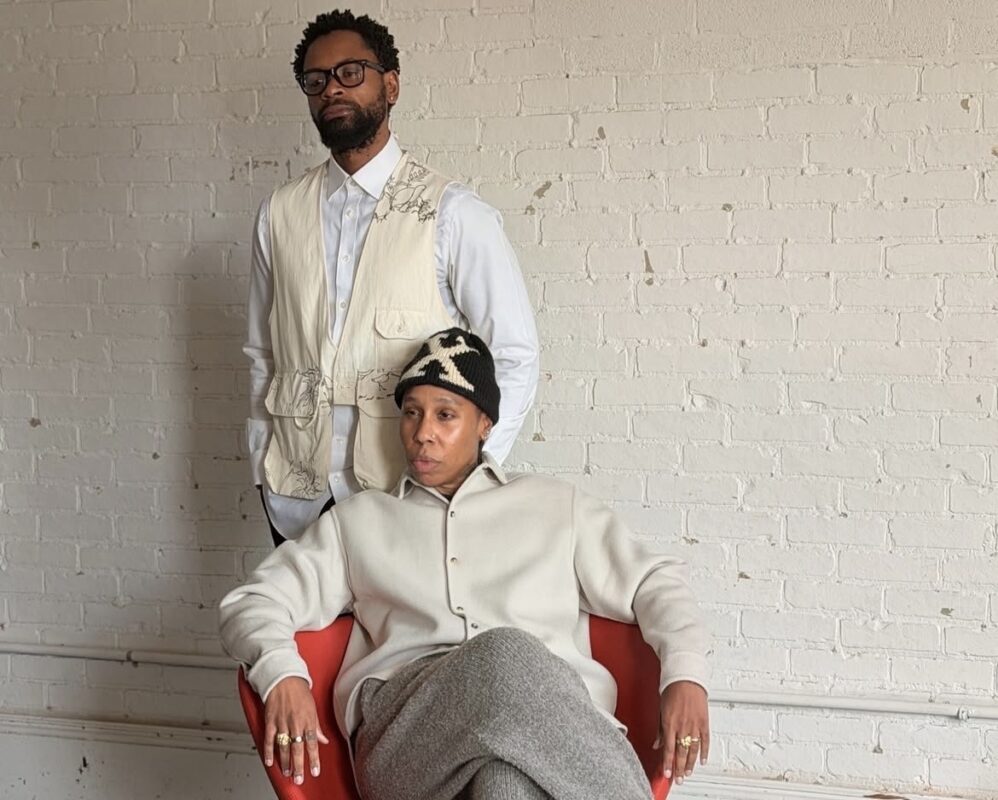
Baltimore Center Stage’s Stevie Walker-Webb is making it his mission to turn Baltimore into an incubator for world-premier theater. Last season, in his first full year as artistic director, he programmed two hugely successful productions: Matthew Weiner’s John Wilkes Booth: One Night Only and Jordan E. Cooper’s Oh Happy Day, which went on to a successful run at New York’s Public Theater in 2025.
Continuing that momentum, this season, Walker-Webb brings longtime friend Lena Waithe—the Hollywood showrunner (The Chi), producer (Dear White People), writer (Master of None), and actor (Westworld), perhaps best known for being the first Black woman to win an Emmy for comedy writing—to Baltimore for her theatrical debut.
Opening in previews at Baltimore Center Stage (BCS) on Feb. 12, trinity, written by and starring Waithe, focuses on three characters confined to a single room and the trifecta of relationships that dominates their lives: family, friends, and lovers.
While the BCS production will feature three Black female actors (Courtney Sauls and Fedna Jacquet, in addition to Waithe), Waithe says she intentionally wrote the script with flexibility built in for casting, so that the characters can be played by anyone—a choice she hopes will help the audience focus on humanity over identity.
At a press conference last week, Walker-Webb, who is directing the show, described trinity, “as if Jean Paul Sartre and Adrienne Kennedy had a baby…with all the swagger that is Lena Waithe.” He added, “It is definitely the coolest thing I’ve ever worked on”—high praise coming from the Tony-nominated director of Ain’t No Mo’.
In anticipation of trinity’s three-week run beginning next month, we spoke with Waithe—who has been in town since early January, rehearsing daily and hitting up Mama Koko’s—about the excitement and vulnerability of her theatrical debut, and why Baltimore was the obvious choice to start this new phase of her artistic life.
What made you decide to venture into theater after so many years in film and TV?
I love TV. I love film. But also, I felt a little too contained in the film and TV space. There’s so many places you can go [with theater]. Being from Chicago, Lorraine Hansbury is one of our favorite writers. Her characters have been embodied by so many different actors and interpreted so many different ways. In theater, you have to, literally, revive—to bring something back to life for a new generation. To me it’s really special and interesting, and I almost wonder if my play would be more timeless than my TV shows or films.
Along with the excitement of your stage debut, was there an intimidation factor?
Yeah, it was intimidating. That’s why I had conversations with Matthew Lopez, with Lynn Nottage, and Martyna [Majok]. I wanted to talk to these playwrights who have inspired me and ask, “What should I know?” I got really great advice. Matthew Lopez said, “Always be chasing a better play.” Martyna said, “There are no rules.” And Lynn Nottage said, “Let people know that there’s a ticking time bomb underneath the bed within the first 15 minutes of the play.”
What was the draw to Baltimore?
Stevie is the person who I wanted to collaborate with, and when he asked if it could be [at BCS], I thought that would be amazing. This theater is on hallowed ground. It’s very sacred. Lynn Nottage opened here. August Wilson [has been here]. These walls, these theaters, these spaces feel like home.
“I almost wonder if my play would be more timeless than my TV shows or films.”
Stevie has spoken with us previously about exactly that, wanting the audience to feel “at home” at BCS. Is that unusual for theater, in your experience?
I think theater has sort of gotten to be this thing that people think of as elitist. I’m from Chicago, and theater is very much in the DNA of our city. Theater just always felt accessible, like our birthright. That’s what I really want theater to be for people. Sometimes when you get into other spaces, you feel very much like you have to be buttoned up. You have to be of a certain ilk. [At BCS], everyone’s welcome. I think that’s what I like so much about Baltimore, as well.
Stevie has also said he wants to create an audience atmosphere that is active. He’s described his ideal theater experience as “a mix between a raucous Southern Baptist church and an Orioles game.” Do you have a similar goal for how the audience will react to trinity?
You know, I’m a big believer in not telling people how to receive your work. That’s up to them. There’s emotional nudity in this play, and [BCS] will have to protect us—you gotta put your phones away because of what we’re revealing on stage. But that’s the only rule.
“This theater is on hallowed ground. It’s very sacred. Lynn Nottage opened here. August Wilson [has been here]. These walls, these theaters, these spaces feel like home.”
Did you discover any big differences between writing for the screen and writing for the stage?
On the screen, every scene has to be short because the attention spans are short. Every scene has to have blood, guts, nudity, sex—something. When I’m watching cuts of the shot, I gotta watch it with my phone in hand. If I find myself looking down or getting distracted, that means we may not be doing our job. In theater, [the audience] has to use their imagination. The beginning of our play starts in outer space. All you have to do [to create that setting for theater] is have some lights and imagination. It brings out the inner child in you when you go see a play.
Personally, one of the reasons I find theater so compelling is because it’s one of the only moments in my life when my phone is absolutely inaccessible. To be in a room with hundreds of other people, all of us focused on the same thing, feels unique and powerful in our culture.
I think now, because there’s so much [online] content coming at us, that live entertainment is something that is going to come back with a vengeance. There’s a time to isolate, there’s a time to gather, and now it’s time for us to gather.
“I think now, because there’s so much [online] content coming at us, that live entertainment is something that is going to come back with a vengeance.”
You’ve said that your intention with this play is to explore humanity, rather than identity. Can you talk more about that?
I’m just so focused on being a human being. It doesn’t mean I’m not proud. I love being Black. I identify as a woman. I identify as a queer person. I come from a working class family. All of those things make up my personality.
But what I have in common with you, with Stevie, with everyone, is that we all want love. We all want shelter. We all want community. We all want safety. And we want the pursuit of happiness. We have more in common than we like to admit, because when we admit that we all have the same needs, then society is actually subject to change. And the truth is, people that are in power don’t want that. Because once we realize that, the water’s gonna look really different.