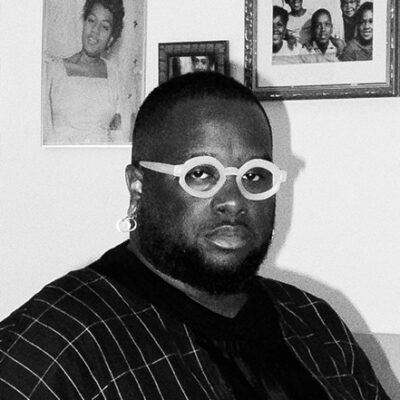
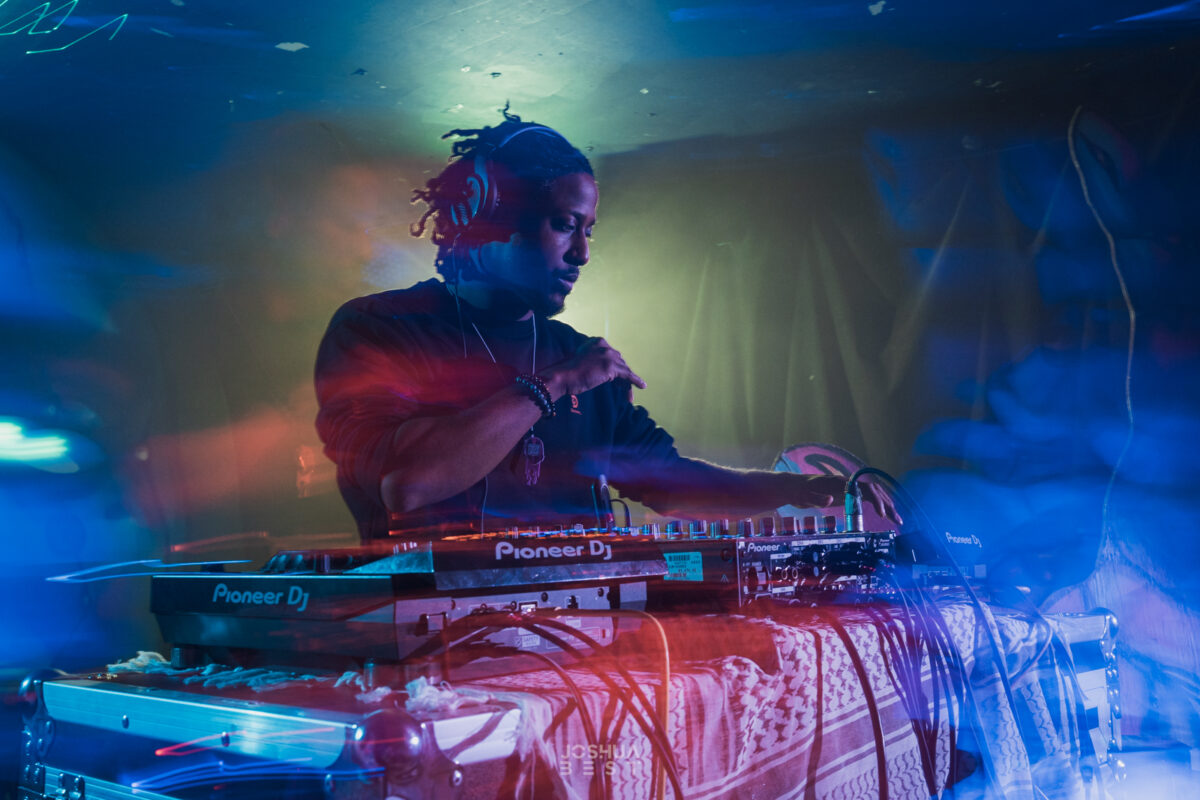
Blair Simms was first captivated by Baltimore Club music through the sounds he heard rumbling through his radio speakers in middle school. As time went on—from witnessing the iconic K-Swift live as a teen to being mentored by producer legends like KW Griff to hearing his own music being played at “shake off” dance parties on the underground Baltimore Club scene—Simms, aka S.DOT, always felt his path was destined for something bigger in this world of music.
Throughout the last 10 years of DJing and producing around Baltimore, the Louisiana-born, Baltimore-bred artist has cultivated his own sound by blending Baltimore Club with electronic genres like gqom and afro house. And that innovative sound has catapulted him beyond bedroom production and DJ sets to a worldwide fanbase. He has performed across the U.S., Canada, U.K., and South Africa. He has been commissioned for remixes with acclaimed artists, like serpentwithfeet, and captivated audiences with a set on the viral Lot Radio.
Now, he’s carrying on the legacy that got him started, and already well on his way to becoming a next-generation star of Baltimore Club. Catch him at his brand-new MAXXED OUT party at The Compound on March 14. With this curated event, S.DOT enters a new era.
What is your relationship with Baltimore Club music? What’s your earliest memory of first hearing it and what was your response to it?
I was about 11 or 12 when I first heard it. I used to listen to the radio at my grandmother’s house, out in Ashburton. I would just tune in and sit by the radio and listen to “The Takeover” with Squirrel Wide and K-Swift [on 92Q]. From there, I think the thing that changed me, that really made me say “I want to do this,” was all of the high-school parties. I was always at those Poly-Western parties. Like every single weekend. I actually met K-Swift there once. And I just really enjoyed being in the element of listening to club music, in the club. From there, I started going to The Paradox.
What was it about the sound that was so interesting to you?
For me, it was always the beat pattern. The beat pattern was so different from things that I had listened to before, but it actually made me want to move. I wasn’t really a dancer. I still wouldn’t say I am now, but I just really enjoyed the way that club music made me feel, the way that the breaks were syncopated. All of that just gave me life. It always felt like an out-of-body experience, listening to club music. And it was something that I really enjoyed just because it was so different from what the norm was.
Because before that, I was in Louisiana. I had some house music that I listened to from the U.K. and Chicago, but I’d never heard club music before. It charged me up differently…I also found it really neat, coming into the Baltimore-D.C. area [later], that where there were two distinct, very Black sounds. And I just fell in love with both club and go-go. They were so different, but still very, very Black.
“Listening to club music always felt like an out-of-body experience.”
What is the biggest difference between being a DJ and being a producer?
Producing is cathartic to me. I love creating new things. It’s the way that I express myself, and I am blessed that other people enjoy the music that I create. But I do that to push all of my stress away. Whereas with DJing, you’re doing the same for other people. You’re creating your own world when you DJ—your set is a journey where you’re taking people through these different songs, and also trying to read the crowd to make sure that you keep people on the floor and keep their bodies moving, so that they can have release. For me, that’s the big difference. Doing both…it keeps you busy.
What does it mean to be a DJ-producer out in the world today—in 2026?
For me, in the grand scheme of just Baltimore Club, it’s an incredible opportunity to showcase this music that came out of Baltimore. Not only the older classics, but all the different eras, including everything from my era in the 2010s, which was a lot quieter, which was not on 92Q. It was more so a very underground, niche sound. So I’m able to kind of unearth those records and make them new for people that have never heard them before and bring them into my world.
I also think that it inspires new producers. I think Baltimore is really having a renaissance on with club music. People actually want to know where the music originated from, where it came from, and then try to go up the like family tree of like, how did this person get here? What does their music sound like? What is their style? And it’s nice to be able to showcase that. …I think Baltimore has a huge place in contemporary dance music right now. Being the birthplace of club music, you hear [its influence] all over the place.
“Baltimore has a huge place in contemporary dance music right now. Being the birthplace of club music, you hear [its influence] all over the place.”
You constantly collaborate with other DJs. What made you want to launch your own party, Maxxed Out, and what inspired the name?
The name came from just like blowing out speakers. [Laughs.] Like turning all the dials up as loud as they could go and putting all of the volume levels on red. But the idea around the party was a thank you to Baltimore. I’ve played so many parties around this city and Baltimore Club music is the reason why I’ve been blessed to be able to travel to London and to Johannesburg and play these shows that I’ve played.
The city’s always shown me so much love through every evolution of my music and even through my DJing. But I’ve never really had a party to help people actually release. That’s something I always wanted to do, but I wanted to make sure that the curation was perfect. I also wanted to make sure I was at a point where I knew I could do this, solo. I wanted to make this thing distinctly mine.
What do you want attendees to experience?
I want people to leave my party revitalized. I want it to be an escape, but I also want it to honor the fact that you’re still here and that you’re able to enjoy life. I want to bring back a lot of the feel of the Dox. I want to be able to marry the fact that this is a party, but you also have like the Baltimore dancers there. I think there has been this huge breakup, because the dancing has gone so underground. But they’re also very much part of the lifeblood of Baltimore Club music. I want to be able to actually have a party where all of the people come, including all of the people that shaped my life and allowed me to be in this position that I’m in now.