Food & Drink
With the Opening of Marta al Mare, Matthew Oetting Cements His Place in Baltimore’s Dining Scene
As the James Beard Award-nominated chef expands his footprint, his new sister spot is sure to show that Oetting is more than a one-hit wonder.
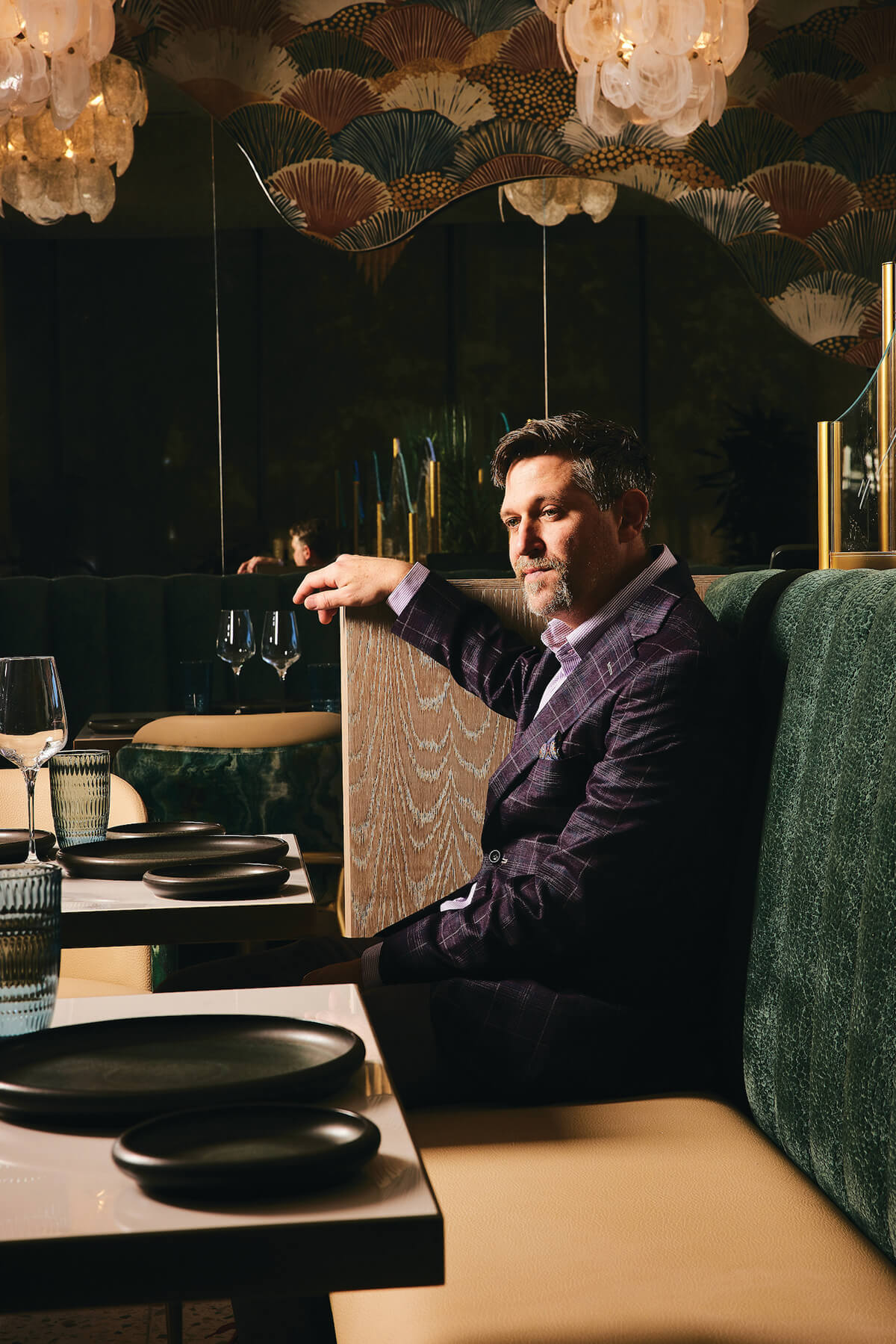
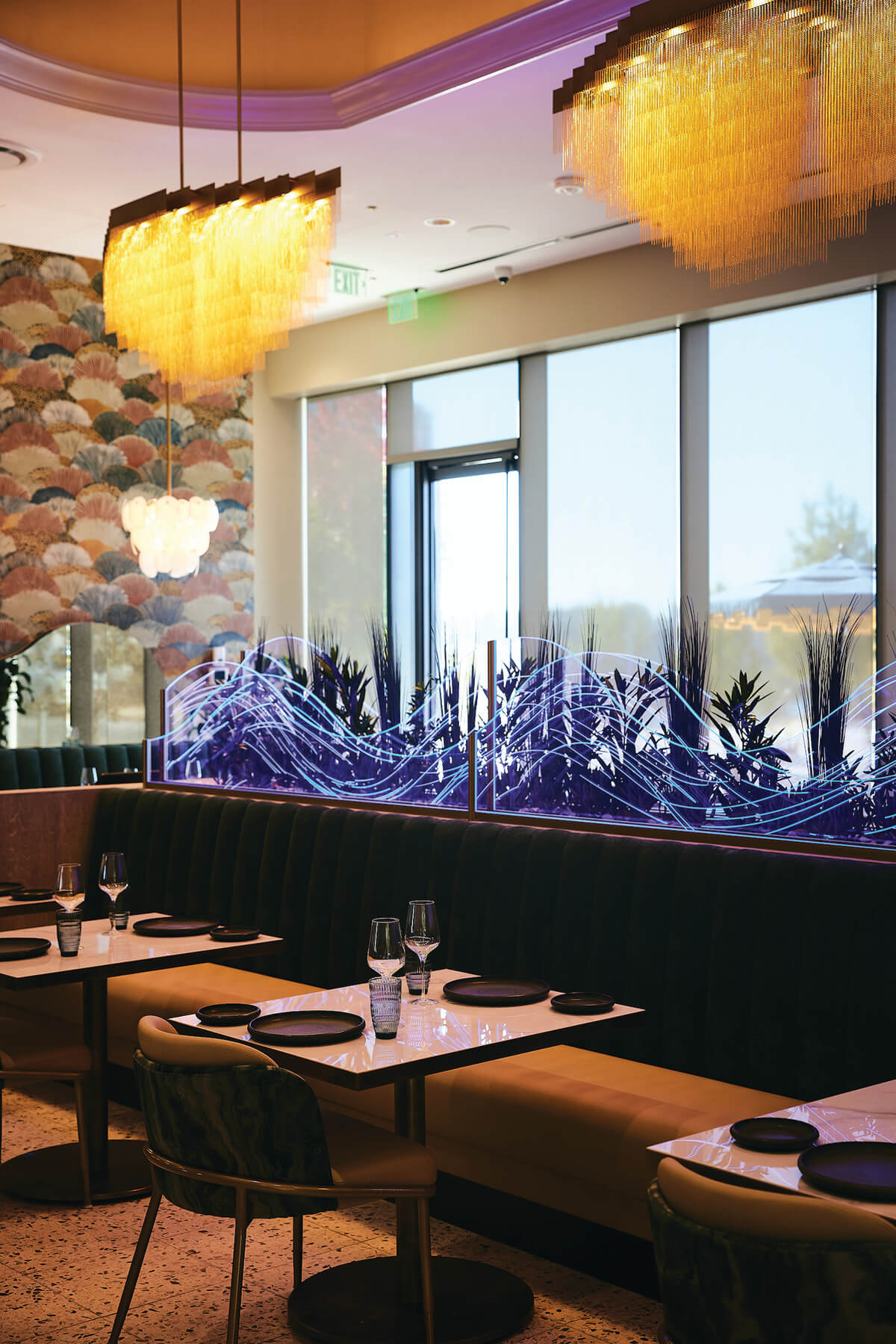
As opening day approaches, Matthew Oetting surveys Marta al Mare, his new seafood restaurant on the first floor of the T. Rowe Price building in Harbor Point. On this sunny September day, his vision is emerging as the hum of construction fills the roughly 110-seat space, which includes an alfresco patio overlooking the Patapsco.
In the kitchen, spanking new stainless-steel counters gleam and the industrial range is spotless. In the dining room, sea-green banquettes are ready to be released from their protective covering and gold chain-mail chandeliers await illumination. For now, the space echoes—a fleeting emptiness before it fills with diners and the team of chefs and line cooks who will help feed them.
Oetting burst onto the scene in 2022 with Marta Fine Food & Spirits, his some 60-seat boîte inside a 1904 rowhouse in historic Butchers Hill. For years, developers courted him about expanding into various properties, but it wasn’t until Beatty Development showed him this raw space, and their vision for Harbor Point, that he felt ready to make the leap.
“It’s all about timing and location,” Oetting says. Seven years into owning the Italian-leaning Marta, the restaurant named after his now-ex-wife, the James Beard Award-nominated chef is ready to take on a new challenge with Marta al Mare, which he describes as, “still Marta, but more seafood forward.”
Marta al Mare’s menu will include whole fish, a pasta selection, and an entrée section with more composed plates. And Oetting is also hoping to introduce new fish such as red mullet and scorpionfish to Baltimore diners.
“There are a million fish in the sea, and I want to cook them all,” he says. “I want to show Baltimoreans that there are so many other things you can try beyond branzino.”
As Oetting expands his footprint, his new sister spot is sure to show that the talented chef is more than just a one-hit wonder. Once his new place is up and running, he plans on spending less time in the kitchen and more time running the business.
“I had to make an investment to buy more suits, because I dress like a 25-year-old,” he cracks.
For now, though, he’s grinding away in the kitchen. A few hours later, he’s back in Butchers Hill at Marta, working in the basement prep kitchen before dinner service. Today he’s testing a pasta recipe for al Mare’s menu. Creating a new menu is a painstaking process that entails coming up with distinct sections (antipasti, crudi, principal plates, etc.) and fleshing out dishes from there. While brainstorming, he’s flipped through cookbooks, surfed Instagram, and pored through the thousands of recipes from the many places he’s worked.
“I draw inspiration from so many of the recipes I’ve made—I refer to this as my archives,” he says, as he scrolls through the document, landing on notes about the cheesesteak egg roll at Stephen Starr’s The Continental in Miami, where he worked as executive chef prior to landing in Baltimore. “Once the menu is about 80-percent viable, I write out all the dishes, including the title and description, and that becomes the first draft of the menu. My chefs and I go section by section—each day we tackle a few more dishes.”
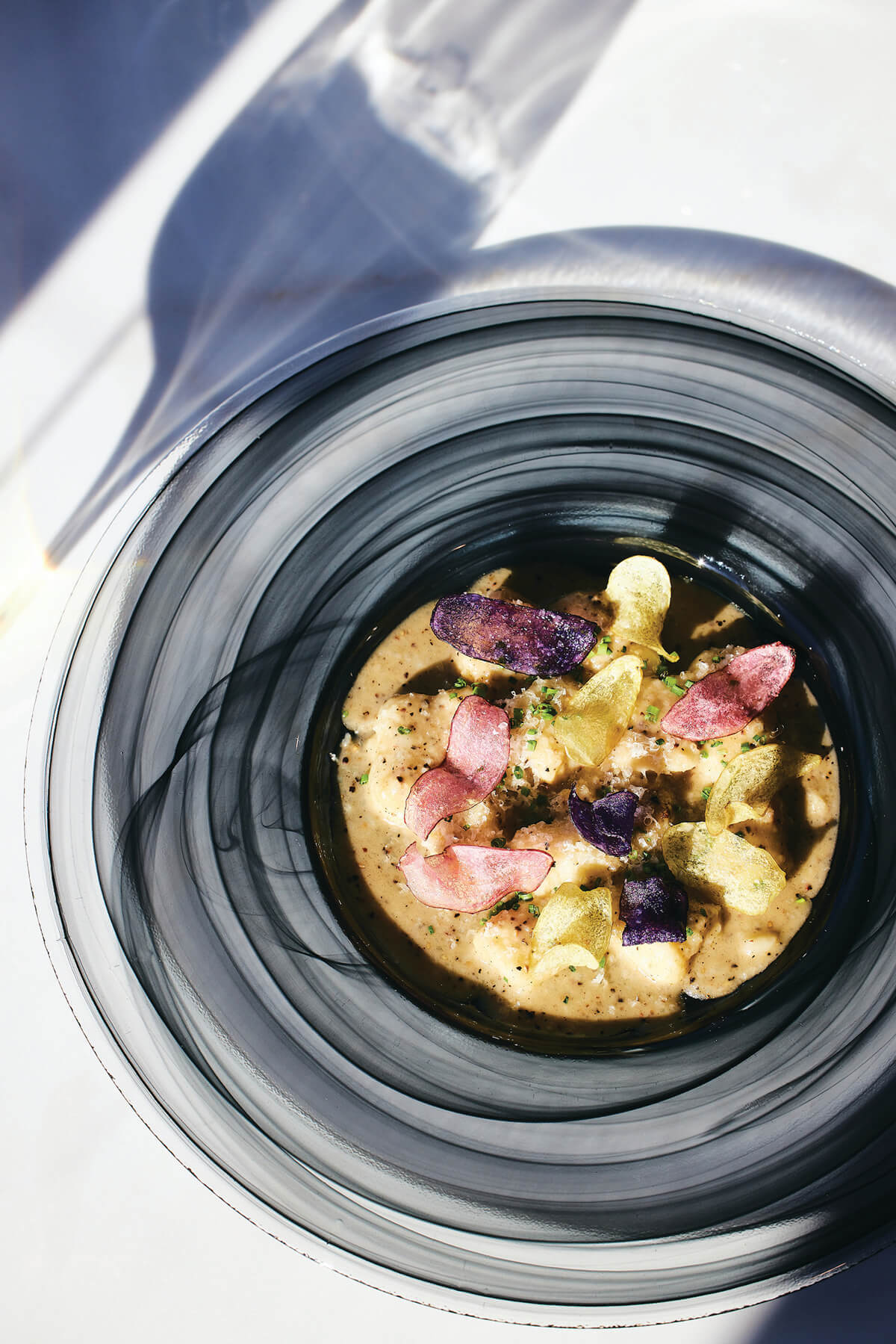
For two months now, he and his team have been testing everything from fritto misto to a dramatic, orange-tinged lobster mezzaluna in tomato lobster bisque. He’s currently on his sixth draft of the menu. Today he’s working on perfecting raviolo that will cap a steak for a riff on steak and eggs. It’s filled with Parmesan pecorino, fontina fonduta, robiolo, béchamel, chives, and preserved truffles. A salt-cured frozen egg yolk is placed in the center, which will help each raviolo hold its round shape. If all goes as planned, once it’s been cooked and cut open, the yolk will ooze across the meat’s surface to add richness and depth to the dish.
Oetting retrieves the handmade dough out of the walk-in and rolls it out. He feeds it into the pasta sheeter and lays it across the table before piping the cheese blend from a pastry bag directly onto the dough. He buries the egg yolk inside the nest of cheese, covers it with more filling and then blankets the whole affair with another sheet of pasta. Next, he cuts the pasta with a ring mold to form six perfectly shaped raviolo. Workshopping a recipe is time-consuming, exacting, and costly when it doesn’t work out.
“When you’re in the R & D phase, it feels like playing,” he says, “but once it’s on the menu, it’s a task to get done. Sometimes you come up with a recipe that’s a pain in the ass—and you’re stuck with it because it’s on the menu.”
Upstairs, he drops a single raviolo into a tank of salted boiling water, then moves it to a sauté pan to continue cooking and dredge it in Parmesan brodo and butter. It’s a thing of beauty with gorgeous, crimped edges and a golden yellow hue, but when he bites into it, the yolk stays solid and the salt has rendered it inedible. He tastes it and dumps it in the trash. This one, he’ll continue to cogitate. (Weeks later, he’s happy to report, “It’s 90 percent there.”)
Oetting takes a somewhat scholarly approach to menu writing. Before bringing a dish to a menu, he’s known for his thorough research on the origins and history of a dish as he develops it.
“Every menu needs a comeback dish,” he says. “That’s a standout dish that people come back for. A comeback dish is rooted in some kind of tradition that has an identity and people can recognize.”
Case in point: Marta’s signature dish, a tuna cannoli—a fried shell encrusted in sesame seeds, pistachios, and garlic chips, and stuffed with yellowfin—came to him completely off the cuff. It’s shaped like the iconic Sicilian dessert but it’s a riff—not a traditional cannoli at all.
“I did an interview with the Baltimore Business Journal before Marta opened,” says Oetting. “And they said, ‘What’s going to be your signature dish?’ I blurted out, ‘Tuna tartare cannoli.’ I’d never even made that dish before, but I was trying to think Italian, and I was thinking about one of the more unique items I’ve done in the past.”
One of the many restaurants where Oetting plied his craft was Atlas Restaurant Group’s The Bygone. “At The Bygone, I rolled a tuna tartare cigar on the menu with edible ‘ash’ that had dried herbs and toasted seeds—I did a riff on that with a ‘cannoli.’”
“I LEARNED HOW TO LET INGREDIENTS SPEAK TO YOU AND BE AN INSPIRATION FOR WHAT ENDS UP ON THE PLATE.”
Growing up in the ’90s in Tempe, Arizona, Oetting was a latchkey kid whose divorced parents worked full-time, which meant he had to learn how to cook for himself. “I made simple breakfast foods like scrambled eggs, bacon, toast,” he says. “I was on my own and in survival mode by the time I was 14.”
Even so, his parents did sometimes make a meal. Dinner at his mom’s was usually some form of fish sticks and canned corn. “Her cooking was terrible,” he says. Mealtime at his dad’s home—Welsh rarebit, roast chicken—was the exact opposite.
“My father is a great cook,” he says. “There was that dichotomy between this is terrible food and this is really good food. My dad was the one who encouraged me and taught me what he knew,” he says.
Oetting’s first job in hospitality, at 15, was at the Tempe sandwich shop, Dilly’s Deli, where he managed to lop off the top of his thumb while slicing tomatoes. (Miraculously, it grew back.) Soon after, it was on to dishwashing and rising through the ranks to grill cook at Fat Patties, a local burger chain. In college, at Arizona State University, where his father worked as an archivist (hence his love for archiving recipes), he majored in business with the goal of becoming a financial advisor. One mind-numbing summer internship later at 19 and he ditched his plans.
“I saw the distinct difference between that job and my kitchen jobs,” he says. “It felt like punishment and I decided that this was probably not the path for me.”
In 2000, he dropped out of Arizona State and enrolled in Scottsdale Culinary Institute, attending school by day and working the pasta station at The Cheesecake Factory by night. The job ended after six weeks.
“When I walked in, they told me they had 2,400 covers on the book!” he says. “The sous chef was like, ‘Please don’t quit,’ not because I was good at my job but because he needed an army to run that kitchen.” (Oetting finished his shift—and quit a few days later.)
From there, the fledgling cook set his sights on working in The Big Apple, specifically at Danny Meyer’s famed Union Square Café in Manhattan, the number-one restaurant in the Zagat Guide at the time (the prestigious Michelin Guide didn’t exist in New York City back then). Though the odds were against him, he composed five handwritten letters to executive chef Dan Silverman before finally getting a response.
“He either emailed me or called me and said, ‘If you stop sending me letters, and you somehow make it to New York City, I will find something for you to do.’”
Soon after, he moved to the City of Dreams to join the hustle and live with his aunt in a Gramercy Park studio, where he could walk to work. “I showed up at Union Square and [Silverman] was shocked,” recalls Oetting. “I was like, ‘I’m Matthew Oetting, and I’m here to start the job.’”
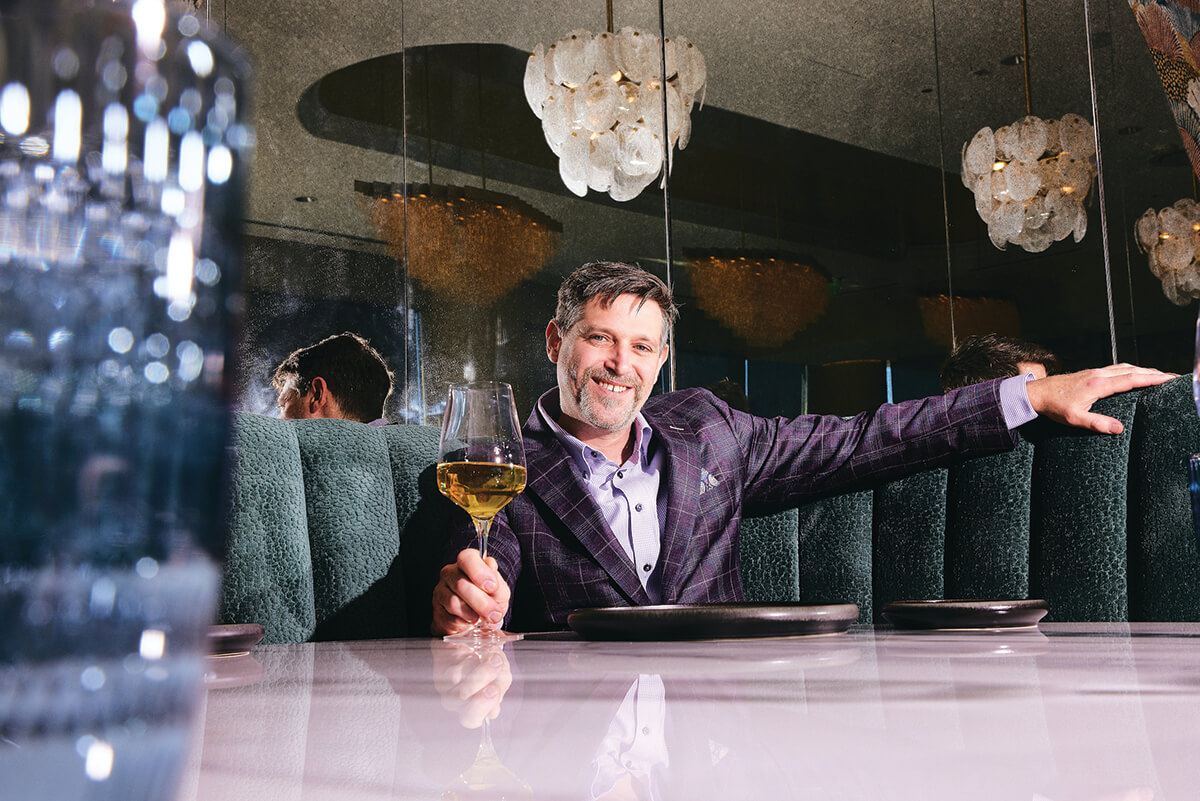
Oetting rose quickly from prep to hot line to sauté. He learned how to handles vegetables and fish and proteins and the all-important skill of staying organized in the chaos of the kitchen. He learned perseverance and how to stick with a dish, doing as many versions as it took to get right even if that meant spending hours long after closing.
From Union Square he went on to work at some of New York City’s trendiest spots, including Telepan (“I learned how to let ingredients speak to you and be an inspiration for what ends up on the plate,” he says), The Modern, Caffè Storico, STK, and Scarpetta, where he learned the intricate art of pasta-making. He cooked for celebrities like comedian Conan O’Brien and rapper Redman. At the then-Trump Soho Hotel, he made a meal for Pink Floyd bassist Roger Waters who, memorably, “toasted to the chef,” he says still smiling at the memory.
He also attended the school of hard knocks, learning a few things that were not part of his formal culinary education. “There were cooks who were your best friends and you could lean on,” he recalls, “and cooks who were your worst enemy. They threw away your salt or all the pepper in your pepper mill. They took your knife and put it in a bowl of ice [making it vulnerable to chipping] just to hold you back. It was—and is—a cutthroat industry.”
All the while, the twenty-something was living the life in the fast lane first chronicled by Anthony Bourdain in Kitchen Confidential. He slept until noon, worked his shift, then hit the bars at midnight—or later. “There were New York bars that didn’t close down until 4 a.m. and some just didn’t close at all,” he says. “There was a bar next to Union Square Café where they locked the door, closed the shutters and continued serving—one drink became 10. You walked out at like 7 in the morning—basically, you were a Manhattan pirate.”
After a move to Miami to work in the plum role of executive chef at Stephen Starr’s The Continental in Miami in 2015, he was tapped by Atlas to become their corporate executive chef. In his four-and-a-half years with Atlas, he helped open some seven properties, including Loch Bar, The Choptank, and Maximón, but by 2022, the peripatetic chef was ready to be his own boss.
“I realized that if I wanted to continue in this industry, I had to find a way to stop being an operator and start being an owner,” he says. “That’s where the idea of Marta started to take form.”
When he first laid eyes on the building at the corner of Pratt Street and S. Collington Avenue, he felt an immediate affinity for the white brick building and its narrow, close-knit streets. “It reminded me of Brooklyn,” he says. “It reminded me of home.”
Home these days is a place Oetting just purchased in Parkville. He shares the space with his three daughters, ages 9 to 15. Now 46, his hair is a tousled mix of salt-and pepper, though thanks to his wiry build, his wardrobe (a Deftones concert shirt with a Day of the Dead-style tattoo poking out of his right sleeve), and a steady diet of rock concerts (most recently Foo Fighters and Mike D.), he exudes an eternal youthfulness.
He’s single now—consciously uncoupled, as they say—and while he recognizes the irony of naming his first restaurant Marta, the Italian form of Martha, in homage to his now-ex-wife, he has no regrets about making her name his brand.
“She sacrificed so much in the name of my career,” Oetting says. “The least I could do is name my first restaurant after her. I think it’s a great name. And we’re not just friends for our kids’ sake. We’re friends because we’ve shared a lot of life experience.”
He does have a few regrets, though. As he rose through the ranks of the brigade system, he admits that his management style sometimes led to a lot of yelling. “I was a product of my upbringing,” he says. “When I was disappointed by someone underneath me, they were told publicly. And now I get a much better result for my team by doing the opposite. I want to surround myself with people who can be better than me. I want to share everything I can.”
Turns out, this newer way of working has been good for his career. Earlier this year, when he was a James Beard Award semifinalist for Best Chef: Mid-Atlantic, a friend called to congratulate him. Oetting was confused. “I thought they were congratulating me on Marta al Mare,” he says. “But they were like, ‘No, congratulations on the award nomination.’”
He finally understood when he looked at his phone and saw what the fuss was about. “I was immediately flushed and overheated,” he says. “I got that feeling you get when you’re a kid and you see your crush and your eyes lock for a second and your heart starts to flutter, and you’re like, ‘She saw me!’”
Chef Zack Mills, co-owner of True Chesapeake in Hampden, is a longtime admirer. He and Oetting first crossed paths at the Four Seasons Baltimore, where Oetting oversaw the opening of The Bygone and Mills was the executive chef at Wit & Wisdom.
“We tended to run into each other after a busy service and commiserate,” Mills recalls. “He became a dear friend very quickly. In addition to being a great guy, he’s a wildly talented chef.”
Of course, it helps that he’s learned from the best and the brightest, including Danny Meyer, who has won not only 28 James Beard Awards but is an entrepreneur in his own right. (He founded Shake Shack, among other restaurants.)
“I worked for Danny Meyer twice and I read his book, Setting the Table,” says Oetting. “He drove home that lunch is critical to the success of your business. You pay rent or a mortgage for 24 hours of the day, so why on earth, when you have the capability to sell products all day, would you only sell products from 5 to 9?”
Unsurprisingly, Marta al Mare will also be open for brunch every day but Monday, with the full menu available to allow for repeat customers.

Back when Marta was opening, Oetting feared that no one would show up. “My greatest fear was that I would have no customers, because no one knew who we were or what we were,” he says.
He has the opposite fear with Marta al Mare. “I am terrified that we are going to do more business than we can handle,” he says. “There are 600 financial advisors in that building every day.”
For now, Oetting keeps his head down and gets back to work.
“I’m as passionate as I’ve always been,” he says. “I strive to stay modest and do what I believe is good. If the accolades come, I hope they come in a deserving way.”