Food & Drink
‘Tis the Season for House-Made Marshmallows
At Sacré Sucré in Fells Point, the timeless treats have moved beyond the cocoa cup and now come in a variety of inventive flavors—marbled with ribbons of matcha, Earl Grey, caramel, or yuzu.
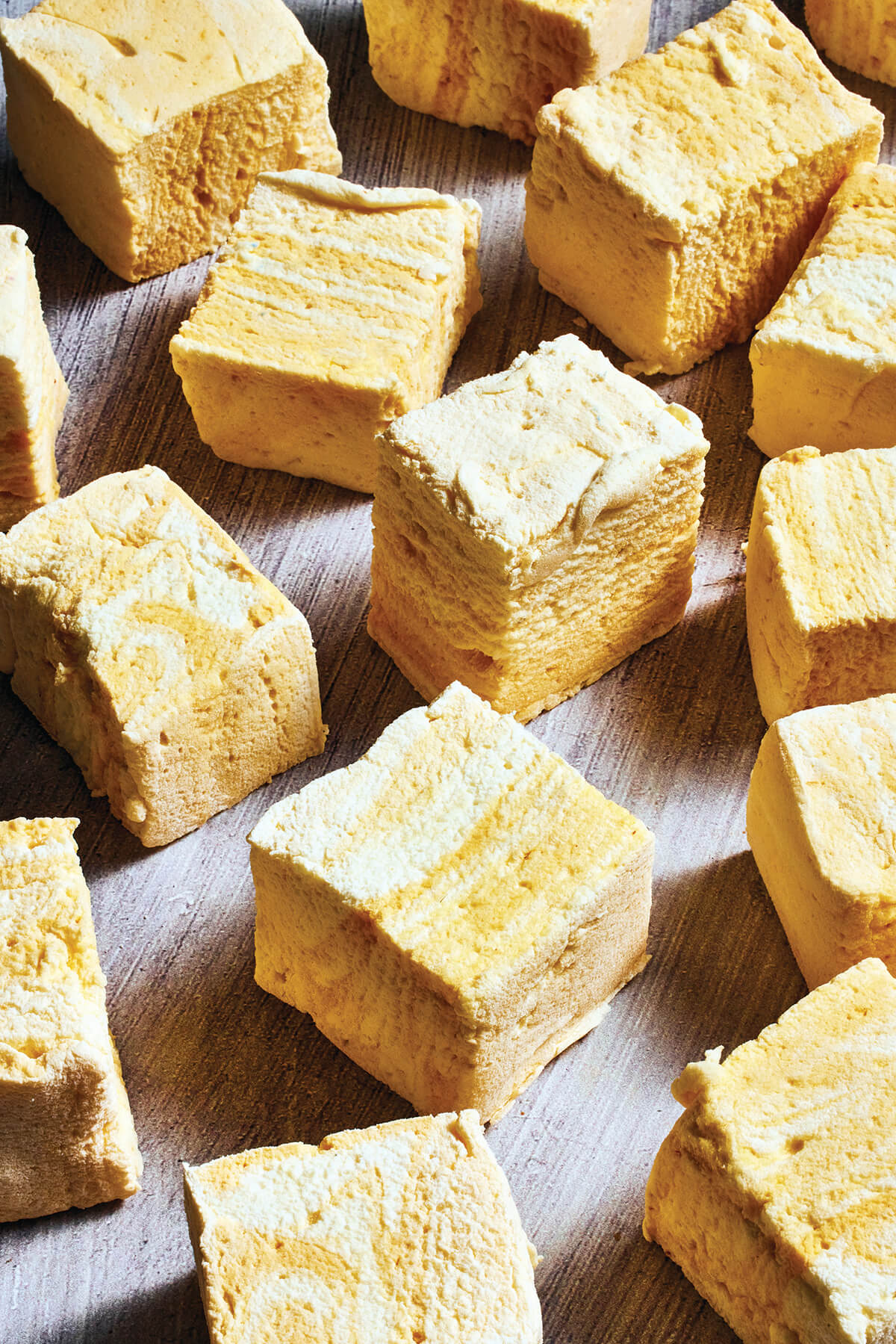
This is the time of year for fluffy white stuff, whether wafting down from the sky or floating in steaming mugs of hot chocolate. In Baltimore, house-made marshmallows are everywhere, including Artifact Coffee in Hampden, where marshmallow fluff tops cups of hot chocolate, and Stone Mill Bakery in Lutherville, where the airy confections are perfectly paired with Valrhona cocoa and steamed milk.
At Sacré Sucré in Fells Point, the delicious delights have moved beyond the cocoa cup and now come in a variety of inventive flavors—marbled with ribbons of matcha, Earl Grey, caramel, or yuzu.
“We started making them when we were going to the farmers market,” says bakery co-owner Manuel Sanchez. “We didn’t want to sell just macarons, which is what we’re known for—we also needed something that was easy enough for us to make at home. Our first batch was so good, we started selling them.”
The marsh mallow, Althaea officinalis, is a wild plant that grows in wet, marshy environments. Through the centuries, different cultures, including the Greeks and Egyptians, have used the plant to treat many ailments, including wounds, inflammations, insomnia, and sore throats. As far back as 2,000 B.C.E., the Egyptians turned them into edible art by squeezing sap from the mallow plant and mixing it with nuts and honey.
The first iteration of the modern marshmallow was invented in the 19th century by the French, who whipped the sap (plus eggs and sugar) into a fluffy candy mold. Gelatin, which gave the confection its squishy texture, soon replaced the mallow root plant, while corn syrup replaced sap, allowing for easier production. (To date, more than 90 million marshmallows are sold annually, according to the National Confectioners Association.) By the early 1900s, marshmallows made their way to the U.S., and soon gave rise to items like s’mores, Moon Pies, and Marshmallow Fluff.
Sanchez sees the spongy sweet as a blank canvas with its own personality. “For me, the appeal is all about having these soft and fluffy marshmallows in different flavors,” he says, “and the fact that something you traditionally see as a candy has now become more of a dessert you can eat on its own.”