Food & Drink
Review: Josefina Paints the Town Red in Harbor Point
Chef David Zamudio's elegant setting is a backdrop for his carefully crafted dishes inspired by Spain.
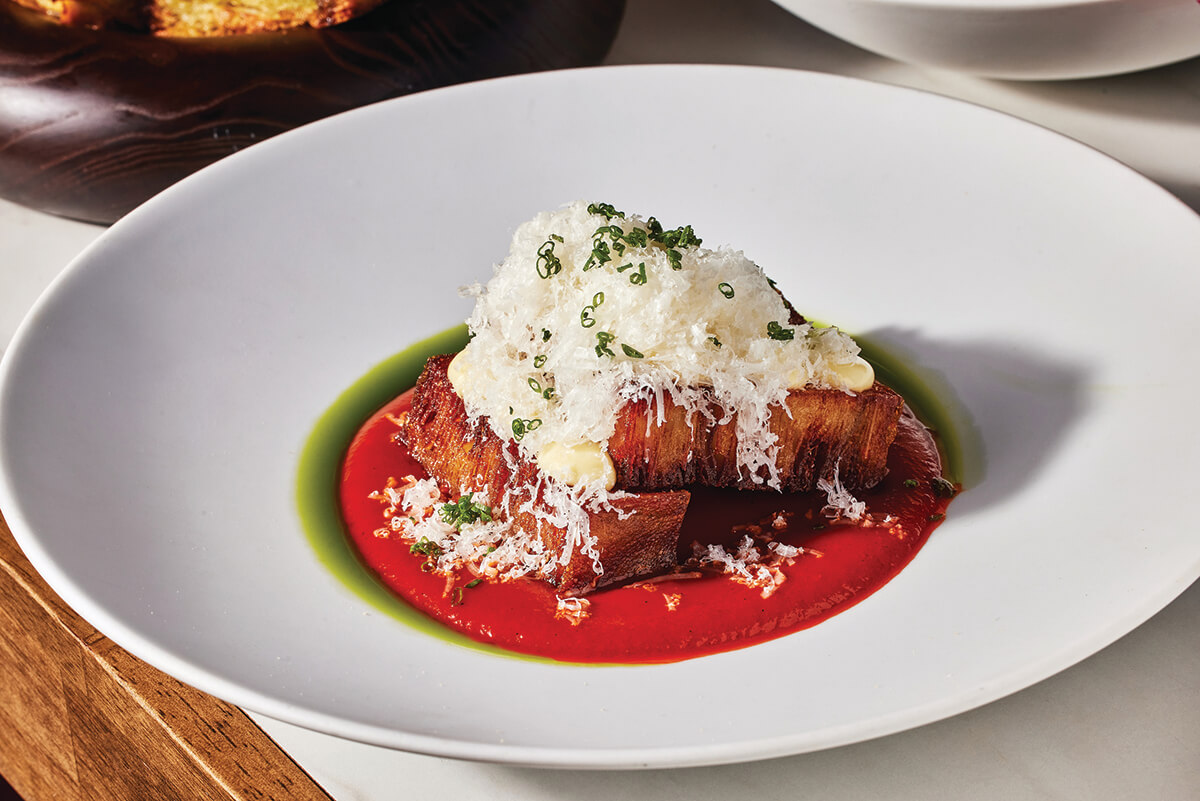
It’s a blustery Sunday night on Harbor Point on the last day of February—usually a quiet month for restaurants—but even after opening only seven weeks ago, Josefina is humming.
Dressed in his bright white chef’s jacket, owner-chef David Zamudio stands behind the gleaming pass of his tricked-out open kitchen. There’s an intensity to his gaze as he dresses oxtail dumplings with truffle caviar, spoons a pool of romesco sauce onto a gold-patterned porcelain plate as an accompaniment for violet cauliflower, and gently jabs a meat thermometer into the center of the bone-in ribeye rubbed with sweet, smoked, and spicy paprika, among other spices.
During dinner service, he’s in the zone—and watching him work is like watching an Olympic-level athlete. With purity and precision, he makes it look effortless as he slides his plates of edible abstract art toward the edge of the pass, where they’re whisked away to the dining room to feed hungry patrons.
Without question, opening your own restaurant is anything but easy, even if you’re a culinary virtuoso. After working around the world, including his native Venezuela, the 32-year-old chef made his mark in Baltimore at Alma Cocina Latina, where he earned a James Beard semifinalist nod for cooking fare from his home country.
For his own restaurant, Zamudio set his sights on Spain, a country where he’s worked in the past (including the Michelin-starred Martín Berasategui) and a place he visits family often. Also driving the decision was the influence that Spanish cuisine has had on his homeland.
“A lot of the food we eat in Latin America came from the Spanish who conquered us,” he says, “so that felt like a great place to start.”
It’s a cuisine he’s drawn to for its bold, simple flavors, iconic rice dishes, tapas, smoky seafood, abundance of vegetables, and ingredients like pimentón (smoked paprika), saffron, and sherry. He’s also interested in modifying those elements in a more modern, approachable way.
“I wanted to tweak some of the most recognized dishes from Spain,” he says, “while respecting the country’s tastes and traditions. For other plates, I just wanted them to be well-executed.”
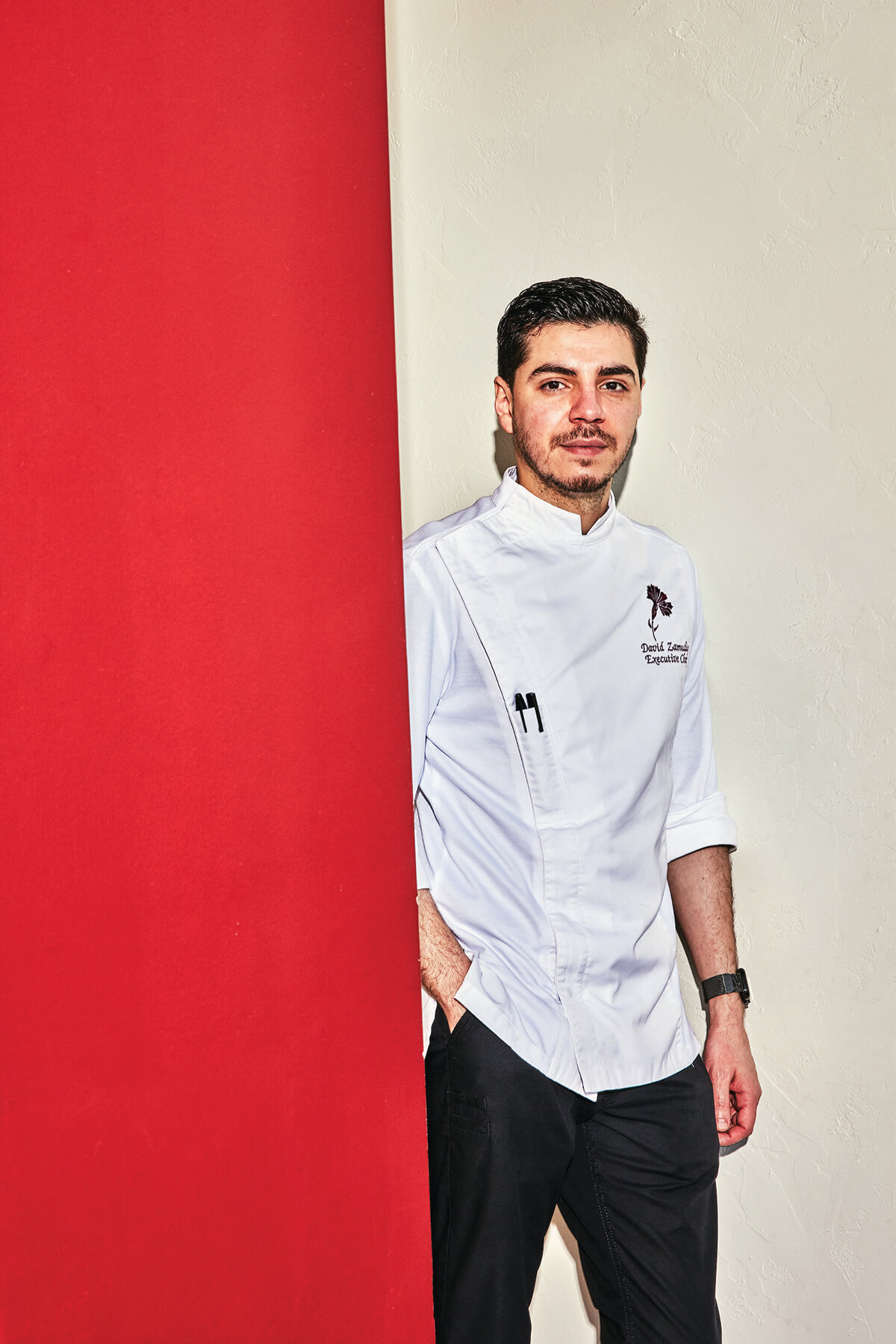
Josefina is an homage not only to his maternal grandmother and the generations of matriarchs in the family who carry that name but to Spain itself. This is evident in its matador red walls, bottles of sherry fino and vermut dramatically displayed on the soaring glass shelves behind the bar, and the single red carnations—the country’s national flower—that grace every table.
The elegant setting is all a backdrop, of course, for the carefully crafted food. The oxtail dumplings are a play on a more classic oxtail stew served to celebrate the running of the bulls. Zamudio’s tapa features succulent pieces of oxtail tucked into dumplings resting in broth and served with truffle “caviar” (pearls of juice extracted from the fungus).
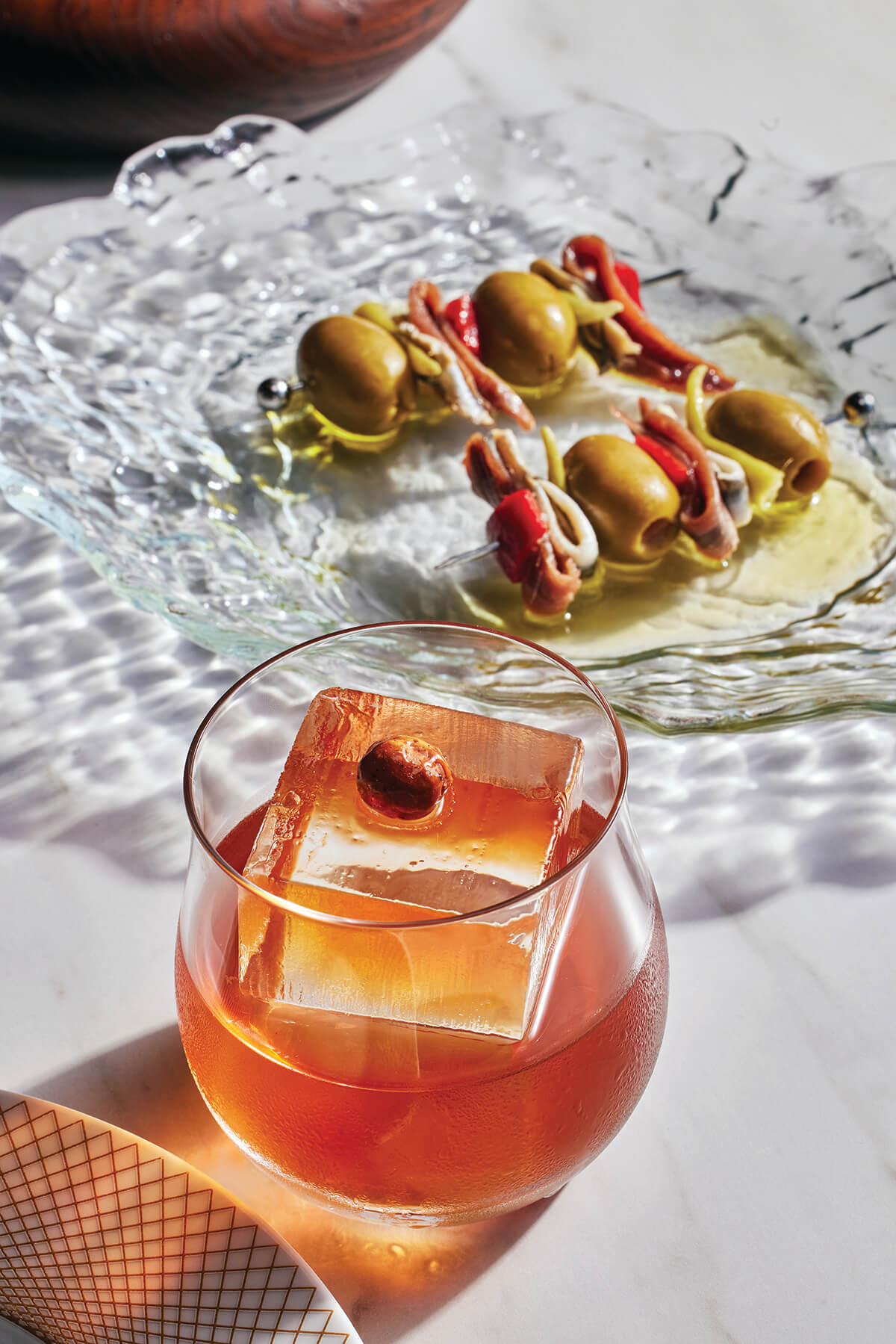
Also featured among the tapas are the more traditional Gilda, a perfect pairing of plump green olives, anchovies, boquerones, roasted red peppers, and mildly sweet green pippara peppers—think Spain on a skewer. Another traditional tapa is the pan de tomate—a blissful bite-sized piece of crystal bread, so named for the sea salt that glitters across its surface—smeared with mashed tomatoes, garlic anchovies, and boquerones draped across the top.
The César Ibérico salad is a clever nod to the wonderful cheeses and cured meats of the country. Here, leafy greens get showered with shavings of Manchego and strands of acorn-fed jamon Ibérico de bellota, the prized pork of the region procured from black pigs who are raised along the Iberian Peninsula. And then there’s Spain’s signature bacalao frito, essentially their answer to fish and chips—two crispy hunks of salted cod cured in kombu seaweed, then tempura-fried and served with a pickly tartar sauce to cut the richness of the dish.
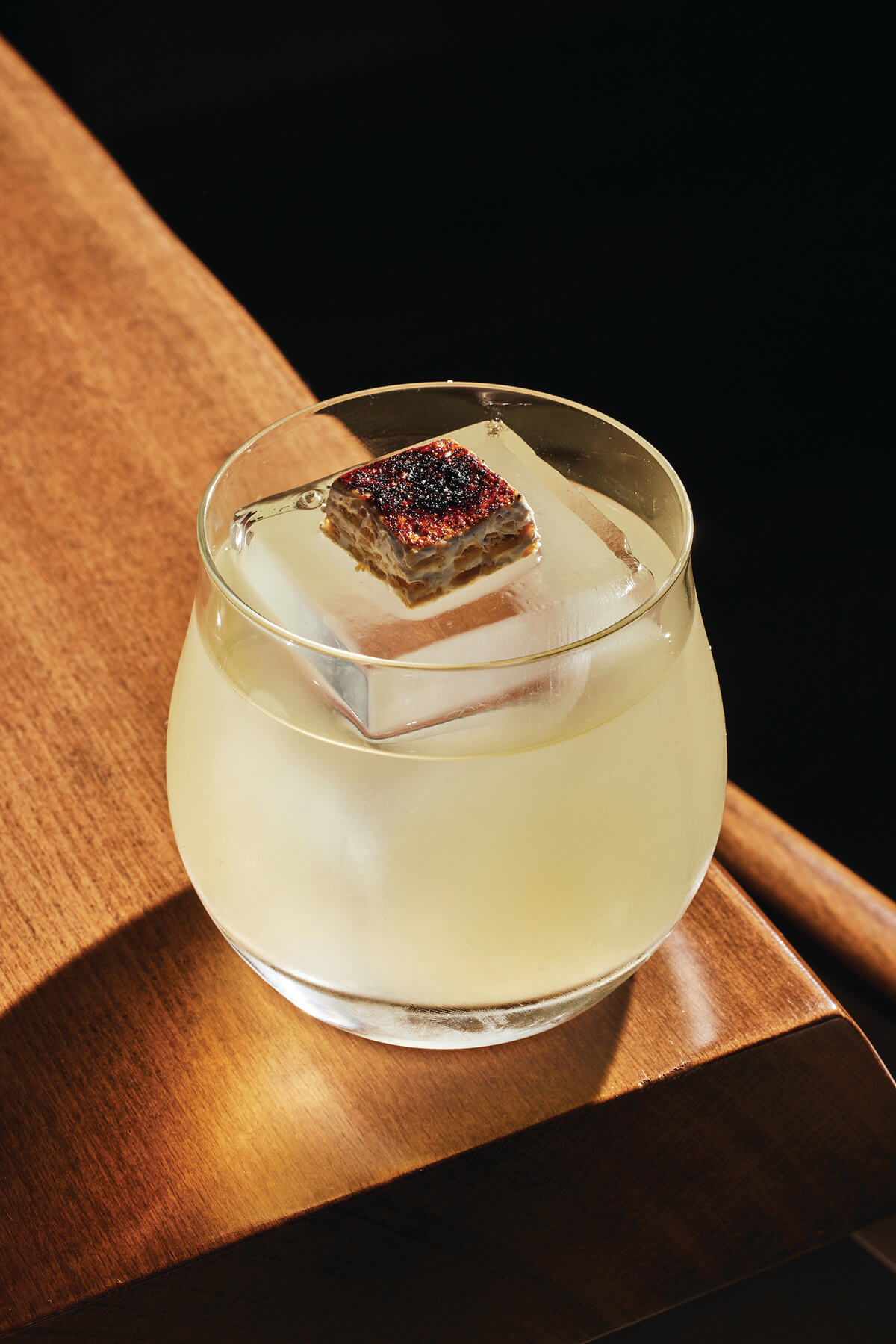
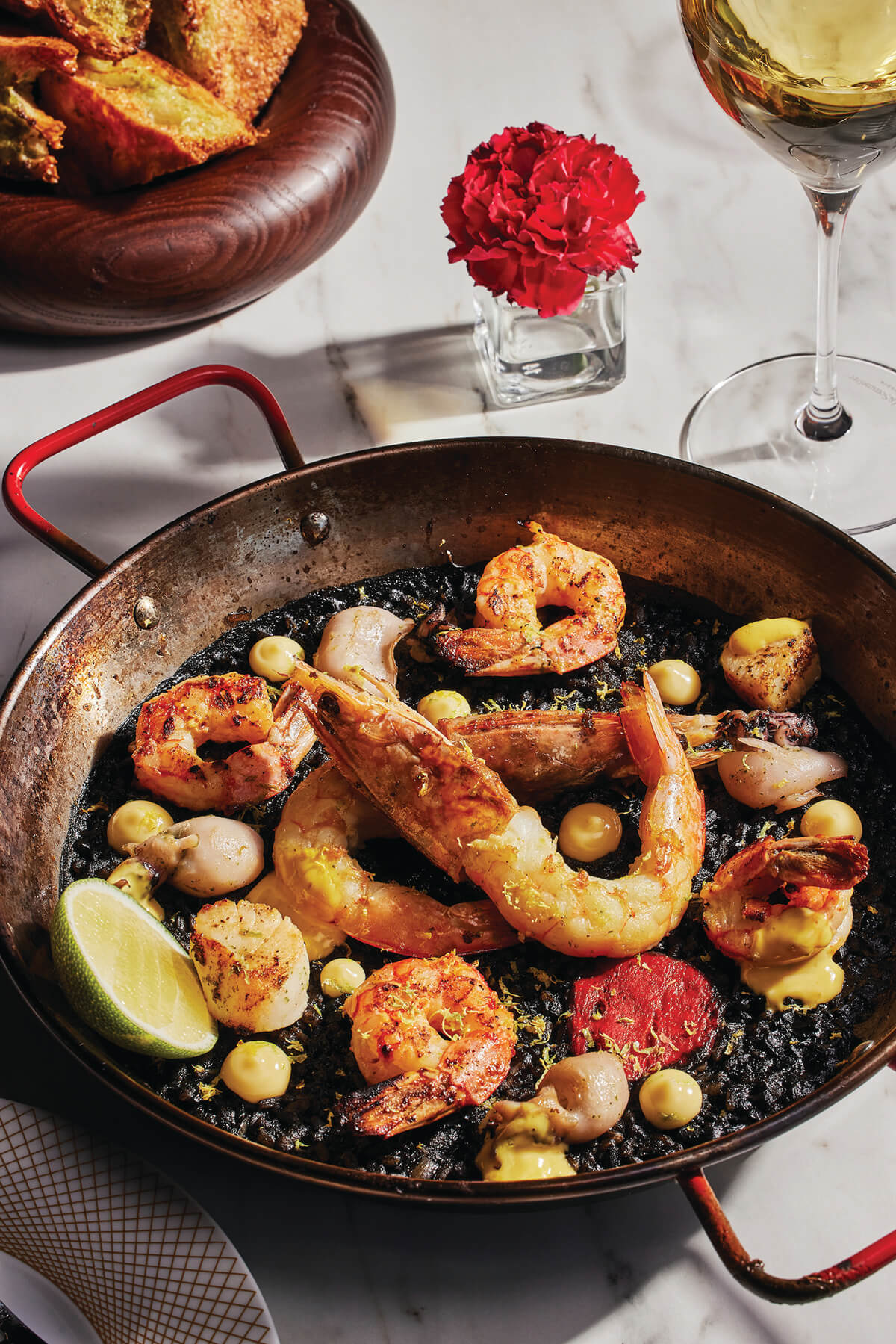
Of course, rice, first introduced to the Iberian Peninsula by the Moors in the 8th century, reigns here as a menu staple. There’s a version made with duck magret and carrot cream and a Valencian-style paella with an entire Cornish hen. The saffron-scented seafood rice, piled with prawns, scallops, baby octopus, and two delicate head-on langoustines, is a terrific rendition of more traditional paella which usually marries seafood with chicken or rabbit and chorizo. Like all the rice dishes, it arrives in a dramatic, two-handled circular paella pan. It’s fantastically flavored with saffron and smoked paprika and sits on a bed of black squid ink Calasparra rice, which deepens the umami.
Even if you’re not a sweets lover, executive pastry chef Maria Alejandra Cobarrubia’s desserts are impossible to ignore. Look for the heart shaped churros and a creamy, caramelized Basque cheesecake, which, says Zamudio, boasts a “secret ingredient.” (He later reveals that it’s blue cheese, which adds depth to the flavor.)
But even in this sea of standouts, it was the subtly sweet, French toast-like Torrija—brioche soaked in eggs, heavy cream, and vanilla before being pan-seared in butter then torched and topped with hazelnut chocolate sauce—that left us longing for more.
If you’ve ever spent time in Spain, a trip to Josefina will transport you right back there—and if you’ve never been, well, this will whet your appetite in more ways than one.

JOSEFINA 1409 Point St., 667-260-2521. HOURS: Sun.-Thurs. 5-10 p.m., Fri.-Sat. 5-11 p.m. PRICES: Snacks, tapas, salads: $6-30; rice and mains: $38-148 (for 36-ounce ribeye); desserts: $8-16. AMBIANCE: Minimalist modern.