
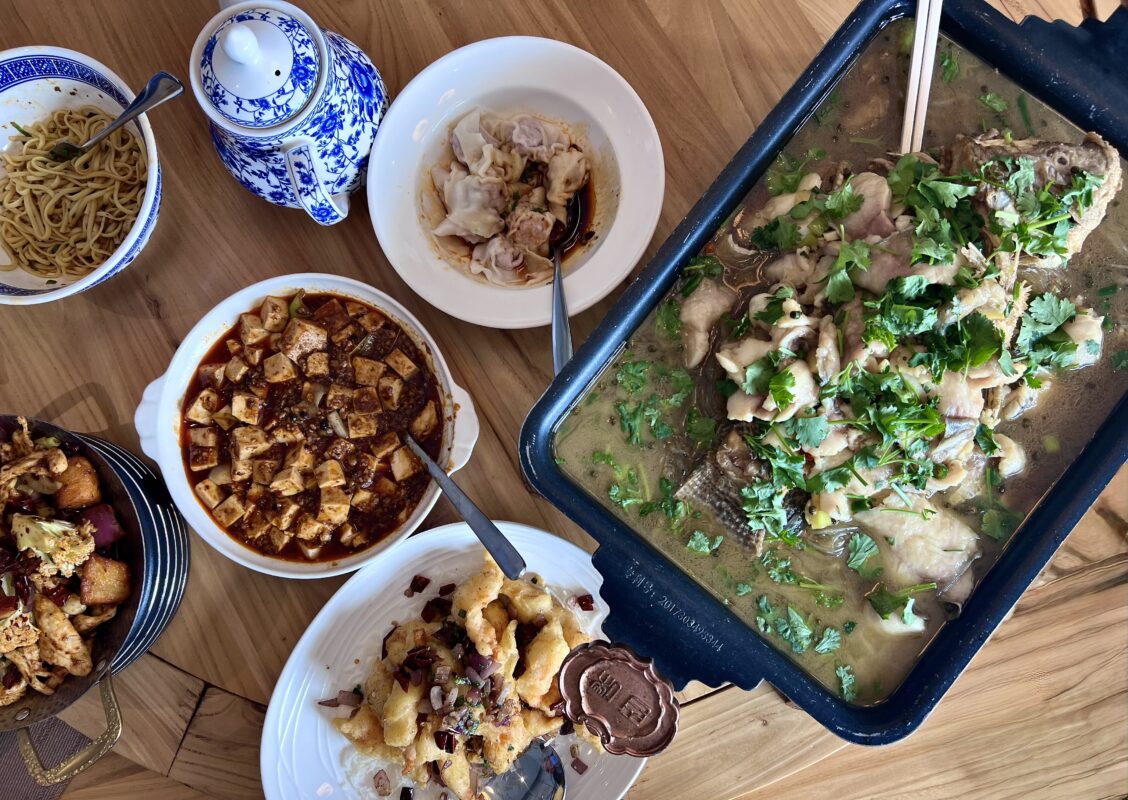
For those of us who crave soup dumplings, mapo tofu, and Sichuan dry hot pot on a regular basis—by which I mean, we dream of Chinese banquets and wake up desperate for water-boiled fish and toothpick lamb—a visit to Ellicott City’s Tea Horse Sichuan Bistro is a much-needed pilgrimage.
Open since 2023 on a stretch of Baltimore National Pike, Tea Horse is the third restaurant from owner Ping Wu, whose first restaurant, Orient Express in Charles Village, has been around for decades. Her second, Towson’s Red Pepper Sichuan Bistro, opened in 2019. Another Tea Horse debuted in Silver Spring last September.
The Ellicott City Tea Horse is a vast and beautiful 6,000-square-foot space featuring a dining room, cocktail bar, three private dining areas, a giant flatscreen showing sports, and a lovely open kitchen where you can watch the chefs make your dishes.
Those chefs—most from Chengdu, the capital city of the Sichuan province and the seat of that region’s diverse and sophisticated cuisine—are led by executive chef ZheXin Zheng, who is also from Chengdu and runs Wu’s other kitchens, as well. As with her other restaurants, Wu and Zheng have crafted food that is true to their home country’s regional cuisine.
The food of Sichuan is characterized by its fondness for chiles, which heat up many dishes in both fresh and dried variations, and in the form of chile oil. Zheng makes his own, and it’s glorious. Just as important are Sichuan peppercorns, which lend the distinctive heat and numbness, called mala, to recipes. (Folktales credit the peppercorns for allowing a greater consumption of chiles, a great story either way.)
The dish that probably shows this off best is the visually stunning whole fish with peppercorns, garlic, cilantro, and glass noodles. It’s a deconstructed version of the traditional bowl of water-boiled fish, and it’s as lovely as it is addictively delicious.
Tea Horse has a small menu of American-Chinese dishes (General Tso’s chicken, orange chicken, beef broccoli), but it specializes in, and excels at, the traditional dishes of Chengdu. Glossy, gorgeous, and photo-heavy, the large menu reads like a food version of Vogue, highlighting traditional dishes like Big Plate Chicken, Peking Duck, cumin lamb, spicy pork trotters, pork intestines in chile sauce, and a marvelous iteration of mei cai kou rou, or steamed pork belly with preserved mustard greens—a party dish I first had at a lychee farm and restaurant in Guangdong. (Order this, but please bring many friends; it is a party dish for good reason.)
There are also terrific versions of more familiar dishes, such as mapo tofu, soup dumplings, wontons in chile oil, dan dan noodles, salt-and-pepper shrimp, and scallion pancakes. Many of these can also be found at Wu’s other restaurants closer to the city—Zheng chefs them all—but what makes Tea Horse worth the trip is the sheer size of it. In particular, those private dining rooms, each furnished with intricately carved wooden chairs, as well as tables sporting the massive lazy Susans that make Chinese banqueting so much fun.
A stunning mural stretching the length of one entire wall visually explains the restaurant’s name. The Tea Horse Road was part of the historic Silk Road, the network of Asian trade routes that ran for over a thousand years, connecting China to the West. The Tea Horse Road connected the merchants of Sichuan, Yunnan, and Tibet to the rest of China and beyond, trading tea and war horses, as well as other necessary items.
So you can consider the route, painted with all the pretty horses, plus mountains and Chinese characters, while you enjoy your plate of spicy pork ribs and try out the stellar cocktail menu, which currently honors the Year of the Fire Horse. This translates into drinks from Maryland distiller Covalent Spirits, helmed by husband-and-wife Drew Cockley and Jennifer Yang, another Chinese-American team (oolong vodka!).
And then there’s that open kitchen, where you can watch the chefs firing the line of woks and forming and steaming all those dumplings to fill their bamboo baskets. It’s a reminder, should you need it, of what goes into traditional Sichuan food: the skill, the care, and the remarkable, intricate, craveable flavors.