Health & Wellness
How to Live Forever
Longevity medicine—which targets the root causes of aging and chronic illness before they develop into disease—is trending, but what is fact and what is fad?
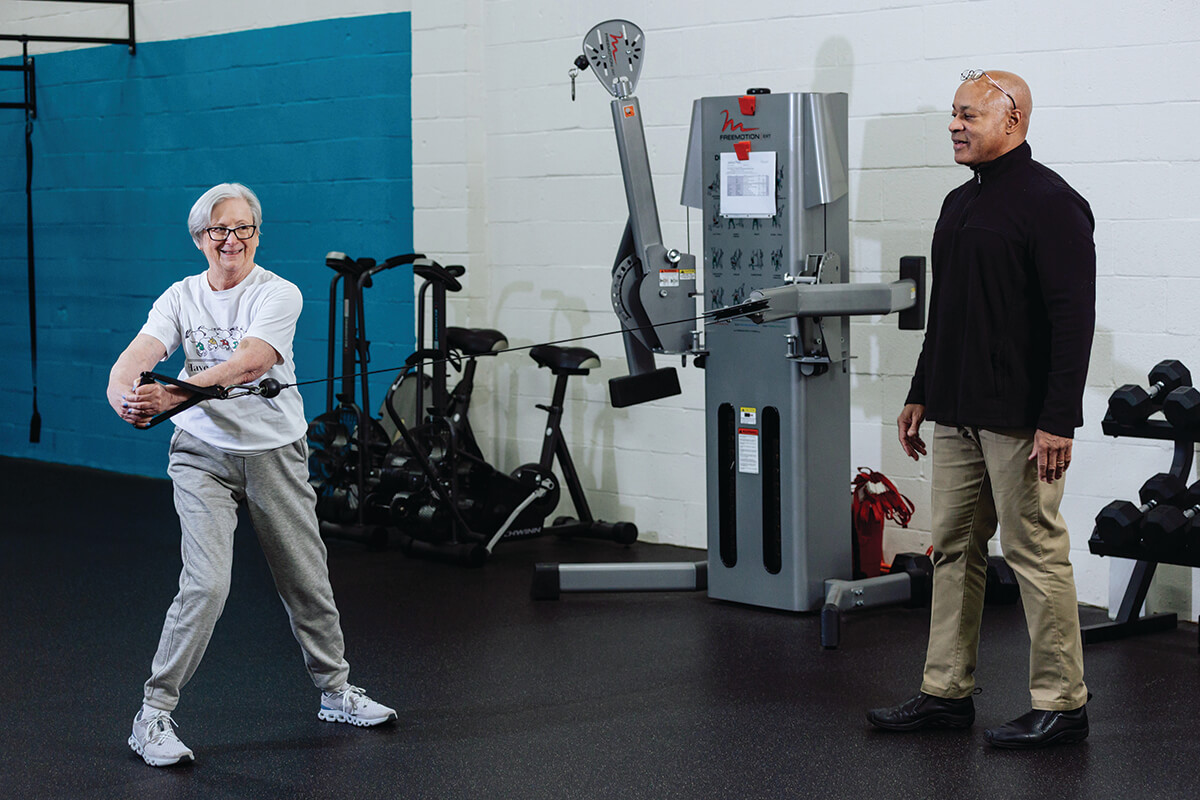
Janice Plein is 78. That’s the average life expectancy for an American adult, according to the U.S. Centers for Disease Control and Prevention (CDC). But this septuagenarian is not on the decline. She’s at the gym, where she can be found twice a week doing planks and doing squats with kettlebells.
A three-time breast cancer survivor and resident of Original Northwood, Plein has exercised sporadically her whole life, including through grueling rounds of chemotherapy and after recovery from spine surgery.
While she has already surpassed her father’s lifespan of 76, living to a specific age is not her goal.
“I want to still be able to do the things that bring me pleasure,” she says. That includes continuing to work at the corporate travel company where she’s been employed for 30+ years and traveling solo to Florida and Nebraska to watch her grandson play college baseball.
Plein’s approach to aging is a perfect example of what doctors call “healthspan”—which refers not only to lifespan, or how long we live, but also to the quality of those years. It’s not the same thing as “antiaging,” a term often used by cosmetics companies to sell products that promise to make us look younger. This is about merging health and lifestyle to live a longer, higher quality life.
The concept of living longer and better is not new. But now, thanks to advances in research, medicine, and technology, along with social media, health influencers, and a proliferation of antiaging hacks and products (redlight masks, anyone?), longevity is trending more than ever before.
The concept of healthspan is central to the purpose of the Johns Hopkins Human Aging Project (HAP), a unique interdisciplinary group of scientists, clinicians, and engineers working together to create innovative solutions to improve the lives of older adults.
“So that not only are people living longer, but they’re living well and getting to do the things that they care about as independently as possible,” explains Dr. Cynthia Boyd, director of the Division of Geriatric Medicine and Gerontology at the Johns Hopkins School of Medicine and member of the HAP leadership team. “And that, to me, is what we’re trying to achieve when we think about healthy aging.”
Leading the longevity charge are an increasing number of doctors who have grown frustrated with the “pill for ill” mentality of the U.S. health care system. Unlike traditional medicine, longevity medicine takes a proactive rather than reactive approach to health care. The goal is to identify and target root causes of aging and chronic illness before they develop into symptoms and disease.
Dr. Charlotte Grinberg is a primary care doctor in Washington, D.C., who launched a longevity medicine practice last fall. She acknowledges that the term “longevity” can mean different things to different people.
For some, it might bring to mind “biohackers” like Bryan Johnson, a tech entrepreneur and subject of the Netflix documentary, Don’t Die: The Man Who Wants to Live Forever. Johnson claims to spend $2 million a year on extreme (and controversial) antiaging treatments, including infusions of his son’s blood plasma.
That’s not Grinberg’s approach. “I’m not somebody who’s trying to deny or even delay death. That’s not my thing at all,” she says.
As an experienced hospice physician, she regularly encountered dying patients urgently grasping for any interventions that might help them live longer, no matter how unlikely.
“A lot of people aren’t taking good care of themselves and [not] engaging in their health care. And then when they get a serious illness, they start wondering, ‘What could I have done differently?’” says Grinberg. “I felt very motivated to move much further upstream…because now I’ve had this unique glimpse into just how much people value and care about life,” Grinberg explains. “There are a lot of things that are within people’s control.”
Scientists estimate that about 20 percent of aging is related to genes, and 80 percent is related to lifestyle. While we can’t rewrite our DNA, we can affect how our genes function through our daily choices and environment. Factors including diet, stress, exercise, and exposure to toxins play a big role in how quickly or slowly we age. This explains why identical twins, who share the same DNA, can age differently and how one can develop a disease the other doesn’t.
But to understand which factors affect our health and longevity, we need data that’s specific to each individual. That’s why longevity medicine focuses on personalized, preventative, and precise care, rather than a one-size-fits-all model.
“I believe that taking a precision medicine approach is very important for defining your longevity trajectory,” says Dr. Anil Bajnath, the founder and president of the American Board of Precision Medicine, founder of the Institute for Human Optimization in Hanover, and author of The Longevity Equation: The Step-By-Step Blueprint to Hack Your Genes, Optimize Your Health, and Master the Art of Existence. Bajnath is also an adjunct assistant professor at the George Washington University School of Medicine and Health Sciences.
“A LOT OF PEOPLE AREN’T TAKING GOOD CARE OF THEMSELVES, AND THEN WHEN THEY GET A SERIOUS ILLNESS THEY START WONDERING, ‘WHAT COULD I HAVE DONE DIFFERENTLY?'”
With each patient, Bajnath starts with a deep dive into their health history, which he calls “a biological audit.” First, he orders a panel of diagnostic tests that include baseline labs, advanced functional tests, and genetic testing. Bajnath looks at blood, urine, stool, and saliva samples to get a comprehensive picture of each patient’s health and how their genes influence things like their energy, metabolism, and gut health—especially important to overall health and longevity since 70 percent of our immune system resides in the gut.
He also looks at environmental factors. Has a patient been exposed to microplastics, heavy metals, or phthalates and parabens from cosmetics? If so, and “if the burden of the environmental toxin outpaces the body’s innate ability to clear it, this leads to disease,” explains Bajnath.
He references a 2025 study that found an association between people living near golf courses and an increased risk of Parkinson’s disease. The research suggests the cause is pesticides in the groundwater. After the lab tests, patients come to his office, where they do “what I call the physical exam of the future,” he says. Bajnath looks at everything from retinal scans to brain activity to something called VO₂ max.
“Basically, this is a reflection of your resting metabolic rate and how efficiently your body uses oxygen when you exercise. It’s one of the best markers we have for long-term health and longevity,” he explains. “What your primary care provider is giving you is Medicine 1.0. What I’m offering is Medicine 3.0.”
Grinberg also uses diagnostic tests to get a more complete picture of her patients’ health. While primary care doctors typically do a standard lipid panel to evaluate cardiovascular risk, “there’s much more advanced testing where you can actually look at inflammatory markers,” she explains. “Precision and personalized testing [give us] more data that you can then act on to ‘risk stratify’ people, motivate them, and do targeted interventions.”
For instance, different people may be at higher risk for different diseases based on their particular genetic makeup and environments.
If this sounds expensive, it can be. Most longevity practices offer concierge medicine, meaning they don’t take insurance. However, self-pay patients may be able to use funds from a Health Savings Account (HSA), and some insurance providers may cover certain tests if patients submit the claims themselves.
The cost of concierge medicine varies widely depending on factors including where the practice is located, the doctor’s experience, and the level of evaluation. Some doctors charge per visit, while others charge an annual membership fee, which typically ranges from about $2,000 to $5,000 per year. Some of the top longevity doctors charge $100,000 or more per year.
Virtual longevity health companies are cropping up online, providing another option for relatively affordable diagnostic testing. Function Health, co-founded by longevity medicine pioneer Mark Hyman, M.D., advertises 160+ lab tests for $365, and offers personalized reports prepared by clinicians.
Whether they specialize in longevity or not, there are a few things all health experts agree on—such as the leading causes of aging and death. Peter Attia, M.D., in his bestselling book, Outlive: The Science and Art of Longevity, calls these age-related conditions “the four horsemen:” heart disease, cancer, neurodegenerative diseases including dementia and Alzheimer’s, and metabolic diseases, such as Type 2 diabetes.
Anything we can do to slow and prevent these conditions is key to living longer. Fortunately, those healthy lifestyle factors are clear: sleep, nutrition, and exercise top the list.
If you had to pick just one to prioritize, it would be the last. In the chapter titled, “Exercise: The Most Powerful Longevity Drug,” Attia writes, “There are reams of data supporting the notion that even a fairly minimal amount of exercise can lengthen your life by several years…Going from zero weekly exercise to just 90 minutes per week can reduce your risk of dying from all causes by 14 percent. It’s very hard to find a drug that can do that.”
GOING FROM ZERO WEEKLY EXERCISE TO JUST 90 MINUTES CAN REDUCE YOUR RISK OF DYING FROM ALL CAUSES BY 14 PERCENT.
Exercise slows and even reverses physical and cognitive decline. That’s something Janice Plein knows well, which is why she sought out personal trainer Stephen Holt following her spine surgery.
A leading fitness expert and owner of 29 Again Custom Fitness in Timonium, Holt specializes in strength training for
women over 50.
“I felt I was feeble after the surgery,” says Plein. “I knew I needed to do something. Stephen was very welcoming. In about a year, I turned around and realized that step by step, without pushing me to exhaustion, he got me from there to here.”
With enviable posture and form, Plein’s mobility and strength would be impressive even for someone half her age.
Holt focuses on strength training with his clients because we lose about three to five percent of our muscle each decade starting at age 30, according to Harvard Health Publishing.
“That’s why we get weak and feeble. Bones get weaker because the muscles are pulling them with less force,” Holt explains. Loss of muscle mass and function is closely linked with a greater incidence of falls and broken bones—the leading cause of injury and death for adults ages 65 years and older, according to the CDC.
The amount of weight lifted matters, adds Holt. “The heavier the weight, the more Type II muscle fibers you’re using.”
Also called fasttwitch muscle fibers, these are responsible for rapid, explosive movements, such as catching yourself if you fall. Yet fast-twitch muscle fibers decline with age unless you keep them active.
Research shows that lifting weights also increases bone density and can protect the brain against dementia. Balance is also critically important to staying healthy as we get older. Holt’s workouts include all three planes of movement: front and back, side-to-side, and rotation. The goal is to work the muscles needed for everyday movements and mobility, like going up and down stairs, raking leaves, or lifting a suitcase into the overhead bin, for example.
Physical health is obviously one key to longevity, but there’s another important factor as well: emotional health. In Outlive, Attia writes, “I’ve come to believe that emotional health may represent the most important component of healthspan. Nothing else about longevity is really worth much without some degree of happiness, fulfillment, and connection to others.”
In 2020, the National Academies released a report, Social Isolation and Loneliness in Older Adults, which stated that
“social isolation presents a major risk for premature mortality, comparable to other risk factors such as high blood pressure, smoking, or obesity.”
“There is a significant amount of research that shows that social connection is really important for maintaining health,” says Boyd. “The more social connections you have, the more likely you are to be doing something physically active, something that’s cognitively stimulating, something that benefits your community.”
She adds, “There’s also a lot of great data showing that volunteering is not only a benefit to the people you’re volunteering in service of, but that older adults who volunteer do better themselves,” in terms of health outcomes and well-being.
And the good news about social connection is that it’s something we can intentionally seek out, whether that’s by attending church, starting a book club, or joining a gym.
Ultimately, we must all decide for ourselves what it means to age well. For Plein, it’s feeling strong and capable.
She says, “I can still lift a case of water at Costco. That’s my benchmark.”
Can You Really Hack Aging?
A look at longevity facts vs. fads
There are lots of antiaging products and hacks out there. Which are legit? And which are downright dangerous? We asked the experts.
Red Light Therapy
Red light therapy is showing up everywhere, from weird-looking facemasks on Instagram to tanning-bed-style setups at the gym. What’s the deal?
First, a short biology lesson: Aging occurs when damage starts building up in our bodies. Our DNA, cells, and mitochondria get worn down and our body’s responses start misfiring, leading to inflammation and “zombie cells.” (Yikes!)
Red light therapy, or what doctors call “photobiomodulation,” works by helping your cells make more energy by activating their mitochondria—the tiny powerhouses inside every cell—and improving how efficiently they turn oxygen into fuel.
Red light therapy has been used by dermatologists to kill damaged skin cells and stimulate hair growth. There’s some evidence that red light therapy can improve skin quality and reduce wrinkles, but more research is needed.
Doctors advise proceeding with caution. Dr. Anil Bajnath says, “You don’t jump into whole-body photobiomodulation, because if you have bad mitochondria, which is what the red light is stimulating, you’re going to perpetuate the bad stuff.”
Intermittent Fasting
Remember those zombie cells we mentioned above? Part of the reason they build up in the body as we age is because our cellular recycling processes, called autophagy, slow down as we get older.
So how do we boost autophagy? Research shows that exercise and certain drugs may help, but there’s something else that has been linked to longevity: intermittent fasting. This refers to eating only at certain times a day and fasting the rest of the day or eating normally for several days and then eating only one meal a day for a couple days.
Bajnath references a New England Journal of Medicine study that identified 18 hours of fasting with a six-hour feeding window as the “magic number” that triggered the molecular master switch to turn on the autophagy process. It’s important to check with your doctor before starting intermittent fasting.
Peptides
Peptides are short chains of amino acids, the building blocks of proteins, that play essential roles in the body, including in the aging process. Peptides are having a moment—they’re the foundation of popular weight-loss drugs like Ozempic, a synthetic peptide that mimics a naturally occurring hormone called GLP-1.
Your body naturally makes many peptides, such as insulin, which help regulate blood sugar. Peptides are also present in protein-rich foods, but are frequently taken as supplements, such as collagen peptides for antiaging and skin health and creatine for building muscle.
“Some functional health or longevity doctors use IV peptides, which can be administered intravenously, orally, nasally, and topically,” says Dr. Charlotte Grinberg. “They can help with lots of different things, like scar tissue healing after surgery or recovering from a cold.”
While research on peptide therapy is ongoing, most over-the-counter peptide supplements appear safe for healthy adults.
Transcranial Photobiomodulation Helmet
If you’ve got $3,000 to spare, the Neuradiant 1070 claims to improve brain function, enhance sleep, and treat neurological conditions like dementia and autism.
This non-invasive technology uses near-infrared light to stimulate mitochondria and enhance cellular energy, promoting neuroplasticity, reducing inflammation, and potentially improving cognitive and motor functions.
It might sound too good to be true, but at least one of our medical professionals thinks it’s worth a shot. Bajnath says, “I just throw it on in between patients to stay sharp.”