Home & Living
The Bay-Wise Program Offers Home Gardeners Coveted Certification for Sustainable Practices
Aimed at educating residents on the impact of harmful landscaping on the Chesapeake, Bay-Wise offers a list of methods anyone can apply to their yard, be it a tiny square of grass in the city or a large property in the county.
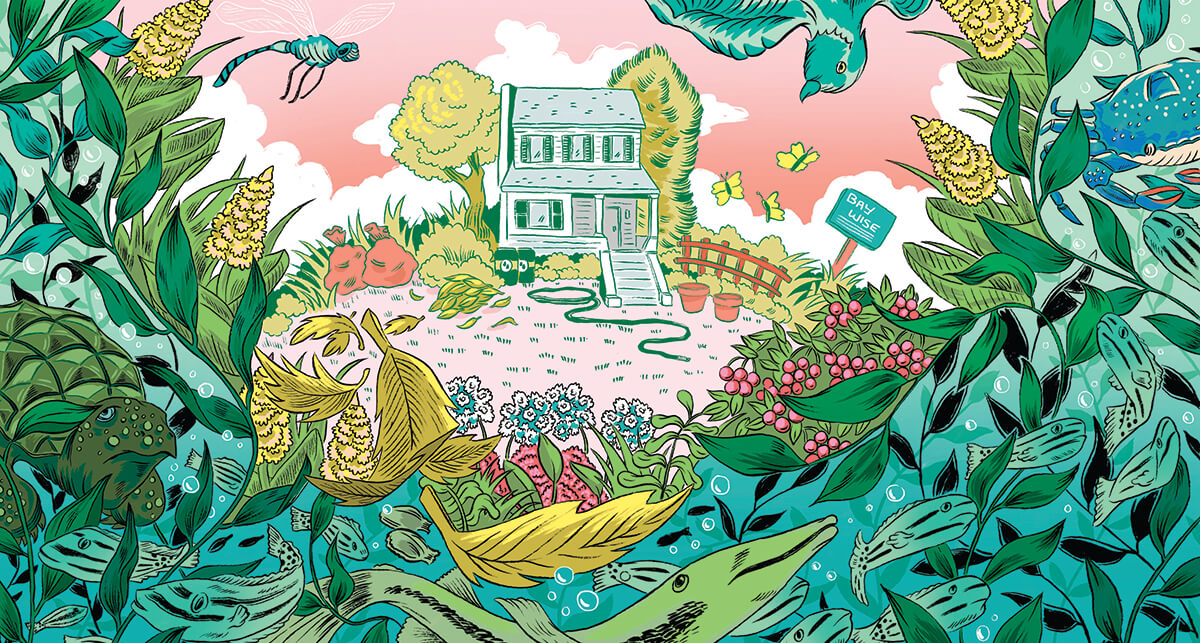
When Susan and Jim King moved to their Owings Mills home three years ago, they knew they wanted to do something special with their two-acre property. They shared an interest in native plants and supporting pollinators, but the property they bought featured little of either.
“Most distressing was the first summer,” Jim remembers. “If you ever saw a butterfly, it was crossing over our property—there was nothing to attract it to stay here. My benchmark for seeing if what we were doing was having an impact was to see if we could change that.”
What they were doing was pulling out invasive plants and planting hundreds of native perennials, trees, and shrubs. They installed raingardens and swales to mitigate water runoff and added a small pond for habitat and to provide water for wildlife. Rather than cut down dead trees, they kept the snags—upright old trees left to decompose naturally—for birds. Jim planted a small meadow near their driveway, too. All this, in a typical suburban neighborhood.
“Especially now that we’re older, we wanted to give back,” Susan explains. “We didn’t want a garden just for the sake of it being pretty.”
The Kings could have gardened quietly, but they were aware of the Bay-Wise program overseen by the state’s extension service, which provides educational resources about the environment. Begun in the 1990s as a means of educating residential gardeners about the impact of harmful landscape practices on the Chesapeake Bay, Bay-Wise offers a checklist of sustainable methods anyone can apply to their yard, be it a tiny square of grass in the city or a large property in the county.
It’s an important reminder that no matter if you’re pulling weeds in Essex or putting chemicals on a lawn in Parkton, most Marylanders live within a half mile of a storm drain, stream, or river, and all we do impacts the Bay.
While one can simply use the checklist as a means to improve a yard’s environmental footprint, gardeners can submit to have their property evaluated by a Master Gardener and certified as Bay-Wise. The program isn’t limited to homeowners and renters; retirement communities and businesses have been certified; the Owings Mills campus of Maryland Public Television is certified Bay-Wise. The program is completely free.
Along with certification comes a small, blue-gray sign to place in the yard. Like the cake-stand trophy from The Great British Bake-off fame, the sign is much-coveted and its own reward.
“Certification is the ultimate goal, but it is more important to learn about these concepts,” says Leslie Erickson, co-lead of Bay-Wise for Baltimore County. The checklist (formally called the “Living Landscapes Metric”) focuses on eight keystone habits, such as recycling kitchen and yard waste on-site, mitigating stormwater runoff, shrinking lawn, and protecting pollinators. There’s emphasis on responsibly removing invasive species and growing native plants.
No matter if you’re pulling weeds in Essex or putting chemicals on a lawn in Parkton, most Marylanders live within a half mile of a storm drain, stream, or river, and all we do impacts the Bay.
By the time most gardeners find Bay-Wise, they are often well on their way to having an environmentally friendly landscape, being a sustainable bunch by nature. But evaluation can be intimidating. The program’s co-lead, Pamela Moss, says when applicants know a Master Gardener is coming to see the yard, they are often worried that everything isn’t picture perfect.
“But there’s a big difference between a property you’d see on the cover of Home & Garden and a sustainable, lush garden with beds full of natives and insects,” she explains. “This isn’t about being photo-ready, it’s about sustainability.”
That does not mean you can’t have both. Too often, people hear “native” landscape and think “messy.” Not so, says Bay-Wise certification holder Paul Dongarra, who lives in Catonsville’s historic district. He set about making his backyard more of an “outdoor room” in 2019, while also mitigating an issue with runoff that made parts of the yard swampy.
“I saw this as an opportunity to not just pump the water back to the street, but to retain it here and improve water resilience and set an example for the neighborhood,” he says.
Dongarra installed a large raingarden and surrounded it with an impressive native meadow. While he loves that it attracts goldfinches and butterflies, he most enjoys watching kids in the neighborhood stop to point out and enjoy all that’s living in the landscape.
“It’s gardening with intent,” he says. “It brings so many people in the community joy.”
Like many Bay-Wise gardeners, Dongarra was already applying sustainable practices; but certification, and that lovely little sign, offers a pat on the back and an opportunity to educate others. For example, it’s a misconception that one can’t have any non-natives. There is no punishment for having peonies.
“I have a lot of plants [planted by previous owners] that aren’t native—you don’t lose points for that, but you do get points for what else is there,” he explains.
When Gavon Peck and his husband bought their home in the Westgate neighborhood in southwest Baltimore, the tiny yard was nothing but grass. They also had water runoff problems. A swale mitigated that and much of the grass is gone, covered in natives. He is in the process of replanting the hellstrip (that bit of sad grass between the roadside curb and the sidewalk) with more perennials.
Peck encourages people to step away from the predictability of lawns. Perennial plants and shrubs provide so much more for kids and adults—and of course, the neighborhood dogs to explore, things that don’t exist in a grass monoculture.
“It’s so beautiful to have plants instead of grass—these are the yards people notice; but of course, that alone won’t get people to change,” he explains. “But what people don’t understand is grass takes a lot of maintenance. Mowing the lawn is no small feat. When you plant with natives…it really is easier than grass.”
Since being certified, Peck feels more comfortable speaking out about sustainability. “People were already asking me about what’s going on in the yard but [the Bay-Wise sign] is a conversation starter and certification made me feel more qualified to speak to the program and sustainable practices.”
Encouraging others to learn about Bay-Wise practices is why the Kings had their property certified. And it’s worked. When they sent neighbors an email about the tree of heaven, an invasive species, taking root in the community, several agreed to cut them down. But the real question was: Did it pass the butterfly test? Indeed, in addition to the frogs that have moved into the pond and an owl now living in one of the snags, the butterflies are so prolific, the Kings have been able to capture monarch eggs in their meadow, raise, and release them.
According to Jim, “The change has been dramatic.”
Wonder How Bay-Wise You Might Be?
Here are a few things to check off your landscape list:
- Create an outdoor compost pile for kitchen and yard waste
- Install rain barrels—water non-edible plants with rainwater (stored water isn’t potable)
- Plant native trees, shrubs, and flowers
- Leave leaves where they fall for habitat creation
- Mulch lightly and avoid synthetic materials like landscape fabric and dyed bark
- Make a plan to remove invasive plants
- Turn off outdoor lights at night to benefit insects and migrating birds
- Reduce the size of turfgrass lawn and always “mow high and let it lie”
- Install a raingarden to absorb stormwater
- Protect native seedlings from deer and mowers
- Plant a diversity of early-to-late-blooming plants to provide pollen
and nectar sources - Eliminate and/or reduce overall use of pesticides, fungicides, etc.
- Learn more or to invite a Bay-Wise leader to speak to your HOA or other community group, here.