Home & Living
Gramophone Makes the Connection Between Technology, Sound, and Home
Now celebrating 50 years, the company demonstrates how invisible tech, sensory design, and artificial intelligence can elevate daily life.
What makes a house feel like home? It is almost never just the paint on the walls or the style of the furniture. Great home design is really about what you see, hear, smell, touch, and feel.
For Andrew Davis, CEO of Timonium-based Gramophone, those sensory details begin with things like state-of-the-art sound systems and integrated television screens. That connection between technology, sound, and home goes back to his childhood.
Growing up in Western Carroll County, Davis was obsessed with electronics. One Christmas, he desperately begged his parents for a Huffy BMX bicycle equipped with a factory stereo. His parents initially said a firm no, convinced he’d blast the music so loud he wouldn’t be able to hear passing cars. But his fascination with sound grew. By middle school, Davis was mowing lawns and shoveling snow to buy mismatched speakers at Sears and wiring them together in his bedroom.
“I was surrounding myself with speakers before surround sound was even a thing,” he recalls. That passion led him to drop out of college, much to his mother’s initial dismay, to pursue consumer tech full-time, eventually buying Gramophone in 2013 from its founder, Brian Hudkins, who was nearing retirement age.
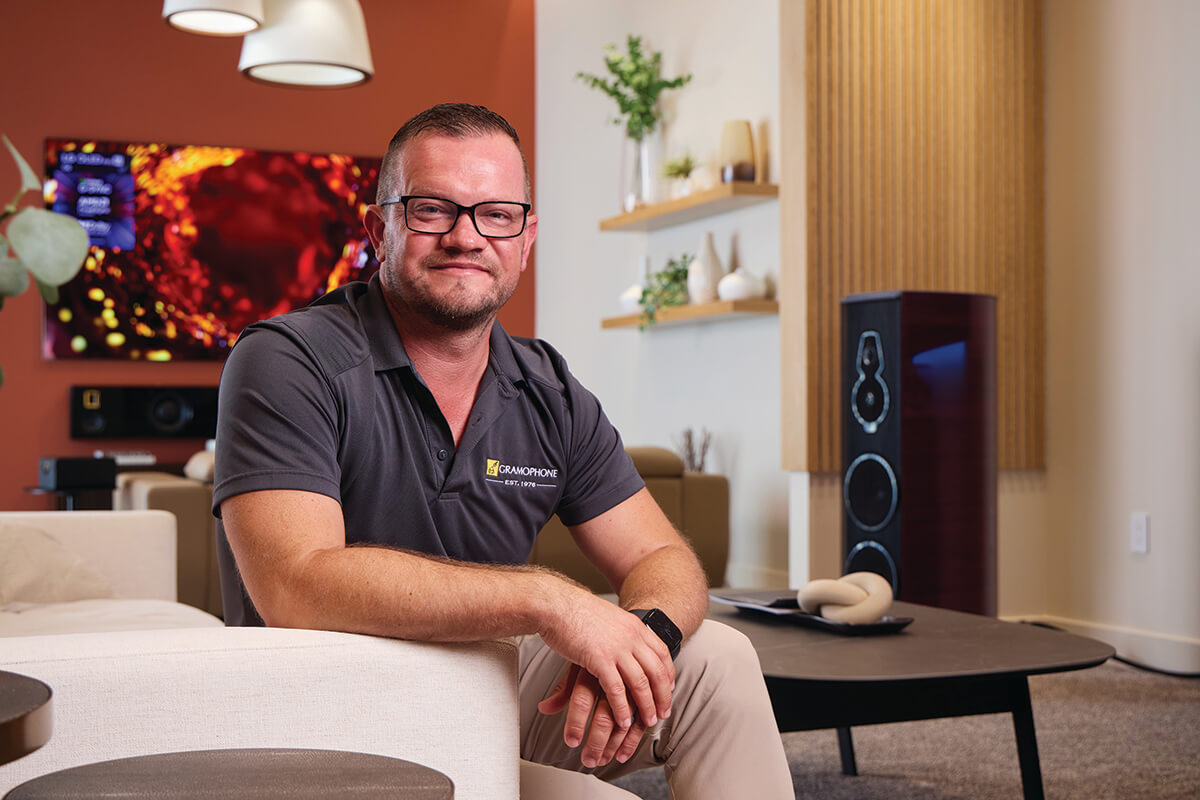
Today, as Gramophone celebrates 50 years in business, you’d never guess the unassuming 41-year-old in the grey polo shirt is running a 125-employee, five-store company along with co-owner Ed Gordon.
To anyone walking into Gramophone’s Experience Center in Timonium, or its nearby retail store, Davis looks like any approachable member of the team. And that’s exactly how he wants it. While advisors tell him to focus on the business from an executive suite, Davis prefers being on the floor with clients.
“Leaders who hide behind desks lose touch,” he says. “Being in the mix is where I keep my pulse on what people actually need and current trends people are asking for.”
While Gramophone’s Design Build team handles the heavy lifting of structural renovations, the Experience Center serves as Davis’ playground for a quieter evolution: to demonstrate how invisible technology, sensory design, and artificial intelligence can elevate daily life.
Step inside one of the showcase rooms, and the first thing you notice is what isn’t there. An 85-inch television sits framed like fine art: no bulky boxes, no visible wires, and no traditional speakers in sight. Davis invites a guest to take the center seat on a blue sofa, and cues up a movie, The Greatest Showman. Suddenly, the lights fade and music swells. Thirteen hidden Sonance speakers, tucked seamlessly behind walls and in the ceiling, transform the cozy room into a three-dimensional cinema.
“How do you want your sound to look?” Davis asks with a smile.
It’s a question that flips traditional home design on its head. Today, that sensory balance goes far beyond family movie night. It is in lighting that automatically shifts to match your body’s circadian rhythm, motorized shades that block harsh glare, and climate systems that balance humidity before you feel uncomfortable.
Now, artificial intelligence is bringing a whole new layer of intuition to the party. Instead of juggling five remotes or tapping phone apps, integrated AI platforms like Josh.ai allow the home to respond to natural conversation. Over time, these systems learn your routines, knowing when to dim the lights, adjust the thermostat, or set the mood for a dinner party without you ever pressing a button.
“At the end of the day, no one wants a house full of complicated gadgets,” Davis says. “Technology should feel effortless. It should just make your home a more comforting place to be.”
At its best, Davis says, technology doesn’t compete with that experience. It disappears into it.