Chris Davis, the once-proud slugger who by then might as well have had his albatross of a contract hanging around his neck, trotted down the orange carpet from center field on Opening Day 2019 to a mix of cheers and boos. By his third strikeout, in the sixth inning, boos were all that was left.
They rained down from a crowd of more than 44,000 at Camden Yards, on a day that’s usually a celebration in Baltimore no matter the score. This was different. When a little-used utility infielder pinch hit for Davis late in the game, the crowd let out a roar louder than anything Davis had heard all day.
He could have ducked out quietly afterward. Instead, he stood at his locker, answered every question from the media, while wearing a gray T-shirt reading “Courage.” I was there.
“I don’t think anybody’s feeling sorry for me right now,” Davis said. “I understand the frustration. Nobody’s more frustrated than I am.”
He was ready to turn it around. He never did. But on Saturday, more than six years from that low, Davis went into the Orioles Hall of Fame at Camden Yards, alongside former pitcher Storm Davis and the late scout Jim Russo. In an on-field, pregame ceremony before the O’s hosted the Philadelphia Phillies, Davis heard only cheers, as if the organization and the city could finally exhale over one of the most dramatic career arcs in franchise history.
It’s worth remembering why there was once so much good noise about Davis. After arriving from the Texas Rangers in a 2011 trade as a 25-year-old, the 6-foot-4 left-handed-hitting first baseman spent 10 seasons in Baltimore and put together a series of enduring highlights, including clobbering 11 career home runs onto Eutaw Street, which is still tied for most in Camden Yards history.
In 2013, Davis led the majors with 53 homers—still the franchise record—along with 138 RBIs and got his only All-Star nod. Two years later, he led the league in home runs again, making him the only player in Orioles history with two 40-homer seasons, as the Orioles, coming off 14 straight losing seasons, made three playoff runs in five years.
“Crush” was so beloved, in fact, that during 2016 free agency, Jimmy’s Seafood publicly offered Davis, his kids, and his future grandchildren free crab cakes for life if he re-signed.
In one of the last big deals made by former owner Peter Angelos, the Orioles signed Davis that January to a seven-year, $161 million contract, the largest in franchise history, with deferred payments now stretching to 2037, when Davis will be 51—Baltimore’s answer to Bobby Bonilla. But almost as soon as the ink dried on the deal, Davis’ production fell off. His body started to deteriorate and he lost his form and confidence at the plate. Then-manager Buck Showalter told him it was hard to watch.
He struck out a career-high 219 times in 2016, hit .215 in 2017, then hit a career-worst .168 in 2018, which was one of the worst seasons by a qualified hitter in major league history. By 2019, he’d go 0-for-54, the longest hitless streak by a position player ever recorded—an ordeal that included that painful Opening Day when he was repeatedly booed.
Later that season, Davis sat in the visitor’s dugout before a game in Washington, took off his hat, and found clumps of his own hair inside it because of the stress. “It tore me up,” Davis said during an extensive interview with Ryan Ripken last week. “It’s so hard when you can be elite…and then it just leaves. It’s super frustrating and it’s confusing.”
Davis has said since that he spent the end of his career masking a back injury he never fully addressed. Spinal injections in one spring training once left him unable to rotate his torso for eight weeks. He pushed through it until a torn hip labrum and bone spurs ended his career for good in 2021.
The contract didn’t cause the decline, but it gave frustrated fans a price tag to point to and fueled public doubts— including from O’s Hall-of-Famer Jim Palmer, who questioned Davis’ work ethic on TV. There was also a 25-game suspension for amphetamines in 2014, after Davis’ longtime therapeutic-use exemption for the ADHD medication Adderall lapsed for one season.
But maybe the lowest single moment came in August 2019, in a blowout loss to the Yankees, when Davis and then-first-year manager Brandon Hyde got into a heated exchange in the dugout physical enough that teammates and coaches had to hold Davis back. He addressed it himself two days later.
“I hit a breaking point,” he said. “It’s going to happen when you have that much frustration. You’re going to have episodes where you have to let it out, unfortunately.” He wished it had happened somewhere private, he said, “but it happened, and I can’t go back and change that.”
By the time he retired in 2021, Davis carried what felt like a big burden. “When I left, it was really hard because I felt like I had let a lot of people down,” he said Friday, inside the Warehouse at Camden Yards. “I was beat up, physically, mentally, emotionally.”
He stayed almost entirely away from the sport for a couple of years, needing the distance. “I always kept up with the Orioles, but I felt like I needed that time to just reset and regroup.”
Now, he sees those years differently. “The hard parts, they help me appreciate the good times even more,” he said, “the good years when we were winning baseball games and going on playoff runs and all that stuff.”
Davis, who turned 40 in March, is now on the field most for youth sports: volunteering as a hitting and infield coach for the baseball team at Liberty Christian School outside of Dallas-Fort Worth, where his three daughters attend, and coaching and driving them to softball games.
It’s in this context that he got the call about the Orioles Hall of Fame selection, something he wasn’t sure would ever come, given how his playing days ended. But last year, at Camden Yards for Adam Jones’ own induction, Jones told Davis flatly he was going in too, if only because he’s the franchise’s single-season home run king.
Davis didn’t buy it until Bill Stetka, the team’s alumni director, called him this spring, while Davis was standing on a practice field in Texas, where his 8-year-old daughter, Grace, was scrimmaging. He told Stetka he’d call him back. They connected again that night, and Davis got the news he was in the O’s 2026 Hall of Fame class.
“It’s a huge honor,” Davis said.
While Davis never made the comeback everyone wanted to see on the field, this weekend, he made a different one—back to Baltimore.
He and his family never lived in the city full time, but after 10 seasons, they feel like part of the community all the same. He and his wife, Jill Davis, donated $3 million in 2019 to fund a cardiac lab and operating room at the University of Maryland Children’s Hospital, named for their oldest daughter, Evelyn, who was born with a heart defect.
The Davises returned to the hospital this week to scoop ice cream and visit patients, nurses, and doctors. “Just doing something special for them is something we care about,” Jill said.
On Friday, at a luncheon inside the Warehouse, Tommy Hunter—the pitcher traded to Baltimore alongside Davis in 2011—introduced him, and Davis hosted Showalter and a room full of old teammates for dinner.
“We had a bunch of guys that had stuff to prove. We had a lot of guys that were from other organizations that had been released,” Davis said Friday. “We leaned into that mentality, and I think it kind of goes hand in hand with the mentality of the city of Baltimore. This is a blue-collar city.”
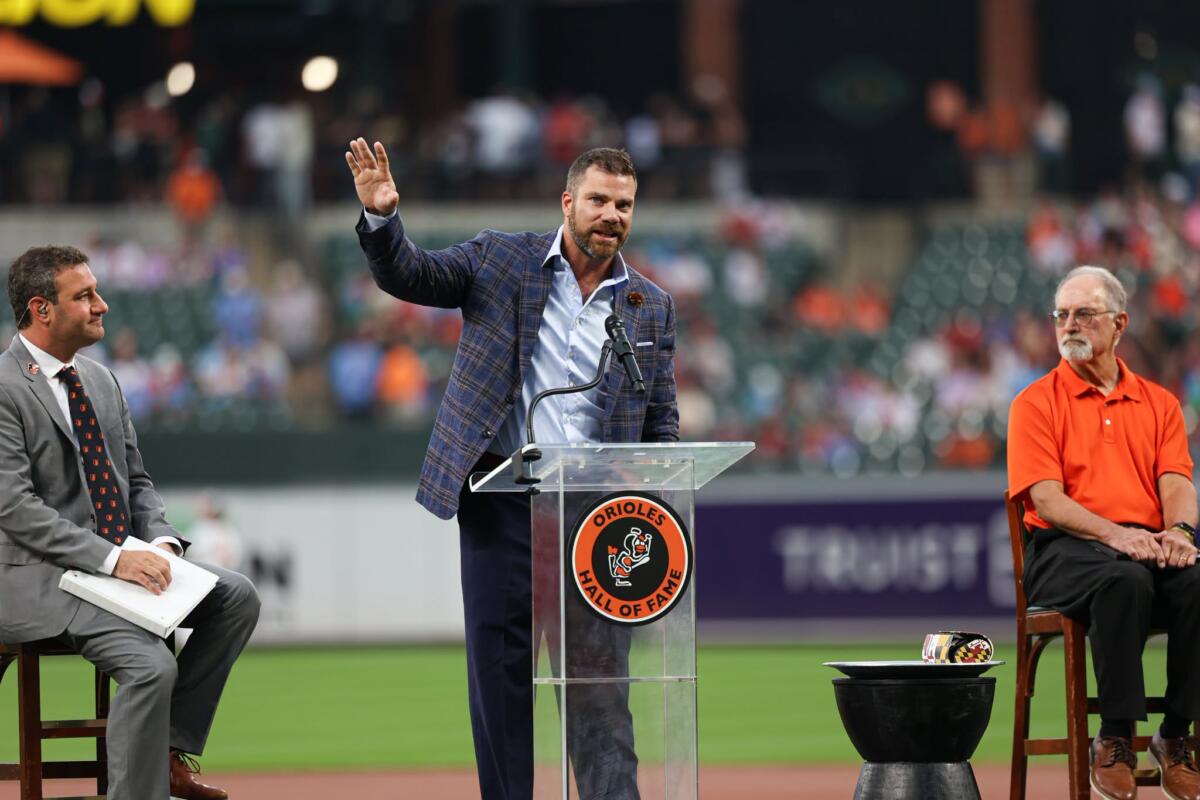
On Saturday, Davis was welcomed to the field at Camden Yards during a pregame ceremony. Showalter and a handful of former clubhouse mates—Matt Wieters, Zach Britton, Darren O’Day, and former hitting coach Scott Coolbaugh among them—watched from behind home plate as a highlight video played on the stadium’s scoreboard. After a deep breath, a suited-up Davis delivered brief remarks to early-arriving fans, many there to see and hear him.
“It’s been an emotional last few days to say the least,” Davis said, before thanking his family and friends for being there. “It’s not about the journey, it’s about the people that you walk the journey with. I’m so thankful to have had such a good group of guys to walk that journey with me.
“It was a big deal to bring winning baseball back to Baltimore. I can’t tell you how much I appreciate everybody coming out, being here. It means the world to me, and I hope y’all enjoy the game.”
Hunter then slipped the signature O’s Hall-of-Fame green jacket over Davis’ broad shoulders.
The O’s lost to the Phillies 5-0, but Davis, watching from a suite with Showalter and his old teammates, didn’t seem to mind. He stayed until the last out, then took selfies and shook hands with fans as they left—some of the same people, or people just like them, who years earlier had wanted him gone.
“You got to keep going,” Davis told a television audience during an appearance in the MASN broadcast booth in the third inning of Saturday’s game. “This game is so hard. You’re going to deal with adversity. You’re going to deal with failure…You have to keep your head up, you have to think about positive things, you have to do things the right way and just keep going.”