Sports
What Made the 2000 Ravens One of the Most Iconic Teams in NFL History?
Twenty-five years after Super Bowl XXXV, we sat down with a few of the stars—and the man who led them—to relive the glory.
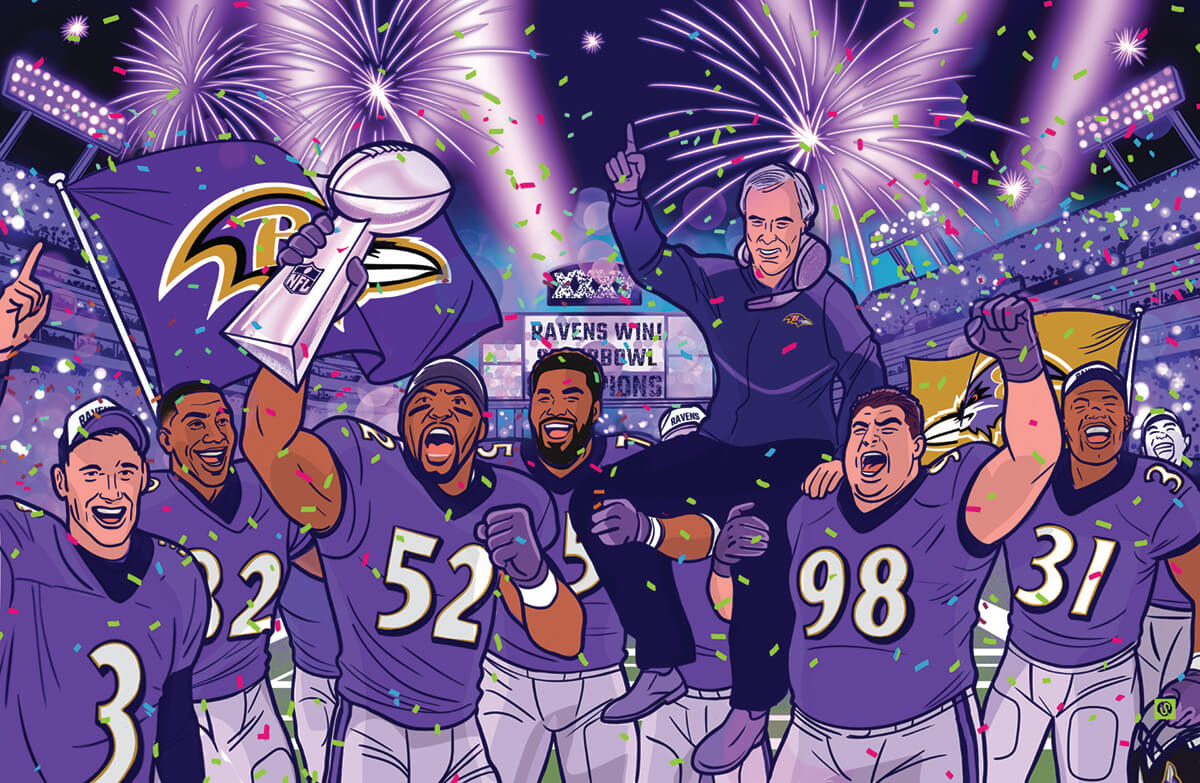
The 2000 Ravens remain one of the most iconic teams in NFL history, a perfect blend of all-world talent, unforgettable personalities, and a lunch-pail work ethic that resonated with Baltimore’s blue-collar fan base. With their legendary defense and ball-control offense, the team rolled to a 12-4 regular season record before buzz sawing through the Broncos, Titans, and Raiders in the playoffs and treating the Giants like an afterthought in Super Bowl XXXV.
The team’s on-the-field achievements deserve celebration, but their arrival in 1996 helped heal the emotional scars that formed when the Colts bolted for Indianapolis a dozen years earlier. It wasn’t the smoothest of starts for the returning team. They played in crumbling Memorial Stadium, lost more than they won, and searched for an identity of their own in the shadows of Johnny, Raymond, Gino, and Art. All that was forgotten when a new crop of superstars—with names like Ray, Jonathan, Peter, and Goose—captured the franchise’s first Lombardi trophy.
Twenty-five years after that defining season, a few of the team’s stars and the man who led them look back at what made the 2000 Ravens one of the greatest teams of all time.
Brian Billick, Head Coach: The Super Bowl run was wholly unexpected and that’s what made it extremely special, not only to the team and the fans, but also to the city of Baltimore, which had lost its beloved Colts. Looking back now makes you realize how great a season that was.
Jonathan Ogden, Left Tackle: We were a great mix of talent, and it was such a good group of guys. It’s always special to look back and remember that we reached the mountaintop. That’s so difficult to do, at any level, and being able to win a championship in the NFL is something I think about all the time.
Qadry Ismail, Wide Receiver: We were like the island of misfit toys. Just an eclectic group of guys. The team was so dominant, but I think more than anything, we just learned how to play together. The camaraderie we had that year felt different. Every day in the locker room, the personalities were on full display, but nobody cared about individual achievements. That’s what made the year so special.
Chris McAlister, Cornerback: That team is my brotherhood. Everyone contributed to the journey. Being with that group…there’s nothing I can compare it to. I’ll always remember and love those guys.
Matt Stover, Placekicker: It was a privilege to be a part of that team. Looking back, you realize how hard it is to win it all. To do it at the highest level was incredible.
Peter Boulware, Linebacker: That season was one of the best experiences of my life. The brotherhood meant so much to me and everybody came together for a singular purpose. It was a special group and a special year.
The team defense ranked first in the league in points allowed (165), rushing yards allowed (970), rushing yards per attempt (2.7), and turnovers forced (49), and set the all-time record for the fewest points allowed in a 16-game regular season (165 total points, 10.3 per game). During a week 4 shutout of the Bengals, the defense gave up just four rushing yards.
Billick: We were the Bullies of Baltimore and bought into that reputation. Part of that swagger develops because of how good we were defensively. We played with athletic arrogance.
Boulware: We intimidated teams by destroying their run game. That was our mentality every week. Then we’d bring the pressure on passing downs. We knew we’d get a sack, fumble, or turnover.
McAlister: It was all about being fearless against the run. Football is different now. Back then, we would try to hurt people legally. Every snap, we came downhill to inflict pain. That’s how we imposed our dominance.
Boulware: If you look at the talent we had on that defense, it was incredibly gifted on an individual level. It’s hard to get a collection of outstanding players to set aside their egos and sacrifice personal recognition for the betterment of the team. But that became our identity, not just a message from the top, and it turned into something special.
McAlister: The way guys pushed each other was relentless. Rod Woodson and Ray Lewis demanded a standard of excellence every day and created a will to dominate your teammates. It sounds strange, but that was the mindset. Ray would challenge me to not let the offense catch a single ball during drills. If you’re competing that hard against your brothers, imagine how hard you played when someone from another team lined up across from you.
The team endured a historic touchdown drought between weeks 5 and 9, failing to cross the goal line in five games and an NFL record 55 consecutive offensive possessions. Despite the futility, the team went 2-3 during the tough stretch thanks to its dominant defense and Stover, whose kicks tallied 49 consecutive points. The challenging stretch could have derailed the season, but it instead galvanized the team and gave it its championship identity.
Billick: That stretch became a defining point in the season and showed that we weren’t going to fracture as a team, which isn’t always the case in the NFL when you go through something like that. I realized we needed a strategic recalibration, and knew the defense was special enough that if we ran the ball effectively and didn’t turn it over, we could win the Super Bowl.
Ismail: A lot of it came down to inconsistent quarterback play. But credit to the coaching staff for leaning into our strengths. We had [running backs] Jamal Lewis and Priest Holmes, who were real dudes, pounding the rock. Jonathan Ogden and Orlando Brown Jr. were two big-bodied tackles anchoring the line, and Jeff Mitchell was holding things down at center. It all started to come together from that point on. Control the field position with the run game, throw the ball to Shannon [Sharpe] in the middle, and take occasional shots on the outside. That became our identity.
Ogden: We just continued to fight. We were thankful we had a great defense, and we understood that we weren’t pulling our weight offensively. We weren’t happy about that, so we kept working to get better. When Trent [Dilfer] replaced Tony [Banks] at quarterback, Billick adopted a more conservative offensive philosophy. We started running the ball more and leaning on Priest and Jamal. The mindset became: Let’s find a way to get 14 points and not turn the ball over.
Boulware: As a defense, we decided to do more than keep teams off the board. [Defensive Coordinator Marvin Lewis] came into a defensive meeting and said, “Preventing points isn’t good enough anymore. Take the ball away. If we take the ball away, we can score on turnovers.”
Ismail: I honestly can’t remember a moment where any of the defensive guys acted like they were above us. Ray Lewis was an eternal optimist. I remember coming off the field, showing my frustration at our inability to move [the ball]. Ray looks over and says, “Hey, hey, hey, baby, don’t, don’t do that. I’m telling you, watch this.” I’m still trying to calm down and took a swig of Gatorade. I look up at the scoreboard and back down at my cup, and Ray is already back on the sideline [after forcing a turnover]. “I told you we’d get it back for you. Now go play,” he says before patting me on the ass and walking away.
McAlister: I think that’s when we became closer as a team, especially as a defensive unit. Our mentality shifted. It became, “As long as teams don’t score, they don’t win.” Those games showed we had what it takes to get the job done. If we were stuck together, we would be fine. We told the offense, don’t worry about it. Just keep fighting.
Ismail: Without the consistency of “Money” Matt during that stretch, there is no Super Bowl. We knew that whenever the field goal team trotted out on the field Matt would get us three points.
Stover: We could’ve fallen apart as a team when we weren’t scoring touchdowns, but we didn’t. To know they felt like we wouldn’t have won games during that stretch without my kicking is a special thing to look back on.
Billick had taken over as head coach in January 1999 and immediately made his mark with as much bravado as the players and added much-needed structure to practices. He also empowered the team’s outsized personalities, with none bigger than Tony “Goose” Siragusa.
Ogden: We got some good players. We drafted well early on, and [General Manager] Ozzie Newsome created a strong foundation for the organization in terms of how we identified talent and the types of players we were looking for. Then Steve Bisciotti bought into the team and brought stability to the organization. Billick was the final piece that helped get us over the top.
Ismail: Billick put together a great coaching staff. He did a masterful job of letting people do their jobs and coach us the right way.
Billick: I wanted to change the team’s expectations of what they could accomplish. In my very first meeting, I told the players that they’d need to decide if they wanted to play in the Pro Bowl or go to the Super Bowl. I let them know that I’d treat them like men if they acted like men. I asked [the veterans] to take responsibility for the culture that we were developing. The younger players bought in because the veterans led the way.
McAlister: Everybody knows Ray was the face of the team, but Goose was probably the most dominant personality and influence. He was completely unfiltered—toward coaches, players, everybody. That’s why everybody loved him. And on top of that, he would do whatever the team needed on the field. The people who knew him best saw his softer side, too. If Goose liked you, he really liked you. You were like family.
Stover: Goose busted everyone’s balls. No one was off limits. That’s important for team chemistry.
Billick: We had a lot of characters who had a lot of character. They had a great time off the field, but also knew when it was time to get to work. Most teams can’t flip the switch like that.
Baltimore bullied its way through the AFC playoffs, dismantling the Denver Broncos 21-3 at home in the Wild Card round before victories against the Tennessee Titans in the Divisional Round and the Oakland Raiders in the AFC Championship game. The Ravens outscored their opponents 95-23 and allowed only one offensive touchdown. It was one of the most dominant championship runs in NFL history.
McAlister: Against Denver, we wanted to dominate in front of our fans and protect our house. People always ask me, “What’s the loudest stadium you ever played in?” I always say Baltimore. At times I couldn’t even hear the guy next to me. We had to use hand signals to communicate because our fans were so rowdy when the other team had the ball.
Boulware: We entered the playoffs with confidence and talked some pretty good trash. We’d already proven what we could do week after week. So, when we said we were going to stop [Titans running back] Eddie George, shut down the Broncos, or contain the Raiders, it was based on everything we had accomplished that season.
McAlister: The Oakland game was billed as a great matchup—top offense versus top defense—but they didn’t fully understand what was coming. We knew we’d destroy them.
Boulware: We found out that [Raiders wide receiver] Andre Rison had planned a team Super Bowl party before they played us. That didn’t go over well in the locker room.
Billick: If you weren’t mentally and emotionally prepared for the physicality we had on both sides of the ball, you weren’t ready for what we brought.
During the 34-7 Super Bowl win, Giants quarterback Kerry Collins threw for only 112 yards, zero touchdowns, and four interceptions, and was sacked four times. His 7.1 quarterback rating is the lowest in Super Bowl history. New York passed the 50-yard line just once, mustered only 152 yards of offense and scored its only touchdown on a kickoff return. Stover booted a 47-yard field goal and McAlister picked off Collins near the goal line to preserve Baltimore’s lead at the half. The championship was essentially won when Jermaine Lewis immediately answered the Giants’ kickoff return for touchdown with an 84-yard kickoff return for a score.
Billick: The Giants were coming off a 41-0 win over the Vikings in the NFL Championship game. They were extremely confident, as they should have been. But I knew the game was ours. The Giants weren’t prepared for how physical we were going to be because they had never experienced it.
Boulware: The Giants didn’t have a chance. That’s how we felt going in. It was one of the most complete wins of our season.
Ismail: We weren’t overthinking the matchup. We were just staying in the moment and handling our business.
Stover: It’s harder to breathe in the Super Bowl. I had to keep telling myself, “Just watch the ball. Slow down. Breathe.”
McAlister: I knew the Giants liked to take shots at the end zone when they got near midfield. Understanding their tendencies let me see the play develop and get in position to make a play on the ball. The interception gave us even more confidence and momentum coming out for the second half.
Stover: I’ll never forget—we’re in the tunnel, getting ready to go out, and Woodson yelled, “Offense gets us 10 points, we win.” We went into halftime with a 10–0 lead, and the defense said, “It’s over. They’re not scoring twice on us.”
Billick: The players believed the game was ours at the half but knew that when they had a team by the throat, they had to finish them. They kept pushing and didn’t let up.
Ogden: When Jermaine returned that kick for a touchdown, I knew we were going to win.
Billick: There was no way the Giants were going to come back in the fourth quarter, so I could look around and soak in the scene. Those were special moments.
Boulware: I was humbled and thanked God for the opportunity, because I don’t care how good you are or how prepared you are, lots of things that are outside of your control need to go your way to win a Super Bowl.
Ismail: I remember thinking, “Wait, what happens now?” Once the confetti started falling, family members joined us on the field, and everyone was soaking in the scene. In the locker room, guys were jumping around, losing it, having the time of their lives.
McAlister: The excitement didn’t fully hit until the confetti dropped from the sky. The grueling two-a-days in training camp, the hard practices, the season-long grind—it all felt worth it in that moment.
Ismail: The afterparty at the team hotel was unbelievable. The entire organization was celebrating. Only the players, coaches, and owners were allowed to touch the Lombardi Trophy, but all our guests were taking pictures with it. I remember thinking, “This is pretty darn cool.”
McAlister: There were plenty of cigars and lots of bourbon. We had a good time.
Stover: My wife and I had been through everything together—the move to Baltimore, the difficult early years. Everything that had built up over time culminated in that moment. I felt complete gratitude for the journey and the opportunity to be part of the organization.
Billick: Everyone on the team was aware of what the victory meant to Art Modell after all he had been through in reestablishing the team in Baltimore. We were very emotional when he came into the locker room, realizing it was a lifetime accomplishment for him.
A dreary day and cold rain didn’t dampen the spirits of the 200,000 fans who lined the streets and crowded around City Hall two days after the Super Bowl victory to celebrate the team that brought football glory back to Baltimore.
Ogden: Baltimore is a football town at heart. It was great to see that passion for football come back. In those first few years, fans were almost trying to remember what it was like to have a team again.
Boulware: My first year, we were 4–12 and still played at Memorial Stadium. Those early years were all about trying to find an identity and building something from the ground up. Even now, 25 years later, being a small part of laying those foundational pieces is something I’m proud of. That’s what made the Super Bowl victory so sweet. I’m grateful we could come through for the fans. They loved us, and we loved them.
Ismail: Baltimore is blue-collar city that loves good football. That’s what matters to them, and that’s what I really appreciate about the fan base. They didn’t know who we were when the team arrived, but they still showed up in force. Other places I’ve played are good football towns, but Baltimore is different.
Stover: The fans accepted us as their own and we were amazed by their passion. The city wrapped its arms around us. Being part of the team that brought them a championship is something I cherish.
McAlister: To be part of the team that brought a championship to Baltimore was an honor, especially after everything the fans had been through after losing the Colts. The Super Bowl run helped bring back some of the pride, grit, and hard work that defines Baltimore. The city is filled with hardworking people, and they appreciated the way we played that year. Our game wasn’t pretty or flashy. We were gritty and fought through adversity together. That’s what resonated most. It took all of us to get it done.