Arts & Culture
Osita Nwanevu’s New Book Makes a Bold Assertion on National Politics
In 'The Right of the People,' the Baltimore-based journalist argues that the U.S. Constitution is not the solution to our dysfunction, but its cause.
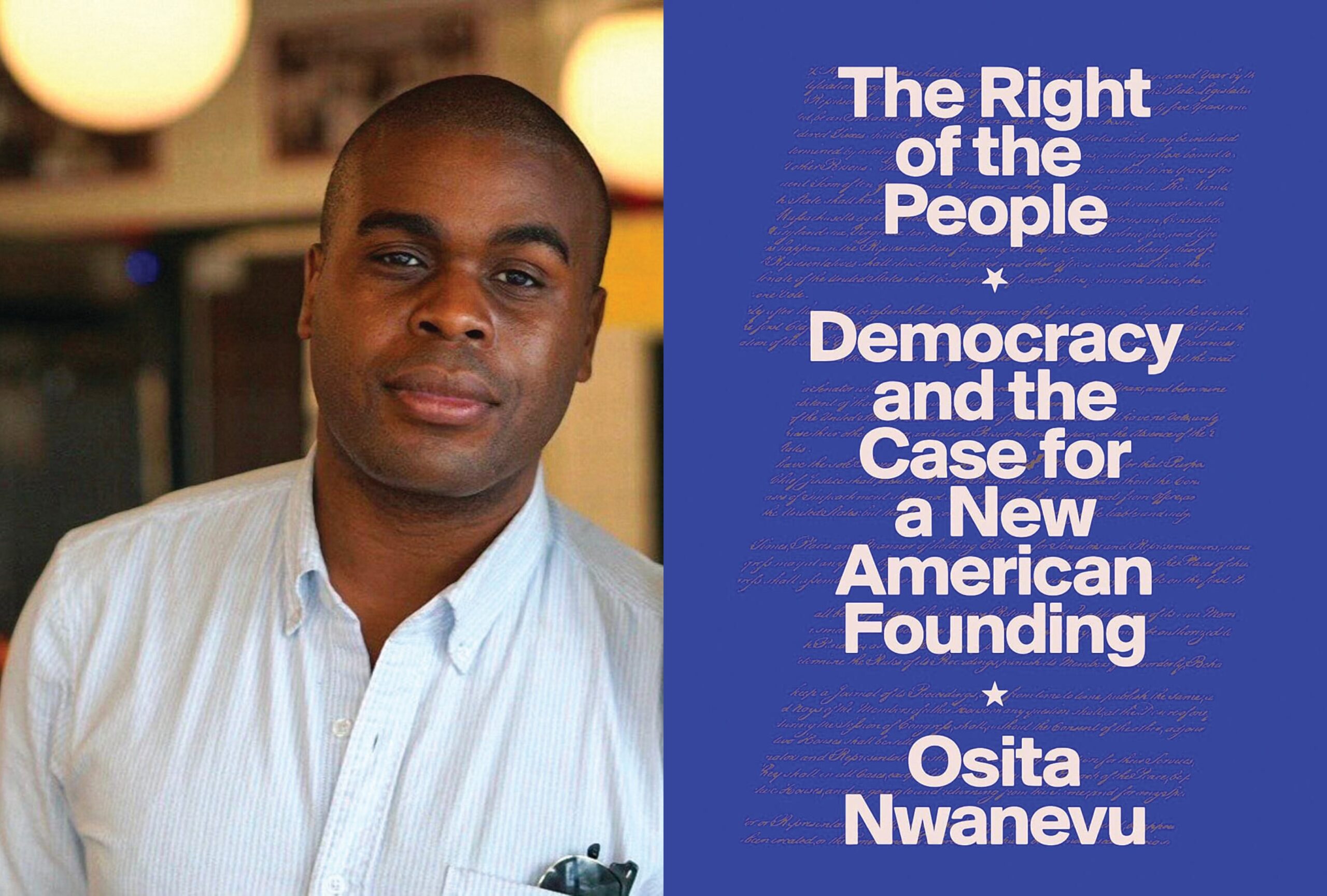
Baltimore-based journalist Osita Nwanevu, a contributing editor at The New Republic and a columnist at The Guardian, has spent the past decade covering national politics. Just 32 years old, his work has always transcended traditional political journalism, combining history, theory, reporting, and analysis to unpack the issues of the day.
His first book, The Right of the People: Democracy and the Case for a New American Founding, published by Penguin Random House, makes a bold assertion. On the cusp of the country’s 250th anniversary, Nwanevu examines and reframes the institutions and practices that, in theory, are upholding American democracy, and argues that the U.S. Constitution is not the solution to our dysfunction, but its cause.
He notes that, at the time of its drafting, critics of the Constitution argued the Founders had created a president akin to an elected king. And since then, the president’s powers have only increased—right up to the exponential expansion undertaken by the current occupant of the White House.
Here, Nwanevu sits down with us to explore the book’s research and analysis.
You highlight that Thomas Jefferson himself believed that even the best constitution was likely only good for about 20 years. Essentially, it was up to each generation or two to reform their government as new challenges and better ideas emerged.
So, I think there’s something odd about our relationship with the founders in this respect, people like Jefferson. We revere their wisdom and insight, they’re very intelligent people, but they also made mistakes in creating the institutions that they did. They had very different ideas, of course, about who belongs to this country and who deserves political rights than we do. To change the system that they set up, that’s our right, it’s our prerogative.
Certainly, we know more about how to govern than they did. They were just starting out the government in this country. We’ve now had over two centuries of experience. We’ve also seen democratic governments around the world pop up that we can draw from. We have political science as a discipline that was not around in 1787 in any kind of serious form.
Most are familiar with our antidemocratic issues—the Electoral College, gerrymandering, the disproportionate representation in the U.S. Senate, the lifetime-termed Supreme Court, etc. When did you conclude these aren’t bugs, but features of the Constitution?
I remember the 2000 election, Bush winning despite losing the popular vote, and I sort of absorbed this vicarious anger and retained a basic sense of unfairness. Then, that’s how Trump wins in 2016 and it many ways it became more difficult to ignore.
He stayed in office despite U.S. senators representing the majority of the American population voting to remove him from office at both impeachment trials. He was able to build the conservative majority on the court that’s going to be in place for perhaps many, many years…If you can win power despite most Americans not supporting your candidates or your agenda, I think that creates an incentive to move further to the political extremes.
You point to three pillars of a functioning democracy—political equality, responsiveness, and majority rule—all places where we are currently failing. You also touch on the amount of money in politics and the growing wealth inequality gap—not as separate concerns, but issues that compound this dysfunction.
That’s right. I mean, there are certain parts of the country, because of the Electoral College, that matter more in federal politics than others. How often do presidential candidates come to Baltimore or Maryland? Look at how many parts of this country are ignored or marginalized or abused, as we see in Los Angeles, as we see in Chicago [with ICE raids and sending in of National Guard units from other states]. That’s all a function of the fact that some places, and their voters, matter much more than others. If we care about democracy, that’s not tenable.
I think people who read this book will see our government in a different light and maybe embrace the idea that an effective democracy doesn’t end division. It provides an equitable means of resolving conflict.
America is a large and diverse country, and this naturally produces a lot of differences. This is why it is necessary to have to a good political system. People think the political environment is difficult now; I promise you, it was not better in 1925 or 1825. We had race riots and political violence that far outstrip what we’re facing now. The Ku Klux Klan was lynching people. Union members were getting shot. We have had a chaotic political history.
Do you have a favorite quote from a Founding Father?
Thomas Paine certainly had a way of cutting through the noise. My favorite from Thomas Paine is the one that I end the book with. “We have it in our power to begin the world over again.”