
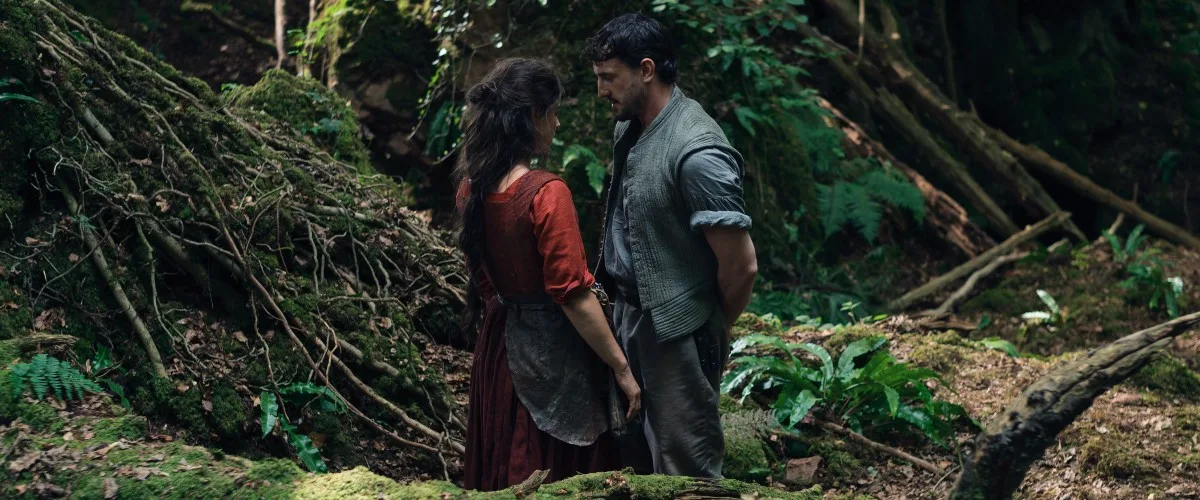
There’s something about Paul Mescal’s earnest, hopeful face that invariably brings me to tears. In fairness, maybe it’s the residual effect of Aftersun, truly one of the most heart-crushing films I’ve ever seen. But before Aftersun there was Normal People and after it, All of Us Strangers, both equally gutting. The man merely has to cast a sad—or worse still, wistful—look and I’m a total wreck. Damn you, Mescal!
So, despite having not read the Maggie O’Farrell novel it is based on, I went into Hamnet well stocked with Kleenex, expecting a tsunami of emotion. I knew it was about William Shakespeare’s only son, Hamnet, whose death was the inspiration for what is arguably the playwright’s masterwork, Hamlet. (We learn right away that Hamnet and Hamlet are interchangeable names.) I also knew that it co-starred Jessie Buckley, who may not have quite the instant access to my tear ducts that Mescal does, but is certainly one of the finest actresses of her generation. What’s more, the film is directed by Chloé Zhao, whose soulful films are filled with striking imagery and depth of feeling. (Her Nomadland was my favorite film of 2020.)
So why did Hamnet leave me cold?
I appreciated the film’s pastoral beauty and the two leads are, unsurprisingly, excellent. But I couldn’t really make the connection between the man I was watching on screen and the greatest English-language playwright of all time. Even in Amadeus, the obnoxiously boyish and hyperactive Mozart exudes a kind of manic genius. In Hamnet, Shakespeare—or “Will” as he’s called here—seems more like a simple country school teacher. Early in the film he lays eyes on Agnes (Buckley), who is stomping through the woods with a hawk on her arm, and runs after her—abruptly abandoning the two little boys he is tutoring. He follows her into a barn where she touches his hand in a probing sort of way—turns out she’s a seer of sorts, who can divine the future with her touch—and they kiss. My first thought was: Do they already know each other? Is this a game where they pretend to be strangers? But no, they actually are strangers and we’re supposed to believe that there is something so elemental and inexorable about their love that it can’t be stopped.
The film is thoroughly imbued with that blend of mysticism and naturalism.
Agnes, it turns out, is the half-sister of the two boys he is tutoring (her own doting mother died in childbirth when she was still a little girl and her step mother is basically of the wicked variety). Because of Agnes’ love of nature, her way of communicating with wild creatures, and her ability to make potions and see the future, she is derisively nicknamed “the forest witch”—an outsider in her own home and village. As for Will, we don’t learn much about him other than that he hates his abusive drunkard of a father. But he barely speaks, something that even the quiet Agnes remarks upon. In response, he says he’s better at storytelling than conversation and recites the myth of Orpheus and Eurydice, expertly, of course. But that’s it. We hear he’s a writer, but we rarely see him write, nor does he seem consumed by ideas or language. The film is so concerned with the beauty and brutality of nature, it misses the intellectualism and wit that powered Shakespeare.
Agnes and Will have three children—their eldest, Susanna (Bodhi Rae Breathnach), and twins Judith (Olivia Lynes) and Hamnet (Jacobi Jupe). Agnes gives birth to Susanna alone in the woods, near the opening of a cavern, bracing herself against a tree stump during contractions. When she is found by Will, holding the baby, she is smiling, fully content. But the next time she gives birth she is forced to do it inside against her will by Will’s compassionate but no-nonsense mother, played by Emily Watson. The boy comes first and then, surprisingly, comes Judith, his twin, who is nearly stillborn. They wrap the infant up, trying to take her away but Agnes refuses to let her go, virtually willing the child back to life. The twins become inseparable—male and female carbon copies of each other, even occasionally swapping clothes.
It is sickly Judith whom the family frets over and worries about, especially when she is stricken with bubonic plague a disease that has been decimating villages. But in a cruel twist, it is not Judith who dies of the plague, but Hamnet. (Judith tells her mother that, in the ultimate act of sacrifice, Hamnet beseeched the gods to take him instead of her—and I think we’re supposed to take that literally.) At the time of the boy’s death, Will is in London, working on his plays. So Agnes is alone with her surviving children as she wails and begs and curses the gods over the body of her motionless son. When Will comes home, he is too grief-stricken to console Agnes, or even speak. The child’s death creates a wedge between the couple. So Will leaves again and retreats into his art.
Most of Hamnet has been visual and visceral—scenes of nature, scenes of the brutality of childbirth and illness, scenes of a content, pastoral family life. (In this sense, the film is very much like Train Dreams, a similarly swoony if dramatically inert film about a simple homesteader and his idyllic family life.)
However, the film’s final scenes, the ones that take us out of the awe and fury of nature and depict the premiere of Hamlet that Agnes reluctantly attends with her brother, Bartholomew (Joe Alwyn), are its best—stirring and literary and meaningful. The overhead shot of Agnes and Bartholomew pushing their way through the eager crowd to get to the front of the stage is a masterclass of filmmaking. The stage production itself is riveting—Noah Jupe, the real-life brother of Jacobi, plays Hamlet, and Mescal, as Will, plays the ghost of Hamlet’s father, covered in white powder and tattered white robes. Agnes, her body pressed against the stage, reaches out to the dying Hamlet, her eyes filled with ecstatic tears. She’s both healed and transported by this monumental work of art. It’s breathtaking. But I didn’t quite see how we went from that home, that family, and that child’s death to this remarkable play. Yes, I cried. But it felt like an unearned catharsis. I wanted to see the film that warranted this powerful final scene.