
After watching Rebecca Miller’s riveting five-part documentary on Martin Scorsese, Mr. Scorsese, I found myself feeling sorry for Scorsese’s eldest daughters, both born when he was still a striving young man. Their father was an obsessive artist, sometimes fueled by cocaine, always fueled by an all-consuming passion for cinema and filmmaking. He was, essentially, an absentee father. His films were his real children. (He’s now long sober and a doting dad to his youngest daughter, Francesca.)
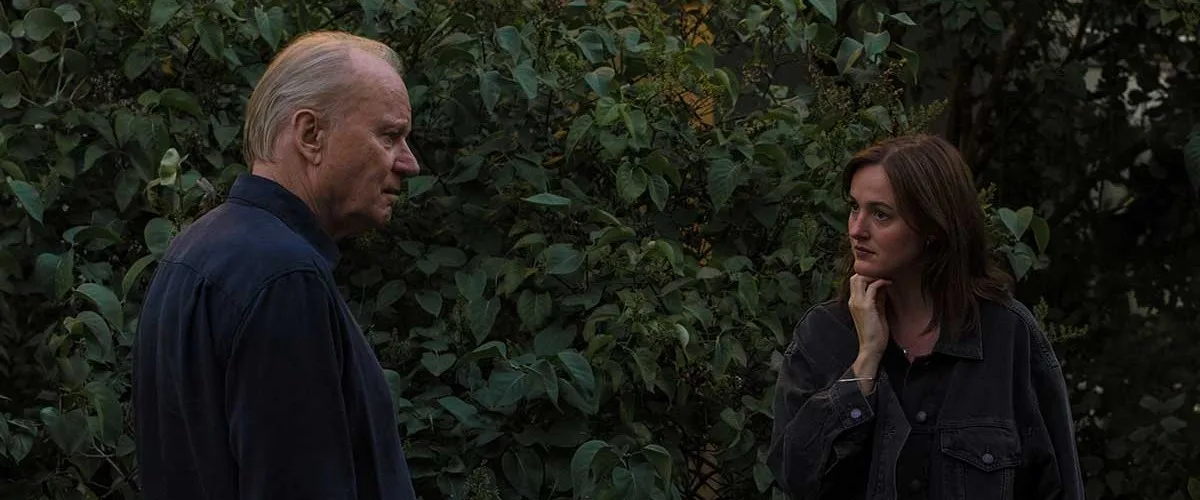
This trajectory tracks in Sentimental Value, the brilliant new film from Joachim Trier (The Worst Person In the World), about a filmmaker who chose moviemaking, and its attendant glory, over his own family. Stellan Skarsgård plays Gustav Borg, a director of some renown (if not quite Scorsese-level renown) who all but abandoned his two daughters to follow his career.
When she was a child, his younger daughter, Agnes (Inga Ibsdotter Lilleaas), played a role in a WWII drama that he directed. She recalls, poignantly, that it was the best time of her life—never before had her father lavished her with so much attention and praise.
Now Agnes and her older sister, Nora (Renate Reinsve), are adults and essentially estranged from Gustav, who divorced their mother and barely came around after that. Nora, it turns out, was the one who became an actress. She’s a brilliant stage actress but suffers from pre-show anxiety, needing to be coddled, coaxed, and managed before finally delivering a bravura performance. Nora is single—she’s having an unsatisfying affair with a married stage director—and leads a somewhat lonely life. Agnes, a historian, has a richer life with a husband and an adorable tow-haired young son, Erik (Øyvind Hesjedal Loven), whom both she and Nora dote on.
The other character, if you will, is the rambling family home, where generations of Borgs have lived. (We are shown that various eras of Borg kids discovered that, if you poked your head in the upstairs furnace, you could clearly hear the adults talking downstairs.) If Nora and Agnes’ childhood was disrupted by their parent’s constant arguing and eventual divorce, young Gustav had a far worse childhood: His mother was arrested for being a member of the Resistance and taken to prison where she was tortured. She later killed herself.
So while the family home holds much beauty and life and love—Triers makes a point of showing us laughter, and frolicking children, and messy dinners in the kitchen—it also carries trauma. And its four walls become a metaphor for the kind of family legacy that is impossible to escape.
The film’s action really kicks off after Nora and Agnes’ mother—Gustav’s ex-wife—dies. Gustav was a somewhat unexpected (and unwelcome) guest at the reception. Shortly after, he approaches Nora with a proposition. He’s written a film for her. No one but her can star in it, he insists. It’s his first film in 15 years. And because of his age, it is likely to be his last.
But Nora’s resentment runs deep—deeper than Agnes’, as it turns out. And she says no. Indeed, she doesn’t even bother to the read the script, as he pleads with her to do.
At a retrospective of his work, Gustav meets the American actress Rachel Kemp (Elle Fanning), a fan, who fawns over him. He offers her the role that his daughter turned down. The film is about a mother who commits suicide after her young son goes to school, but Gustav keeps insisting it’s not about his mother. In further blending of life and art, he decides that he will film his swan song in the family home.
Gustav spends lots of time with Rachel, who has insecurities about the role, especially when he suggests she dye her blonde hair brown, like Nora’s. Should she talk in a Norwegian accent, she asks. Is he sure that an American is right for the role? Can he explain why the mother chooses to kill herself? You have to find the answer yourself, he says. There is something distracted in his direction. We can tell his heart is not quite in it.
Meanwhile, Agnes has been letting Gustav come around more. At her mother’s memorial gathering, Agnes had to introduce a shy Erik to his grandfather. Now the little boy runs straight into his grandfather’s arms.
But Nora remains aloof. We can see that she and her father are quite alike. Neither can express their feelings particularly well—they throw their emotions into their art.
Gustav throws himself into his project, perhaps seeking the rush he found as a young man. He insists that only his former cinematographer shoot his new film but when he visits his old partner, he’s shocked to see that he’s an old man now who uses a cane. Gustav mumbles some excuse about the studio wanting to pick the film’s DP and backs away. What he’s really horrified by, of course, is his own mortality.
Sentimental Value is about regret and trauma and the things left unsaid. It also asks some pointed questions about art: Gustav is a great filmmaker. And Nora is a great actress. Was the collateral damage of their hopelessly fractured relationship worth it? And is there a way they can learn to communicate, if not directly, perhaps through their art?
I was a huge fan of Trier’s The Worst Person in the World (I called it “loose-limbed and insightful” while naming it my sixth favorite film of 2021) and I think this film is even better, a masterwork. Clearly, Trier has found a muse in Renate Reinsve, who has a bewitching economy to her work, a way of saying more with less. (Sometimes Scandinavian understatement can be a balm.) And Skarsgård has never been better. There was a time, clearly, when his Gustav was bedding young starlets. Now he is more of a father figure. The irony that he is a better father to Fanning’s Rachel than he ever was to Nora or Agnes is not lost on us. He still shows his mischievous, raconteur side, but now he wears his sadness and regret like a cloak. And Trier, who has two young daughters himself, directs the whole affair with beauty and pathos and wit. His deeply humane film is an object lesson: You don’t need to be monomaniacal to make great art.
Sentimental Value opens this weekend at The Charles.