
Sure, high school can be a minefield, but real ones know that middle school (or junior high school as they called it back in my day) is where the true horror lies. This is the case for both genders, but it might even be worse for boys, who have the looming threat of physical violence to go along with those surging hormones and fear of social ostracization.
If you look at any bunch of 12 and 13 year old boys, you’ll see all shapes and sizes, some still looking very much like rosy-cheeked children who get tucked into bed at night, and others looking like small men, having sprouted up after puberty, with underarm hair, pimples, deeper voices, and a confusing new preoccupation with sex.
Director Charlie Polinger takes this tumultuous time and turns it into actual body horror in his new film, The Plague. The action takes place at a camp for water polo, which seems less like an actual camp and more like somebody’s nightmare version of one. It’s set at a cold, almost Soviet-like school, with long, empty hallways, military-style sleeping quarters, and a sauna that the boys, oddly, share with the occasional adult. The water polo coach (Joel Edgerton) is kind and a little dumb and in no way ready to handle the physical and emotional destruction his young charges are capable of.
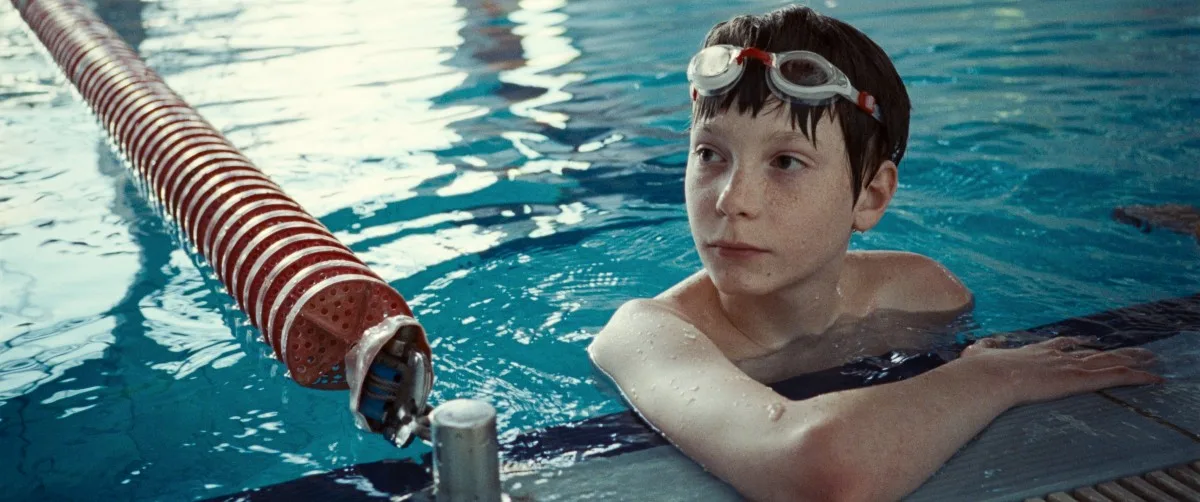
The film’s first shot, a beaut, is underwater—a series of squirming and pumping legs, looking more like sea creatures than boys. Polinger leans into the rowdy, even feral nature of these children—it’s Lord of the Flies Goes to Camp. Our hero is Ben (Everett Blunck), a sensitive child, still baby-faced, but already lanky and tall. His sensitivity makes him a natural target for bullies, but he’s lucky—at first at least. He’s not the lowest kid on the social pecking order. That distinction belongs to the stoic Eli (Kenny Rasmussen), who is accused of having “the plague,” causing the rest of the boys to squirm and scatter when he comes too close.
The inventor of this plague—a precision tool of social ostracization—is a pint-sized sociopath named Jake (Kayo Martin), who is cute and confident and casually cruel. “It’s similar to leprosy,” Jake explains, pointing out that Eli’s rash goes beyond mere teenage acne. “It’s some plague shit. Turns your brain into baby food.”
Jake is cordial enough with Ben, but he immediately clocks him as a potential object of prey.
“Say ‘stop’!” he demands of Ben, in front of the other 7th graders.
“Sop,” lisps Ben cautiously, as the boys howl.
From that instant forward, Ben is nicknamed “Soppy.” (A 7th grader’s ability to find the thing you are most insecure about and mock it remains undefeated.)
Ben is all too aware of Jake’s capacity for social ruination and he regards Eli as a cautionary tale.
But, admirably, Eli manages to remain true to himself—dancing and singing along with a cardboard Betty Boop doll he has made and quoting science fiction films in funny voices. He’s precocious, genuinely odd, and exists somewhere between accepting his fate and believing he might actually deserve it.
“Don’t come near me,” he whispers to Ben. “You might catch it.”
As for Ben, he intellectually knows that the plague is made up but also fears he might catch it. He keeps inspecting his body in the mirror. Is that a pimple or…?
For a while, things go on like this until Ben can’t take it anymore—the cruelty toward Eli is simply too much for his tender heart. So he tentatively befriends Eli, even slathering on Eli’s rash cream, and you can guess what happens next.
The Plague is a clever film, utilizing a horror-film score (human voices chanting, gasping, and moaning in eerie fashion) and directed with cold polish by Polinger. The three lead boys are remarkable. As Ben, Blunck is so pained by the cruel world around him, he will positively crush you. Rasmussen is both off-putting and strangely heroic, bent but not broken by his tormentors. (Here is where Polinger’s lack of sentimentality shines through—sometimes the unpopular kids were, in fact, weirdos). And Kayo Martin’s Jake might be the best of them all—a mop-topped imp with a rakish grin, a natural leader whose charm can turn to menace on a dime.
I admired The Plague but I confess that after a while it got repetitive, having run out of things to say. Still, it’s a slick and nasty piece of work—and I mean that in the best possible way.
The Plague is opening at AMC Columbia on Friday January 2.