
If you were to tell me that you watched Emerald Fennell’s Wuthering Heights and found it to be overwrought, obvious, and absurdly heavy-handed, I would have no choice but to agree you. Also, I kinda loved it.
Fennell is the kind of director who takes big swings; she risks embarrassment—of herself and her actors (who could forget Barry Keoghan masturbating on a grave in Saltburn?)—and yields big emotions.
You could watch Wuthering Heights and laugh at how over-the-top it is, bordering on camp. Or you could give in to those big emotions and gorgeous, extravagant backdrops.
It’s safe to say that Emily Brontë’s Wuthering Heights is a novel that lives in our collective imaginations. Even if you haven’t read it, you’ve probably seen one of the adaptations. And even if you’ve done neither, you understand the archetype of Heathcliff—powerful, masculine, smoldering, and untamed. What’s more, the book’s depiction of all-consuming love has created countless imitators (mostly to the detriment of young women, but I digress). Of course, there was much more to the novel than the love story—Brontë was making trenchant points about racism, classism, misogyny, and generational trauma. But that’s not what we all conjure when we think about Wuthering Heights. We see fog and rocks and fields of moorland grass; we see Cathy in tightly corseted dresses; we see Heathcliff atop a horse, with a billowing black cape. (Another thing we don’t see? The second half of the book, which has been all but ignored by the film and television adaptations.)
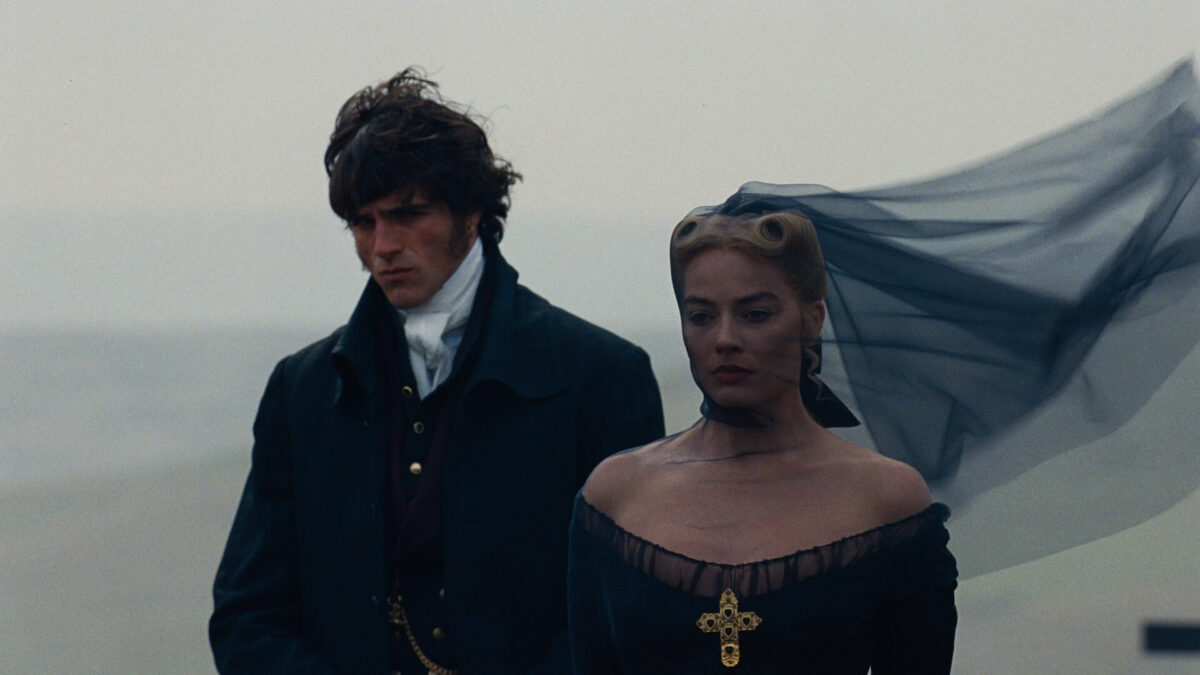
So Emerald Fennell has made it clear that is the Wuthering Heights of her imagination, the way she felt about the book when she first read it at the age of 14. That’s why she puts the title in quotes—it’s an interpretation, a sense-memory, a vibe. Her movie is much dirtier than the book—I don’t remember Healthcliff sucking on Cathy’s fingers after she masturbated in the novel—but not as dirty as some hoped/feared. Even if Fennell is too smart not to recognize that there’s something toxic and destructive about Cathy and Healthcliff’s all-consuming love, she is still trying to create a timeless romance, something 14-year-old Emerald would’ve swooned over. (The picture above is Cathy and Heathcliff after a funeral. He raises her black veil to kiss her, like she is some sort of cursed bride.)
A plot recap, if it’s been a while: Cathy (played by Charlotte Mellington as a girl) is a motherless child being raised in the moors by her alcoholic, gambling addict father (Martin Clunes, excellent). One night, he impulsively brings home an illiterate boy (Owen Cooper) who was being beaten on the street by his caregiver. The maids and cooks in the modest home are irritated by the foundling’s presence—one more mouth to feed—but Cathy is delighted. She immediately dubs him “Heathcliff”—she has essentially named and claimed him. “I’ll never leave you!” she says. They run in the moors, play on the rocks, and Heathcliff endures beatings to shield Cathy from her father’s rage. They grow into hot young adults, now played by Margot Robbie and Jacob Elordi, and soon their preternatural connection becomes an all-consuming sexual and romantic passion. “Whatever our souls are made of, his and mine are the same,” says Cathy. Then the obscenely wealthy Mr. Linton (Shazad Latif) moves in next door and Cathy, understanding that her father is destitute and there’s no future with Heathcliff, agrees to marry him. Heathcliff, taking this as a personal rebuke, rides away on horseback and returns five years later, a wealthy man. Their five years apart have only intensified their love.
Fennell directs Linton’s home with what can only be called Baz Luhrmann-esque fury. It’s a garish and grotesque display of wealth and Cathy is stuffed into bright red dresses, dripping with heavy jewels. The contrast between the gilded mansion and the wild, natural world of the moors is, well, one of those slightly embarrassing things I was talking about. It’s like, girl, we get it. Nonetheless, Fennell knows how to the direct the hell out of a shot, whether Cathy is standing next to the wallpaper Linton made to eerily emulate her flesh or sitting on the edge of a cliff, waiting for her beloved to return.
Let’s address the controversy over the casting. It’s quite clear, in my mind at least, that the Heathcliff of the novel is a POC. He’s literally described as a “dark-skinned gypsy” and a “little Lascar” (slang for sailors from the Indian subcontinent). And yet, in film and television he has been depicted by no less than Laurence Olivier, Ralph Fiennes, and Tom Hardy. Only director Andrea Arnold chose to cast a Black man as Heathcliff in her 2011 adaptation, and good for her, but it didn’t stick.
Fennell maintains that Elordi looks the Heathcliff from the cover of her worn paperback—and I can believe it. It says a lot about whose stories get told and passed on in our culture that most of us assumed Heathcliff was a dark-haired white man.
Putting the racial blunder aside, Elordi is, indeed, a magnificent Heathcliff. He’s a physical specimen—otherworldly handsome and brutish, even (or perhaps especially) with Heathcliff’s long hair and straggly beard. When he comes back from his self-imposed exile, his hair is short and his beard is shaved; he’s wearing fancy clothing (including a hoop earring and an anachronistic gold tooth), but he’s still something of a gorgeous brute. (Why do you think Guillermo Del Toro cast him as a hot Frankenstein’s monster?)
Some have suggested Margot Robbie, in her mid-30s, is too old to play Cathy, who is supposed to be a teenager. They downplay her age in the film, at one point calling her “nearly a spinster” (although, I imagine that would be, like, 21 in 1847) but it doesn’t really matter. Robbie, in fact, does have the kind of beauty men fight over, and she’s a great actress, expressive and keen. Crucially, Cathy and Heathcliff are both kind of dicks, so it’s important that they are played by charismatic movie stars, otherwise their love affair would be unwatchable. And the chemistry between them is, as the kids would say, straight fire.
So there you have it. Wuthering Heights is not faithful to the book, but it is faithful to what the film aroused in young Emerald Fennell’s imagination. It’s a remarkable thing to be able to evoke the passions of a young female bibliophile. The resulting film is a bit silly, very sexy, visually decadent, and, yes, wonderful.