Arts & Culture
Fifty Years Later, Alex Haley’s ‘Roots’ Maintains its Historical and Sociological Force
The influence of the groundbreaking book continues to unfold, in large part through the work of Haley's nephew at the Maryland State Archives.
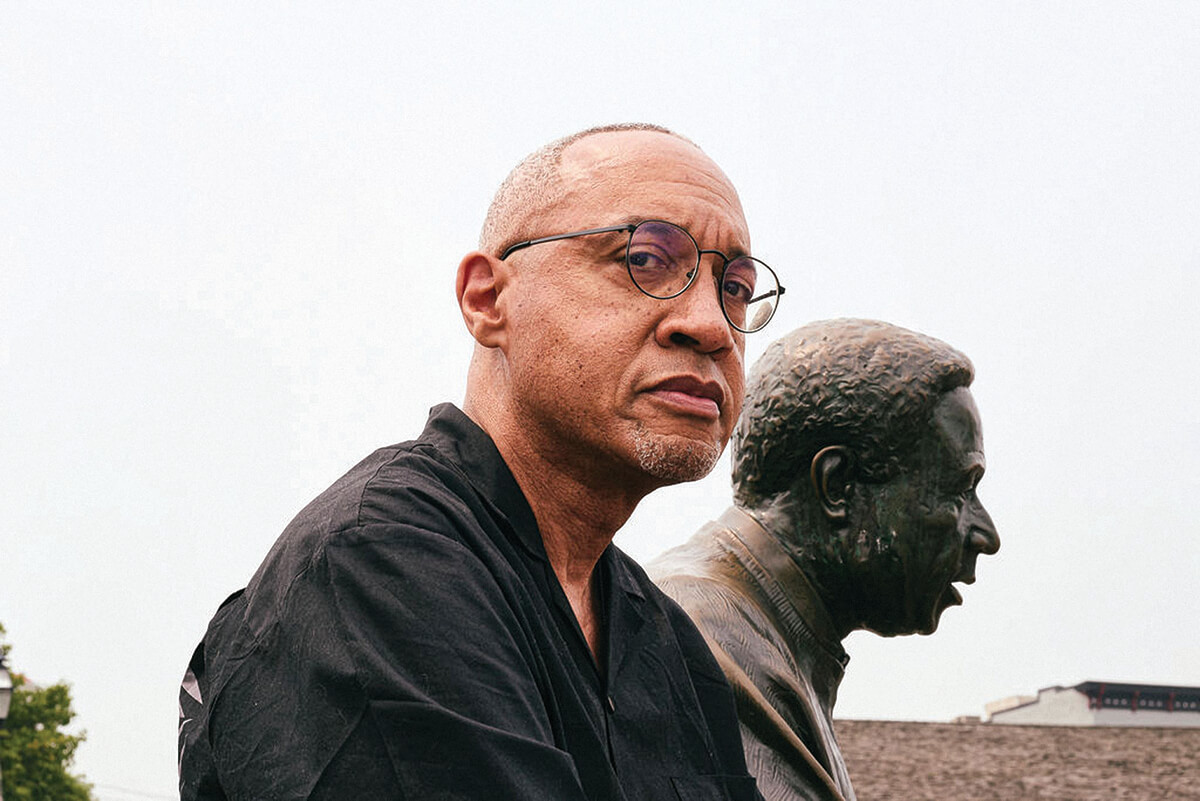
When Alex Haley’s novel, Roots: The Saga of an American Family, was published in the fall of 1976—in the midst of America’s Bicentennial, no less—it became an overnight commercial and critical success. The book spent 22 weeks at No. 1 on The New York Times bestseller list, earned Haley special citations from both the Pulitzer Prize and the National Book Award, and was translated into 37 languages.
Fifty years later, whether you’re reading it or are listening in audiobook form, Roots maintains its historical and sociological force—as well the narrative pace of good fiction and the detail and vividness of cinema.
In January 1977, the miniseries based on the book became the most-watched television show ever, transforming the way Americans—Black and white—thought about slavery, family history, and the nation’s past. (Ironically, the previous record holder for largest television show audience had been the two-part airing of Gone with the Wind, just months earlier.)
Already a renowned journalist, writer, and co-author of the acclaimed The Autobiography of Malcolm X, Haley had started his Roots research with little more than the word “Naplis” (which he would learn referred to Annapolis) and a few African pronunciations handed down through his maternal lineage, including a surname, Kinte. He followed language and other clues to West Africa and the Gambian River area where he came to believe his teenaged ancestor Kunta Kinte had been stolen from his farming village and Muslim family.
Ultimately, Haley traced his journey to the port of Annapolis, where an estimated 100,000 Africans were sold into bondage before Maryland ended its participation in the international slave trade in 1774, and then to Spotsylvania County, Virginia, where his family’s oral tradition indicated his ancestors had been forced to work on a tobacco plantation.
The lynchpin of Haley’s research had come during a visit to the Maryland State Archives in Annapolis, which he first visited in 1967. Archivist Phebe Jacobsen, who would become a dedicated collaborator and lifelong friend, located a pivotal 1767 Maryland Gazette shipping advertisement for the slave ship Lord Ligonier. The timing of the Ligonier’s arrival from Gambia and the notice of its “cargo” of 98 individuals essentially corroborated the Haley family’s oral history.
Writing in The New York Times’ Sunday book review section, James Baldwin said of Kunta Kinte: “We are in his skin, and in his darkness, and, presently, we are shackled with him, in his terror, rage, and pain, his stink, and the stink of others, on the ship which brings him here. It can be said that we know the rest of the story—how it turned out, so to speak, but frankly, I don’t think that we do know the rest of the story. It hasn’t turned out yet, which is the rage and pain and danger of this country.”
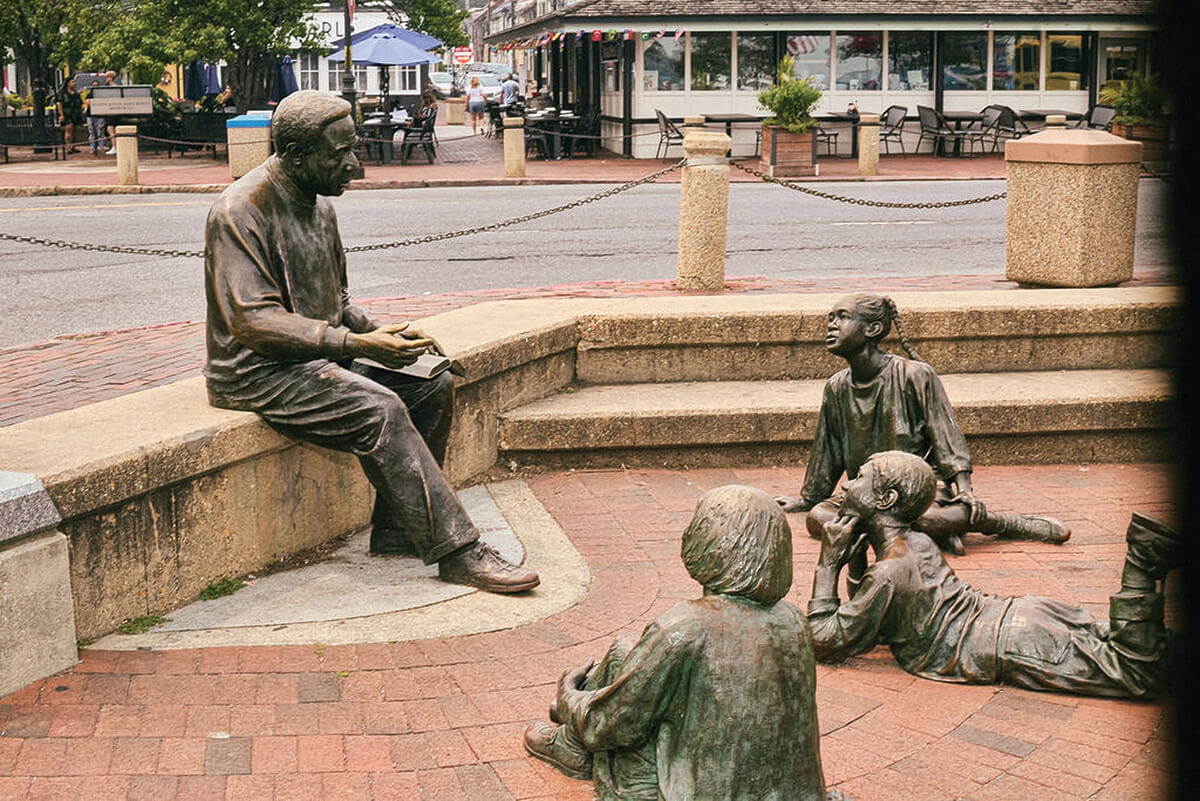
After initial pushback against the Kunta Kinte-Alex Haley Memorial at the Annapolis City Dock, and years of fits and starts, the final phase of the landmark statue was dedicated in June 2002. Meanwhile, the impact and influence of Roots continues to this day—in both good and controversial ways.
In May, the Knoxville, Tennessee school district briefly banned the book until community backlash and state-wide pressure forced its reinstatement. Locally, for three-plus decades, Alex Haley’s nephew, Chris Haley, has built upon on uncle’s work as the director of the Legacy of Slavery in Maryland initiative at the State Archives.
With the 50th anniversary of Roots: The Saga of an American Family and events like the annual Kunta Kinte Heritage Festival in Annapolis this month, Baltimore caught up with Chris Haley to ask him about Roots, his uncle, and his own work at the Maryland State Archives.
Among the artifacts at the State Archives is an old-fashioned school composition notebook, which you just recently found. It was used as a visitor’s log and on the cover, where it reads “PROPERTY OF,” the word “Searchers” is handwritten. What a great word. Then inside there is a date, Aug. 2, 1967, and your uncle’s name in green ink and his purpose: genealogical research for the forthcoming book, Before This Anger.
l love that archivist Phebe Jacobsen had written in “Searchers.” Yeah, originally, he was calling the book Before This Anger. If we look at that title and say the anger was enslavement, the anger was rape, the anger was race-based brutality, economically reinforced—then what was the before? The before was family, the before was a village, the before was freedom and a sense of purpose—the African portion of the story.
Whether you’re the literary or television audience, these are people like you, or another other family like yours. This is like any other story about a young man who is coming of age.
The original title is revelatory. The book’s first 150 pages are set in and around Kunta Kinte’s village. It’s a wonderful, and then terrifying, read, but the long introduction is necessary in terms of gaining a full understanding of his experience.
Part of the inspiration for Uncle Alex in taking on this book was working with Malcolm X. He begins right after Malcom X is killed and The Autobiography of Malcom X is rushed to print. This might be me hypothesizing because I didn’t speak to my uncle [who died in 1992] directly about the original title, Before This Anger, but there has long been this stereotype, this trope, about any Black man who speaks up about the disenfranchisement, unfair discriminatory practices.
I’ve heard it said about me when I talk about Black history. It is no different in 2026 than it was in 1976 or in the mid-1960s, which is in the heart of the Civil Rights Movement when Malcolm X is very active, the Nation of Islam is very active, when Martin Luther King is very active, when marches are very active. So, Alex Haley said, well, “Okay, let me tell you why. Before this anger, we were not savages. We were not people without languages, without religion. We were not people without families, without love. We were not people without goals and aspirations. That’s why we’re angry now because before this anger, we had all this.”
The research lynchpin was the discovery at the State Archives of the Maryland Gazette advertisement, correct? It’s startling to see in person: “Annapolis, Sept. 29, 1767—JUST IMPORTED—In the ship Lord Lingonier, from the River Gambia—A cargo of choice healthy SLAVES.” As well as the additional note that the ship will return to London with tobacco, which, of course, had been raised and harvested by enslaved individuals.
It was one of the more tangible, evidentiary documents that connected Africa with America. It gave a real sense of that journey and what I think has been the iconic connection between the Gambia and Annapolis and Africa and America. Certainly, for my family, but also, spiritually, for many families whose ancestors from Africa were enslaved in North America.
It’s interesting to see people in Annapolis today engaging with the memorial statue of your uncle reading to children.
I grew up in D.C. and reading the book and then watching the miniseries, I don’t recall Annapolis ringing in my ears. I don’t think now Annapolis comes to mind in other parts of the nation. But for Annapolitans and Marylanders, the memorial has brought reflection about the story of Roots and Kunta Kinte, and has changed the way they understand the city.
It’s the country’s 250th anniversary, but it’s only more recently we’ve truly come to understand the role Annapolis, the state capital and briefly the American capital during the Revolutionary period, played in chattel slavery.
Absolutely. The memorial has become a major symbol in the city, a touchstone for any African-American march or celebration in Annapolis, which did not exist previously. It’s where Gov. Wes Moore started his walk to the State House when he was sworn in.
There was pushback when the memorial was first proposed. The then-Annapolis mayor opposed it. And there was vandalism when just the initial memorial plaque was put in place.
In 1981, when it’s first proposed, Roots was fresh in everyone’s mind, and I think Annapolis wanted to maintain this image of a quaint Colonial town, home to Maryland signers of the Declaration of Independence, etc. The mayor said something like, “Alex Haley isn’t from Annapolis.” An initial idea was to build a statue representing Kunta Kinte in chains, but that was shot down. It’s interesting, too, how history is fought over. There is a larger-than-life statue, Bunyan-esque, of my uncle in Knoxville, which is where he is from and returned to live. Same place that banned Roots earlier this year.
Along those lines, you recently visited Philadelphia to see firsthand where the National Park Service had dismantled slavery memorial plaques at the President’s House following a federal executive order. The exhibit detailed the lives of nine people enslaved by George Washington.
It was discouraging to see what happened. But encouraging to see people were openly fighting back, literally taping up print-out plaques in their place. This attempted erasure is right down from the Liberty Bell.
One impact Roots had was an explosion in Black genealogy. Suddenly, lines wrapped outside the National Archives, where research requests tripled. And now we have the long-running PBS show Finding Your Roots with historian Henry Louis Gates Jr.
It was encouraging that research could be done and it isn’t just about finding out your ancestry was enslaved—and that someone could diminish your existence because your ancestor was enslaved. Like no, “My ancestor was a hunter. My ancestor was a prince. My ancestor lived in this part of Africa.” It’s not just about what he was here in America. And whatever he was here in America, he was also skilled lumberman or skilled cobbler or skilled cook.
Roots reminded Black people that 1) You might be able to learn more about your ancestry than you think and 2) What you find is not something that you should be ashamed by.
We’d be remiss if we didn’t ask about the Legacy of Slavery in Maryland project, which you direct.
Initially, it was all about the Underground Railroad. Beyond that, the mission has become documenting and commemorating the lives of thousands of unknown individuals, both free and enslaved, Blacks and whites who were engaged in—for or against—the institution of slavery in Maryland. They are found in census records, other citations, including Maryland Penitentiary ledgers, but they are otherwise unknown to the world. A few even fought against slavery and went to jail for trying to help someone escape. My hope is to have all of them be identified. We have this database with over 500,000 references to individuals who are a part of this history of slavery in Maryland.
In this work, the tragic story of an enslaved Anne Arundel woman named Cinderella Brogden was uncovered. She was married to Abraham Brogden, a freedman who worked at a nearby plantation. In December 1848, her husband learned she was to be sold out of the area to pay off a debt and so together they fled to Baltimore, home to a large free Black population.
Caught before the runaway-slave ad made the newspaper, Abraham was sentenced to several years in prison for “enticing a slave to run away.” Returned to enslavement and then sold, Cinderella died before his release.
The story of Cinderella Brogden is now memorialized on a plaque outside of the Belvoir plantation. It’s one of my biggest satisfactions of the Legacy of Slavery program. We were mining everyone who was enslaved or was charged with aiding and abetting someone to escape, but not looking for this type of individual or that type of individual. The purpose of documentation is for other researchers to use—though we pick a few out to highlight because they tell a broader story. It’s the details that hit us and make her story universal.