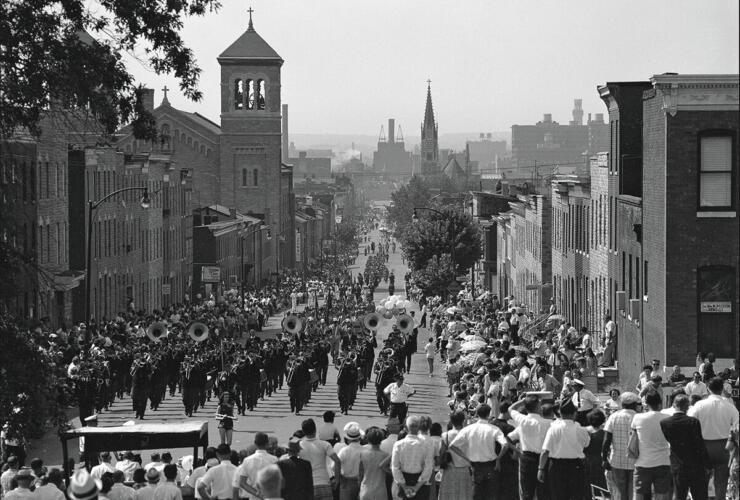
History

The Continental Army was in shambles in the fall of 1776. The Declaration of Independence had been issued just months earlier, but the revolution appeared to be slipping away. Gen. George Washington had been defeated time and again, including at the disastrous Battle of Long Island where Washington himself escaped capture only because of the courage and sacrifice of Maryland’s First Regiment.
In mid-November, following a series of Continental Army retreats, the British laid siege to Fort Washington in Manhattan. The British and Hessian soldiers of King George III then advanced across the Hudson River to New Jersey, forcing the abandonment of Fort Lee. Thousands of American soldiers were killed, wounded, or captured during these British assaults, including 2,800 patriots at Fort Lee alone. Combined with mass desertions, the Continental Army dwindled to little more than 5,000 available men.
The surviving American troops fled to Pennsylvania with the British on their tail.
That December, however, with winter setting in, British Commander William Howe stopped the chase. He positioned outposts from central Jersey to the Pennsylvania line, in towns like Trenton, Bordentown, and Princeton. Believing the rebellion nearly crushed, he sent other troops back to winter quarters in New York.
The Continental Congress, which had been assembling in Philadelphia, did not anticipate Howe would temporarily halt his advance at the shores of the Delaware River. Just 30 miles from Trenton, they feared the British would sack the City of Brotherly Love next. After adjourning on Dec. 12, 1776, they hustled for safely to Baltimore Town—whose estimated population was just 6,000 at the time.
Congress convened again on Dec. 20 at the Henry Fite House, on the site of today’s CFG Bank Arena. The three-story, 14-room tavern, with fireplaces and a stable for 30 horses, was the largest building in Baltimore. It was near places to lodge and eat, but also on the western edge of town and out of cannonball range from Baltimore’s harbor. While Congress met there, Fite’s Tavern took on the name Congress Hall. Unfortunately, the building was destroyed by fire in 1860.
While in Baltimore, Congress members complained they could only get to the Fite House on horseback through deep mud. But they created the Board of War during this time and a new Treasury Committee, too. “We have done more important business in three weeks than we had done, and I believe should have done, at Philadelphia, in six months,” Samuel Adams declared early into the session.
Congress stayed in Baltimore through the end of February 1777. Famously surprising the British with a daring, Christmas night crossing of the icy Delaware River, Washington won several key battles during the intervening months, including the Battles of Princeton and Trenton, rejuvenating American hopes and morale.
Congress reconvened in Philadelphia again on March 5. Howe would eventually occupy Philadelphia in the fall of 1777, causing Congress to flee yet again, but to York, Pennsylvania, this time.
Although the American Revolutionary War would last another six hard years, no major battles were fought in or near Baltimore (unlike the War of 1812). And so, sandwiched between Philadelphia and the final victory in Yorktown, Virginia, the Revolutionary War story here has long been underappreciated. In particular, the crucial role played by local women, African Americans, immigrants, exiles, indentured servants, and foreign allies—in a revolution that reshaped the course of human history—has rarely, if ever, been told completely.
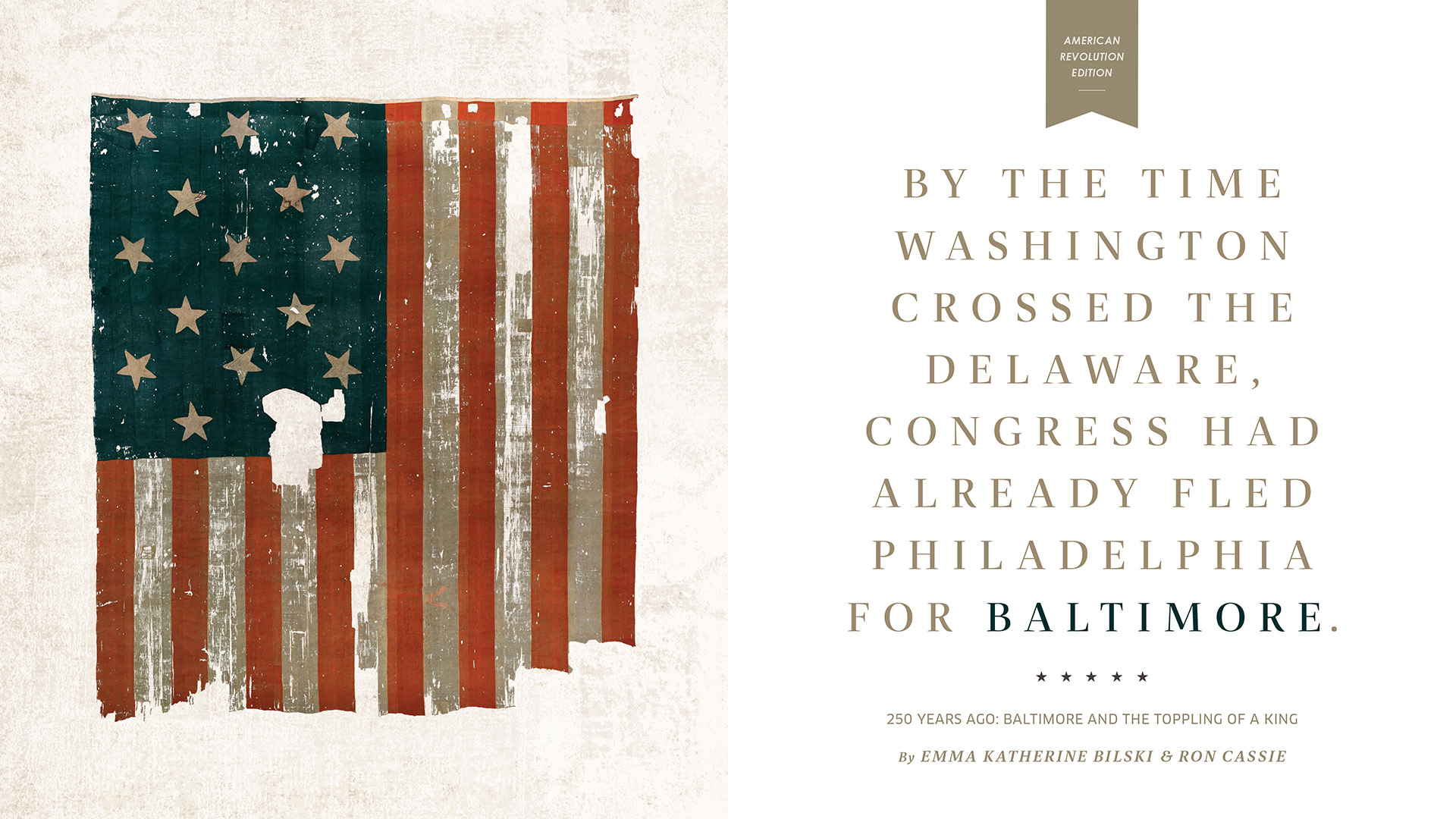
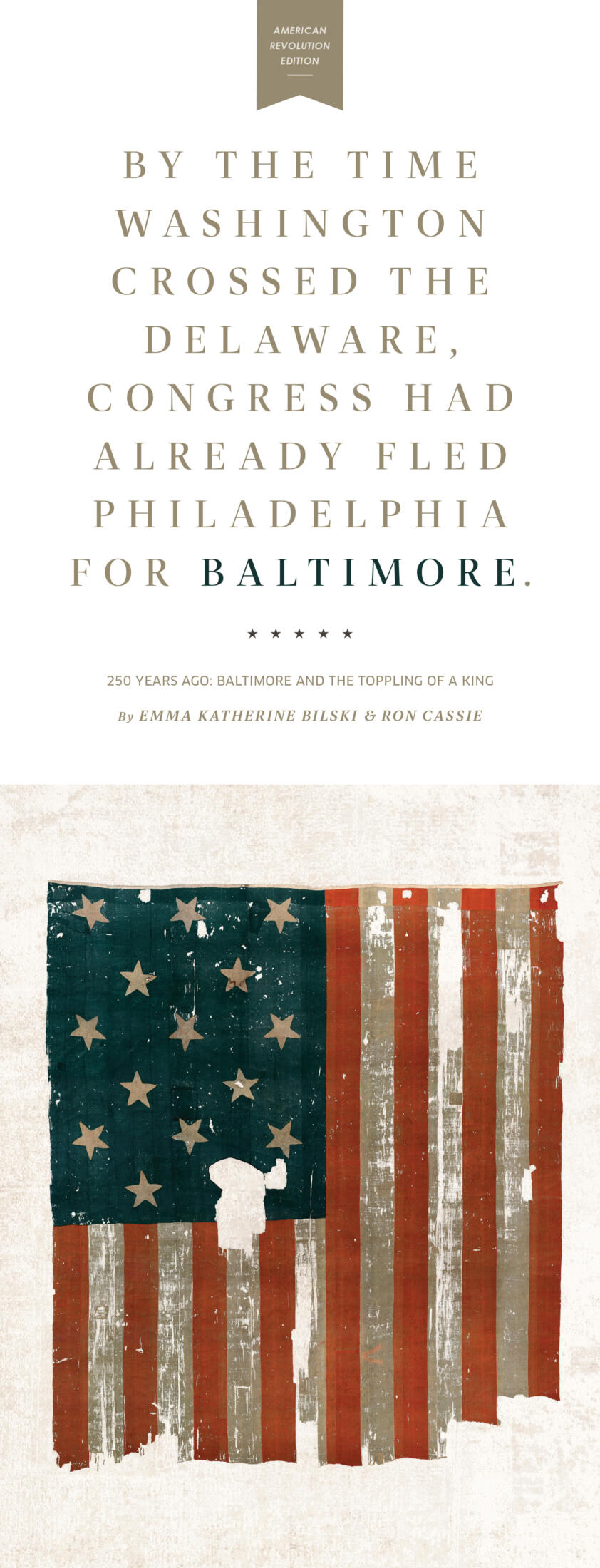
OPENING SPREAD:
Mary Pickersgill’s 1813
hand-sewn Star-Spangled
Banner (42' x 30') that
flew over Fort McHenry. —COURTESY OF THE SMITHSONIAN NATIONAL MUSEUM OF AMERICAN HISTORY.
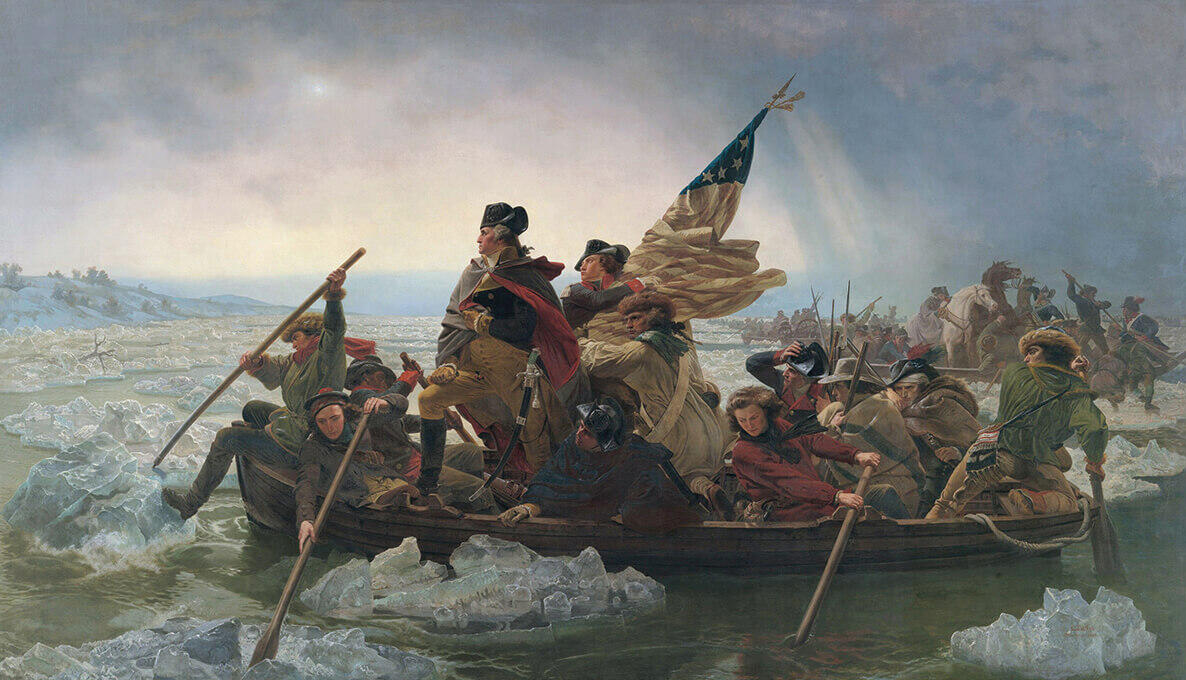
“Washington
Crossing the Delaware”
is one of three 1851 oil
paintings by artist Emanuel
Leutze, depicting the
surprise Christmas night
attack on Trenton, New
Jersey. —EMANUEL LEUTZE, PUBLIC DOMAIN, VIA WIKIMEDIA COMMONS
I. Baltimore Town’s Sons of Liberty
Nine years before the Revolutionary War broke out, Baltimoreans were already organizing in opposition to British colonial policies. Laid out in early 1730, Baltimore Town had become a growing urban center with an economy based on trade through its burgeoning port. By 1765, when Britain’s Parliament passed the Stamp Act, local merchants were already suffering the effects of a credit squeeze, currency shortage, and an adverse balance of trade with England and continental Europe.
Leading Baltimore merchant William Lux feared that the direct tax on colonial print materials—newspapers, pamphlets, magazines, legal and business documents, among other goods—“must inevitably ruin us.” Worse still, the Stamp Tax revenue was used to fund British troops stationed on American soil. Lux, whose father, Darby Lux, gave the anglicized version of his name to downtown’s Light Street, was a member of the Mechanical Company of Baltimore, the ad hoc representative government formed because the Maryland Assembly refused to allow Baltimore Town to officially incorporate with its own city government.
In February 1766, William Lux wrangled members of the Mechanical Company of Baltimore into a local chapter of the Sons of Liberty, following the lead of Boston, New York, and other colonial cities. These Baltimoreans, who were merchants and moderately well-off craftsmen motivated at least in part by economic self-interest, joined with the Boston Sons of Liberty—think Paul Revere, John Hancock, the Adams brothers—and enacted a nonimportation agreement with Britain in protest of the Stamp Act (aka, taxation without representation). Through community pressure in key cities, these early groups of antimonarchy agitators compelled colonial officials to illegally transact business without the stamps mandated by the Act.
After news arrived in Baltimore in April 1766 that the British Parliament had repealed the Stamp Act due to intense resistance in the colonies, the Sons of Liberty disbanded. Even so, their tactics and alliance, including the coalition between craftsmen (“mechanics” in the parlance of the time) and merchants that undergirded the Mechanical Company—set the precedents for political organizing in Baltimore during the Revolutionary War.
II. Tavern Business
In Baltimore Town, as well as most of colonial America, taverns were crucibles of Revolutionary fervor and venues for political assembly and debate. Referred to interchangeably as “inns” and “public houses,” too, taverns offered meals along with beer, hard cider, wine, and liquor—colonists drank roughly three times as much modern Americans—and lodging for travelers. Some taverns catered to elites, for example serving tea, hot chocolate, and coffee to genteel travelers for breakfast; some did not and served only simple fare, if they sold food at all. In general, taverns were places where white men drank and talked, making plans, holding court, and practicing politics while the white women and Black people who worked at the inns were excluded from social and political participation.
In 1773, the very first issue of Baltimore’s first newspaper, the Maryland Journal and Baltimore Advertiser, ran an advertisement declaring that “Daniel Grant...hath opened an Inn and Tavern at the sign of the Fountain”—at the intersection of today’s downtown Light and Redwood streets, just north of the present-day Water Street Tavern. Grant “hath provided every Thing for the Accommodation of Gentlemen, their Servants, and Horses, in the best Manner.” In other words, this was one of those fancier establishments. Over the course of the war, the Fountain Inn accommodated a number of Founding Fathers and Revolutionary War leaders, including John Adams, Thomas Jefferson, the Marquis de Lafayette, and of course Gen. George Washington.
Troop movements brought military officers like Washington and his young French protégé, Maj. Gen. Lafayette, to town. But when Washington slept here, who made his bed? Who brought the general his morning tea and his evening Madeira? Domestic laborers, largely enslaved African Americans, indentured servants, and free white women, who were critical to Baltimore’s Revolutionary War role as a staging point for the Continental Army. Some of this specific domestic labor was likely done by the Black women enslaved by Daniel Grant, including Nanny Smith, Catherine, and Penn, who are named in a subsequent city tax list. The tavern owner’s presence is still visible today in the name of Grant Street, which abuts the old Fountain Inn location.
In fact, Washington and his staff stopped at the Fountain Inn in September 1781 on their way to the decisive Battle of Yorktown. It was also from the steps of the tavern that Washington reviewed the Maryland militia in 1798, when war with France threatened.
Coincidentally, a recovered cannonball from Fort McHenry—fired by the British during the Battle of Baltimore in 1814—sits as a very small monument in front of today’s Redwood Place apartments near the site of the Fountain Inn.
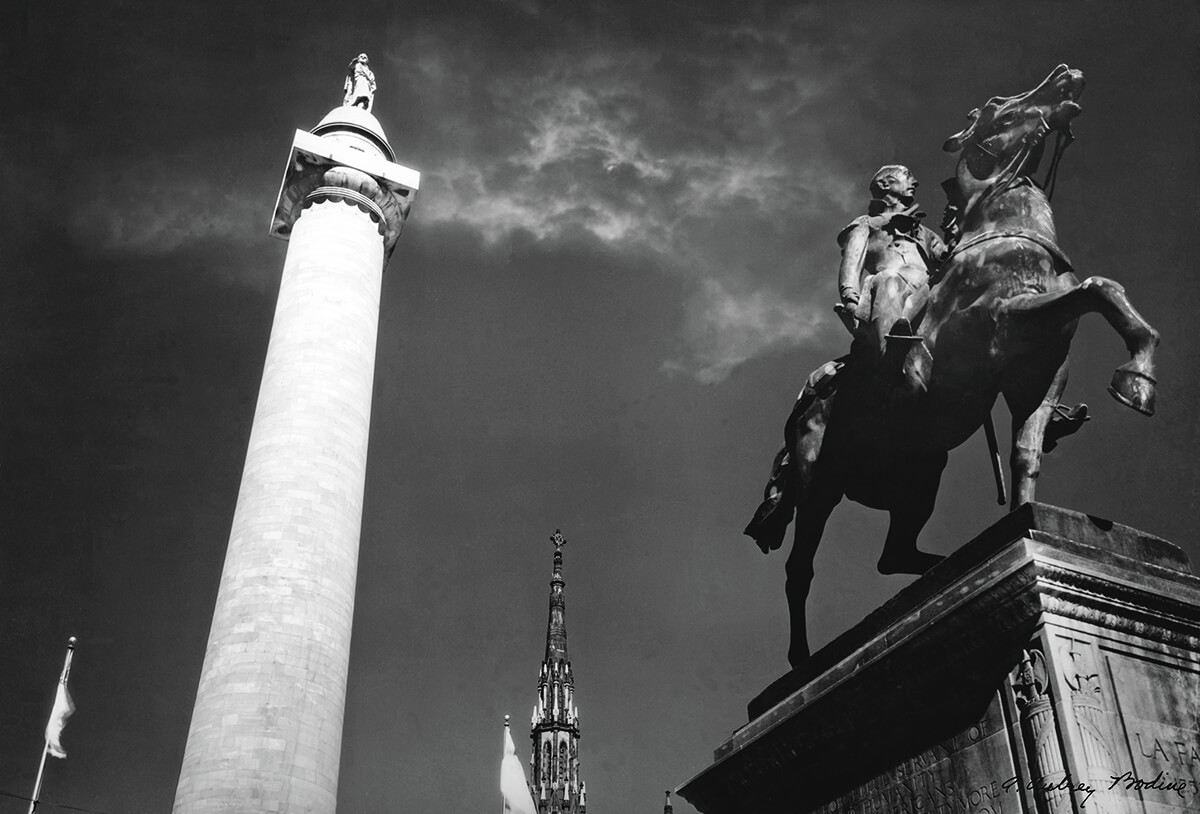
Baltimore’s monuments
to the Marquis de
Lafayette and
George Washington in
Mount Vernon Place. —A. AUBREY BODINE
III. Revolutionary Roads
There remain few traces of Revolutionary War-era Baltimore Town in present-day Baltimore City, besides the names of many of our central streets. There is the aforementioned Light Street and two—Fayette Street and Lafayette Avenue—which pay homage to the beloved volunteer freedom fighter from France. Others include John, Eager, and Howard streets, which honor Maryland-born Continental Army Col. John Eager Howard. Eutaw Street commemorates the bloody 1781 Battle of Eutaw Springs in South Carolina, where Howard and Maryland troops fought fiercely.
Paca and Chase streets are named for two of Maryland’s Declaration of Independence signers—William Paca and Samuel Chase. Stricker Street is named for John Stricker, who served with Washington and later became a commanding general in the War of 1812. And then there’s Baltimore’s Lafayette Square, and the Lafayette statue and the city’s Washington Monument at Mount Vernon Place, which began construction in 1815. It must be noted all these men were also significant enslavers, outside of Lafayette. A lifelong abolitionist, Lafayette later tried, unsuccessfully, to persuade the future first president—one of the richest men ever to hold the nation’s highest office—to emancipate the men, women, and children he enslaved.
Interestingly, Baltimoreans named Pratt Street, the city’s main harbor thoroughfare, as well as Camden Street (and thus Camden Yards) as an expression of their gratitude to British parliamentarian Charles Pratt, the 1st Earl of Camden. A staunch supporter of civil liberties, Pratt opposed the Stamp Act, insisting taxation was predicated on representation, and advocated for the American colonists.
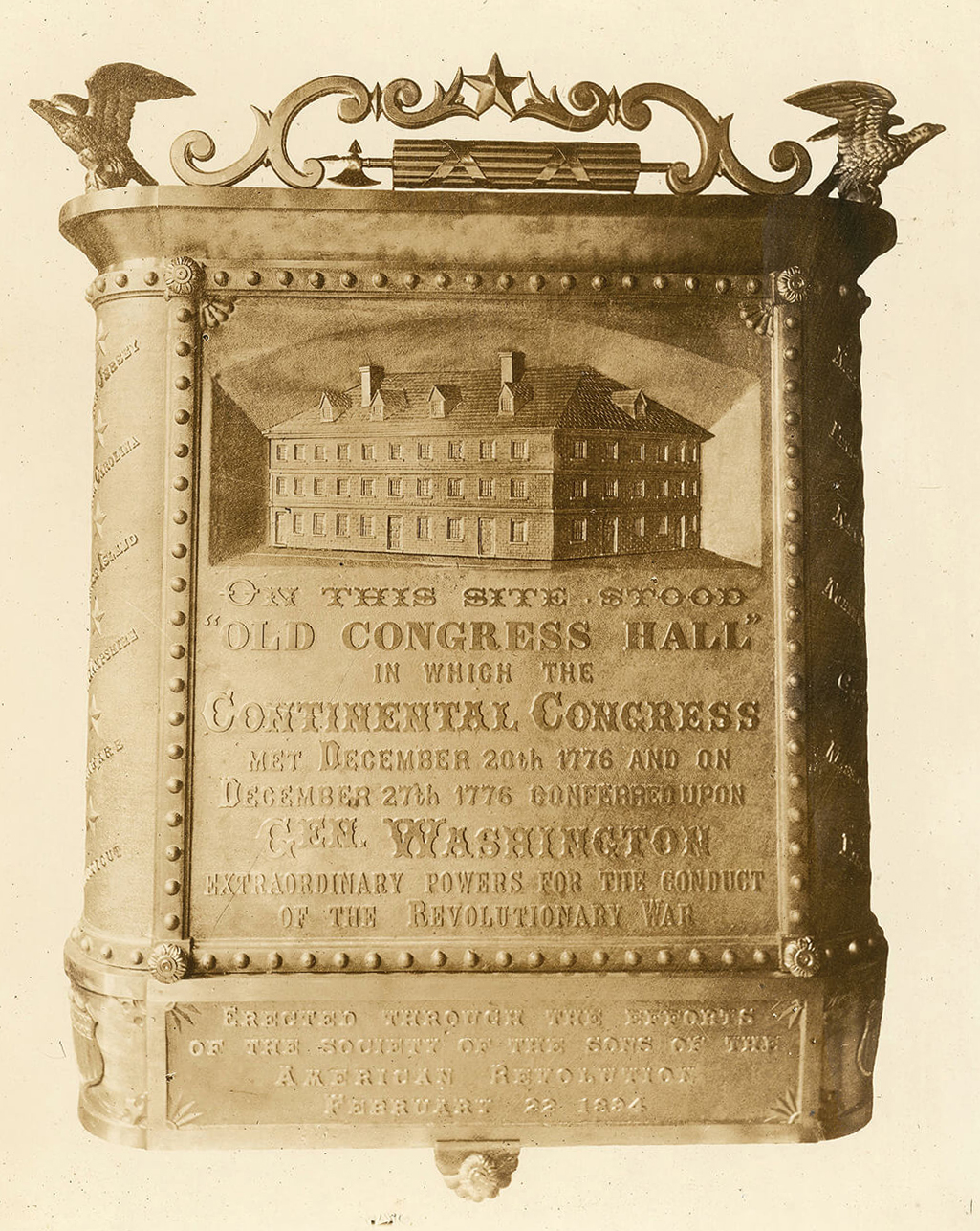
The
plaque inside CFG
Bank Area, which
commemorates the
site’s one-time home
of the Continental
Congress. —ENOCH PRATT FREE LIBRARY/STATE LIBRARY RESOURCE CENTER
There are more markers of Baltimore’s involvement in the revolution: Tucked inside the northeast corner of the CFG Bank Arena is a large bronze plaque commemorating the Continental Congress’ three-month legislative session on that site.
From Dec. 20, 1776, until Feb. 27, 1777, Baltimore Town was the capital of the United States. By this time, Baltimore was more or less universally pro-Revolution in its politics and comparatively well-fortified with Fort Whetstone—later rebuilt as Fort McHenry—as well as artillery breastworks on Fells Point. Theoretically, Baltimore was also defensible because of geography—all told, a good place to flee from the approach of British forces.
During his stay, Massachusetts delegate John Adams wrote in his letters that “Baltimore is a very pretty Town.” He enjoyed long walks around Fells Point and other parts of town and dined with local civil and military Revolutionary leaders, but like other members of the Continental Congress, also complained repeatedly that the streets were “very dirty and miry” and “the muddiest I ever saw.”
Of course, Baltimoreans were not at fault for their miry streets, Adams noted, “because they had determined to pave the Streets before this War came on, since which they have laid the Project aside.” (Apparently, Baltimore’s imperfect streets have been an issue from the start, but their initial paving at least did resume after the war.)
Later in 1777 and for similar reasons, Maryland Gov. Thomas Johnson and the five-man Council of Maryland also “adjourned to Baltimore.” Like Congress before them, they were fleeing British forces who were en route to Philadelphia. The Brits’ fleet had sailed right past Annapolis on their way up the Chesapeake Bay. It is unclear where this executive branch of Maryland’s government sat in session while in Baltimore, although they had made use of Grant’s Fountain Inn on previous visits to town.
Wherever they met, the governor and council fretted over reports of loyalists and deserters and hashed out the logistics of military manpower and supplies. Arriving in mid-August, they adjourned to Annapolis at the end of September when they ran out of money to pay their debts in Baltimore.
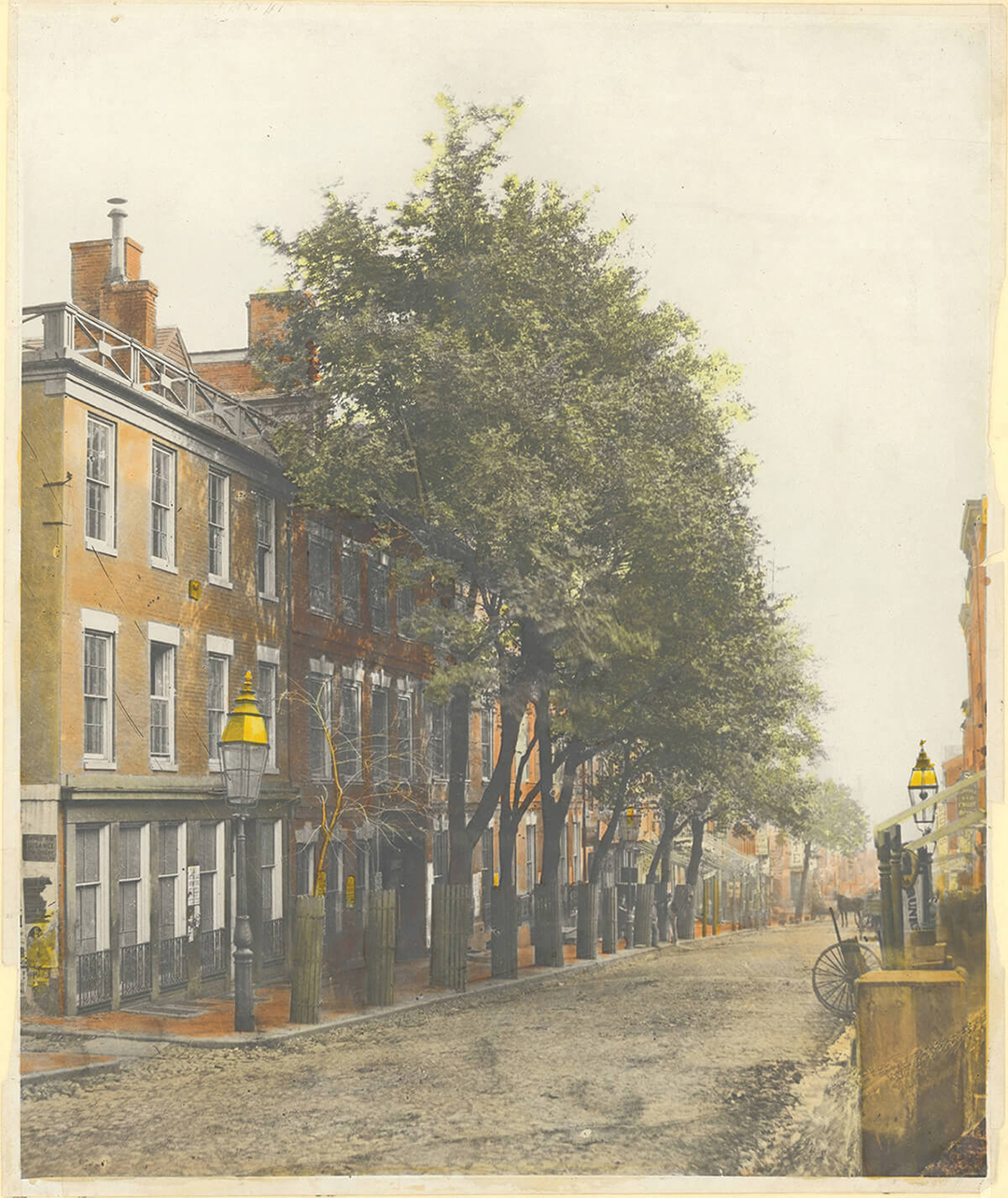
A colorized
photo of the old
Fountain Inn. —ENOCH PRATT FREE LIBRARY/STATE LIBRARY RESOURCE CENTER.
IV. Allies and Immigrants
Warfare depends upon logistics and the Continental Army depended on Baltimore Town. Our history goes largely ignored in histories of the Revolutionary War, because Baltimore was not a battlefield—but it is incorrect to say nothing important happened here. As a port town with an agricultural hinterland and a well-established ironmaking industry, Baltimore was an important supply and distribution center for food, clothing, and ordnance for Revolutionary troops up and down the eastern seaboard.
In February of 1781, the quartermaster general and commissary general of the Continental Army sent word to Baltimore’s civic leadership that the Marquis de Lafayette was on his way to Baltimore with his detachment of troops. The Marquis was moving as rapidly as possible and required essential provisions for his troops on short notice. They emphasized, “we are assured of your readiness to do essential service by your country on every occasion.” So, Baltimoreans got to work.
When Lafayette arrived in Baltimore, it became clear the soldiers under his command were in dire need of clothing as well as food. Under the leadership of David and Elizabeth Poe—coincidentally, the patriotic, future grandparents of the celebrated poet by the same name—the prosperous families of Baltimore Town pitched in together. The gentlemen took up a collection to buy materials, and the ladies set up something like an assembly line and produced approximately 3,000 garments for the soldiers in less than three months. (One document suggests that the clothes were produced within three weeks.)
In response, the Frenchman wrote, “Permit me to request my respectful thanks may be presented to the ladies of Baltimore...not only from a general respect to the fair sex, but more particularly because I know the accomplishment of those to whom I am indebted.”
The chivalrous Lafayette was a frequent visitor to Baltimore and Maryland during and after the war. The inscription at the base of the statue of him on horseback in Mount Vernon Place reads:
LA FAYETTE IMMORTAL
BECAUSE A SELF-FORGETFUL SERVANT OF
JUSTICE AND HUMANITY
BELOVED BY ALL AMERICANS
BECAUSE HE ACKNOWLEDGED NO DUTY MORE
SACRED THAN TO FIGHT FOR THE FREEDOM
OF HIS FELLOW-MEN
Brigadier Gen. Casimir Pułaski, an exiled Polish officer who later became known as “the Father of the American cavalry,” also spent time in the Baltimore area during the Revolutionary War, recruiting for his regiment, colloquially known as “Pulaski’s Legion,” in early 1778.
Roughly six months earlier, Pułaski was credited with saving George Washington’s life, or at minimum preventing his capture, with a bold charge at the Battle of Brandywine that allowed the general time to escape. Pulaski, however, struggled to obtain both funding and respect from the Continental Congress and army leadership, so by all accounts he had a more frustrating time in Baltimore than did Lafayette. Despite the frustration—or even more so, because of it—his formation and training of a wildly diverse cavalry regiment led by immigrant officers was a truly remarkable accomplishment. His service is honored with the naming of Pulaski Highway as well as a massive relief statue at Patterson Park.
It’s worth noting today that historians estimate that up to one-third or one-half of the Continental Army were immigrants. Also, that Native and Black Americans fought on both sides and that a sailor of mixed African and Indigenous ancestry, Crispus Attucks, is traditionally regarded as the first person killed in the Boston massacre, and thus the first patriot killed in the American Revolution.
As a coda to the Pulaski story, recent osteoarcheological research on his remains has indicated Pułaski was likely intersex (born with both male and female sexual characteristics). Perhaps Pułaski’s Legion was more indicative of diversity in American history than anyone realized at the time.
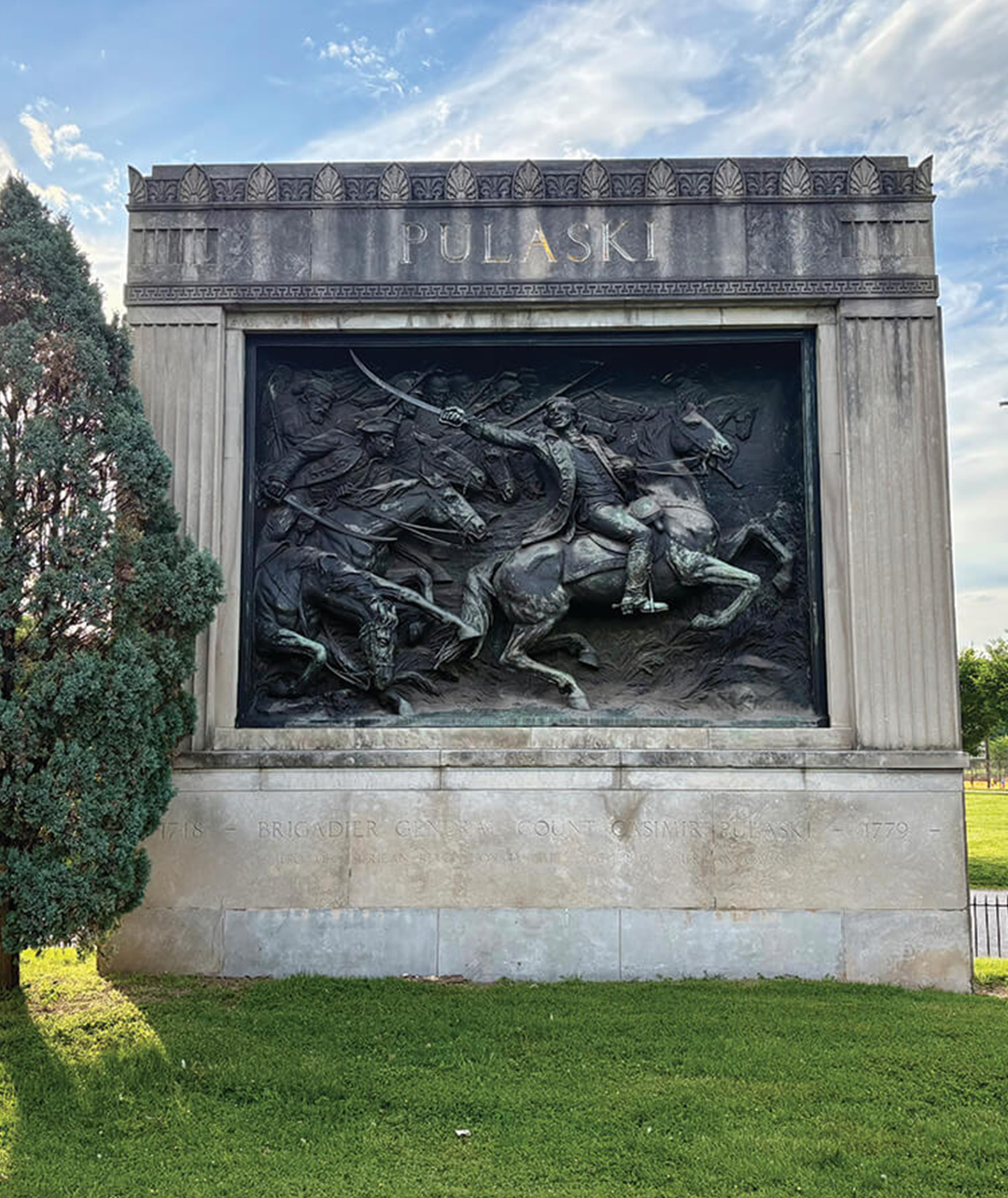
the
bronze relief sculpture
of Gen. Casimir
Pulaski at Patterson
Park —RON CASSIE
V. Black Labor and Liberty
Despite the full-throated rhetoric about liberty, Baltimore’s contributions to the Revolutionary War effort were often produced by the hands of enslaved African and African-American laborers. Nowhere was this more apparent than in the town’s defenses. On Whetstone Point, at the site where Fort McHenry still stands today, around 250 laborers built Fort Whetstone in a few grueling months in 1776. One 19th-century historian specifically described all these workers as “colored.” Whether or not he had evidence for that claim, it is clear the available workforce for large public works projects in Baltimore was made up primarily of enslaved Black people.
During the Revolutionary War, indentured servants and free white men joined the armed forces. Marylanders, including Baltimoreans, who served heroically in the Continental Army (see the accompanying “Maryland 400 sidebar”) are immortalized in our state nickname, the Old Line State. But because Baltimore was a manufacturing and distribution hub for the Continental Army, enslaved people were kept on the home front where their labor was needed, instead of being sent off to fight. They toiled in hazardous conditions at forges and furnaces, making cannons and ammunition; they worked at Baltimore’s shipyards and built ships for the nascent United States Navy; at ropewalks, they made miles upon miles of rope for those same ships; and much more.
The laborers who constructed Fort Whetstone likely included the 100 (or more) people enslaved by Baltimore Town’s revolutionary leaders, as well as the approximately 137 people enslaved by the Principio Company—whose iron-working operations included a small iron mine on Whetstone Point. We don’t know all their names, but as of 1781, the enslaved miners who worked there included Chintz, Cyrus, Dick (noted as “Blind Miner”), Joe, Prince, Sypio, and Will (a “Lame Miner”). The civilians who worked at Fort Whetstone in the months after it was built included free and enslaved Black men. One was known as Nathaniel the carpenter and another was Ned the drayman (cart-driver). A Black woman named Bett carried water for the fort, according to the personnel rosters from the fort, at the Maryland State Archives.
The uncomfortable clash between the ideals of liberty and the reality of bondage did not go unnoticed by Black Americans. Enslaved people fled Baltimore Town and Baltimore County, seeking freedom, throughout the war. Troop movements in the Chesapeake region offered fruitful opportunities for enslaved people. On Nov. 7, 1775, the loyalist governor of Virginia—John Murray, the fourth Earl of Dunmore—officially offered freedom to enslaved people who fled their revolutionary enslavers to join the British armed forces. This “Dunmore Proclamation” opened the metaphorical floodgates. Baltimore’s leading enslavers eventually responded by setting up an expensive system of slave-patrol boats in 1780, the cost of which they tried to foist onto the government of Maryland as an additional component of coastal defense against the British.
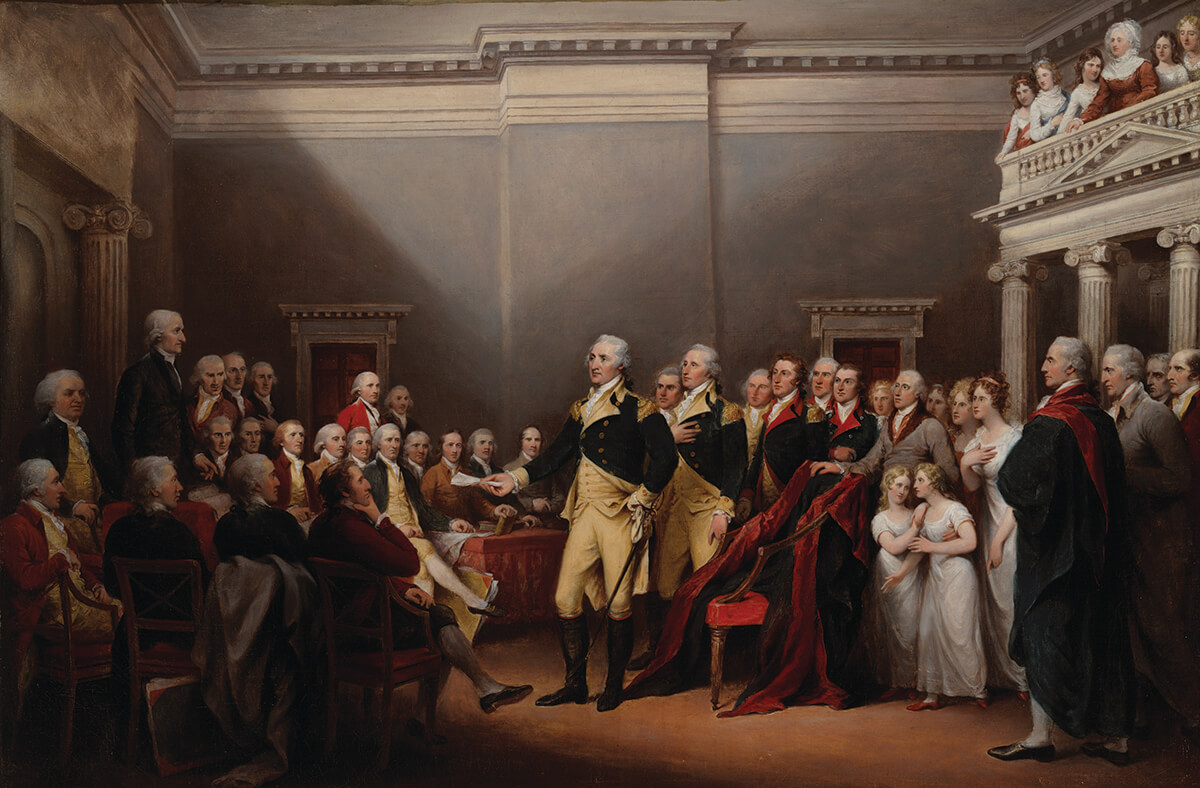
Gen.
George Washington
surrending his
military commission
to the Continental
Congress at the
Old Senate Chamber
of the Maryand
State House in
Annapolis. —WIKIPEDIA COMMONS/YALE UNIVERSITY ART GALLERY, TRUMBULL COLLECTION.
VI. An Independent-Minded Woman
From 1774 until 1784, the newspaper of Baltimore Town, the Maryland Journal and Baltimore Advertiser, was published by an entrepreneurial and patriotic woman named Mary Katherine Goddard. One contemporary account described Goddard, who never married, as a “woman of extraordinary judgment, energy, nerve and strong good sense.” Such was her reputation that Benjamin Franklin appointed her the first postmaster of Baltimore, which made her the first woman to run a national government office. Her brother, William Goddard, co-edited the newspaper with her at other times, but the Maryland Journal was essentially her responsibility during the Revolutionary War.
Although Mary Katherine Goddard later enslaved and eventually freed multiple people, most notably a young Black woman named Belinda Starling, she does not appear to have relied on an enslaved workforce during her tenure as the newspaper’s primary editor.
At the request of the Continental Congress while stationed in Baltimore, Goddard also famously produced the first printed edition of the Declaration of Independence that included the names of all its signers.
She printed her full name at the bottom, too: a lot smaller than John Hancock’s name, but no less permanently inked and indented into the paper. A copy of this January 1777 printing is held in the collection of the Maryland Center for History and Culture, not far, of course, from our Washington Monument and the statue of Lafayette. The imprints of her name, and the signers’ names, remain tangibly present.
At noon on July 29, 1776, the Declaration of Independence was read out loud to the people of Baltimore where the Battle Monument stands today, near the Clarence M. Mitchell Jr. City Courthouse. At the time, it was the site of the courthouse of Baltimore County, which had jurisdiction in Baltimore town. Loyalist sheriff Robert Christie Jr. had refused to do the reading, and he fled town after threats of mob violence.
Local attorney and clerk William Aisquith read it instead. As Mary Katherine Goddard described the event in her newspaper afterwards, “the Declaration of INDEPENDENCY was proclaimed...at the Head of the Independent and Artillery Companies, and the several Companies of Militia, to the great Joy and Satisfaction of the Audience, with a Discharge of Cannon, &c. and universal Acclamations for the Prosperity of the Free UNITED STATES...
“In the Evening the Effigy, representing the King of Great Britain, was carted through the Town, to the no small Mirth of the numerous Spectators, afterwards thrown into a Fire made for that Purpose,” Goddard recounted. She added, “Thus may it fare with all Tyrants.”
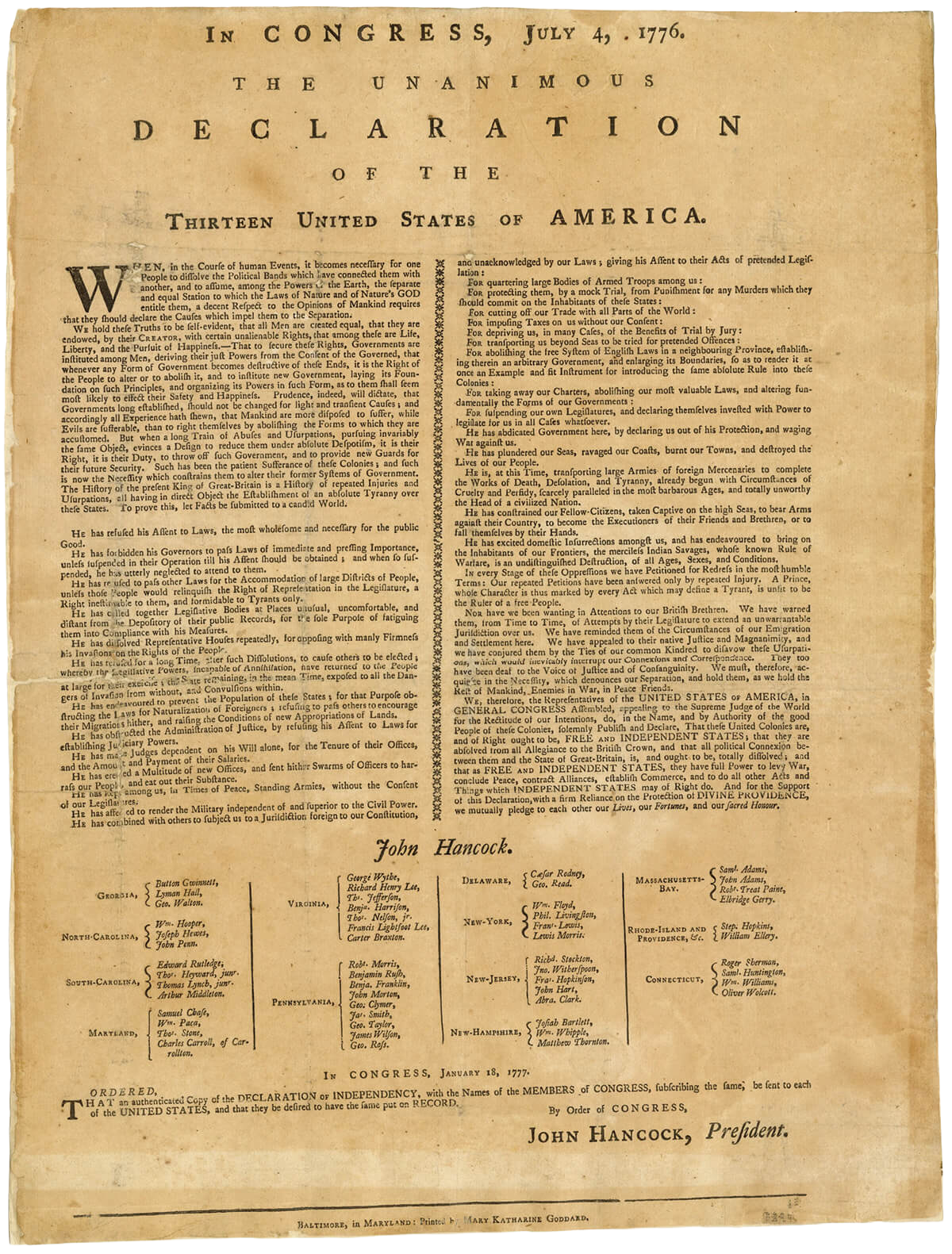
Baltimore’s Mary
Katharine Goddard’s
printing of the
Declaration of
Independence
commissioned by
the Continental
Congress. —COURTESY OF MARYLAND CENTER FOR HISTORY AND CULTURE / RESOURCE ID 569
Epilogue: No Kings Day
The heavy fighting in the Revolutionary War finally reached a conclusion in October 1781 at the Battle of Yorktown, which forced the surrender of British Gen. Charles Cornwallis. Aided greatly by French troops and French naval support, the Continental Army surrounded the British forces and compelled the beginning of negotiations that ultimately led to the recognition of American independence.
However, Gen. Washington remained commander in chief of the Continental Army for two more years until a formal peace was agreed upon with the signing of the Treaty of Paris in September 1783.
In early December 1783, nine days after the last British soldiers left American soil, Washington bid farwell to his officers at Fraunces Tavern in New York City (a museum today). Overcome with emotion, Washington lifted a glass and said, “With a heart full of love and gratitude, I now take leave of you; I most devoutly wish that your latter days may be as prosperous and happy, as your former ones have been glorious and honourable.”
Then he began making his way to Annapolis, where Congress was convening temporarily—ironically, a mob of still-unpaid Continental soldiers had threatened the Congress in Philadelphia—with the intention of resigning his military commission. The idea of a victorious general willingly surrendering absolute power without seizing the throne or a dictatorship would shock the world.
Washington resigned as commander-inchief on Dec. 23, 1783. In a ceremony in the Old Senate Chamber at the Maryland State House—the moment commemorated by Baltimore's Washington Monument—his action established the precedent of military subservience to civilian authority in the United States. Returning to life as a private citizen, Washington placed his trust in the fledging republic’s democratic experiment.
THE MARYLAND 400
The "Old Line State” regiment is honored with a monument in Brooklyn.
IN AUGUST 1776, Thomas Stone, one of Maryland's four signers of the month-old Declaration of Independence, sent urgent news from Philadelphia to Annapolis that a major battle loomed in New York City. Stone reported “...by the last accounts they [the British] were shipping their men and making all necessary preparations for an attack.” Fortunately, the unit that became known as the Maryland First Regiment was already headed north.
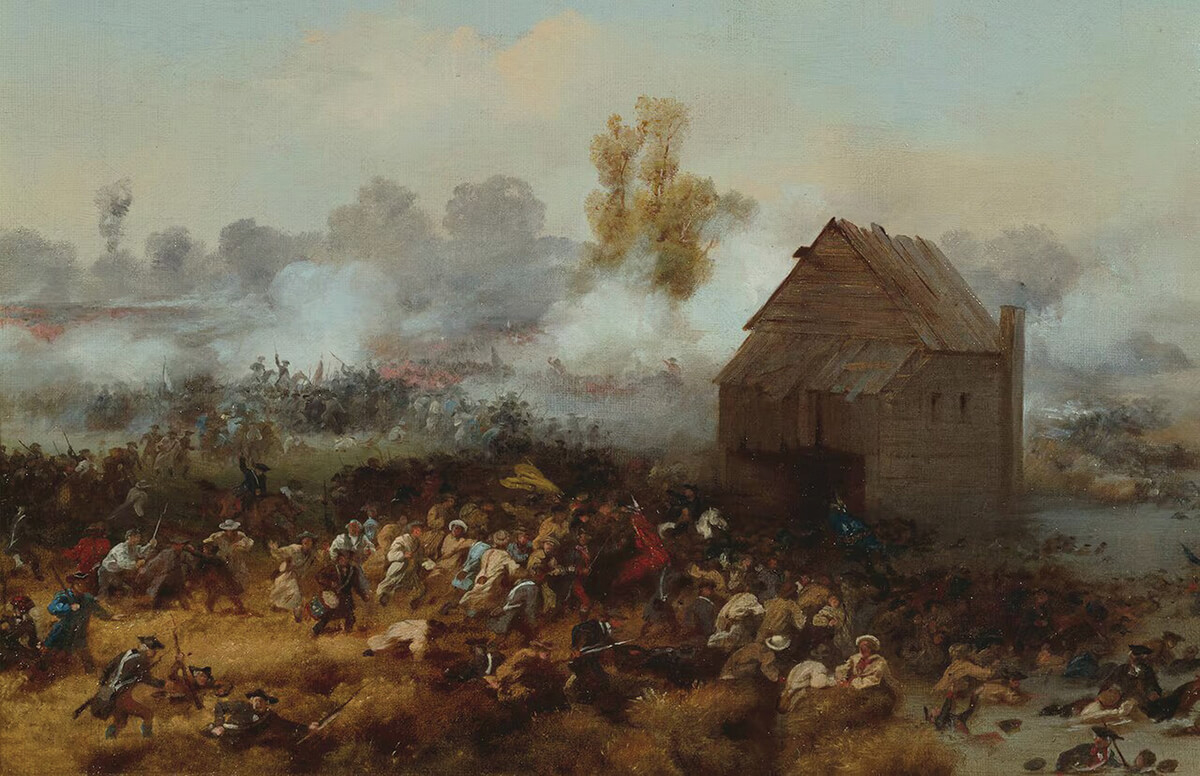
Anticipating the British assault, George Washington placed most of his Continental Army forces in Manhattan. The British, however, landed 10,000 infantrymen on Long Island's western edge where the Marylanders were now stationed—launching a brutal fight in what is today’s Brooklyn. As the morning of August 27 progressed, the overwhelming British troops surrounded the Marylanders. According to one survivor’s account, the British “infantry poured volleys of musket balls in almost solid sheets of lead.” Yet, the “Maryland 400” charged and charged again with their fixed bayonets.
The significance of the “Maryland 400,” roughly the size of the five companies that took the heaviest losses, cannot be overstated. (The moniker may have been a shout-out to the “Spartan 300” of lore.) The intense fighting stalled the British offensive for the day, allowing Washington and his army to safely retreat—thereby saving the Revolutionary War and also earning Maryland its “Old Line State” nickname. Watching the Marylanders’ charges from a hilltop, Washington is said to have cried out, “Good God, what brave fellows I must this day lose!” When it was over, 256 Marylanders lay dead, with a hundred more captured. Only Maj. Mordecai Gist, a 33-year-old Baltimorean, and a handful of others would make it back to the American camp.
Painting by
Alonzo Chappel, 1858,
depicts Lord Stirling
leading an attack against
the British in order to buy
time for other troops to
retreat at the Battle of
Long Island, August, 1776. —ALONZO CHAPPEL, PUBLIC DOMAIN, VIA WIKIMEDIA COMMONS
A LETTER TO THOMAS JEFFERSON
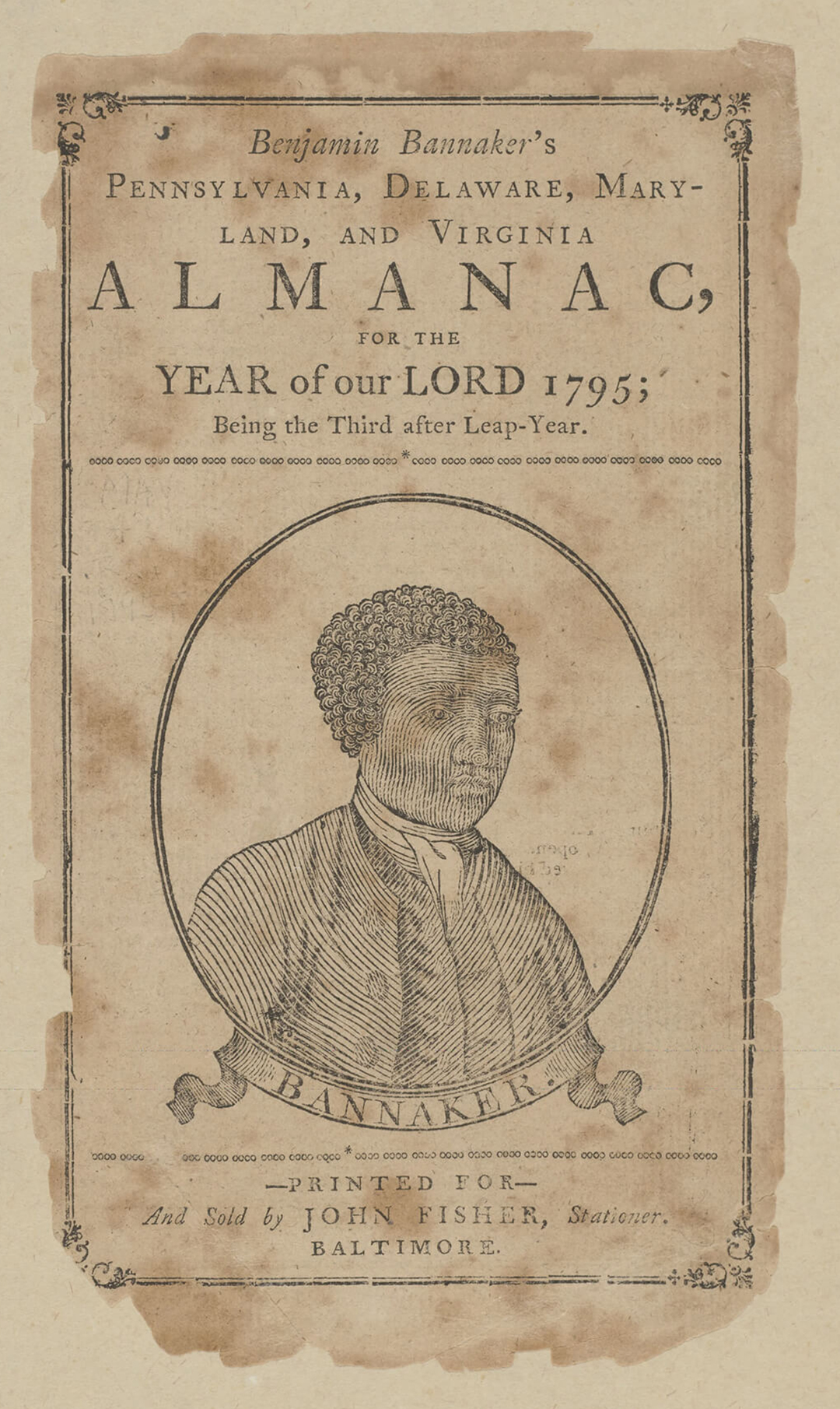
—COURTESY OF MARYLAND CENTER FOR HISTORY AND CULTURE/RESOURCE ID 2241
IN AUGUST 1791, Baltimore County-born Benjamin Banneker, a self-taught astronomer, agriculturalist, and surveyor, and son of a formerly enslaved father, penned a letter to Thomas Jefferson that challenged prevailing claims about Black people’s supposedly inferior intellect. Claims later expressed by the future president in his Notes on the State of Virginia, first written in 1781. Included was a copy of Banneker’s forthcoming almanac.
Banneker connected the conditions of enslaved people to the colonists’ struggle for independence from British tyranny and pointed out the hypocrisy of the Declaration of Independence author, citing his own “self-evident” truth “that all men are created equal.” The letter also appealed to Jefferson’s belief in a just and merciful God. While Jefferson penned a brief reply, thanking Banneker for his almanac, he did not directly address the ethical and moral criticisms raised by the man often considered the first African-American man of science. Banneker’s 100-acre-plus property and 18th-century residence are now home to the Banjamin Banneker Historical Park and Museum in the wooded hills between Catonsville and Ellicott Ciy.
Here are excerpts from Banneker’s handwritten missive:
Sir, I freely and Chearfully acknowledge, that I am of the African race, and in that colour which is natural to them of the deepest dye, and it is under a Sense of the most profound gratitude to the Supreme Ruler of the universe, that I now confess to you, that I am not under that State of tyrannical thraldom, and inhuman captivity, to which too many of my brethren are doomed; but that I have abundantly tasted of the fruition of those blessings which proceed from that free and unequalled liberty with which you are favoured and which I hope you will willingly allow you have received from the immediate hand of that Being, from whom proceedeth every good and perfect gift.
Sir, Suffer me to recall to your mind that time in which the Arms and tyranny of the British Crown were exerted with every powerful effort in order to reduce you to a State of Servitude, look back I intreat you on the variety of dangers to which you were exposed, reflect on that time in which every human aid appeared unavailable, and in which even hope and fortitude wore the aspect of inability to the Conflict, and you cannot but be led to a Serious and grateful Sense of your miraculous and providential preservation; you cannot but acknowledge, that the present freedom and tranquility which you enjoy you have mercifully received, and that it is the peculiar blessing of Heaven.
This Sir, was a time in which you clearly saw into the injustice of a State of Slavery, and in which you had just apprehensions of the horrors of its condition, it was now Sir, that your abhorrence thereof was so excited, that you publickly held forth this true and invaluable doctrine, which is worthy to be recorded and remember’d in all Succeeding ages. “We hold these truths to be Self evident, that all men are created equal, and that they are endowed by their creator with certain unalienable rights, that among these are life, liberty, and the pursuit of happyness.”
Here Sir, was a time in which your tender feelings for your selves had engaged you thus to declare, you were then impressed with proper ideas of the great valuation of liberty, and the free possession of those blessings to which you were entitled by nature; but Sir how pitiable is it to reflect, that altho you were so fully convinced of the benevolence of the Father of mankind, and of his equal and impartial distribution of those rights and privileges which he had conferred upon them, that you should at the Same time counteract his mercies, in detaining by fraud and violence so numerous a part of my brethren under groaning captivity and cruel oppression, that you should at the Same time be found guilty of that most criminal act, which you professedly detested in others, with respect to yourselves.
Sir, I suppose that your knowledge of the situation of my brethren is too extensive to need a recital here; neither shall I presume to prescribe methods by which they may be relieved; otherwise than by recommending to you and all others, to wean yourselves from these narrow prejudices which you have imbibed with respect to them, and as Job proposed to his friends “Put your Souls in their Souls stead,” thus shall your hearts be enlarged with kindness and benevolence toward them, and thus shall you need neither the direction of myself or others in what manner to proceed herein...
...with the most profound respect your most Obedient humble Servant,
—Benjamin Banneker
THE BURNING OF THE PEGGY STEWART
Often overlooked, Maryland patriots held their own Annapolis "tea party."
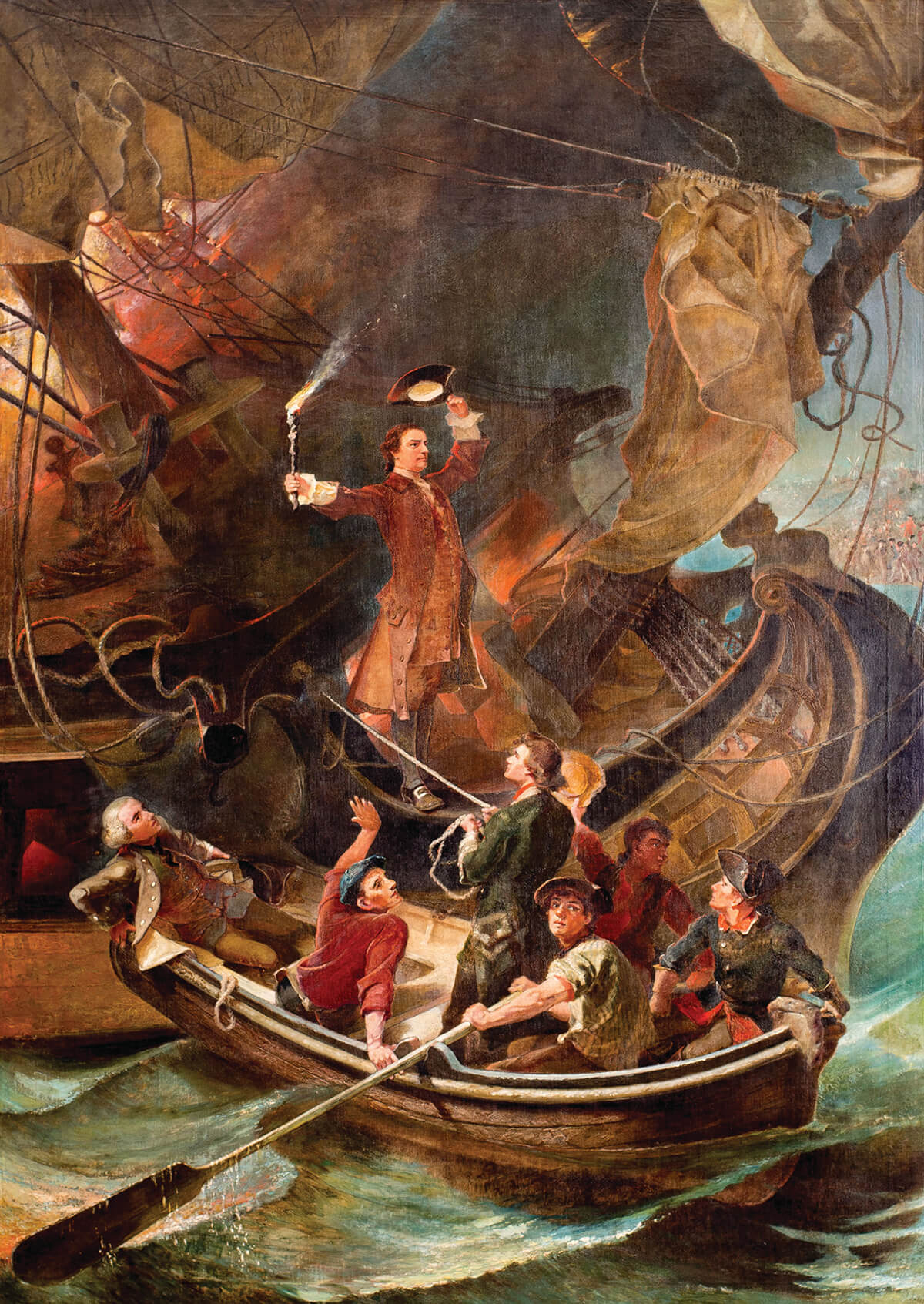
The original 1896 painting by Francis
Blackwell Mayer of the Peggy Stewart protest is
on display in the Old House of Delegates Chamber
in Annapolis. A three-panel 1906 depiction by
Charles Yardley Turner of the events surrounding
the Peggy Stewart burning hangs in Baltimore’s
Clarence M. Mitchell Jr. Courthouse. —COLLECTION OF THE MARYLAND STATE ARCHIVES: BURNING OF THE PEGGY STEWART / FRANCIS BLACKWELL MAYER (1827-1899) OIL ON CANVAS, 1896 / MSA SC 1545-1111
THE BOSTON TEA PARTY is a defining story of the American Revolution. Passed by the English Parliament, The Tea Act of 1773 granted the British East India Company a monopoly on tea sales in the 13 colonies, adding fuel to the American colonists’ “no taxation without representation” rally cry. Less familiar, however, are similar episodes up and down the Atlantic coast. Roughly a dozen cities joined in with their own tea protests, including Annapolis, where angry mobs forced Loyalist merchant Anthony Stewart to row out to the ship he owned, the Peggy Stewart, and burn it—along with its import tea—himself.
Stewart had paid the import tax, which helped fund the British occupation and violated the colonists’ non-importation resolution, to ensure the ship’s breathing cargo—53 indentured servants—would be allowed to safely disembark, which they did.
The Oct. 19, 1774 burning of the Peggy Stewart, named for its owner’s daughter, incidentally, was destructive evidence of the revolutionary fire brewing in Maryland just five months before the start of the war.