Arts & Culture
Senator Cory McCray’s Memoir Recounts How an Apprenticeship Changed His Course
At 18, after serving time in juvenile detention, McCray was accepted into a five-year apprenticeship program with the International Brotherhood of Electricians.
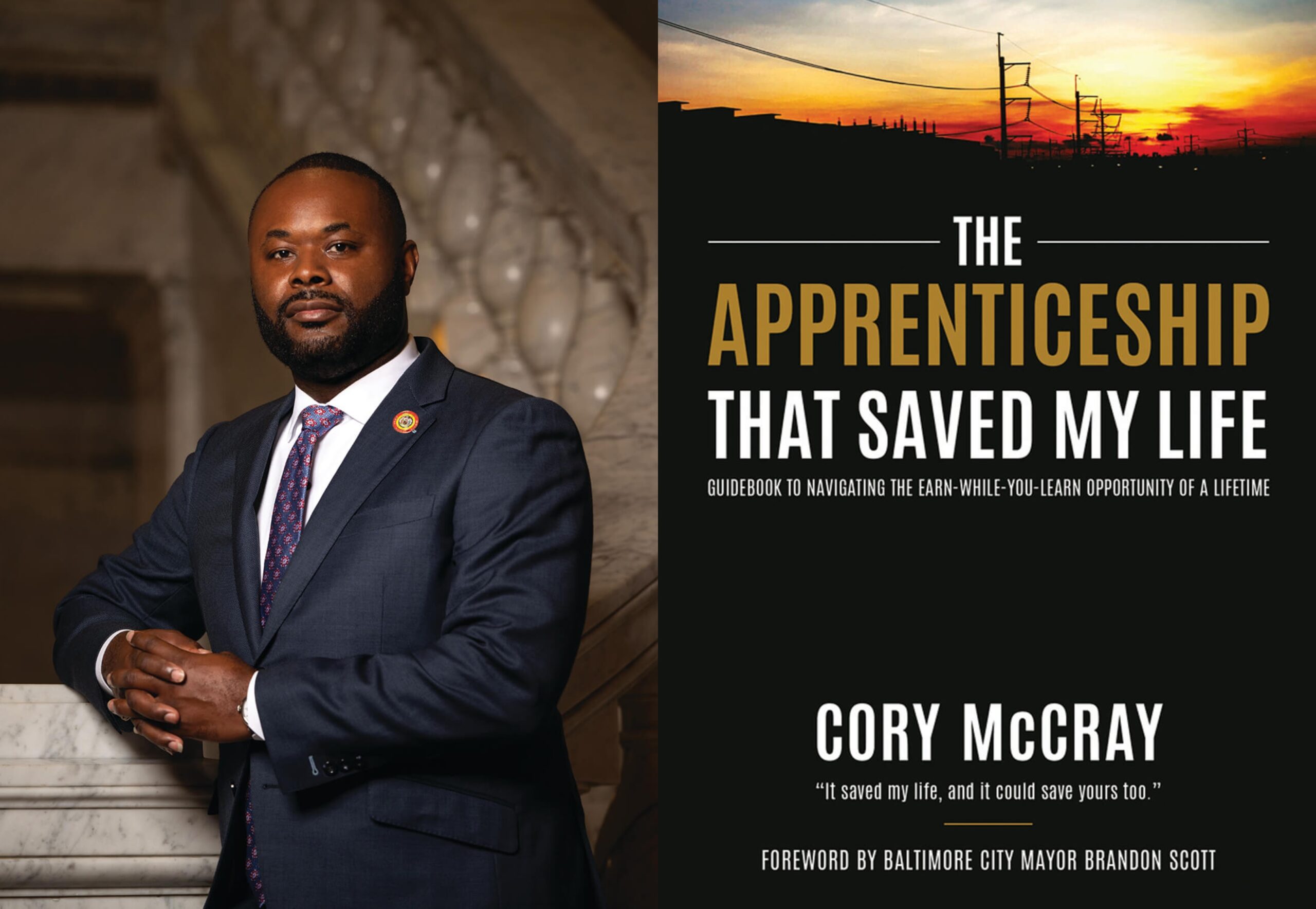
As a teenager, Cory McCray’s life was on a trajectory familiar to far too many Baltimore young men. Expelled from several city schools, he twice faced adult gun and drug distribution charges before he turned 18—eventually resulting in a 10-month confinement at the Victor Cullen Center juvenile facility in Western Maryland.
McCray’s mother worked multiple jobs, trying to distance her son and family from the pitfalls of the inner city. But when he was sentenced to detention, he was unable to envision a different path for himself, only seeing the streets and increasingly long prison terms in his future. He told his mother to give him up on him. (She did not.)
Now 43, a married father of four, and northeast Baltimore’s elected representative in the state senate, McCray shares his journey in The Apprenticeship That Saved My Life. In this candid and engaging memoir, McCray recounts how a phone call from his mother to the Maryland Department of Labor—requesting a list of every licensed apprenticeship in the state—unexpectedly changed his course.
Violent crime, thankfully, has taken a sharp downturn over the past three years. But there’s still a lack of economic opportunity for young men, particularly young Black men. Was that the prompt for this book?
I visit schools once or twice a week…so they can meet someone who looks like them and can speak to their [circumstances] and their potential. But as you get older, you think, “How can I add value? How can I scale impact?” I thought this book was the appropriate next step to lean in on this apprenticeship conversation. It’s something that I can leave with them.
At 18, you were accepted into a five-year apprenticeship program with the International Brotherhood of Electricians. It quickly proved life-changing because it paid solid wages while you learned on the job. You bought a house two years later.
When I found out about the apprenticeship, I was blown away. How did I live in this city all my life and no one told me about this opportunity? The other thing is, if you don’t see it, you can’t believe it. I didn’t have electricians in my universe.
One thing that comes across is there are steps for acceptance into an internship program that those born in upper middle class ZIP codes may take for granted.
I still remember being in a school and asking, “If you were senator for a day, what’s one thing you would change about your school?” A young man gets up and says he would have driver’s ed at his school. I just stood for a second and thought about everything it took me to even apply for the apprenticeship. I had to be at least 18, have a high school diploma or GED, one year of algebra—and a driver’s license.
We took those same young people to Annapolis, put together a bill, testified before the House, testified before the Senate, watched the governor sign that bill, and now there is a $2-million appropriation inside of the State Department of Education for high schools with a poverty level of at least 40 percent for a [driver’s ed] grant they can apply for.
It could go without saying your backstory is different than most in the General Assembly.
I do see through a different lens. When I looked at [ex-offender] voting rights, and I’m a data person, I looked at two ZIP codes when we were debating the issue where only 10 people were on parole or probation. In the ZIP code I represent, there are 937. When you look at that correlation or that disparity from one ZIP code to another—it makes a difference in how you view other pressing issues—food security, housing, vacancies. Also, having bookstores and things of that nature because the buying power isn’t in that neighborhood.
Did you ever feel hesitant about sharing your story?
So, not all my colleagues know my background. When we were debating juvenile justice, one colleague said to me young people in the juvenile system didn’t grow up like me or don’t get see the world the way my son does. I wanted to say I’m probably the most qualified person to be in this conversation, but people who’ve only seen me in the last 10-15 years assume that to get to this position, you had to go a certain direction or go a certain pathway.
But I need to have transparent conversations with young people…I was at Jessup [Correctional Institution] and Cheltenham [Youth Detention Center] recently. Adults also need understanding and to feel like they have a chance. I have to let people know I’ve been at the bottom, too.