Business & Development
Meet the Engineer Leading the High-Stakes Effort to Raise the New Key Bridge
As the MDTA's chief engineer, Jim Harkness has been thrust into Baltimore’s most consequential infrastructure project in decades.
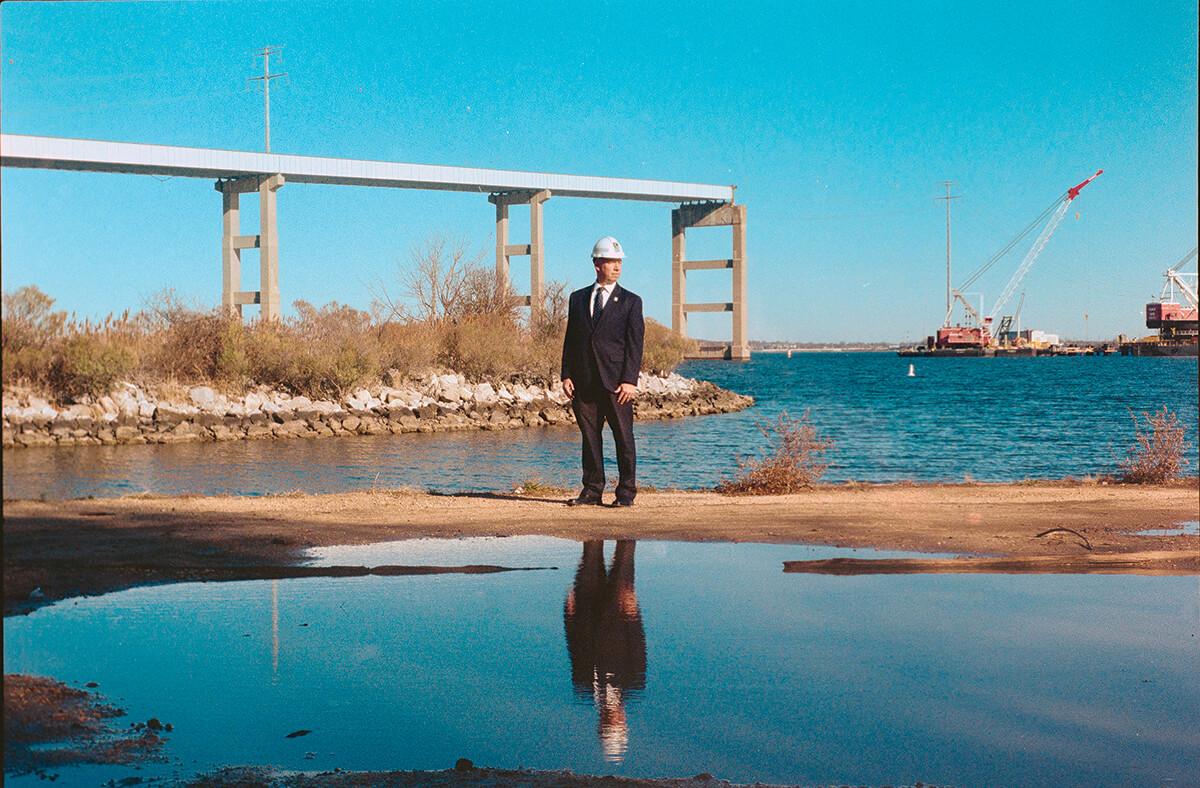
At 1:34 a.m., the phone rang, and Jim Harkness reached toward its glow in the dark. One of his employees at the Maryland Transportation Authority (MDTA) broke the news. Five minutes earlier, a ship had collided with the Francis Scott Key Bridge. Details were scant until more calls came in quick succession and the full picture began to emerge.
“I started getting my stuff together,” says Harkness, “and headed into work.”
As chief engineer for MDTA, which operates the state’s eight toll roads, Harkness’ office was, and still is, at the agency’s Sollers Point site in Dundalk, just north of the iconic steel truss structure. He drove the 47-year-old bridge twice daily on his commute from Carroll County, enjoying the sunrise over the water or views of downtown Baltimore at dusk.
In the early morning of March 26, 2024, all that changed. The Key Bridge collapsed in seconds. Six maintenance workers filling potholes on the deck vanished into the Patapsco River, their bodies all eventually found in submerged vehicles. Two other men escaped with their lives. Mangled steel and part of a crumbled span fell across the bow of the Dali, when the roughly 110,000-ton vessel crashed into one of the bridge’s inadequate piers.
After the initial reports, Harkness became one of the first of some 35,000 daily Key Bridge commuters, truckers, and travelers to adjust their lives without the major connector to southeast Baltimore. This time, he took Interstate 95 and the Fort McHenry Tunnel. On the way, he got a situation report from MDTA staff and made calls, orchestrating part of the early state response to a shock that millions would soon wake to, all before reaching his office and seeing the destruction for himself.
With first responders already searching for workers in the water, Harkness’ immediate thought was to assign inspectors to assess the safety of the still-standing sections, then find a contractor to help clear debris and reopen the blocked Port of Baltimore—ASAP. But as those triage tasks were being addressed, he also began thinking about what came next: “figuring out a path forward for a replacement,” he says.
In the gray daylight, just after 10 a.m., Harkness was among the officials standing behind Gov. Wes Moore as he offered details about the collapse in the first of many media briefings. It was then that talk of a rebuild was first mentioned.
“Can you look to the future at all at this point?” one reporter asked.
“This is going to be a long-term build,” said Moore.
Knowing the bridge—along Interstate 695, over a federal navigable channel—would be part of a national emergency-relief effort, and that President Joe Biden was promising full reconstruction funding, Harkness gathered colleagues that same day to discuss working on a plan with the Federal Highway Administration (FHWA).
“Let’s figure out the necessary steps to kick off a project of huge scale,” he told them.
The idea of a rebuild began almost immediately.
Thirteen days later, state officials had to submit a cost estimate for federal disaster aid. They forecast an up-to-$1.9-billion rebuild, to be completed by 2028, comparable to other 21st-century American bridge constructions.
Even then, though, the projections were characterized as aggressive. “Thirteen days in, you have to make some assumptions,” Harkness says now.
And there was a lot they didn’t know.
“We’re building something that is a gateway to Baltimore. We’ve got to do it right.”
Almost two years later, this past December, Harkness stands on the third floor of a modest business-park office building near the BWI Airport, wearing a white button-down shirt and dark tie. The site has become a second office; he and a handful of MDTA staff share the workspace with FHWA reps, consultants, and a dozen-plus employees from the rebuild’s contractor, Kiewit. Together, they’re advancing on a “progressive design-build,” where design and construction run concurrently to speed up the process and avoid surprises.
Harkness, 48, is a Pennsylvania native, Penn State grad, and father of two boys who’s worked as a civil engineer in Baltimore for nearly three decades. After almost 10 years as a traffic consultant, and three with Baltimore’s Department of Transportation, he joined the MDTA in 2014, helping on projects like the I-95 express toll lanes and Nice-Middleton Bridge. Since 2021, as the authority’s chief engineer, he’s led numerous design and project management efforts, but nothing like this one.
“The past 18 months have certainly been different than other points in my career,” he says. The rebuild’s “expedited nature” fills 90 percent of his work calendar, even though the MDTA currently has about 100 other projects in its pipeline (including the even larger Bay Bridge replacement). And with more attention, there is more scrutiny.
In November, the MDTA amended its earlier forecast, projecting a late 2030 opening for the new Key Bridge, eliciting swift social-media criticism—“we will have moved out of Maryland before that bridge is finished!”—and a higher cost, up to $5.2 billion, surprising even industry experts. The agency cited several factors, but the bottom line is this: “Once we gathered all the data, our assumptions needed to be adjusted, and they adjusted up,” says Harkness.
He’s careful with his words, which is unsurprising for someone who considers risk for a living. Maryland Port Administration director Jonathan Daniels calls him “calm and rock steady,” which is a useful temperament for being thrust into Baltimore’s most consequential infrastructure project in decades.
While the state owns and operates the Key Bridge, the MDTA engineering and construction divisions lack the capacity to work on a project this large and time-sensitive alone. Kiewit, one of North America’s largest contractors, has extensive experience in Maryland and brings not only expertise and resources also as many as 200 designers to this high-stakes public-private partnership. They’re also currently working with Amtrak on the Frederick Douglass Tunnel in West Baltimore.
In August 2024, they were chosen by the state for a $73-million Phase 1 contract for the rebuild and began demo-ing the old bridge for the new one. The firm also has exclusive negotiating rights for Phase 2 construction, which could start in June.
Most weeks, Harkness sits with MDTA project-development head Brian Wolfe, his deputy Jason Stolicny, and 30-some Kiewit staffers for task-force meetings on structural updates and finer details. Daily, firm supervisors meet to plan the next day’s work. “There’s a lot of collaboration—it’s necessary to keep the ball moving,” says Harkness.
One of those advisors is Bob Palermo, a veteran geotechnical expert. At the office, he hands Harkness three Coke can-sized jars filled with Patapsco soil samples. To design anything, they needed to understand the build site. A large cross-section map of the riverbed under the new bridge’s roughly two-mile path (about 250 feet southeast of the circa-1977 original) reveals the challenge: Beneath the water is up to 100 feet of mucky deposits, a coarse sandy layer, then harder ancient clay. That’s where hundreds of steel foundation piles—including 45 eight-foot-diameter ones for the two main support pylons, aka towers—could be set, presumably.
Testing had to confirm assumptions. In the fall, crews on barges used air compressors, a 145-ton hammer, and one of the East Coast’s largest cranes to drive six 200-foot-long, 340,000-pound piles into the riverbed. They set a metal load atop the frame then applied pressure. Palermo measured. The piles resisted 11 million pounds, or 11,000 kips, even better than anticipated.
“The last job I worked on was the Tappan Zee Bridge [over New York’s Hudson River], and we went to 7,600 kips,” he says. “So, this is bigger.”
“Bigger” was the largest unknown after the collapse. The original Key Bridge’s 1,209-foot span between its largest piers covered an 800-foot channel with 185 feet of vertical clearance, safe enough for 20th-century commercial vessels. (In 1980, a freighter one-tenth of the Dali’s weight hit and only lightly damaged a pier.)
But cargo and cruise ships today are larger and heavier, and safety standards for new bridges are beefier, too. The Coast Guard is requiring the new bridge have a 230-foot clearance over the channel. And in a move to minimize collision risk and meet American Association of State Highway and Transportation Officials (AASHTO) standards, the new cable-stayed main span needs to be wider, at 1,665 feet, the longest in the U.S.
“Once you get all that information, you find out you couldn’t construct your assumed approach,” says Harkness.
The larger blueprint means more material, cost, and time to build. It also requires a taller pair of primary pylons and additional tension cables for support. At 600 feet, the towers will be taller than any building in the Baltimore skyline, constructed in 31 “lifts”—20-foot-high concrete chunks—each taking three to four weeks to cure into shape. Without delay, building those alone will take over two years.
“No matter how good we are, nine women will never make a baby in a month,” says Wayne Thomas, a Kiewit senior vice president overseeing the firm’s rebuild operations. Thomas spent most of his 30-plus-year career in Baltimore before moving to Philadelphia; his adult children are Laurel and Katyn (as in Catonsville).
The most dramatic details the rebuilders didn’t know, though, had to do with pier protection. It was always taken into account, Harkness says; nobody wants another collapse. But with larger bridge dimensions, AASHTO guidelines, and the Patapsco’s natural characteristics, they now estimate spending over $1 billion to protect them.
Originally, simpler stone berms were considered to keep runaway ships at bay, but the makeup of the riverbed didn’t make that feasible. Instead, 276 concrete-filled steel piles will be driven in around the bridge’s six largest piers, including 78 to support football-field-sized fenders around the main pylons’ 20-foot-thick concrete foundations. Imagine two fortress-like islands.
“It’s what this bridge needs,” says Harkness. “We’re not adding anything unnecessary.”
Even so, the bigger budget and slower timeline has raised plenty of questions from stakeholders. “As leaders, we have an obligation to give the public a detailed breakdown of what’s driving the changes,” says Congressman Johnny Olszewski, who lives in eastern Baltimore County. Like all the other former daily Key Bridge drivers, he’s added time—sometimes more than 90 minutes—to his commute to Washington, D.C.
Harkness wants the rebuild finished as quickly as the rest of us … But “we’re not compromising on safety,” he told the MDTA’s board in November.
Harkness sits in traffic like everyone else when heading to the MDTA headquarters. He wants the rebuild finished as quickly as possible, just like the rest of us. He points out that the project reached “70-percent design,” an industry milestone for most major specifications and cost estimates, in 14 months versus seven years, the average for comparable projects. But “we’re not compromising on safety,” he told the MDTA’s board in November.
Meanwhile, certain aspects of the rebuild are beyond his control, and could hinder progress.
While Maryland is suing the Dali’s owner for the collapse’s responsibility and cost of a new bridge, any payout won’t come for years (and will be reimbursed to the federal government). And while full federal funding was codified by Congress in 2024, it hinges on annual appropriations, meaning potential delays. In the meantime, working capital is necessary, like to buy the giant steel piles made in Texas and Louisiana.
Contingencies are in place, but aren’t free. The MDTA plans to sell a $600-million bond in early 2026 to help with financing. The unspoken effect? Maryland taxpayers will absorb costs and likely higher tolls.
The better news: There’s widespread agreement that a new bridge is vital to Baltimore, and beyond. Apart from squeezing traffic into the Fort McHenry (I-95) and Harbor (I-895) tunnels, as well as secondary roads, the collapse has sent trucks carrying hazardous materials not permitted in the tunnels around the north and western Beltway, adding to congestion and travel times.
And while steel and car factories aren’t major southeast Baltimore employers like when the original Key Bridge was built in the 1970s, Amazon’s distribution centers and other warehouses and industries are an economic driver, while the Port of Baltimore handled more than $60 billion in cargo coming in from under the bridge in 2024. Roughly $22 billion in freight crossed over it the year prior.
Harkness understands the project’s scope—and meaning. “From some of our first meetings, you could feel it in the room,” he says. “The responsibility to deliver for the residents of Maryland, and the region, is never taken lightly.”
Later, during a public livestream, the engineer sits in front of roughly 500 viewers, introduces himself, and begins. “I’m proud to be presenting tonight,” he says before sharing an image of the new bridge design and highlighting its features: the cables, main span, shaped pylons, and pier protection, illuminated against a pink morning sky.
It’s a vision he wakes up to now. A new Key Bridge, years away, built to withstand what the last one no longer could. Bigger, stronger, still symbolic.
“We’re building something that is a gateway to Baltimore,” Harkness says. “We’ve got to do it right.”