News & Community
The National Lacrosse Hall of Fame Marks a Decade in Sparks
Given its present-day ubiquity in Baltimore, it’s no surprise that lacrosse’s national museum is here. But the city and region’s importance to the sport was hardly preordained.
Here stands John Flannery, “the father of American Lacrosse.” Hanging on a wall of the National Lacrosse Hall of Fame and Museum in Sparks, a circa 1879 portrait shows the 26-year-old Canadian, posing outdoors in a crew-neck shirt and dark shorts, stick over his shoulder, his confident expression suggesting he’s ready for a game—and the Gilded Age.
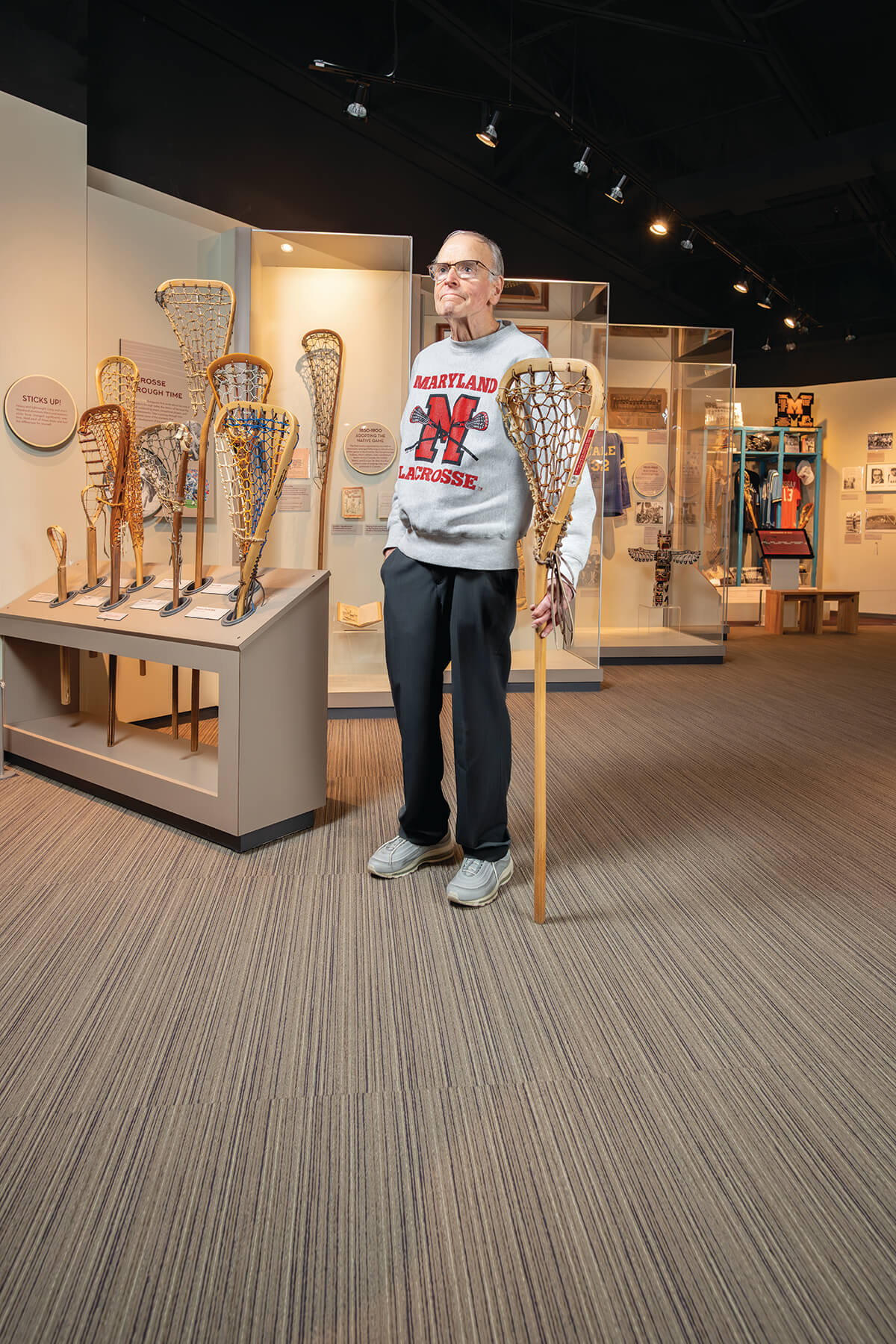
A few feet away, though, visitors learn that lacrosse’s origin story dates back even further. About a dozen wooden sticks of various shapes and sizes highlight the sport’s Native American heritage and different forms of the game played as early as the 11th century.
“Canada was the first place that the white man started playing it—they saw the natives playing,” says Joe Finn, pictured above, the Hall of Fame’s longtime archivist, gesturing amid exhibits that span the centuries.
Given its present-day ubiquity in Baltimore, it’s no surprise that lacrosse’s National Hall of Fame is here, and has been since 1957. As lacrosse season hits full stride this spring, they will celebrate their 10th anniversary at the Baltimore County headquarters of USA Lacrosse. But the city and region’s importance to the sport was hardly preordained.
In 1636, French missionaries first recorded the Huron tribe of modern-day Ontario playing a ritual game. They called it “La Crosse,” the webbed sticks being reminiscent of a bishop’s crozier. Two centuries later, a Montreal dentist published its first rule book and, with that, the aforementioned Flannery eventually brought the fast-paced game—12 against 12; most goals wins—with him to the United States.
Organized lacrosse spread from there, including to the Old Line State. In 1878, members of the Baltimore Athletic Club traveled to an athletic competition in Rhode Island. There, C.J. Iglehart came up short in the one-mile run, but his crew caught New Yorkers and Bostonians competing for a national lacrosse title.
“They liked what they saw,” Finn says, “so they brought rules and equipment home.”
“THE SPORT’S HISTORY RUNS DEEP IN BALTIMORE.”
A few months later, Baltimore’s first recorded lacrosse game took place in West Baltimore. As The Baltimore Sun reported, 24 men played “the Canadian Indian game of lacrosse, which has been gradually growing in favor in this vicinity, and is decidedly an improvement on baseball.” Spectators paid 25 cents. The game lasted 90 minutes. The winners received silver scarf pins shaped like lacrosse sticks—the first awards for the sport in Baltimore, but hardly the last.
Since then, lacrosse has woven its way into the fabric of life here. Johns Hopkins University fielded a team by 1883, more clubs emerged, and today, nets dot school and neighborhood yards.
In 2016, USA Lacrosse opened a new headquarters in Sparks and built a beautifully designed home for the Hall of Fame, replacing cramped quarters near Hopkins. Inside, there are also tributes to women’s lacrosse, which was popularized in the U.S. by a Bryn Mawr School coach in 1926, and Morgan State University’s pioneering Ten Bears team, the first from a historically Black college. Additionally, there are displays devoted to international competition (lax returns to the Olympics in 2028). Admission is free.
On one wall, wooden squares with the names and faces of more than 450 Hall of Famers form a mosaic. There’s Jim Brown (yes, the football legend), dozens of Baltimore natives, and a record 72 inductees affiliated with Hopkins, as well as 34 from rival University of Maryland, speaking to the region’s dominance of the sport.
Finn, who joined the Hall of Fame as a volunteer in 1998, knows about every player and artifact.
“A lot of people are surprised by the James Naismith connection,” he says, referring to the Basketball Hall of Fame namesake, who invented that sport to stay in shape for . . . lacrosse. The sport’s history runs deep, and it lives in Baltimore.”