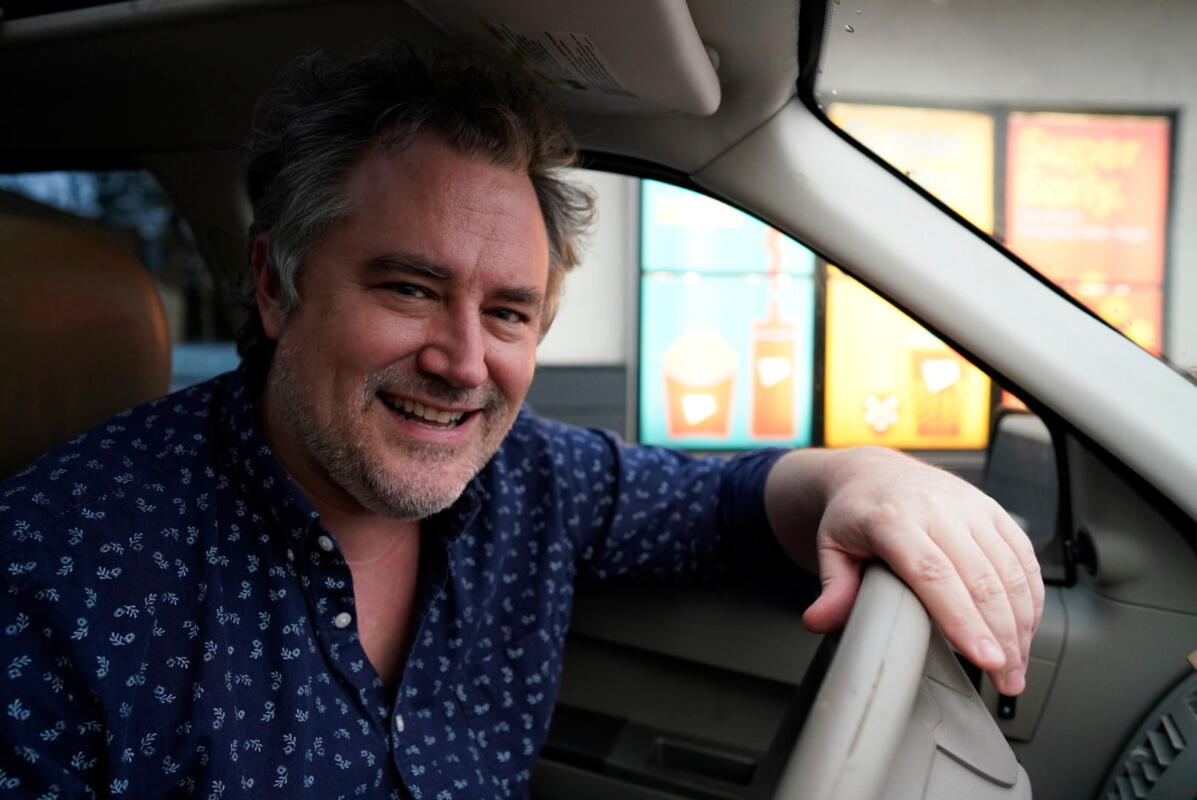
Long before “Steamed Hams” became a meme, a remix, and a kind of absurdist shorthand for internet humor, it was just a small joke in a single episode of The Simpsons—written by a kid from Carroll County.
“It was the only bit I ever wrote by myself,” says Bill Oakley, the native Marylander who would go on to help define the show’s Golden Age. “Everything else was collaborative, but for that episode we had a fantasy football-style draft for characters, and everyone had to do a short.”
The episode, “22 Short Films About Springfield,” is now considered a classic. But at the time, it was an experiment: a collection of quick vignettes instead of a traditional storyline. Oakley picked Principal Skinner and Superintendent Chalmers, and built a tightly wound, escalating farce around a ruined lunch, a fast-food cover-up, and a baffling regional phrase. The result would quietly air in 1996, then explode decades later into one of the most enduring comedy clips on the internet.
Before all that, though, there was Westminster. Oakley was born there and raised in nearby Union Bridge, a rural town where access to fast food—let alone culinary trends—was limited.
“We didn’t have any of that where I grew up,” he says. “No McDonald’s, nothing. If we went to Baltimore once a year, that was a big deal.”
This week, a Baltimore visit as an adult will be an equally big deal, as Oakley brings his latest project, the traveling “American Culinary Curiosity Dinner,” to Mobtown Ballroom in Station North on April 16.
Equal parts dinner party and cultural lecture, the sold-out event will feature a seven-course tasting menu created with Mobtown’s head chef Jake Cornman and built around obscure regional dishes—foods that, like “steamed hams,” often make perfect sense in one place and none at all anywhere else.
Between courses, Oakley walks diners through the stories behind the delicacies, along with anecdotes from his time in television. The result is something that feels less like a traditional dinner and more like a live-action footnote to the strange, interconnected history of American culture. The Baltimore event sold out quickly, but Oakely is optimistic about bringing the show back to town in the future.
The sense of distance that he felt growing up in Union Bridge—both from pop culture and the broader food landscape—ended up fueling his career, first as a writer and now as a regional food enthusiast.
After moving to Washington, D.C., for high school, Oakley attended St. Albans, where he met his longtime collaborator Josh Weinstein. The two went on to Harvard Lampoon, sharpening a comedic voice that balanced meticulous structure with a taste for the ridiculous.
Breaking into television, however, proved less glamorous.
“I wanted to work in TV, and in 1989, the only TV in D.C. was America’s Most Wanted,” Oakley says. His early work involved writing TV Guide listings and publicity copy—hardly the pipeline to sitcom writing rooms.
A brief stint in New York on a short-lived cable project led to a move to Los Angeles, where Oakley and Weinstein spent nearly a year unemployed. At one point, Oakley was preparing to take the Foreign Service exam. Then a spec script they wrote for Seinfeld started circulating.
“Larry David called it the second-best spec script he ever read,” Oakley says.
That script never aired, but it got them in the door. In 1992, they were hired by The Simpsons, writing their first episode, “Marge Gets a Job.” Within months, a wave of senior writers departed, leaving Oakley and Weinstein working alongside a young staff that included Conan O’Brien.
The upheaval became legend. The new guard pushed the show into riskier, stranger territory—what many fans now consider its creative peak. By the mid-’90s, Oakley and Weinstein were running the show themselves, overseeing episodes like “Who Shot Mr. Burns?” and, yes, “22 Short Films About Springfield.”
Then came the afterlife. “I started hearing about ten years ago that it was a prank in Australia—people calling supermarkets asking if they had steamed hams,” Oakley says. “Then the remixes started.”
Between 2016 and 2018, thousands of versions of the scene appeared online, each bending the original into something new—musical variations, surreal edits, painstaking recreations.
Around the same time, Oakley’s focus shifted in a way that feels, in retrospect, inevitable: toward food.
What began as casual curiosity—documenting fast-food stops and regional specialties—quickly grew into a second act. Oakley developed a following for his deep dives into hyper-local American dishes, the kind that rarely leave their hometowns. He launched a Discord community dubbed “The Steamed Hams Society,” collaborated on novelty beer projects, and became a recurring voice on The History Channel’s The Food That Built America.
What “Steamed Hams” tapped into, intentionally or not, is the same thing driving Oakley now: a fascination with the hyper-local, the deeply particular, and the quietly absurd corners of American life. The stuff that doesn’t travel well—until, suddenly, it does.
And if his latest project proves anything, it’s that whether it’s a joke, a meme, or a plate of food, the right audience will always find it. Even if it takes a few decades—and another special dinnertime trip to Baltimore—to get there.