History & Politics
Can Anyone Stop Baltimore City’s Most Dangerous Drivers?
Crashes have killed nearly 500 people in Baltimore City over the past decade, and safety advocates say leaders have left tools on the table.
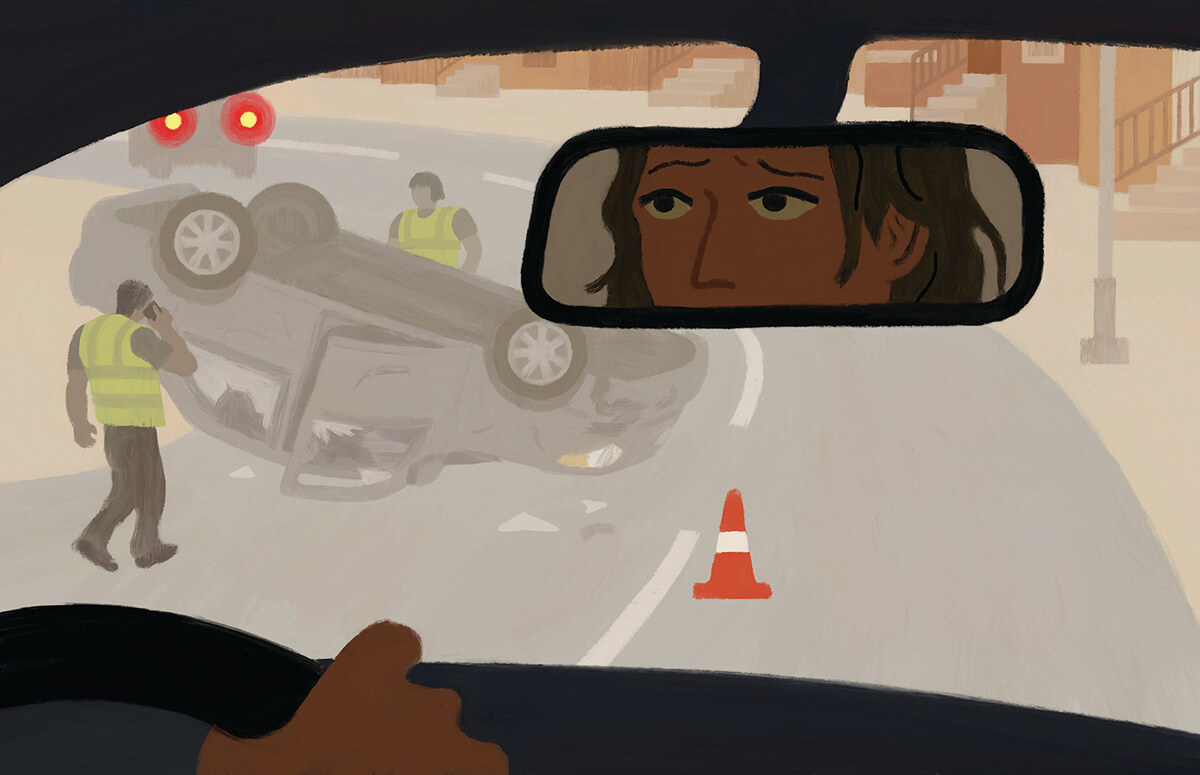
One morning last September, Erin Nutsugah turned onto Harford Road and got stuck in a backup on the bridge over Herring Run. Three years earlier, Baltimore City had transformed the road’s design after rebuilding the bridge: two travel lanes instead of four, a northbound pedestrian/bicycle lane separated by plastic bollards and rubber curbs, and a southbound bike lane protected by a bus lane. The idea was to make the road safer for all users, even if a little slower for drivers.
As Nutsugah sat in traffic, a sedan caught her eye. “He did what people do all the time,” says Nutsugah, 36. “He peeled out of the lane and went flying down the bus lane.”
Annoyed, she rolled her eyes. After a couple light cycles, she saw the sedan at the end of the bridge, stopped with its door open. She suspected a fender bender.
“I was like, ‘Oh, well, that dumbass, that’s what he gets,’” Nutsugah recalls. “Then she encountered the true horror of what had happened. “I realized there was a pair of legs sticking out of his windshield.”
The sedan’s driver had struck a cyclist. Nutsugah noticed the woman’s locs hanging over her face as her head rested in the driver’s bloody hands.
We’ve all got our stories about outrageous Baltimore drivers. A driver once raced through a four-way stop past my children as they played in our front yard. I yelled, “Slow down!” He stopped, got out, and said, “Calm your ass down or I’ll beat the shit out of you in front of your kids.” (I calmed my ass down.)
The story goes that COVID emptied the roads and drivers discovered they could go full Mad Max with no consequences. That’s not quite right. Roads became deadlier, but research shows the increase in fatalities came mostly in the evening and early morning hours and that it wasn’t so much drivers changing their behavior as it was risky drivers driving more.
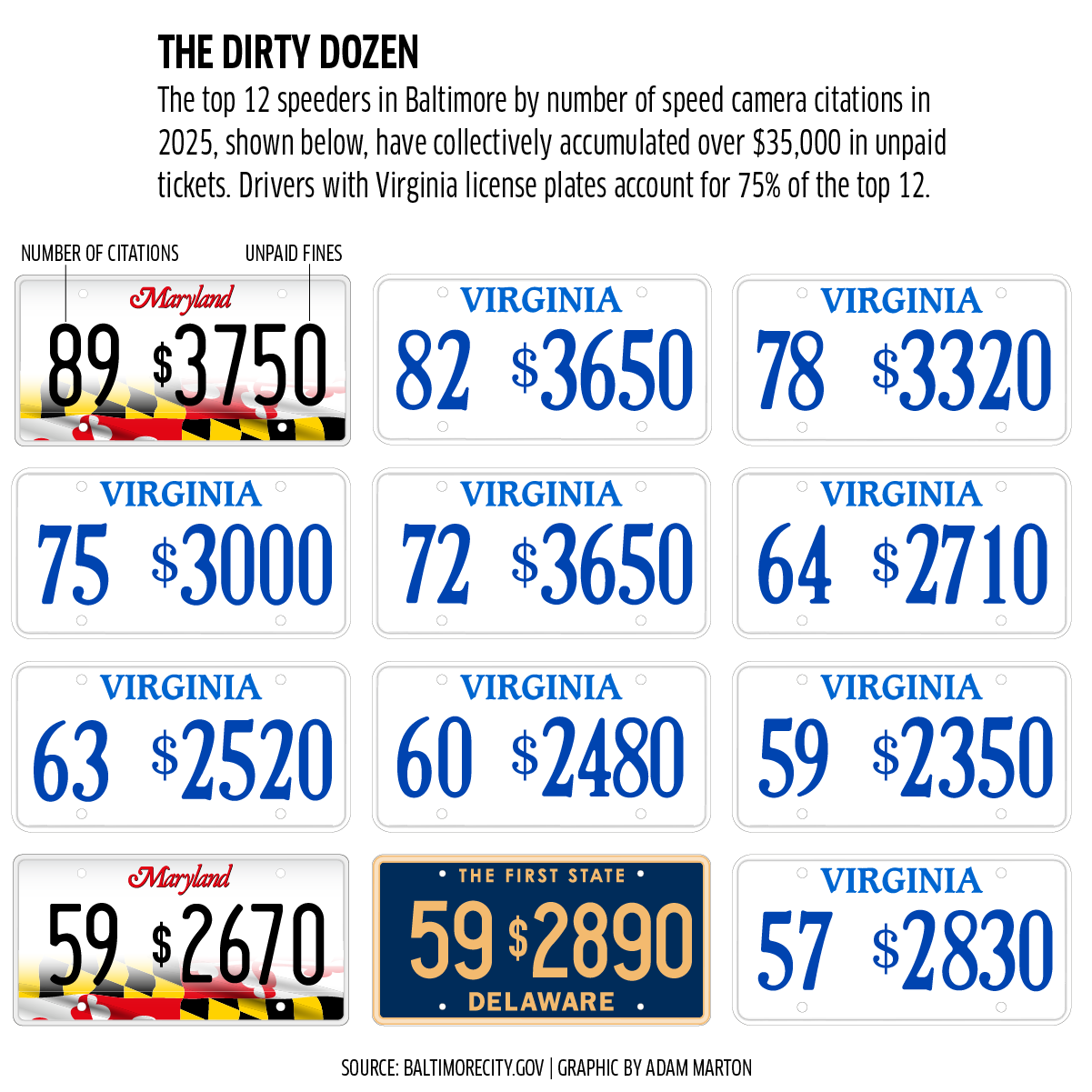
Fatalities have declined since their post-pandemic peak, but it’s still bad enough out there to make any Baltimore-area driver tense up at the sight of a car with front-end damage and Virginia tags (more on that later). Some crashes make the news, like the two drivers going over 120 miles an hour who collided in a work zone on the Beltway in 2023, killing six workers. Most do not, however.
No news organizations covered the cyclist struck on the Herring Run bridge in September. Also underreported is that crashes have killed nearly 500 people in Baltimore City over the past decade. This past year was the safest since 2018, but the city still saw 39 fatal crashes, with 10 involving pedestrians and one involving a cyclist.
Even before 2020, policymakers were deploying safety measures like speed cameras and road infrastructure that slows drivers and protects pedestrians and cyclists. But safety advocates interested in protecting Baltimoreans from the city’s most dangerous drivers say leaders have left tools on the table.
“I REALIZED THERE WAS A PAIR OF LEGS STICKING OUT OF HIS WINDSHIELD.”
You’ve probably noticed a new look on some Baltimore streets. In 2018, a Baltimore City “Complete Streets” ordinance gave the transportation department guidelines to design roads that are safer for everyone—pedestrians, bicyclists, transit riders, scooter and wheelchair users, as well as motorists.
In 2019, the councilman behind the ordinance, Ryan Dorsey, helped Baltimore land state funding to put a commercial stretch of Harford Road, not far from the 2025 crash Nutsugah witnessed, on a “road diet.”
Not everyone loved it. Dorsey’s opponents in the 2020 and 2024 primaries criticized his focus on “bike lanes.” But the strategy has taken root across the city, as evidenced by additional traffic-calming speed bumps, curb extensions, and flex-post-delineated crosswalks. When the city retimed traffic signals last year, some pedestrian signals got a “leading interval” that provides several seconds to enter an intersection on foot while all lights remain red.
Road design is one way to encourage safe driving. Legislators are also going after illegal out-of-state registrations.
“I am known at community association meetings as the ‘Virginia tag girl,’” says Del. Jackie Addison, who represents my corner of the city in the General Assembly, with a laugh.
Once, Addison recalls, she was standing on a sidewalk talking to state Sen. Cory McCray when they heard a boom and saw a vehicle with Virginia tags peel off after slamming into a wall. In June 2023, she added, a driver with Virginia tags struck and flipped her car.
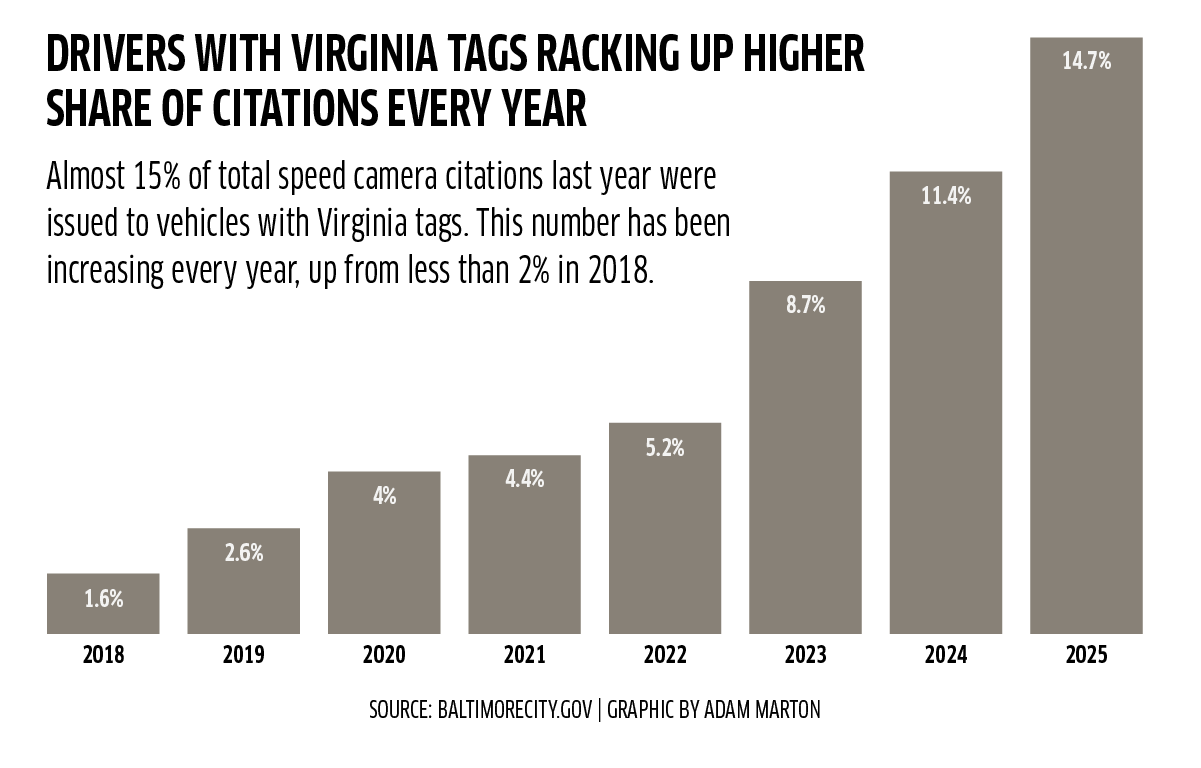
Virginia tags are cheaper than Maryland tags and, until last year, Virginia allowed drivers to register without insurance for a $500 fee. In fact, so many Maryland drivers register in Virginia that the state loses between $8 million and $12 million in revenue a year, according to the state DOT.
Maryland can refuse to renew vehicle registrations because of unpaid red light and speed camera fines, but those fines won’t keep you from getting Virginia tags. This doesn’t exactly incentivize responsible driving.
Last year, Addison sponsored a bill to let jurisdictions boot and tow cars registered in Virginia by Maryland residents. It died in the Senate Judicial Proceedings Committee.
Why, some might wonder, do we need flex posts, speed cameras, and the boot when there’s good old-fashioned police enforcement? A 2024 traffic enforcement blitz by Baltimore police focused on areas known for deadly crashes, and in February, the BPD announced a new “citywide traffic team” to prevent dangerous driving. But police enforcement is less tempting when you consider the racial disparities in traffic stops that helped put the BPD under a federal consent decree. It can also be dangerous for police.
In January, a driver stopped for suspended tags allegedly took off and dragged an officer. And Baltimore’s most dangerous driver just might be the cop charged with attempted murder in November for allegedly chasing a pedestrian into a vacant lot and striking him with his cruiser.
In a statement, Baltimore police spokesperson Lindsey Eldridge wrote that while traffic enforcement “reduces dangerous driving behaviors and crashes,” relying solely on enforcement “often only temporarily curbs reckless driving behavior among the most egregious drivers.”
The state of Baltimore’s roads has scared Del. Addison out from behind the wheel. “I don’t drive anymore,” says Addison, who, with Sen. McCray, has once again submitted a bill to boot cars with Virginia tags.
In December, I met Laura Weatherington to learn more about the Harford Road crash involving the cyclist, just one of 44 crashes and 14 crash-related injuries in the city that day.
When it happened, Weatherington was at a red light near St. Francis of Assisi, where she planned to attend daily mass. She saw the cyclist approach the intersection and enter a clearly marked crosswalk.
“She starts to cross her bike in front of the first car stopped at the red light,” says Weatherington, 56. To her right, she saw a car “steaming down” the bus lane. “Before I could even react, I just screamed,” she continues. “And then all of a sudden, the bike is flying in the air.”
The cyclist shattered the windshield and continued into the car. Weatherington walked over to hold the cyclist’s head while two other witnesses supported her shoulders.
“The three of us were holding her until the paramedics arrived,” says Weatherington, choking up. “She was making a sound that I remembered from my brother when he was in a car accident: this gurgling kind of sound. For a couple of weeks, I couldn’t close my eyes and not see her.”
I told Weatherington what I’d learned about the crash. I hadn’t located the victim, but from my reporting, I suspected she survived. The car’s Virginia plates had unpaid speed camera citations totaling more than $1,000.
“I’ve been waiting to get a call that I had to go to court, but that will probably be in a year or two,” Weatherington responds.
Nervously, I shared more: A Baltimore Police Department spokesperson had told me no charges were pending.
She stiffened. “What?!” she said. “How could he not have been arrested and charged?”
She had expected to see him in handcuffs. Looking back, she regrets not speaking with the reckless driver. “What I wish I had said to him was, ‘No destination is worth your life or anyone else’s.’”
It’s clear that plenty of drivers in our region think otherwise, and the lack of accountability for dangerous driving compounds victims’ suffering.
In early 2024, Katie Ervin and her two young children were in a turn lane on North Avenue when an SUV flew through a red light and hit their vehicle head on.
“It was completely totaled,” Ervin tells me. “I was the most injured, being in the front seat, and the kids were relatively unscathed physically.”
The police report says the SUV driver “drove backwards trying to get away and got stuck.” Surveillance footage confirms that and shows him crossing the yellow line before he smashes into Ervin’s car, even though the lane ahead of him was clear. But Ervin and her children, all of whom went through mental health therapy after the crash, saw no accountability for the man who nearly killed them.
“Essentially nothing happened,” she says. “There wasn’t even a citation for reckless driving or running a red light.”
The video above shows three clips from CitiWatch surveillance footage of Katie Ervin’s car being struck by an SUV at North Ave. and Aisquith St. in Baltimore City.
The first clip, at the 0:13 mark, shows the crash. The second, from 50 seconds later, shows the SUV backing onto the sidewalk. The third, from 20 seconds after that, shows the aftermath of the crash: Ervin’s car, on the right, now faces backwards, and the car that her vehicle was slammed into sits further back in a center turn lane, smoking from its grille.
In response to my email asking why no one was charged in this crash or the one on the Herring Run bridge, police spokesperson Eldridge responded that video footage was unavailable at these scenes and that officers must witness infractions to testify in court about them.
Absent a lengthy investigation, Eldridge wrote, which “typically occurs in fatal crashes,” courts generally rely on driver and witness statements and police reports. I noted that bodycam footage shows an officer on the scene discussing surveillance footage of Ervin’s crash. Eldridge replied that the department had since pulled the footage, confirming what I’d described.
“The decision to issue a citation rests within the officer’s discretion and a citation was not issued in this incident,” she wrote.
Online Maryland Judiciary records show someone with the same name and age as the SUV driver in that incident with charges for “driving or attempting to drive vehicle while impaired by controlled dangerous substance” in 2020 and 2021. The first resulted in probation before judgment; a judge indefinitely postponed trial for the second. Ervin suspects the driver was overdosing; first responders mentioned the overdose reversal substance Narcan.
“This far out from it, I’m pretty okay,” Ervin says. “At the time it just made me super angry…I was angry that there were no repercussions. The person is sick, granted, but the person is going to do it again, potentially.”
To get a sense of the accountability that our worst drivers can expect from the judiciary, I visited a Baltimore County District Court in December to witness the trial of a driver who, according to online court records, had previously pleaded guilty to speeding in a bus lane, failing to stop for a school bus with flashing red lights, and other infractions, including an open case for driving 26 miles an hour over the speed limit past a college campus.
Tag numbers associated with his offenses racked up 52 citations in less than a year, resulting in more than $2,400 in unpaid fines. In 2025 alone, he was charged with possessing a suspended license once, driving without a license twice, and driving with a suspended license five times. He had failed to appear at a September 2025 trial for driving without a license. A bench warrant was served three weeks later. He posted $1,500 bond, and the trial was rescheduled for early December.
I sat through about 20 defendants. In two similar cases—one for driving without a license, one for driving on a suspended license—the prosecutor offered to drop charges for all other infractions. Finally, the driver I’d come to see was called. No one answered. The judge granted the prosecutor’s request for a bench warrant.
Nearly eight weeks passed without the warrant being served. On, January 27, three days after a massive winter storm, the man was charged with driving without a license, failing to use caution in hazardous conditions, and “failure to control vehicle speed on highway to avoid collision.” A state crash report indicates he was driving too fast for the icy conditions and slammed into a salt truck on the shoulder, injuring someone in his passenger seat.
“WE HAVE OVER 100 YEARS OF CAR-CENTRIC LAWS AND POLICIES TO DISMANTLE. WE JUST GOT STARTED.”
State officials and legislators have been trying to stem the tide of road casualties for years. The General Assembly authorized speed cameras in 2009, and several bills have passed in recent years to implement aspects of Complete Streets across the state. In 2024, the General Assembly required the Motor Vehicle Administration to report on enforcement taken against illegal out-of-state tags.
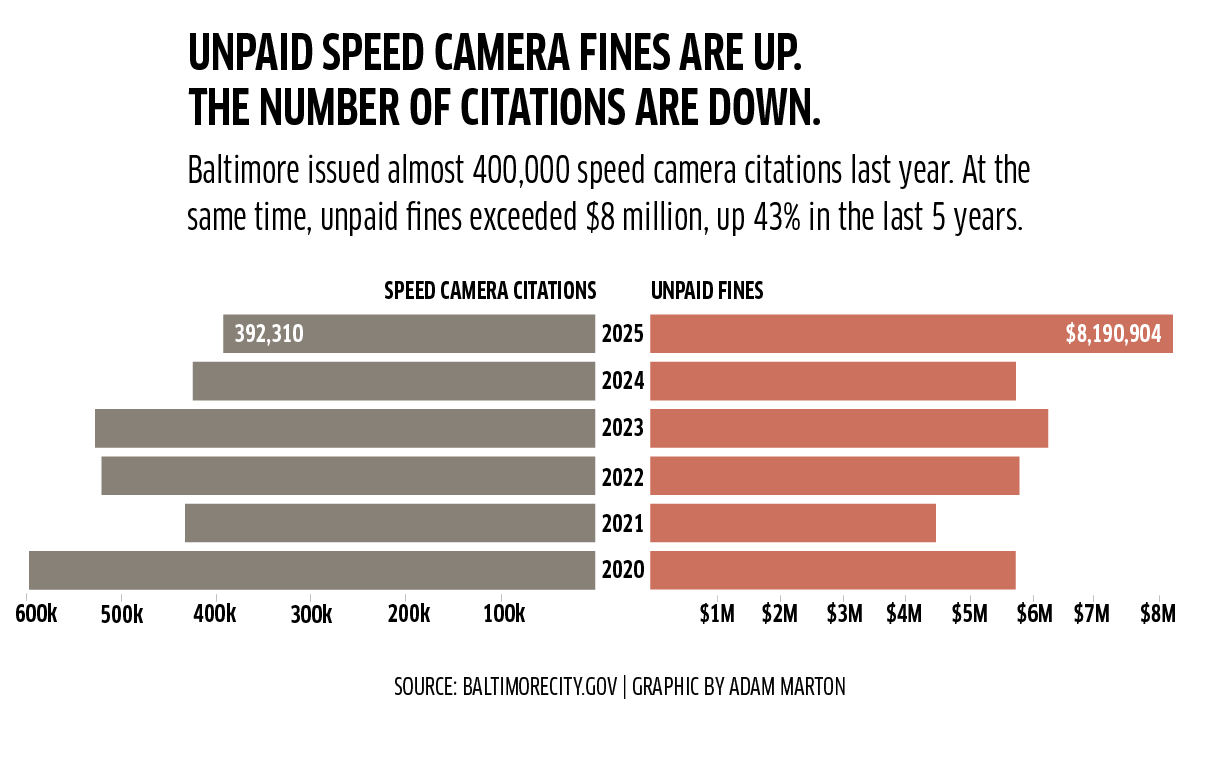
Last year, the legislature authorized a pilot of stop-sign camera enforcement in parts of Baltimore City and added new tiers to speed camera fines. Fines used to be $40 across the board. They now go as high as $425 for 40 or more miles an hour over the speed limit.
Research has demonstrated the effectiveness of speed cameras and road safety infrastructure nationally and locally, and Maryland overall has followed the trend of declining injuries and fatalities since a post-pandemic peak. But not all the trends are good.
Baltimore traffic fatalities spiked to 65 in 2024, current state fatality rates outpace those from the decade before COVID, and risky driving is still there on our streets for anyone to see. The new tiered fine structure, for instance, hasn’t stopped the car whose tags have the most speed camera citations in Baltimore City for two years running: 224 in total and $13,747 in unpaid fines and lateness penalties. Since the new tiers kicked in on October 1, that tag has incurred one citation for breaking the speed limit by at least 16 miles an hour and two citations for going at least 20 miles an hour over.
A bill to boot and tow for unpaid speed camera fines failed to pass in 2023. A variety of factors hinder the passage of traffic safety legislation, including privacy concerns related to adding more speed and surveillance cameras; equity issues around penalizing already disproportionately policed lower-income drivers; and a general pushback against the Complete Streets design, which requires drivers to slow down while raising the accessibility of pedestrians, bicyclists, and transit users.
“We have a long way to go,” says Del. Robbyn Lewis, a Democrat who ditched her car a decade ago and started the Livable Streets Coalition to improve safety and walkability in her Southeast Baltimore neighborhood. “We have over 100 years of car-centric laws and policies to dismantle. We just got started.”
If the General Assembly wants to bring down the hammer, other states offer some models. A New York state senator’s bill, not yet passed, would require installation of a speed limiter on vehicles owned by repeat offenders. (Baltimore County Democrat Nick Allen submitted similar legislation in the House of Delegates in 2025 and again this year.)
California is piloting a program to refer drivers to the DMV for possible license suspension after one ticket for going at least 100 miles an hour. Washington, D.C.’s STEER Act authorizes the city to file suit against drivers for unpaid speed camera fines. Last year, D.C. Attorney General Brian Schwalb’s office sued 24 drivers, including some from Maryland and Virginia, who collectively owed more than $1 million.
Less draconian is the strategy in Hoboken, New Jersey, where former mayor and current New Jersey State Representative Ravi Bhalla prioritized “low-cost, high-yield” measures like daylighting, which blocks illegal parking spots near intersections to increase visibility for drivers and other road users.
Bhalla started with plastic stanchions. “With a few hundred dollars, you have now created a safer intersection for pedestrians as well as bicyclists and motorists,” Bhalla says. “Once you get buy-in from the community, you can do other forms of daylighting that are maybe aesthetically more pleasing and more useful functionally.”
Having shown “proof of concept,” Bhalla’s team replaced stanchions with bike racks, rain gardens, and curb extensions that shorten the distance across the road for vulnerable pedestrians like seniors and parents with small children. Hoboken has also installed license plate-reading cameras to ticket people who park in bike lanes, loading zones, and bus stops. In 2022, the city speed limit dropped from 25 to 20 miles per hour. Granted, the population is about 60,000, but Hoboken’s last traffic fatality occurred in January 2017.
“The problem is cultural, not legislative,” Lewis says. “We’ve been brainwashed to believe—and this is reinforced through our decisions about the design of our streets, speed limits, every sort of built environment decision, as well as the law—that car convenience is more important than human life.”