History & Politics
In 1916, Harry Houdini Escaped a Straitjacket Dangled Above a Packed Baltimore Street
The legendary performer’s most famous local appearance, 110 years ago this month, drew 50,000 people to one of downtown’s busiest intersections.
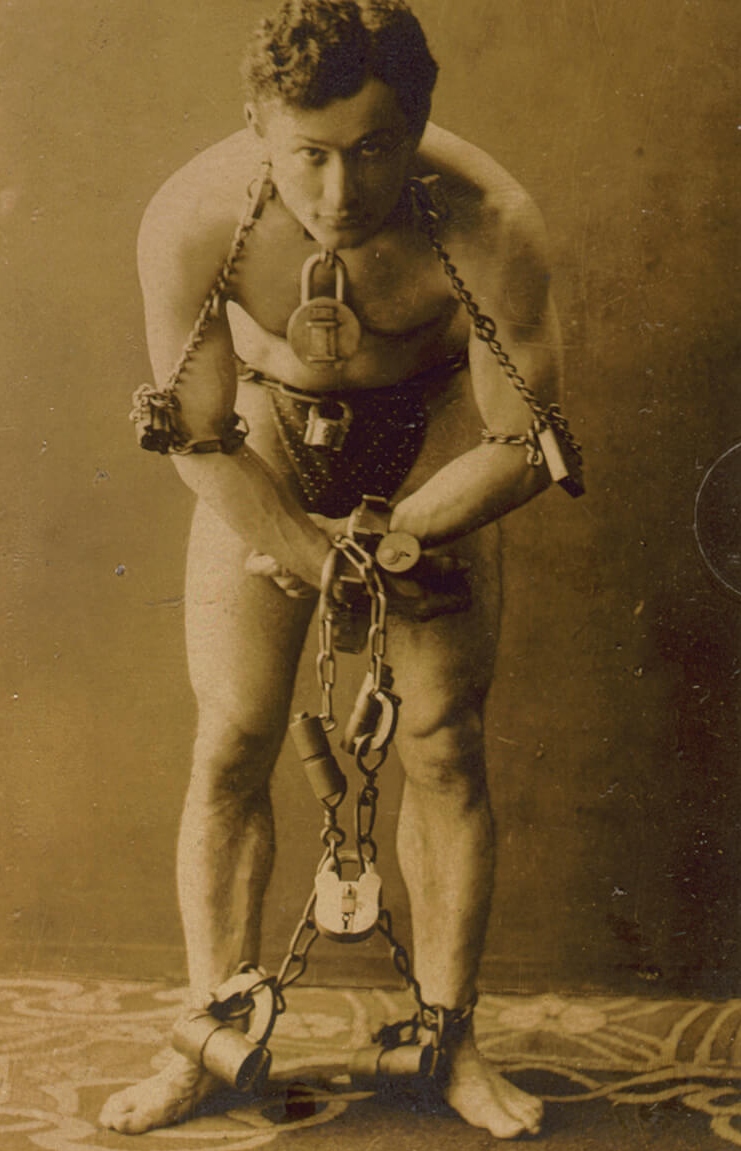
After placing Harry Houdini in a straitjacket, binding his legs, and hanging him upside down from a cornice of the old Sun Building, the Baltimore Police Department boasted that their handiwork would be the first to hold the cagey escape artist. Officers George Baudel and James Moncks had pulled the straitjacket extra tight, tugging it twice before fastening its leather strap. From there, they buckled the sleeves of the suit, securing his sheathed arms across his chest.
“Run me up as high as you want,” Houdini told the officers, dismissing their braggadocio. “It’s immaterial to me.”
The legendary performer’s famous 1916 appearance in Baltimore, 110 years ago this month, drew an estimated 50,000 people to one of downtown’s busiest intersections. The crowd, which began arriving two hours before the lunchtime show, crammed the streets, windows, and rooftops, bringing traffic to a halt.
To the onlookers’ delight and BPD’s dismay, Houdini—wriggling like a hooked marlin—contorted himself from the confinement in little more than three minutes. He tossed the straitjacket to his fans below and took a dangling bow, while still strung high above the crush of spectators.
Ever the promoter, Houdini’s public exploit was intended to hype his appearance that week in the city. At West Franklin Street’s Maryland Theatre, Houdini promised to unveil his famous “Chinese Water Torture Cell.” He also challenged carpenters, locksmiths, and craftsmen to construct something from which he could not extricate himself.
Houdini’s greatest trick may have been his own reinvention, however. He was born Erik Weisz in Budapest. Not, as he often claimed, in Appleton, Wisconsin, where his father briefly served as rabbi to a local congregation before losing his appointment and falling into poverty. Harry Handcuff Houdini—the name he used when registering for the draft in 1918—was inspired by French magician Jean-Eugène Robert-Houdin, whom he admired.
Though he rarely attended synagogue and his wife, Bess, was Catholic (“I am always afraid,” she said, explaining why she never watched him perform), he never tried to escape his Jewish heritage. During World War I, he formed the Rabbis’ Sons Theatrical Benevolent Association with Irving Berlin and Al Jolson.
Houdini’s last performance in Baltimore took place on Nov. 9, 1925. At the Academy of Music on Howard Street, he once again thrilled audiences with his water-torture escape as well as his career-capping “Three Shows in One” exhibition, which included illusions, more escape acts, and the exposure of fraudulent psychics—a personal crusade. The show’s equipment filled a 60-foot railcar.
Symbolically, Houdini’s performances represented self-liberation in a country of immigrants, many of whom had also changed their names to assimilate and sought freedom of one type or another—political, economic, psychological—from their past.
The most enduring stage performer of his time, Houdini died on Halloween 1926—from an inflammation of his abdomen lining following an appendectomy. (He did not die in his wife’s arms after nearly drowning during an underwater escape, as portrayed in the 1953 Tony Curtis film.) He was also no stranger to Baltimore or Maryland, appearing nearly 100 times in the state during his career.
“Houdini’s own story, combined with his public persona, embodied the ability to escape from individual limits, limits of all kinds,” says Spencer Horsman, the magician/owner of Illusions Magic Bar, who recreated Houdini’s famous straitjacket escape high above the Federal Hill venue at its opening 20 years ago. “What’s his quote? ‘My brain is the key that sets me free.’ He was an artist, a storyteller, a powerful imaginative force who transcended confinement. That’s why we remember him.”