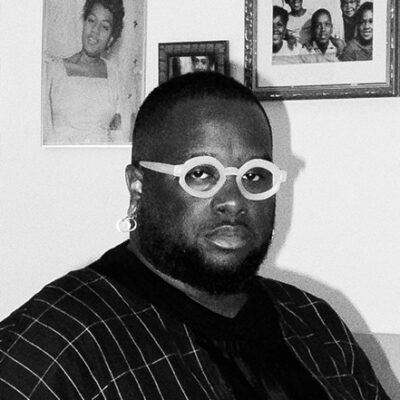
Born and raised in Miami, Lia J. Latty found her way to Baltimore through the Maryland Institute College of Art’s BFA photography program. She graduated in 2022, but long before that, she began doing the work to give Black artists the time and space to shine.
Her own photography echoes the historical profoundness of Black portraiture. Using lighting to affirm Black skin, her work underscores the importance of reclaiming Black bodies as a means to humanize Black people.
In her series Oreo, for example, she pushes the boundaries of traditional portraiture by sharing photos of Black subjects holding a personal object. Each image is parallel to a handwritten note, in which the subjects confess how they have felt like outcasts in their respective communities because their interests and desires fall outside of the traditional expectations of Blackness. By pairing the visuals with the micro memoirs, Latty not only interrogates conventional aesthetics of Black portraiture, but also challenges the sociocultural limitations that have constrained Black identity.
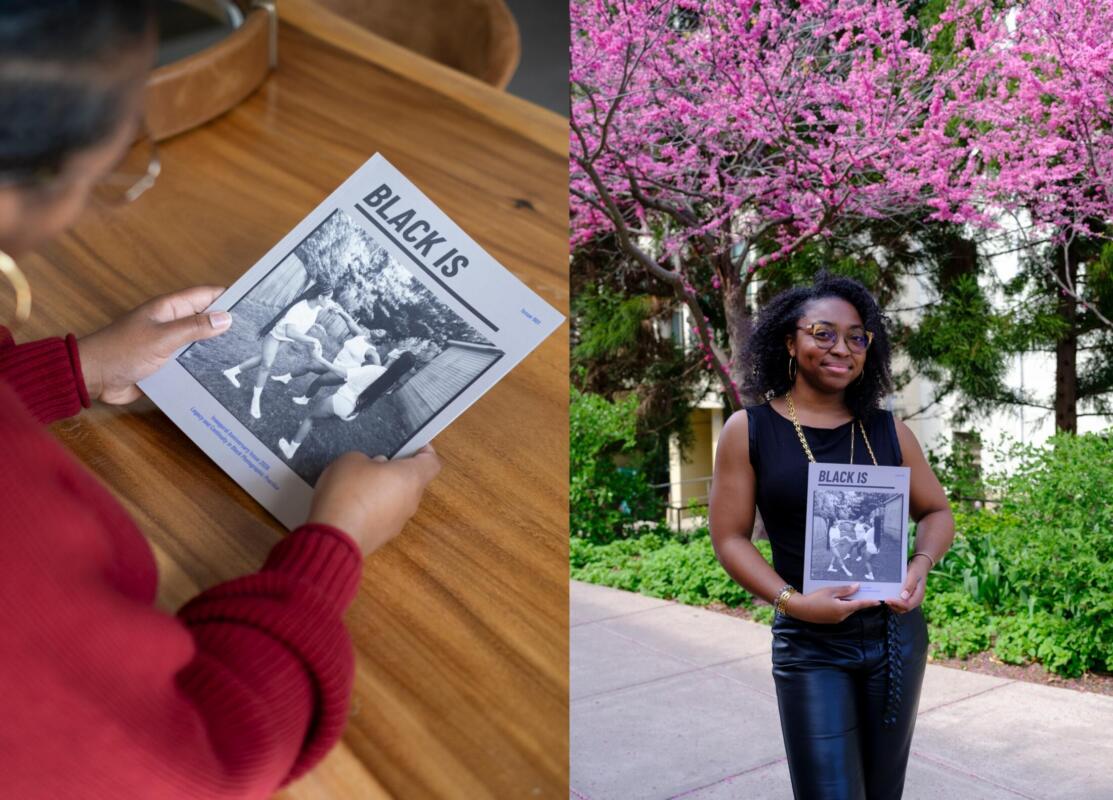
That urge to share the narratives of others expanded beyond her personal studio in 2021, when Latty launched Black Is—a digital magazine that amplifies the work of Black photographers in Baltimore and beyond. In the years since, the publication has grown to form its own creative community, hosting frequent in-person meetups and providing educational resources on its website.
This Friday, May 22, Black Is will launch its inaugural print issue with a celebration at Charm City Cultural Cultivation in Waverly, which currently houses Latty’s curated group exhibition The Everyday: Scenes in Baltimore. From 7-9 p.m., art lovers are invited to kick off Artscape weekend by grabbing their inaugural copy while enjoying refreshments and live DJ sets.
Ahead of the party—which will also serve a fifth-anniversary bash for Black Is—we spoke with Latty about the magazine’s evolution.
What are your earliest memories that were foundational for becoming a photographer?
The most direct interaction I had with exploring photography was back in middle school. At the time, one of my friends had received a camera for her birthday and asked our friends to model for her. When we hung out, I sometimes asked her if I could use her camera, and eventually that curiosity grew to me wanting a camera of my own. My godfather, who used to be a wedding photographer, gifted me my first camera, a Nikon D90. That gift allowed me to explore photography further and grow a deeper love for the medium. As a shy kid growing up, photography was the best way for me to show my perspective of the world.
How have your experiences from both Miami and Baltimore informed your work?
Being born and raised in Miami allowed me to develop a global perspective from a young age. Miami is one of the very few cities in the United States that doesn’t feel like it’s a part of this country because of its international orientation. I grew up having friends from different countries and backgrounds. The downside, though, was the lack of Black culture I experienced outside of my home. I struggled with insecurities and anti-Blackness because I didn’t have enough representation around me in the city.
When it came time to look into colleges, I was accepted into MICA’s Pre-College program in 2017, and that experience allowed me to be exposed to the Black culture I was lacking. I intentionally chose MICA because it was located in a predominantly Black city, and I wanted that cultural balance for myself. These experiences and desires ultimately informed the work I make that addresses identity and representation.
What inspired you to begin Black Is?
One day during my sophomore year at MICA, I decided to check out a couple of photobooks by Black photographers from [the school’s] Decker Library. Learning about the [1963-founded Black photography collective] Kamoinge Workshop from their book, The Black Photographers Annual (1973), is what inspired me to create Black Is Magazine. I was very inspired by the work they did as a collective and I questioned why I didn’t learn about them in any of my photography history classes.
The racial reckoning in the summer of 2020 is what pushed me to seriously consider my place in the art world as a young Black woman artist who needed a way to navigate it. I wanted to know who my peers were in the industry at large and find ways to support each other from afar. January 2021 is when the publication officially launched online with an interview-based approach, with the first artists being Shan Wallace, Asha Holmes, Kyle Yearwood, and Hannah Price—two of whom are from Baltimore.
What makes Baltimore a good arena for this project?
Having the platform be incubated in Baltimore allowed me to further expand on my ideas for the publication without feeling the pressure of a competitive environment like New York City. Not only that, I was able to develop my curatorial eye with some of the photographers that are here and build relationships with them through the platform.
How do you balance your own work as a photographer with curating Black Is? How does one practice inform the other?
I’ll be honest, the work I’m doing for the magazine is taking more priority over my personal art practice at the moment. However, I do see the magazine as an extension of my art practice. I’m still addressing issues of identity and representation through the magazine, but through a curatorial lens. If there’s an opportunity to photograph an artist for their interview, then I’m the one who handles it. I actually did my first photo essay for the magazine last year where I documented the attendees of AFRAM and their experience with the festival. In a way, I’m able to experience the best of both worlds through my own platform, on my own terms, and I find that so powerful in this moment.
What do you hope people take away from the first print issue of Black Is?
The inaugural print issue for Black Is Magazine, “Legacy and Continuity in Black Photographic Practice,” is a major milestone for me and the platform. I’ve experienced multiple waves of self-doubt over the years around where the platform was going, but in March of last year I committed to producing the first print issue myself with a very DIY approach. I’m very happy with the final result.
As we celebrate our five-year anniversary this year, it felt very fitting to have the theme for the first print issue center around legacy and cultural memory within the global African diaspora. Our presentation at Artscape’s Scout Art Fair [May 22-24 at the Baltimore War Memorial] is also an extension of the print issue, and the work by Alaina Lurry, Dahveed Wilkins, and Reginald Ransom III speaks to the theme. I want people to take away the feeling that this work matters, and deserves to be preserved.
What additional work do you think is necessary for the Black photography community to thrive in Baltimore and beyond?
For starters, we need a more centralized community for Black photographers here. Since August of last year, I’ve been hosting an event called “Black Is: Critique & Connect” at Charm City Cultural Cultivation for Black image-makers in the city that need feedback on their work. Whether an artist is self-taught or studied art in college, we still need a space where we can receive constructive feedback on our work, and it’s harder to find that programming outside of a school setting.
The community here would also benefit from structured mentorship programs with established photographers from the city and afar. There’s still not enough support that’s offered to early-career photographers who are at the beginning of navigating the creative industry. The last one I’ll throw in there is a community darkroom that offers accessible classes and workshops on how to work with film.
With social media and AI taking up so much space when it comes to image representation in 2026, how important is it for Black photographers to not only do the work but also print the work physically?
Ownership of the creative process is so important for Black photographers to control. Now more than ever. The instantaneous nature of AI goes against the need for mastery, and mastery requires genuine interest, patience, passion, and a little obsession. The early-career Black image makers, like myself, have to be truly invested in the medium of photography and how it contributes to Black visual culture. When you become invested in photography, you quickly learn that viewing your images on a screen is very limiting. Printing the work allows us to see how our images take up space and interact with other pieces in the room.