
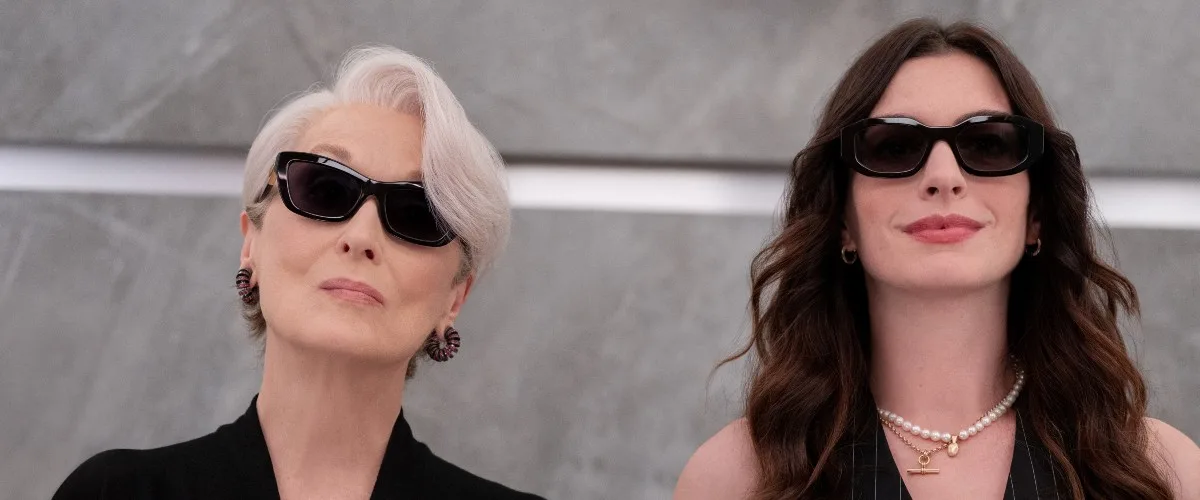
When contemplating a sequel, especially one that comes out two decades after the original, you must ask yourself the following questions:
- Is it better than the original?
- Is it even in the same league as the original?
- Does it make a good case for its own existence?
- Does it give us a chance to spend time with some characters we’ve grown attached to over the years?
Regarding The Devil Wears Prada 2, my answers are, in order: No. Also no. Not really. And yes.
The original The Devil Wears Prada, which came out in 2006 and followed the adventures of the hopelessly unstylish (at first) young journalist Andy Sachs (Anne Hathaway) facing off against the formidable Anna Wintour proxy, Runway magazine editor Miranda Priestly (Meryl Streep), has turned into one of the quintessential comfort films. It’s the kind of film you can watch over and over again—and probably recite some parts by heart. It’s aspirational in a variety of ways: A young woman finding her voice. A formidable woman softening a bit, while demonstrating why she’s so formidable. A snooty but loving guncle (everyone’s favorite heterosexual gay man, Stanley Tucci). An arch nemesis turned reluctant ally (Emily Blunt). And fashion, all that glorious fashion.
Much has happened in the ensuing 20 years. Everyone agrees that Andy’s boyfriend (Adrian Grenier, who doesn’t appear in the sequel) was a dud. Miranda Priestly’s “cerulean blue” monologue—this film’s answer to A Few Good Men’s “you can’t handle the truth”—has gone viral. Oh, and print media is, let’s just say, not the powerhouse it used to be.
As the sequel starts, Andy is an award-winning investigative journalist whose newspaper has just folded. Meanwhile, Miranda has a crisis of her own—she wrote glowingly about a fashion brand that was revealed to use sweat shops and is now the subject of memes that vilify her, depicting her with a Pinocchio nose or dressed as a fast food worker with a speech bubble that reads, “You want lies with that?” (Films notoriously have a hard time replicating meme culture.)
Somehow, Andy is hired to be a feature writer at Runway magazine in the hopes that her famous journalistic integrity will send the right message to readers.
When Andy bounds into Miranda’s office on her first day back at Runway, she’s excited to finally be on the same footing as her old boss—indeed, she assumes that it was Miranda who put in the good word for her. Instead, Miranda turns to Tucci’s Nigel and says, “Who is this?…Do I know her?” (It’s a funny, albeit lazy joke.) And just for a second, all of Andy’s poise and confidence is out of the door. Briefly, she’s that gawky college grad wearing Marshalls sweater sets.
Part of the fun of the original was witnessing Andy’s makeover, but in this film, she’s fabulous from the jump, dressed in fitted blazers, oversized sunglasses, and stiletto heels. (Nigel quips, “Oh, look what TJ Maxx dragged in,” when he first sees her, but no one’s buying it.)
As mentioned, the dud of a boyfriend is out of the picture, but they give Andy an almost insultingly perfunctory love interest, an architect played by Patrick Brammall. (If anyone can explain his overarching role in the film, other than to remind us that Andy is still a catch—duh—please let me know.)
The film’s crisis, essentially, is how can they save Runway in a world of venture capitalists who buy up publications just to cut staff, reduce coverage, or worse. If in the original film Runway was all-powerful in its influence, reputation, and glamour—now it’s just a little sad.
Justin Theroux has a funny turn as Benji Barnes, a Jeff Bezos type who is dating Blunt’s Emily. He’s depicted as a big nerd who has been given the glam treatment by his stylish new girlfriend (who can’t get enough of his money but clearly despises him).
All the leads are still in good form—both in terms of performance and appearance (they are remarkably well preserved). Streep, in particular, makes great hay of Priestly having to cut back on things—how dare they make Miranda hang up her own coat (sacré bleu!) and fly coach (the horror!).
This is clearly one of those cases where all the famous people were game to do a sequel so they built a script to make it happen. Although only two writers are credited—Aline Brosh McKenna and Lauren Weisberg—it has the distinct feel of having been written by committee. The film is competently directed by David Frankel, who also did the original, although there are a few too many shots of Andy striding quickly through New York traffic for my taste.
The Devil Wears Prada 2 is a chance to hang out with our old friends and see some great clothing—and little else. For some, that will be enough.