
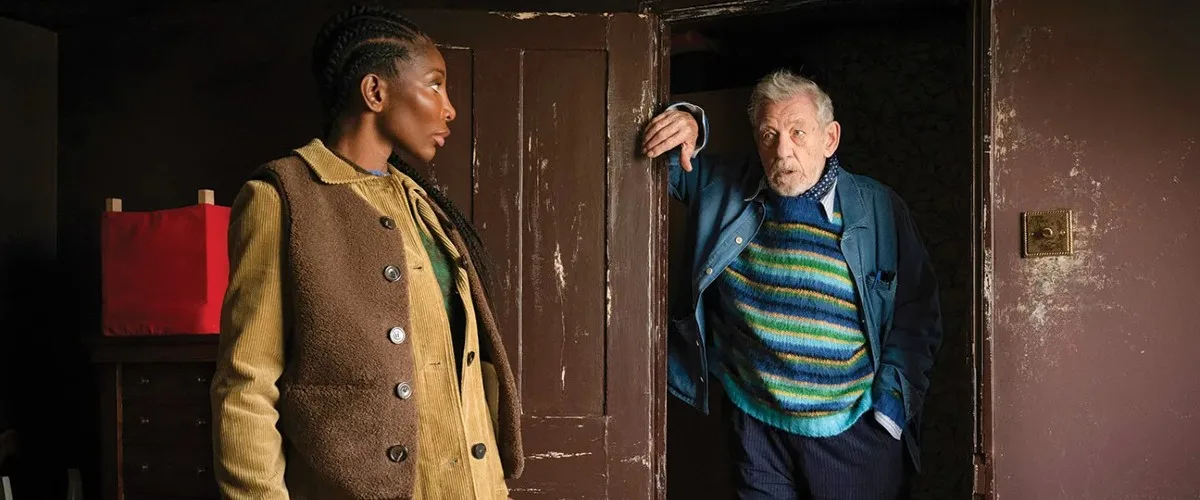
Sometimes you’re glad a film was made simply because it allows a great actor to be great. Such is the case for The Christophers, Steven Soderbergh’s film about the relationship between an aging art icon and a forger, starring a wonderfully game Ian McKellen as disgraced painter Julian Sklar.
Julian is a feast of a character—prideful, scabrous, witty, and performatively cruel—and McKellen leaves no crumbs. It’s hard to distinguish between Julian’s public persona—first he was an enfant terrible of the art world, then a universally acknowledged master, then a canceled “Great Man,” and finally a professional grouch—and his private one. The lines have clearly blurred.
After his cancelation, which is alluded to but never specified (although hardly shocking since Julian says and does all sorts of inappropriate things), he retreated to his home studio—a massive duplex in London filled with canvases (some empty, some half-finished, some complete), palates, books, empty clawfoot bath tubs, dress forms, lamps, tapestries, and all manner of clutter (kudos to production designer Antonia Lowe for creating this exquisitely lived in and character-revealing home). He stopped painting, instead earning a (disreputable) living by doing Cameos (slapping on a beret, dropping a bon mot or two, and saying “happy birthday” or what have you) and acting as the Simon Cowell of the art world on a reality TV competition show called Art Fight. He pretends to be disdainful of it all—the consumerism of the art world, the shallowness of reality TV, the ludicrousness of those Cameos—but clearly part of him delights in those things, too.
Julian has two adult children—Barnaby (James Corden) and Sallie (Jessica Gunning)—whom he despises. Understandably so, they’re insufferable, but it’s hard to tell which came first—his disdain or their awfulness.
It’s their idea to hire a forger named Lori (Michaela Coel) to complete a series of paintings called the “Christophers.” These were Julian’s most successful works, made when he came out of the closet and fell in love with a young man, who eventually broke his heart. The third series of the Christophers has remained unfinished. Knowing that their father is old and in poor health, the siblings concoct a plan: Lori will apply for a job as Julian’s assistant while secretly finding and completing the unfinished works; then they will be “discovered” in the attic and sold for millions upon Julian’s death.
The gimlet-eyed Lori has a relationship with both Sallie and Julian. She was a classmate of Sallie’s at art school—we find out that Sallie made one feeble attempt herself to complete the Christophers and failed (we eventually see the laughably bad work)—and knows of her mediocrity. She also has an aversion to Julian, but we don’t find out why until later. She reluctantly accepts the gig.
Making her way through the (intentionally) complicated front door of Julian’s home and up the noisy staircase, she applies for the job as assistant. Mostly, she just listens as Julian holds court—“if you’re an artist I don’t want to know about it,” he says, while getting her name wrong (he calls her Lisa) and going off on a series of tangents. Lori’s skill is stillness, for the most part. She lets him monologue and pays close attention, missing nothing. Finally, impressed (mostly with himself), he hires her. One of her tasks will be to destroy the unfinished Christophers, which gives her perfect access to the works.
One day, Julian finds an article she published in an art journal that was brutally critical of him and his latter stage work. (She calls him bloviating.) He’s deeply offended, but he gains a new respect for her, even more so when she comes clean about his children and their plan for the Christophers. “What makes you think you could do [the forgery]?” he asks pointedly. She somewhat defiantly breaks down his work—describing how the thickness of his paint and the use of light conveys his moods, his feelings about Christopher. Her insight is undeniable. Suddenly, he seems to want to impress her and maybe even know her, although she remains intentionally opaque.
And this is my biggest problem with The Christophers—which I generally liked: Lori is a cryptic character to a fault. Does she hate Julian? Does she want his approbation? Is she growing fond of him through their work? Is this all some elaborate form of revenge? And why did she choose forgery? Yes, it’s hard to make a living as an artist—she works part time at a food truck—but not all struggling artists turn to forgery. Is it merely a skill she has, or does it say something about her as a person that she has not found her own artistic voice? The film never explores this.
As an actress, the brilliant Coel is a formidable foil to McKellen. It’s fun to watch them face-off, even as I did yearn to know more about her.
Additionally, the film feels a bit ambivalent about this once great man. Julian is clearly an asshole. His cruelty toward his children is inexcusable no matter how awful they are (casting Corden was a deft, if slightly nasty, touch). And Julian’s whole schtick is cruelty—discouraging and publicly humiliating the artists who earnestly share their work with him on TV. But he is undeniably entertaining, too. And, of course, there’s a good deal of vulnerability and even self-loathing just beneath the surface. I guess we’re supposed to feel that he deserves it all—the fame, the respect, but also the infamy and the subsequent isolation.
The Christophers is a great film-club-discussion type movie. I hosted a screening of it this weekend and there were lots of disagreement over Lori’s true feelings for Julian and vice versa—had she grown to love him? Did he see her as the daughter he wished he had? And what of the art of forgery? One clever audience member suggested that Soderbergh—the anti-auteur, who calls himself a cinematic “shapeshifter”—might have genuine respect for such powers of mimesis. Is there inherent value in excellent forgery? Insights into cancel culture and the commodification of the art world are less compelling. But I must say, I had a blast with The Christophers. In the end, it’s a script worthy of McKellen’s gifts—which, in turn, makes it a gift to us all.