
In our new Walk & Talk web series, we send a reporter and a local tastemaker to a Charm City cultural event and record their real-time reactions.
This week, arts contributor Kerry Folan met up with Baltimore Jewelry Center director Shane Prada at The Walters Art Museum for a preview of the new exhibition Douriean Fletcher: Jewelry of the Afrofuture—a major showcase for the 39-year-old self-taught jewelry maker, whose designs for the 2018 movie Black Panther put her in the international spotlight.
On view April 18 through August 9, the exhibit explores the self-taught metalsmith’s jewelry as a powerful narrative tool in art, Black identity, and visual storytelling. As part of the opening day celebration on April 18, instructors and artists from the Baltimore Jewelry Center will lead a free workshop in which participants learn more about narrative jewelry and storytelling through art making.
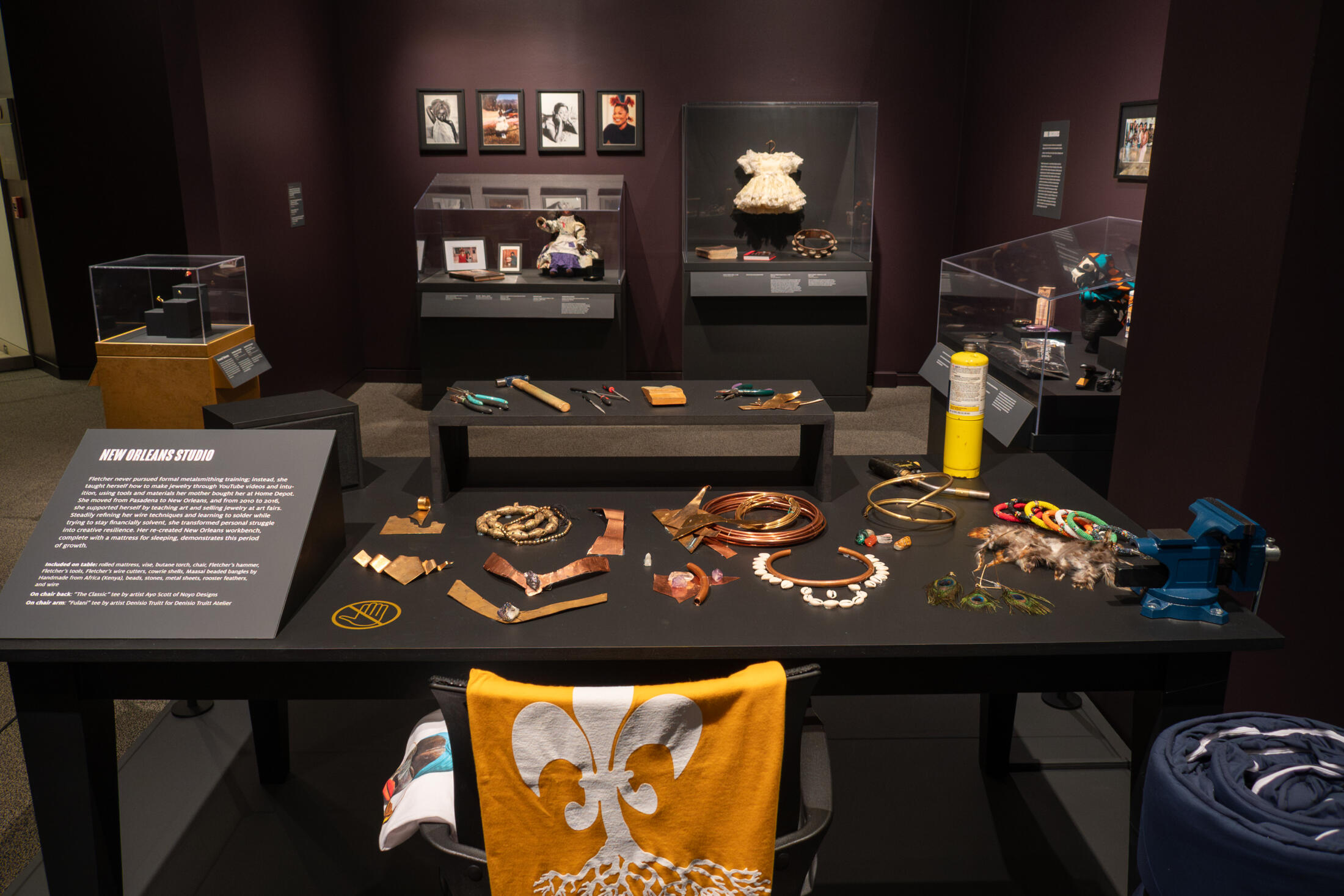
A re-creation of the jeweler’s bench Douriean Fletcher used when she first began metalsmithing, back when she was in her early twenties and working at an arts nonprofit in New Orleans, sits at the start of Douriean Fletcher: Jewelry of the Afrofuture.
I am not a jewelry maker, or even generally very handy, so among the tools laid out here I recognize only the hammer. But I’m with Baltimore Jewelry Center director Shane Prada, who knows quite a lot about jewelry, and about Fletcher.
Prada names the objects I don’t know—the butane torch, the wire cutter, the cowrie shells, beads, metal sheets, rooster feathers, and wire used in the designs. There is also an old T-shirt of Fletcher’s, and the mattress she used to sleep on if she was working late.
Prada is visibly energized to see the ephemera from Fletcher’s early life, including nearby family photos, her mother’s bible, and the tiny church dress she wore as a child.
“I get very excited by shows that include objects from the artist’s life and tell a narrative,” Prada says. “The choice to put day-to-day objects in this show really grounds it in an understanding of the person who’s making the art. Like, Fletcher was raised in the Seventh Day Adventist tradition, which doesn’t believe in adorning the body. That is a really interesting thing to know about someone who grew up to be a jewelry designer.”
We’re on the ground floor of The Walters Art Museum on an unseasonably warm April afternoon to view the Douriean Fletcher exhibition before it opens to the public this weekend.
The deep purple-painted temporary exhibition gallery feels lushly cool in contrast to the hot day—a smart design choice for a show that will be on view through the dog days of a Baltimore summer. It also has the effect of making Fletcher’s large-scale gold pieces glow in the dim room. (I think of Junichiro Tanizaki’s classic essay “In Praise of Shadows,” which famously challenges the Western insistence on equating white with all things good and argues for the aesthetic superiority of the dark.)
A glimmer from a case of earrings catches Prada’s eye, and we move towards it.
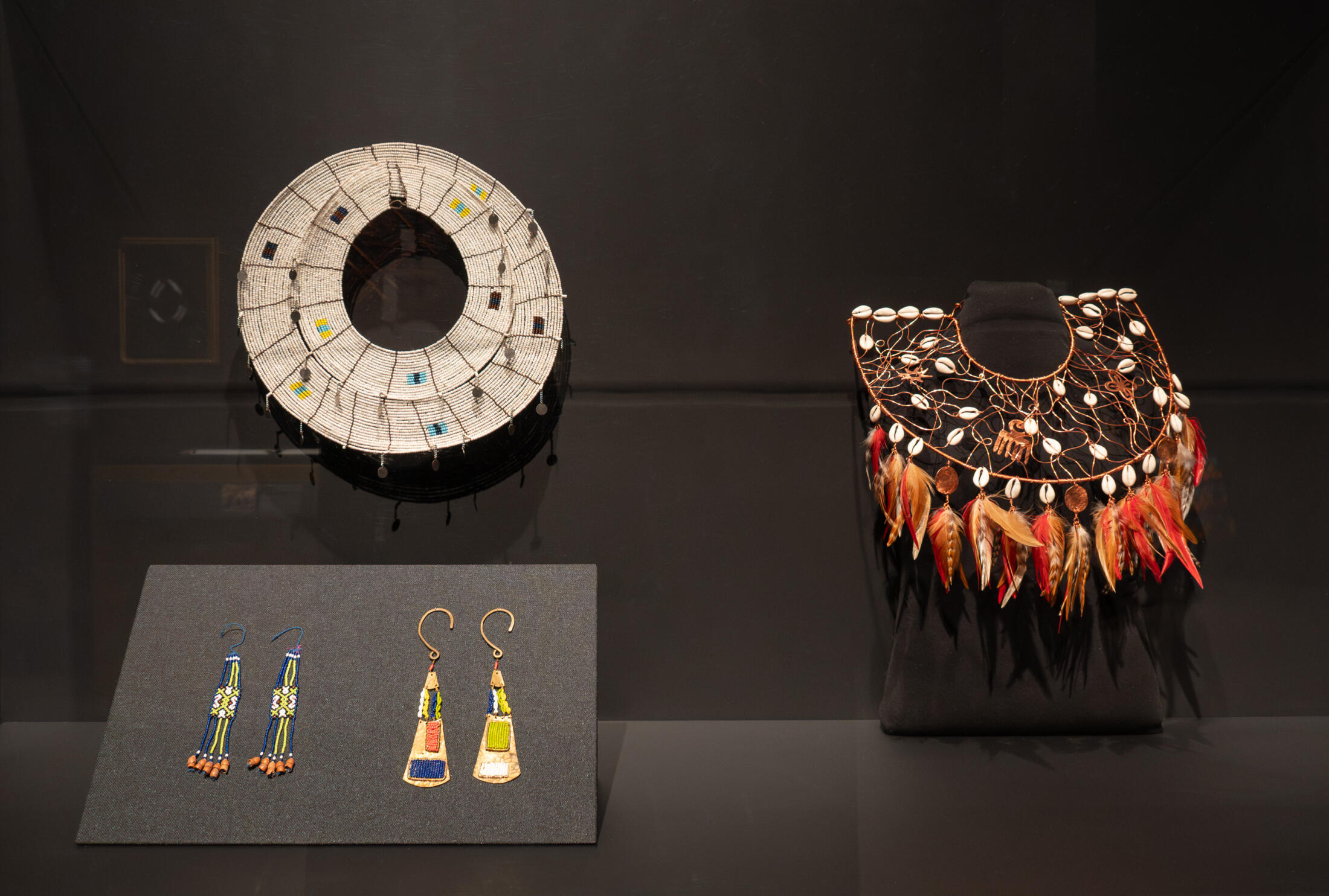
“Ooh, there are some really excellent compositional choices here,” she says of a pair of big brass ear cuffs adorned with colored beads, in what look to me like abstract patches.
I ask what she likes about them. “So, they’re asymmetrical, but they’re still relatively balanced. The choice of color is quite pleasing.”
She points out the way the beads are organized in both a linear way when you zoom in (they’re lined up neatly in rows like beads on an abacus), and a more organic way when you zoom out, with the colored patches positioned incongruously on the brass plate, breaking any kind of grid.
“You can tell this is a person who has a deep knowledge, or deep natural sense, of materiality, composition, and color,” Prada says. “Jewelry is a small package, so understanding how to play with small elements of composition and color really matter.”
These earrings demonstrate the type of work the Pasadena native artist was doing when renowned costume designer Ruth E. Carter discovered her in 2015 and invited her to collaborate on the Hollywood productions Fletcher is now famous for—particularly the Black Panther movies, which imagine the fictional world of the wealthy and powerful African country Wakanda. Mannequins displaying those iconic costumes are in the next room. Prada and I head in their direction.
“This is a really cool piece,” Prada says, stopping in front of a long, pale pink cape and dress with an open-work silver bodice cage worn by Queen Ramonda in Wakanda Forever. Again, I ask her what she likes about it.
“Well, as someone who loves clothing as much as I love jewelry, I like the idea of taking this exoskeletal costume piece and elevating a garment, which is the fun thing about contemporary jewelry. It’s often very large.
“I mean, you can see the earrings that I’m wearing almost reach my shoulders,” she says gesturing to a pair of dangly oversized chain links that appear to be made out of some kind of hard plastic, “and yet it’s rarely made of fine material. It approaches sculptural art.”
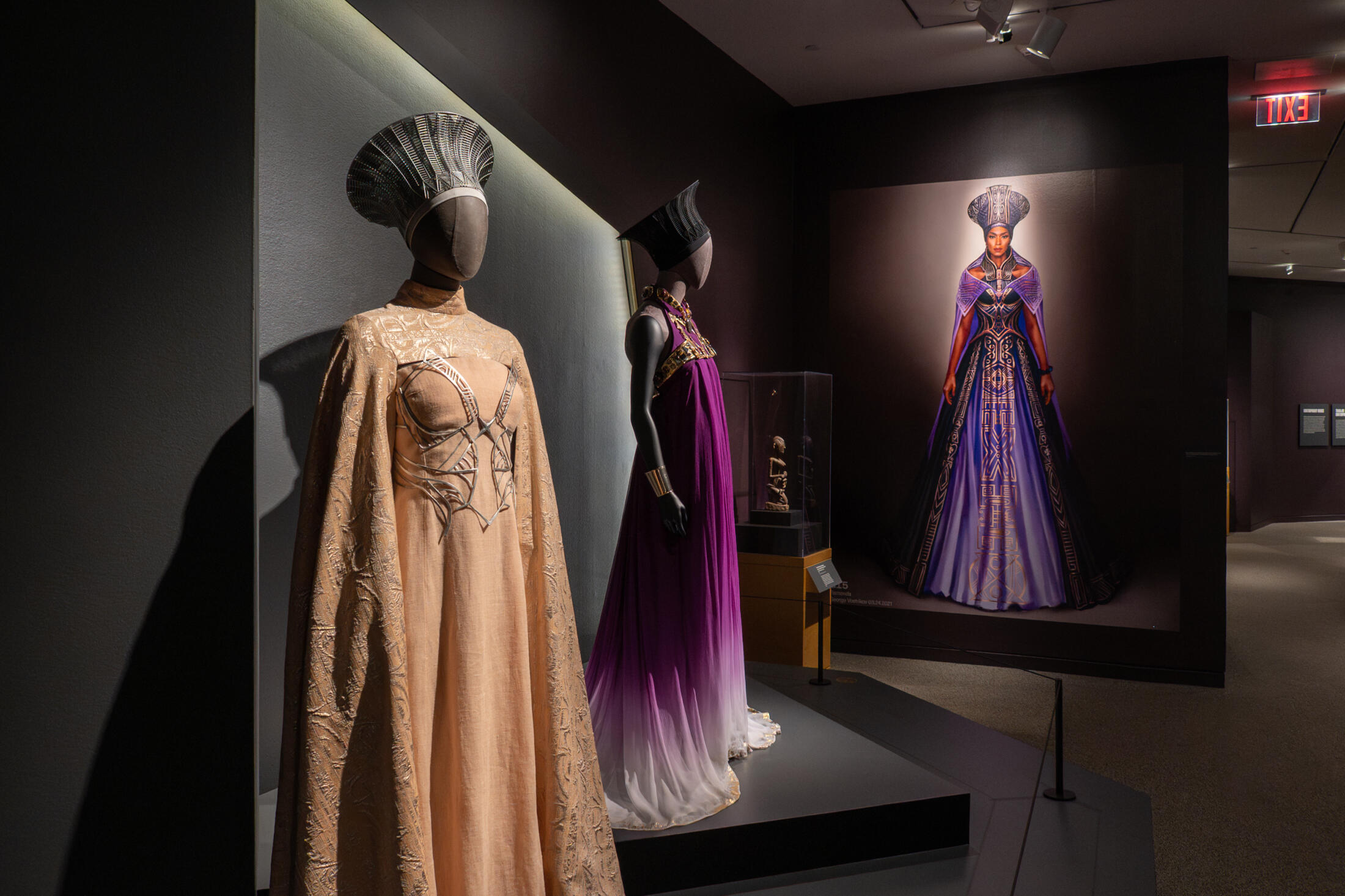
As we look at the rest of the costumes—including an enormous gem-laden headdress, a copper necklace and bracelet worn by Okoye during T’Challa’s funeral, and faux jade necklaces inspired by ancient Mayan earthenware figures on display nearby—I ask Prada what she thinks makes Douriean Fletcher, the Douriean Fletcher.
After all, Fletcher is the first jewelry designer to be included in the Motion Picture Costumer Union, a sought-after collaborator by luxury department stores and brands, and one of the only living jewelry makers I can think of to get a solo show at major museums. I can name dozens of fashion designers off the top of my head, but the only jewelry lines I can think of are brands, like Cartier and Tiffany. How does a young, self-taught artist emerge to be such a star in this field?
“We don’t have many Douriean Fletchers, right? But she clearly was doing things like these editorial shoots,” Prada says, referencing a photograph from 2016 where Fletcher is modeling some of her creations. “That costs money. It also shows she’s valuing herself as a creator and as a designer. That takes a lot of believing in yourself and positioning yourself, like, ‘Yeah, I made this.’”
Later on, at the official press preview, I am able to ask Fletcher the same question.
“I think that what sets me apart is being my own model, being the person that was telling the story of the jewelry, and being very specific about what I wanted to say,” she tells me. “All my work was coming from my own personal experience. My first few pieces came from this dream I was having, and from my own personal desires. So I just put myself in the middle of my story.”
As the exhibition demonstrates, this is something Fletcher continues to do to this day.
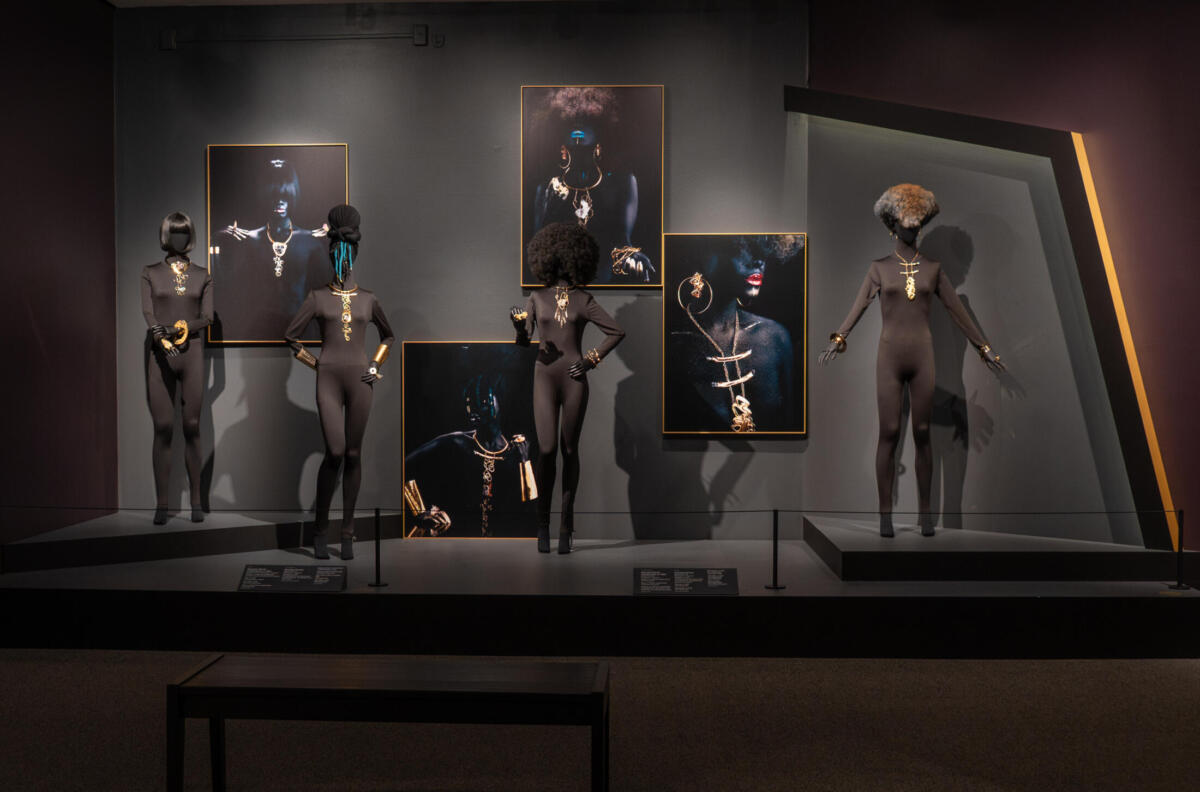
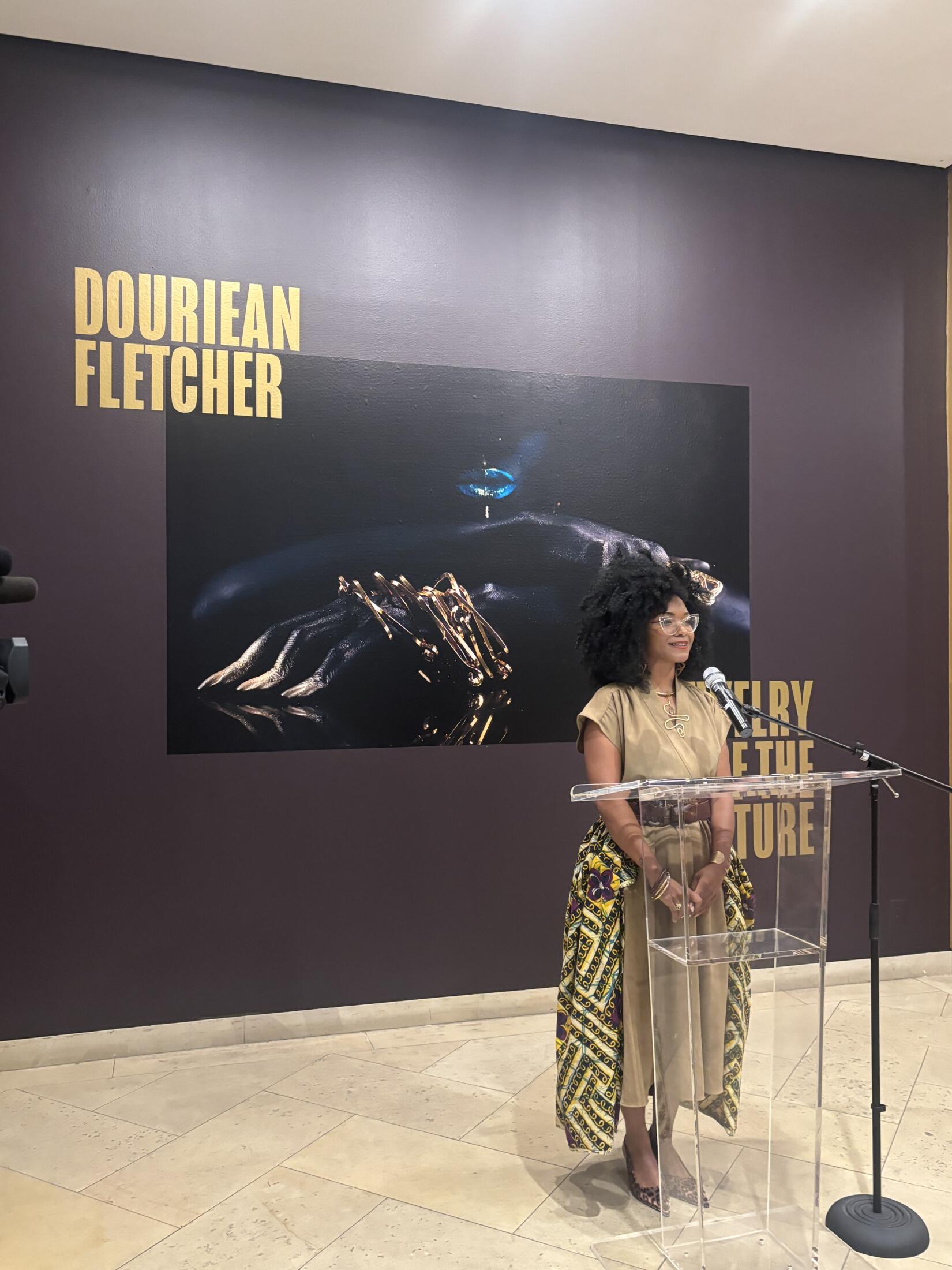
As Prada and I round the corner to the final section of the show, which focuses on Fletcher’s current personal practice, we are confronted with several striking blown-up photographs of Fletcher posed on a dark background, wearing the gleaming gold pieces from her 2021 Messenger Collection. Prada gravitates towards a particular necklace, with what looks to me like an enormous crystal strapped with wire to a squiggly gold plate. She points out its relationship to Fletcher’s earlier pieces.
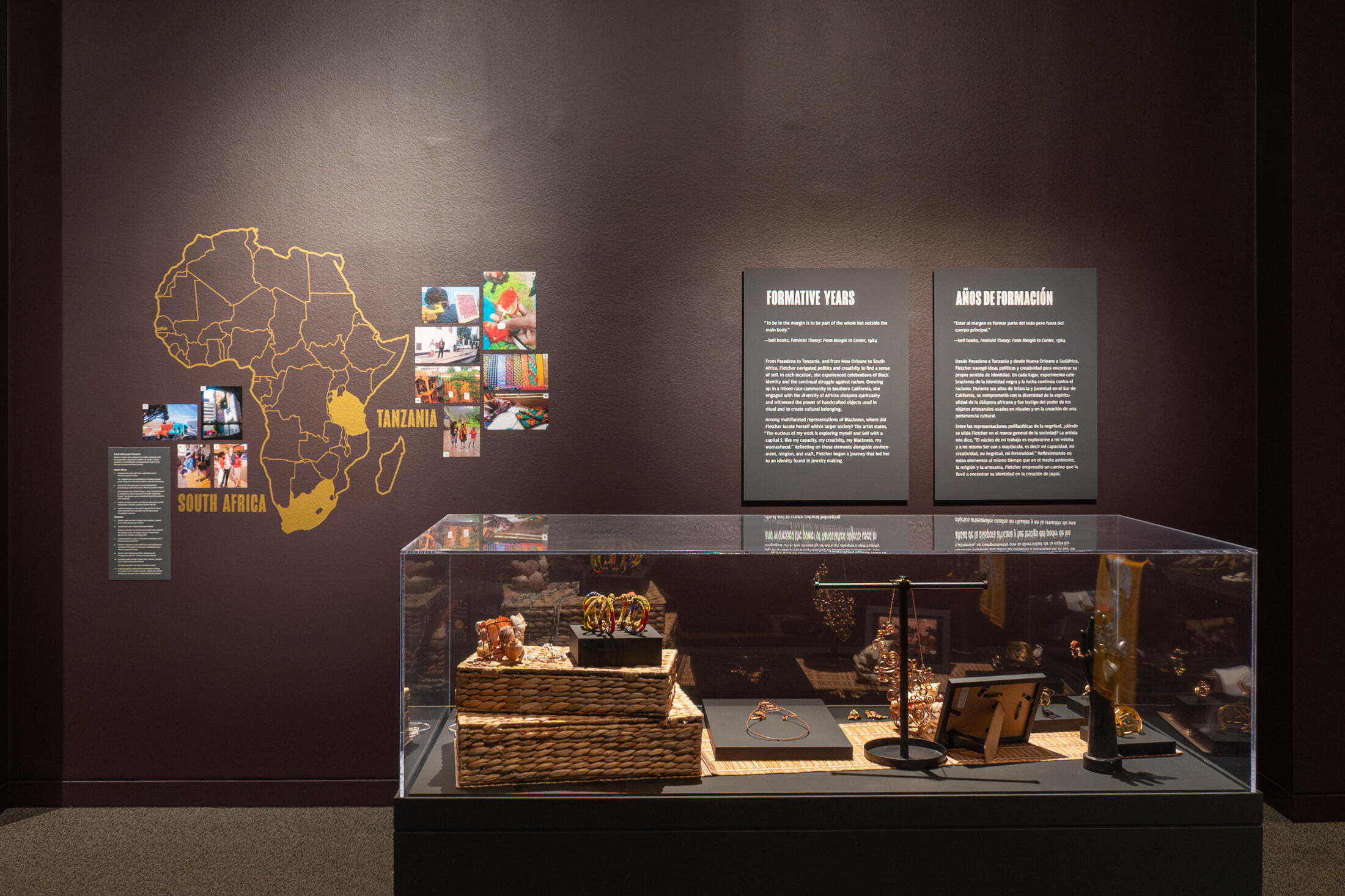
Fletcher was inspired by the jewelry of Alexander Calder and Art Smith, who were known for preferring wire wrapping to soldering or welding techniques. She was also influenced by two specific ancient Egyptian rings in The Walters’ collection (on display near the exhibition entrance), which Fletcher discovered through a Google search in 2008, back when she was just starting. Like Fletcher’s necklace, the rings use wrapped wire in their designs.
“So, in fine jewelry, your hardest stone settings will be something like a bezel or a channel—these settings that require a lot of exactitude,” explains Prada, referring to settings where the metal rims the stone, protecting it and securing it in place. “There are rules about the way that you should do them. To me, this is all so connected to a kind of cultural supremacy, this ‘right’ way of doing something. But truly, we don’t have to follow rules like that, especially when it comes to art.
“And in this case, when we encounter a simple way of capturing a stone that has not been cut and faceted in this very traditional, more Western style, the raw beauty of the stone gets to be seen and shown off.”
Prada finds this really exciting, especially for a self-taught artist looking for alternative approaches to traditional jewelry making.
“[Fletcher is] getting elevated in a place like Bergdorf Goodman with designs that she didn’t perfect through a refined goldsmithing education or years in art school,” she says. “To me, it’s like she’s announcing that it’s okay to do things your way. While we see this often in art, we see it less so in craft education, and I think there’s something really freeing in witnessing this kind of jewelry in a museum.”
We head back towards the entrance, where we left our bags and where The Walters’ ancient Egyptian rings are displayed. As we gather our things, preparing to leave, Prada stops to admire one of the rings that Fletcher found on Google all those years ago—that in so many ways brought her here to Baltimore.
An engraving of the Egyptian god Ptah in green jasper stone sits in a gold swivel ring. Wire wraps the sides of the ring shank, adding a layer of texture and interest.
“Wow—see, nowadays, we would mimic a texture like that by using a motorized tool,” Prada says, remarking on the craftsmanship and unknowingly echoing Fletcher’s own comments on the ring in the museum’s press release (which I have read, but she hasn’t).
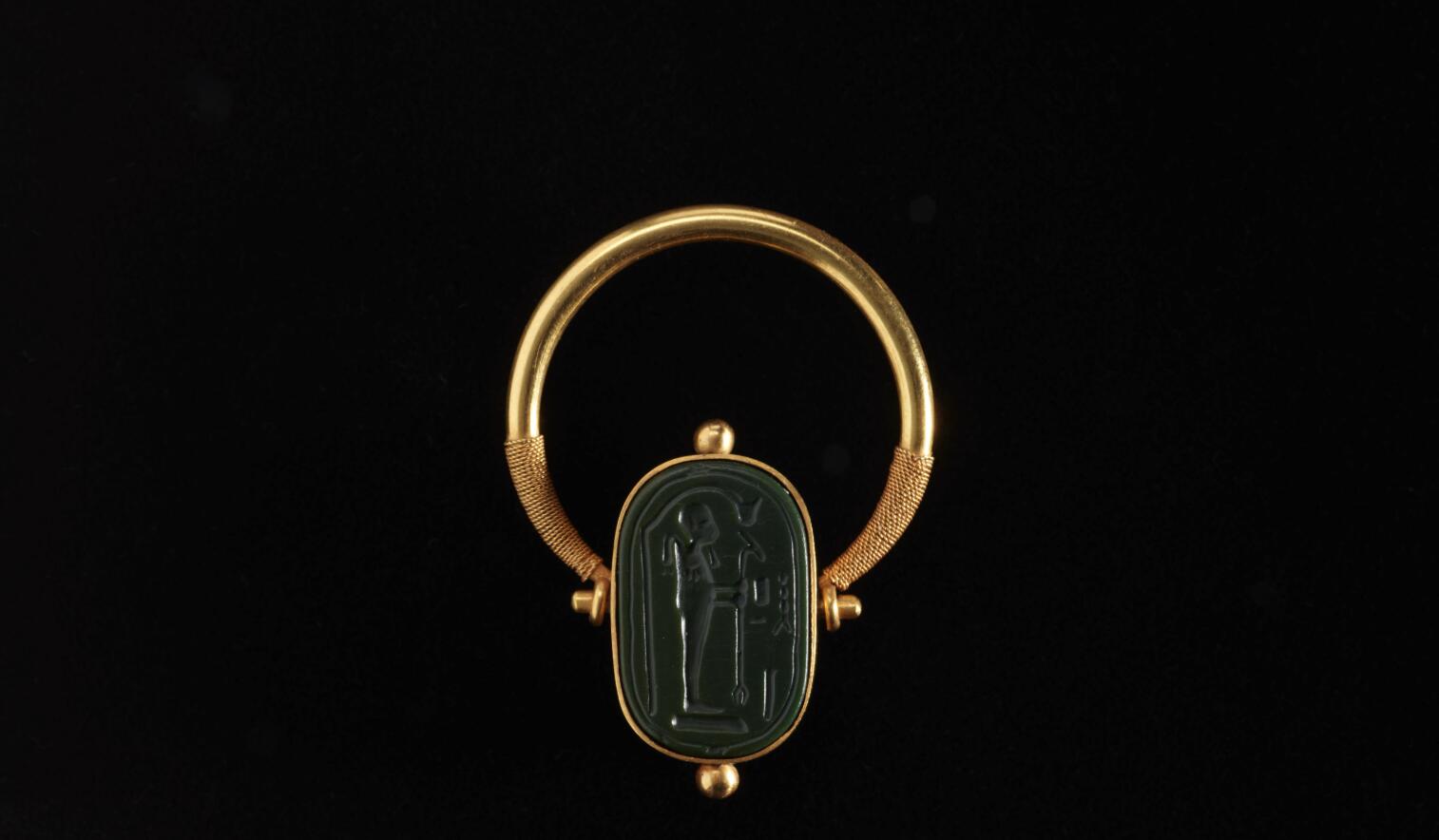
Fletcher is quoted there describing the mark of the hand on these 2700-year-old pieces as deeply inspiring to her: “You can tell someone physically wrapped the wire—that actual hands have worked on it, as opposed to a soldering iron,” she says. “The representation of handcrafted art in museum spaces is so important.”
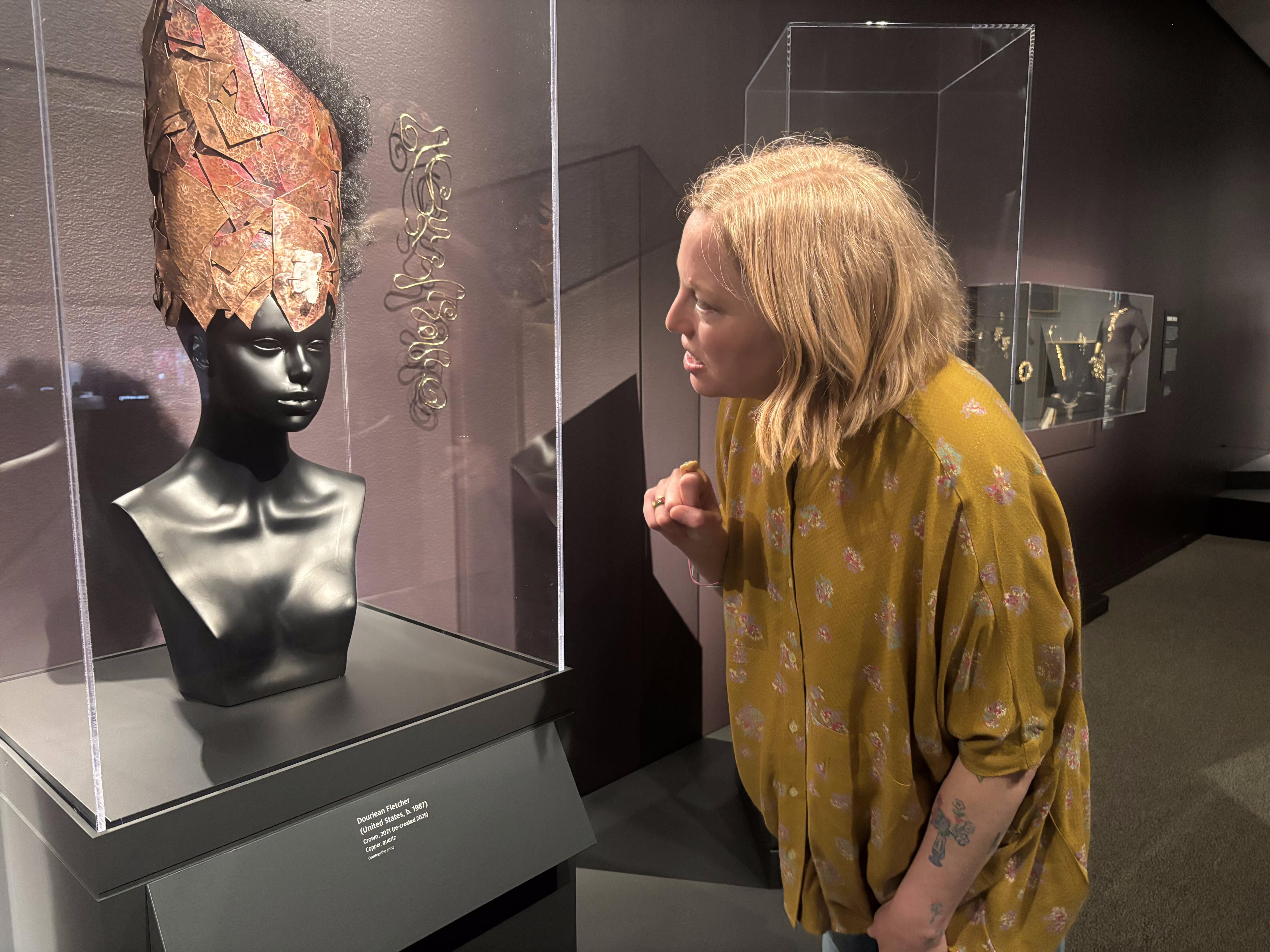
Prada continues, leaning in for a closer look.
“We so often think about antiquity as very boring. But, no. They were just like us, and they wanted things to be fun and interesting. We should all be looking to history for our jewelry.”