Arts & Culture


THE CROWD AT THE BALTIMORE SOUNDSTAGE is rapidly filing in. They are young and old, Black and white, queer and straight, hipster and normcore. Of course, only one man could draw such a wildly diverse group in Baltimore: John Waters. They’re all here for his “Date With John Waters,” a Valentine’s Day-themed iteration of his annual comedy show. In the entranceway, there is Waters merch: a “Filthy Towel”; a barf bag that reads, “He’ll Make You Sick”; and a graphic T-shirt with a picture of Waters and the words “Join the Cult!” printed across the front.
The buzz in the room is palpable. Behind me, a group of millennials is discussing their favorite Waters films. “I’m just going to be a basic bitch and say Pink Flamingos,” one says, although she notes she also has a soft spot for Pecker, which she saw on her first date with her current partner. There’s a general agreement that Pecker is really good. “I’ve watched it so many times,” says her boyfriend. Someone else mentions a recent screening of Multiple Maniacs at The Charles Theatre: “Halfway through the screening, I thought, ‘I should’ve smoked a bowl before this.’” There are knowing laughs.
Throughout the packed theater, new friendships are being forged, all bonding over a mutual love for Waters and his come-as-you-are, merry prankster ethos. Finally, the man of the hour emerges, looking dapper as always in a red velvet suit and standing in front of a podium decorated with an illustration of himself—The Pope of Trash—dressed as an actual pope. The crowd cheers loudly. Waters pulls out a notebook and starts to tell jokes. Not just any jokes, but a rapid-fire series of set-ups and punchlines, one after the other, told at a breakneck pace, easily two jokes a minute. Many of the jokes, naturally, are about Valentine’s Day. “I guess I’m your foreplay tonight,” he says.
There is what can only be described as a riot of dirty words—“rimming” and “cunnilingus” and “butt plugs”—and plenty of phrases you’ve never heard of before. (Now might be a good time to remind you that this is a John Waters profile. It will not be G-rated.) There are jokes about turds, because bathroom humor will never not be funny to him (to wit: the ceremoniously bequeathed “John Waters All Gender Restrooms” at the BMA). There’s self-deprecation: “I was born with dementia,” and pop culture references that fly over the heads of many in attendance, much to his dismay. “Lillian Hellman used to be so famous,” he sighs. There are jokes about his age. He notes that a “gerontophile” is someone who is attracted to old people. The next step for him? Necrophiliacs.
The theme of the show is basically this: Be irreverent, break the rules, dismantle the patriarchy and, frankly, anything else that bores you. Waters has made it clear at this point that he no longer associates with the left—he finds them to be humorless scolds—and says his politics these days are in the “radical middle.” But many of the jokes are at the expense of President Trump and his cronies (he suggests that drag queens go to the Melania film and heckle it). At the end of the show, he does a Q&A, answering questions about his number-one tip for staying sexy forever (“have fun; be curious; eavesdrop”) and his best-ever date (“you didn’t pay enough to find out”).
There’s a freewheeling, casual, almost familial atmosphere as people shout out their questions, and as the night goes on one thing becomes eminently clear: John Waters loves his fans as much as they love him.

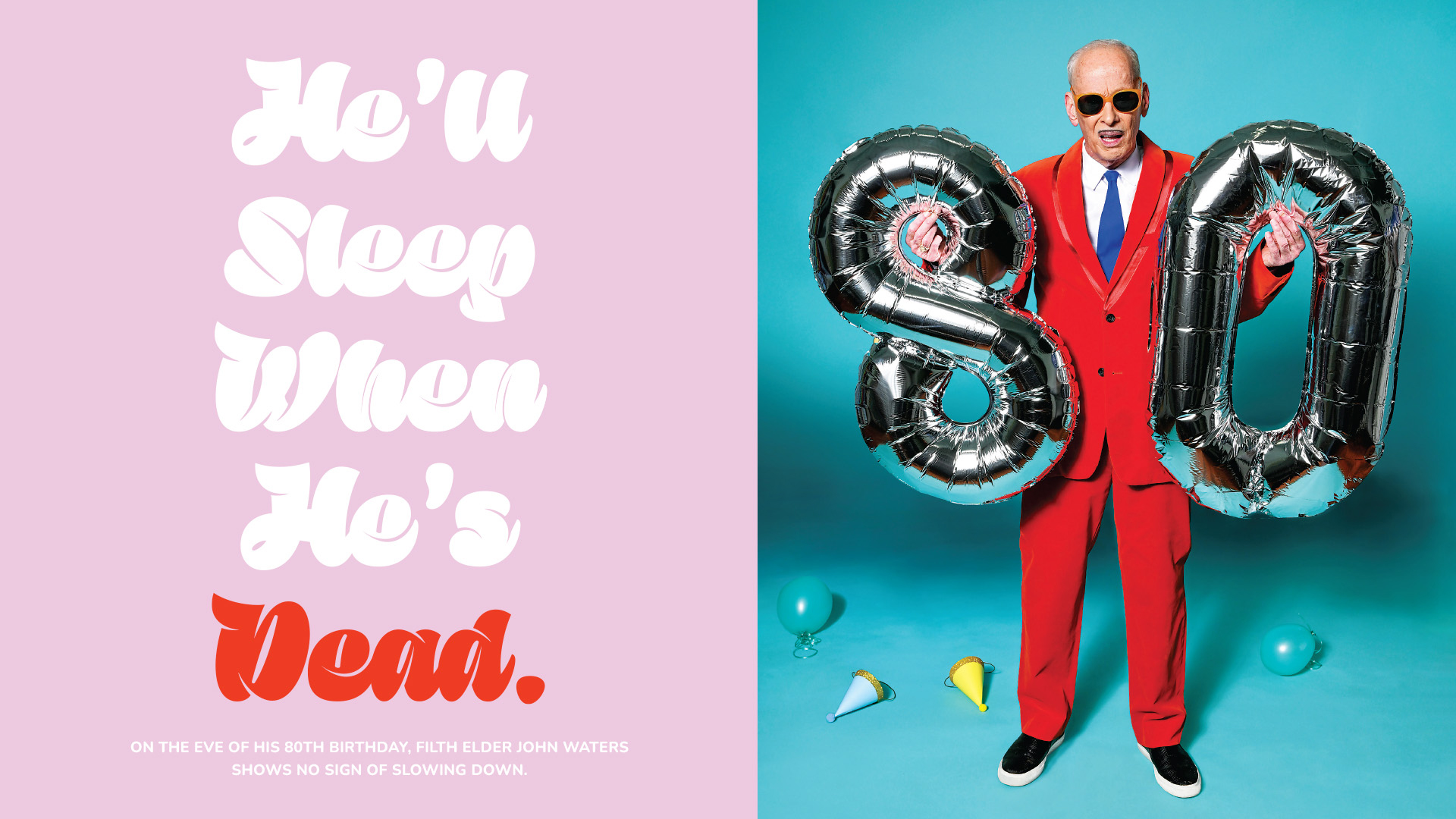
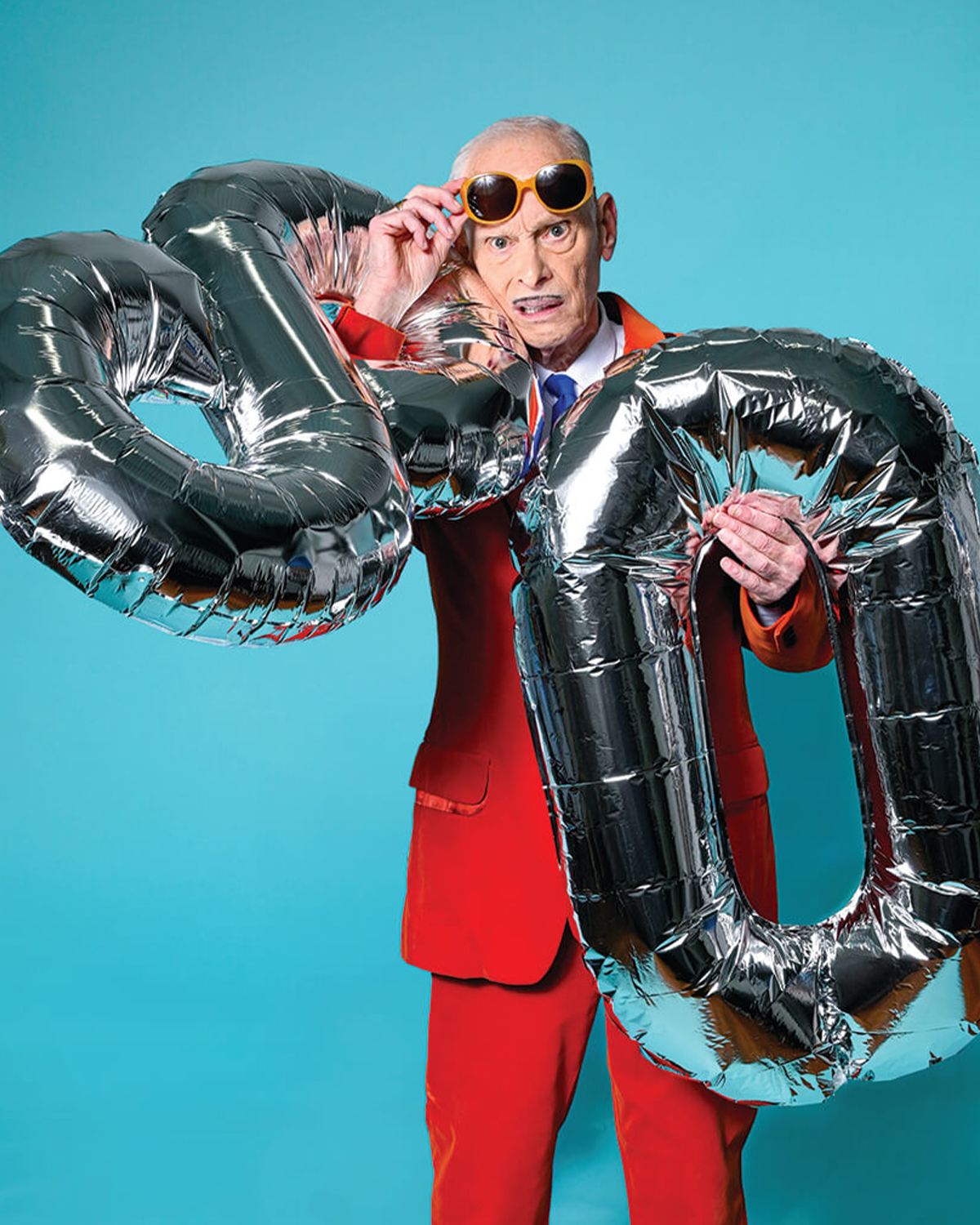
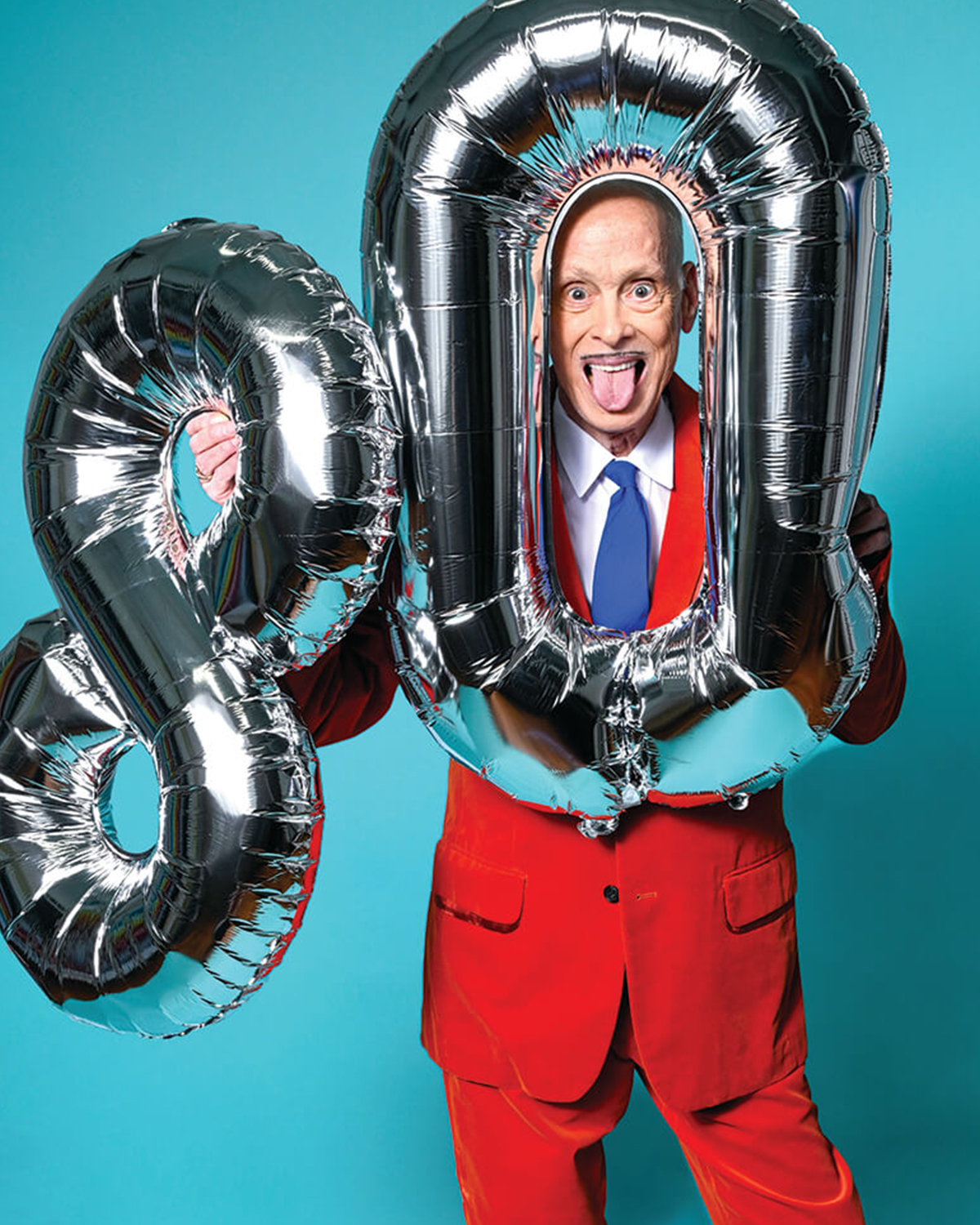
ighty-year-olds are not supposed to be cool. Wrinkles aren’t cool. Bad knees aren’t cool. AARP memberships are not cool.
And yet, on the eve of his 80th birthday, John Waters remains eternally, ineffably, indisputably cool.
He’s not the only old guy who’s cool, but he’s the rare old guy who has the ability to constantly reinvent himself.
Mick Jagger, for example, is cool but mostly because he’s been doing the same Mick Jagger schtick for 60 years. He’s like some geriatric version of his strutting 1960s persona—impressive, for sure, but more a marvel of stamina than anything else. Ditto for Iggy Pop (who happens to be a good friend of Waters’), still defiantly shirtless and screeching, punk rock forever—but not exactly evolving.
There are old celebrities who remain cool by staying out of the spotlight. It’s their elusiveness that makes them cool. Jack Nicholson sort of falls into this category these days. As does, say, Sophia Loren.
And there are plenty of aging celebrities who are revered—kept alive by longtime fans and admirers—but not relevant.
But Waters, who was born on April 22, 1946 at Union Memorial Hospital, is different. He fits into a very rarefied category—occupied only by him, David Byrne, Jane Fonda, and perhaps one or two others. It’s not just that kids dig his classic work—the iconic films like Pink Flamingos, Polyester, Hairspray, and Serial Mom—although they do. It’s that he’s still making work that they consume today.
This year, he appeared in the intro to Sarah Squirm: Live + In the Flesh, a comedy special by SNL’s raunchiest and edgiest cast member (who, come to think of it, with her kitschy costumes and potty mouth, seems like a bit of a Waters protégée). In the special, he played a judgmental stage manager: “Now go out there and remind them why God invented the barf bag!”
He was on the couch—along with Baltimore’s own Stavros Halkias, uncharacteristically deferential—for John Mulaney’s post-modern talk show, Everybody’s Live with John Mulaney.
And his own annual “A John Waters Christmas” comedy show plays to sold out shows across the country.
He hosts an annual hardcore music festival—I kid you not—called Mosswood Meltdown. This year’s lineup includes Bikini Kill, The Dead Milkmen, Iggy Pop, and the god-tier indie band, Pavement. On the webpage for the festival, which takes place on July 17-19 in Oakland, California, Waters calls it, “The Warped Woodstock” and an “Asshole-free Altamont.” (As a rally cry, he suggests: “Coachella, go to hella!”)
On top of that, he has modeled—looking elegant and suave for a 2020 Saint Laurent campaign and hamming it up with one of his besties, the actress Mink Stole, in a 2022 Calvin Klein campaign highlighting “chosen families.” (He was also hired for the 2019 Nike “No Cover” campaign celebrating ’90s NYC streetwear—ironic since he hates exercise.)
He has been cast in the next season of American Horror Story. (Showrunner Ryan Murphy is a friend.)
On Instagram, the John Waters Divine Trash Page has 198,000 followers. On TikTok, where the audience is even younger, the page has 288,000 likes.
A TikTok video from November of last year, which features Waters bad-mouthing gay bars—“they’re so square . . . I want bohemia—in bohemia, gay and straight people [hang] around together”—has more than 60,000 views.
So how has he done it? How has the Pope of Trash, a nickname coined for him by Beat writer William Burroughs, turned himself into the Filth Elder (a nickname he has given himself)?
I decided to go straight to the source to find out.
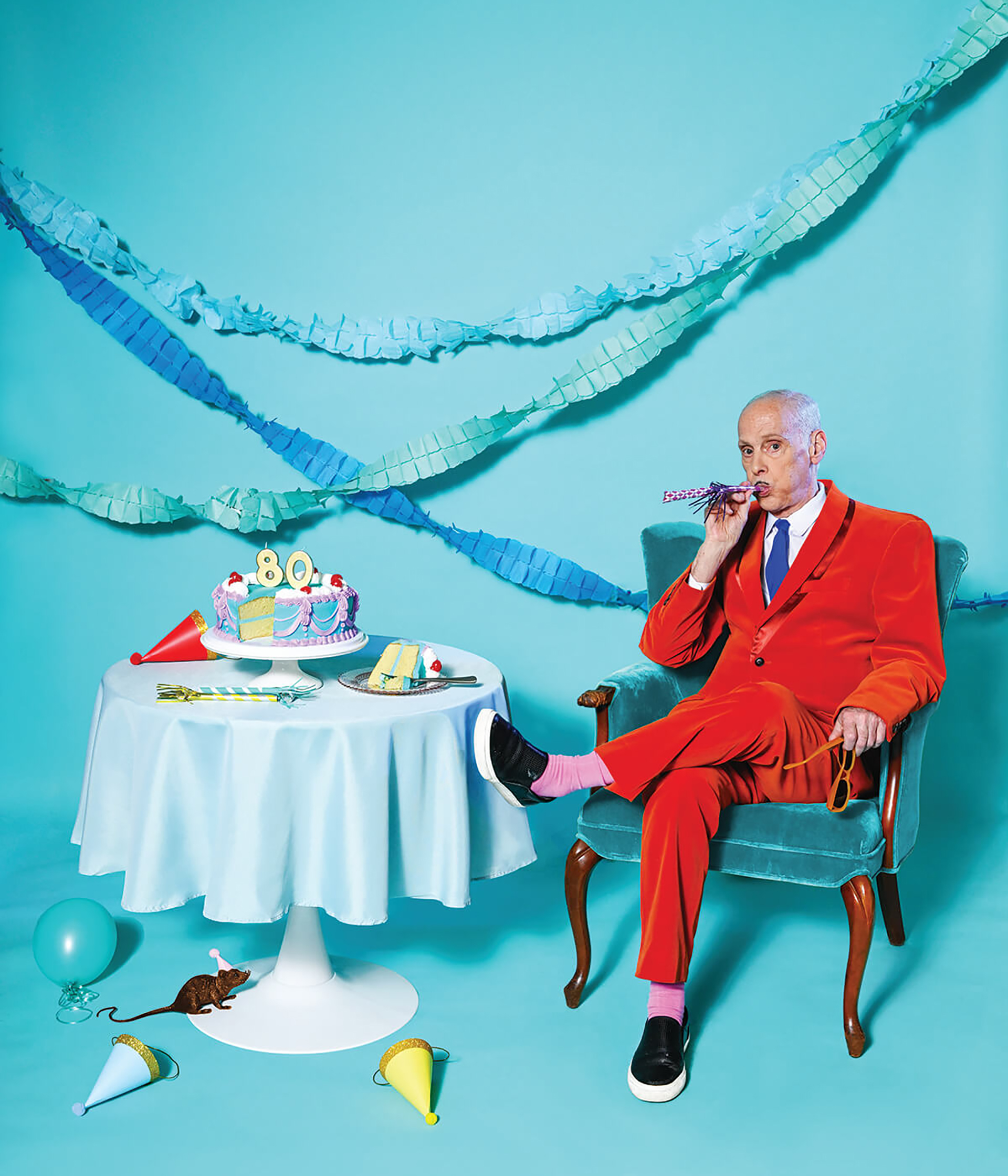
WARDROBE: WATERS’ OWN; CAKE: HERMAN’S BAKERY.

is home, in a tony section of North Baltimore, is not what you’d expect. The living room where we have our conversation has leather and worn velvet couches, lots of brown, artwork, and wall-length shelves spilling over with books.
“Young people hate this,” Waters says. “They hate brown furniture more than anything else. But it’s mostly books and contemporary art, right? Granny [stuff].”
Look closely, however, and there are a few clues that a Filth Elder resides here—for one, sitting in the corner on a rocking chair is an eerily life-like doll named Bill. It’s clear that Bill has been there for a while, because he’s looking a little worse for wear.
“He’s getting scarier and scarier looking,” says Waters, with glee. “He started out white and now he’s black, like a dildo—they change colors. My son is turning into a black dildo—and I accept him.”
While Baltimore is—and always will be—his home base (“of course I love it...I never left”), he now has four homes.
There’s this house, his primary residence, plus an apartment in New York, an apartment in San Franciso, and, just purchased, a house in Provincetown, Massachusetts.
“What man buys a fourth home at 80?” cracks Waters. “An optimist.”
He says all the houses have virtually the same décor.
“People always say, this looks exactly like your other house!”
Which makes sense, because Waters is a man who likes the comfort of rituals.
He takes pride in the fact that he gets up every morning at the exact same time.
“To the second, I get up at 6 a.m.,” he says. Then he checks his emails and takes a bath.
“Not a shower—too violent for me.”
Next, he reads the six newspapers he has delivered to his home—including The Baltimore Sun, The Washington Post, The Wall Street Journal, and USA Today.
From there, he reads about six more newspapers online, including The London Times.
“And then at 8 a.m.—not 7:59, not 8:01—I go into my writing room and get to whatever I’m writing that day.”
The ideas come from the newspapers, they come from his life, they come from the internet, they come from pretty much anywhere.
His favorite websites are Chaturbate (the world’s largest adult webcam site) and Andy Warhol’s grave webcam. (“Best Andy Warhol film ever made,” he says.) He occasionally lurks on Instagram—for some reason, the algorithm feeds him videos of cats destroying houses—and TikTok, but he never posts. “I make a living by what I say,” he says. “Why would I put that for free online?”
Once he comes up with a joke or an idea, he has a system of sorting them in little cubbyholes. One cubbyhole is for film ideas, one for books, one for stand-up specials, etc.
He scribbles the ideas by hand—notepads in the car, notepads next to his bed.
He writes for a few hours and then he moves onto running his business.
“My Filth Empire is complicated,” he explains.
Indeed. He does roughly 50 comedy shows a year—the annual Christmas specials, plus shows with names like “John Waters: Going to Extremes,” the aforementioned “A Date With John Waters,” and this year, the “John Waters 80th Birthday Celebration.”
There are speaking engagements (he headlined the Association of Writers & Writing Programs Conference, held this year in Baltimore), talk show appearances, photo shoots, readings, book signings, gallery talks and openings, acting gigs (he delights in pointing out that he has more than once played a “pervert” on Law & Order: SVU), exclusive private events like the Vanity Fair Oscars party, the four-day Camp John Waters (with this year’s guest counselors, Ricki Lake and Mink Stole), that punk rock fest he hosts, more than the occasional magazine interview (he’s very generous with the press), and so on. It’s exhausting just thinking about it.
When I ask him if he exercises, he replies: “Yeah, walking around in airports.”
He still looks great—lanky and tall, although he insists that he’s no longer skinny.
“Here’s how you be skinny,” he says. “You wear something weird on your face and good shoes, and they don’t look in the middle.”
But he does take care of himself. Famously, he adheres to the idea that if you eat well during the week, you can indulge yourself on weekends.
And he stopped smoking 23 years ago.
“I write it down every day,” he says. “I haven’t had a cigarette in 8,346 days. It’s the only thing I ever regret in my life—smoking cigarettes.”
He was a heavy smoker—five packs a day of Kools.
“I smoked having sex in the middle of the night. I set the bed on fire. I smoked swimming. I smoked doing every possible thing.”
He says he doesn’t miss it. For one thing, he’s lost friends to cancer. “And if you smoke now, you’re stupid, right?” he says. “When I was young there were ads saying, doctors recommend you smoke Kools when you have a cold. What doctors? They should be in jail!”
He no longer thinks smoking makes you look cool—and vaping is even worse. “It’s sneaky. Sneaky little bastards. I see them sneaking around and vaping.”
He doesn’t, however, regret the viral PSA he created many moons ago that for a long time was played before the trailers at The Charles Theatre. Ostensibly a PSA against smoking, it was quite the opposite, with a smirking young Waters taking luxurious drags of his cigarette and talking about the impossibility of sitting through a European art film without one. “I’m telling you, smoke anyway, it gives ushers jobs.” The video ends with an enormous plume of smoke emerging from Waters’ lips that he swallows in one impish gulp. (Disappointing fact I learned about the video: It was not created for The Charles Theatre, as I had assumed. He made it in one take for the Nu-art Theatre in Los Angeles to be played before a showing of Pink Flamingos. “The film ran there for 10 years. Talk about good legs.”)
Still, even for a non-smoker, a guy who watches what he eats, it’s a grueling schedule.
“But he loves it, he lives for it, he’d have it no other way,” says his longtime friend, the film critic Dennis Dermody.
“He has that energy about him,” says veteran MPT broadcaster Rhea Feikin, another longtime friend (you’ll see a pattern emerging here). “He doesn’t get tired easily and when he does, he doesn’t give in to it. He doesn’t baby himself at all. That’s part of his professionalism.”
The comedy tours and other projects are a way to supplement his (considerable) income—he hasn’t made a full-length film since 2004’s A Dirty Shame.
“The movie business as I know it is completely over,” he says. These days it’s a world of studio tentpoles and streaming television.
Briefly, it seemed like Liarmouth: A Feel-Bad Romance, the hilariously profane novel he wrote in 2022, was going to turn into a film starring Aubrey Plaza as scammer Marsha Sprinkle, an absolutely delicious pairing of actress and auteur. Plaza was ready to sign on the dotted line—but the funding never came through. He accepts this with characteristic equanimity. He’s a realist.
He misses making movies but, in a way, it’s all the same to him—writing novels, writing screenplays, doing stand-up, creating visual art. It’s all an expression of his fertile, endlessly creative mind.
He tells me he’s been doing some form of those comedy gigs since the beginning—even before the films—starting with puppet shows for friends. (He would have the puppets bite the hands of children in the audience and make them scream.) The only difference now is that he does his comedy in front of thousands of people.
“Have you ever bombed?” I ask.
He looks confused, “Like, no one showed up?”
“No, like, no one laughed.”
It’s as though I’m speaking Greek.
“No, that’s never happened.”

here’s a reason why John Waters is everyone’s dream dinner guest.
He is truly one of the wittiest people you’ll ever meet. He’s well-versed in virtually every subject—from art to film to politics—and his takes are always incisive, irreverent, and laugh-out-loud funny. He has a way of talking, of italicizing certain words, that is unmistakable. (You don’t just read a John Waters quote, you hear it.)
When I ask Waters who his own dream dinner party guests are, he points out that he’s already met almost everyone on his list. (“I was even in the same room with Tennessee Williams,” he says, “but he had been drinking—he wasn’t at his best.”) Of those no longer with us, he offers outlaw gay playwright/ philosopher Jean Genet; Peyton Place writer Grace Metalious; Elvis Presley—“cause he’s how I knew I was gay”—and authors James Purdy and Jane Bowles. He doesn’t pick Dorothy Parker because she’s “been at too many dead dinner parties for me.”
As for the one living person he still wants to meet? Eminem.
Waters’ considerable skills as a raconteur are not the only reason he’s a coveted dinner party guest. He has impeccable manners, too. Rhea Feikin calls him a “well-bred boy,” which is true. He grew up in Lutherville and was raised Catholic. He went to the ultra-preppie Calvert School through the sixth grade, which “taught me every single thing I know and use today,” he says.
That’s part of the fascinating paradox of Waters: He’s a man famous for showing Divine eating dog shit or being sexually defiled by a giant lobster, but he’s also one of the most polite, professional people you’ll ever meet.
Over and over again, his friends talk about his kindness and his generosity.
“He’s the most loyal friend you could ever imagine,” says Dermody.
“He is a fabulous and true friend, not just to me, but to everybody whom he’s friends with,” says Feikin.
And this is crucial. It’s impossible to truly know John Waters without understanding the importance of his friends. They’re his chosen family—a term usually reserved for kids, often queer ones, who got kicked out of their homes. In Waters’ case, his parents were loving and supportive, albeit slightly baffled by him. “I always assumed that [his parents] had no idea how they created this subversive and hilarious creature,” Feikin says.
But his friends are his world.
And the rumors are true. He is going to be buried with his fellow Dreamlanders—including Pat Moran, Mink Stole, and Dennis Dermody—right next to Divine at the Prospect Hill Cemetery in Towson.
“We call it Disgraceland,” he says.
One day, visiting Divine’s grave, Waters turned to Dermody and deadpanned: “FINAL DESTINATION.”
Dermody has known Waters since 1972, when they met through a mutual friend—famed Dreamlander Cookie Mueller—in Provincetown.
“She kept saying, ‘You’ve got to meet my friend, John. You have the same taste in books and movies. And we met, and that was very true.”
Waters and his crew used to come for summers—they’d see films and have cook-outs and take drugs and create mischief.
“We had a shared anarchy that made it exciting,” Dermody says.
Dermody still marvels at how his rebel friend, the ultimate counterculture figure, has become so damn respectable: an entire exhibit devoted to him at the Academy Museum of Motion Pictures in 2022. A star on the Hollywood Walk of Fame that same year. An exhibit at the Baltimore Museum of Art.
Dermody remembers attending the opening of the Broadway musical, Hairspray, based on Waters’ seminal film. He said he’d had mixed feelings about the original Hairspray, despite its critical and commercial success, because Divine had died so shortly after “and ruined everything.”
“I couldn’t think of Hairspray anymore without being sad by the whole experience,” says Dermody. But then he joined Waters and Waters’ parents, along with a few close friends, at the Broadway opening. “And we were crying at the end when they dragged John up on stage and people were cheering and giving a standing ovation. It was like, ‘Okay, this can be happy again.’”
Like most of Waters’ friends, Dermody has had cameos in some of the films. Most memorably he was one of the people “whacking off” in the porn theater in Cecil B. Demented.
“They did a close-up of me and everything,” he says with unmasked pride. “I just remember [actor] Stephen Dorff saying to me, ‘Go Dennis, go!’”
Local grand dame Rhea Feikin, a Baltimore institution herself, is another—and perhaps the most unlikely—of Waters’ longtime friends. They met in the 1970s, back when they were both hanging out at the beatnik speakeasy Martick’s. “He had lank, long hair and was really skinny,” Feikin recalls. She was drawn to the bohemian wildness and liveliness of Waters and his crew and she provided a shield of respectability for him.
“Whenever he had an opening at The Senator, he would ask me to sit next to his mother because I was the only person he knew that she thought was sane,” she says with a chuckle.
Feikin adored him from the moment she met him—and still does. “I admire him enormously and I treasure our friendship. Even though he’s become famous, he’s never changed and he’s never forgotten any of his friends.”
At Feikin’s 90th birthday party, Waters performed a skit with a puppet. Back in simpler times, Feikin did a weather report on WBAL with a puppet sidekick called Sunshine. Waters called his potty-mouthed version, “Sun Slime.” Sample dialog: “Happy birthday, you bitch!” It brought the house down. And even this slice of silliness was scrupulously planned.
“He wrote a script and made sure there was a podium,” Feikin says. “He is never not prepared.”
She, too, has appeared in Waters’ films, memorably in Hairspray, where she played a teacher and uttered the famous line about Tracy Turnblad’s hairdo: “Whatever you call it, it’s a hair don’t!” She says people still occasionally run up to her on the street and shout the line.
When I ask Feikin what her friends think about her relationship with Waters, she gives a delighted laugh: “They’re jealous.”
But perhaps other than Glenn Milstead, aka Divine, who died of a heart attack in 1988, Waters’ closest friend and confidante has always been a brassy redhead with a larger-than-life persona of her own, Emmy Award-winning casting director Pat Moran. “He knows me like the back of his hand,” Moran says with a chuckle.
They met in 1964 at Flower Mart—both suburban kids trying to soak up the beatnik life of the city—and have been thick as thieves ever since.
“Somebody either gets you or they don’t,” says Moran. “And he gets me—and I get him.” Like all of Waters’ friends, she gushes about his kindness and loyalty—his willingness to step up when times are bad. They’ve been through a lot—the AIDS crisis, the death of friends, various personal trials.
“He’s been there like an anchor,” she says. Is he perfect? “No,” she scoffs. “He can be an asshole and so can I! But we always tell each other the truth.”
At one point she and Waters were the poster children for a kind of punkish youthful rebellion. “But we’re old people now,” says Moran, in a “go figure” sort of way.
Yet they remain as close as ever.
“We talk on the phone every day,” she says.
Indeed, it’s a friendship that will literally never expire, considering that they’ve both going to be buried next to Divine.
“You don’t get out of this [friendship group] until you croak,” Moran says.
I ask Waters what he thinks Divine would’ve been like as an old person. “He probably would’ve done the same thing I did—find a way to keep going and reinvent himself,” Waters says. And he definitely would’ve explored more acting gigs. “He got great reviews for the first time in his life after Hairspray. . . . He would’ve played men, women, everything.”
Waters is proud that his dear old friend has become an icon, even in death. “It’s amazing to me that he’s more famous now than ever,” Waters says. “People put flowers on his grave. Kids have tattoos of him—they talk about him all the time. He’s not dead in that way.”
But all things being equal, I say, it’s better to actually be alive, right?
He laughs: “I’d rather be alive and unemployed than dead and famous.”

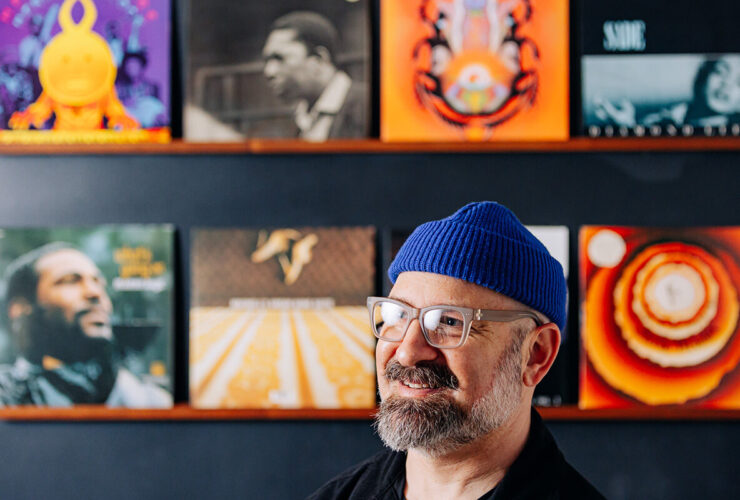
f course, Waters is very much both alive and famous. As you can imagine, he gets loads of fan mail: letters, postcards, artwork, dolls, albums, and lumpy packages of indeterminate status. But he doesn’t receive it at home, or even his office. He has it sent to his favorite indie bookstore, Atomic Books in Hampden.
“John’s an avid reader and likes strange books, the weirder the better,” says Benn Ray, who co-owns the store with his partner, Rachel Whang. “He also loves getting fan mail.”
So it was arranged, many years ago, that all of Waters’ fan mail would be sent to Atomic Books.
“One time, I think someone sent him an uncooked ham,” Ray says.
Atomic Books has become the unofficial John Waters store in Baltimore and Ray says they have benefited enormously from the partnership. “We sell more John Waters books, I think, than anyone else in the world.”
Occasionally, overly optimistic Waters fans—from all over the world—will stop by the store, hoping to run into the man himself. “And sometimes they do!” says Ray.
When Waters does a signing—of a book or a DVD or his recent audio project, The John Waters Screenplay Collection (reading his scripts out loud, Waters says, made him realize just how shocking they truly were)—he does it at Atomic Books.
“They’re sort of like festivals,” Ray says. “People start lining up first thing in the morning, sometimes even the night before. The line will go around the block.” And Waters takes his time with every fan. He signs paraphernalia, as long as it wasn’t bootlegged (he and his lawyers are constantly on the lookout for fraudulent Waters merch). The year he came to promote his hitchhiking odyssey, Carsick, he brought a cardboard sign, à la the cover of the book. He stayed until the end of the line.
“He was there until 1 a.m.,” Ray says.
So what is it that inspires such devotion in Waters’ fans? And why do young people still think he’s cool?
“I don’t get up every day and try to be cool,” Waters says. “But I think as long as you continue to be in touch with young people, they’ll think you’re even cooler.” Another key, says Waters, is not to trot out the old “we had so much more fun in my day” canard.
“No, we didn’t,” he says. “They are having just as much fun.”
And he should know. Yes, Waters goes out to nice restaurants and goes to galleries and does fancy things with his fancy friends, but he also still loves to hang out at the Club Charles, with its famous motto, “I’ll Sleep When I’m Dead,” and go to heavy metal bars.
“I just like to see how everyone looks.” He praises Baltimore’s thriving underground culture. “Baltimore has always had bohemia because it’s cheap.”
He likes young people, finds them interesting and fun.
“He wants to know what young people are into. He wants to know what’s going on,” Dermody says. “He [told me], you can’t get old if you hang out with young people.”
“He genuinely likes all different kinds of people,” notes Feikin.
“Let’s get real here,” Moran says. “Young people love him because he’s lovable.”
And somehow, despite the edginess of his humor, he has never been canceled. “I say unbelievable shit and no one ever gets mad,” Waters says.
This is partly because the audiences who attend his performances are self-selecting. “If you’re coming to see me you want me to [go there].”
Also, he says, “My whole show is about going to that edge. But I always make fun of myself first.”
It goes back to that inclusivity thing. Waters’ work is always about bringing people together—the squares and the outlaws, queer and straight, Black and white.
Even his tour merch displays that ethos: “Join the Cult.” He wants you to be a part of his joyful, iconoclastic club. And honestly, who wouldn’t want to be a member?