News & Community
Meet the Man Making Watches from Salvaged Key Bridge Steel, and Donating Profits to Victims’ Families
For nearly a decade, Alan Tsao’s Baltimore Watch Company has turned local icons—Natty Boh, Old Bay, the Orioles—into limited-edition luxury timepieces. But this project demanded something deeper.
A piece of the Key Bridge—a toaster-sized, 80-pound, steel chunk—sits on the showroom floor of Alan Tsao’s Baltimore Watch Company inside the Union Collective in Hampden.
But instead of looking like part of the silver-gray structure that iconically spanned the Patapsco River, this block of metal is deep black, like volcanic rock. “That’s because someone torch-cut it,” from one of the trusses pitched above the waterline after a cargo ship crashed into the bridge in the early morning of March 26, 2024, explains Tsao.
A friend happened to be on the salvage crew tasked with cutting apart those mangled pieces before demolition. With his supervisor’s approval, he handed Tsao 200 pounds of steel—raw material for an idea that dozens of clients had urged for months since its fall: “Make a Key Bridge watch.”
It’s not as peculiar a request as it might sound. For nearly a decade, Tsao’s Baltimore Watch Company has turned local icons—Natty Boh, Old Bay, the Orioles—into limited-edition luxury timepieces. But this project would demand something deeper: transforming tragedy and hardened bridge steel into a finely crafted tribute. But the 37-year-old Timonium native thought it was worth the effort.
Using that salvaged steel, a machinist in Harford County is now milling 500 solid dials. Down the hall in Tsao’s Union Collective workshop, rotors, hands, glass, straps, and cases will form the finished watches, to be sold for $1,500 each. But Tsao isn’t keeping the profits. After covering his costs, he plans to hand a $200,000 check directly to the families of the six workers who died in the Key Bridge collapse.
Baltimore, and ingenuity, runs in Tsao’s blood. Like his great-grandfather, a Chinese immigrant who in 1932 opened a Roland Park laundromat (that Tsao’s parents still run today), he built his business from scratch. But why the interest in expensive watches?
“It’s an obsession,” he says, which began when he marveled over the craftsmanship of his first Fossil watch at age 10. Eventually, his collection grew to include higher end Omegas and Breitlings. Then, after graduating from the University of Baltimore, Tsao worked at a property management firm, got married, and, after one too many watch purchases, his wife quipped: “Why not make your own?”
In 2017, Tsao launched his first design through Kickstarter and quickly learned the costs of overseas sourcing and manufacturing. Five years later, in 2022, he took the full-time leap after an angel investor commissioned 250 custom pieces following a chance meeting at a local watch show.
Smartwatches, inflation, and tariffs be damned, in the past three years, Tsao has found a niche: making classy, automatic timepieces that tell Baltimore stories. Each design is locally flavored. And the reception has reflected the city’s hometown pride, with sales hitting $1.5 million last year. But “this year,” says Tsao, “has been about building something special.”
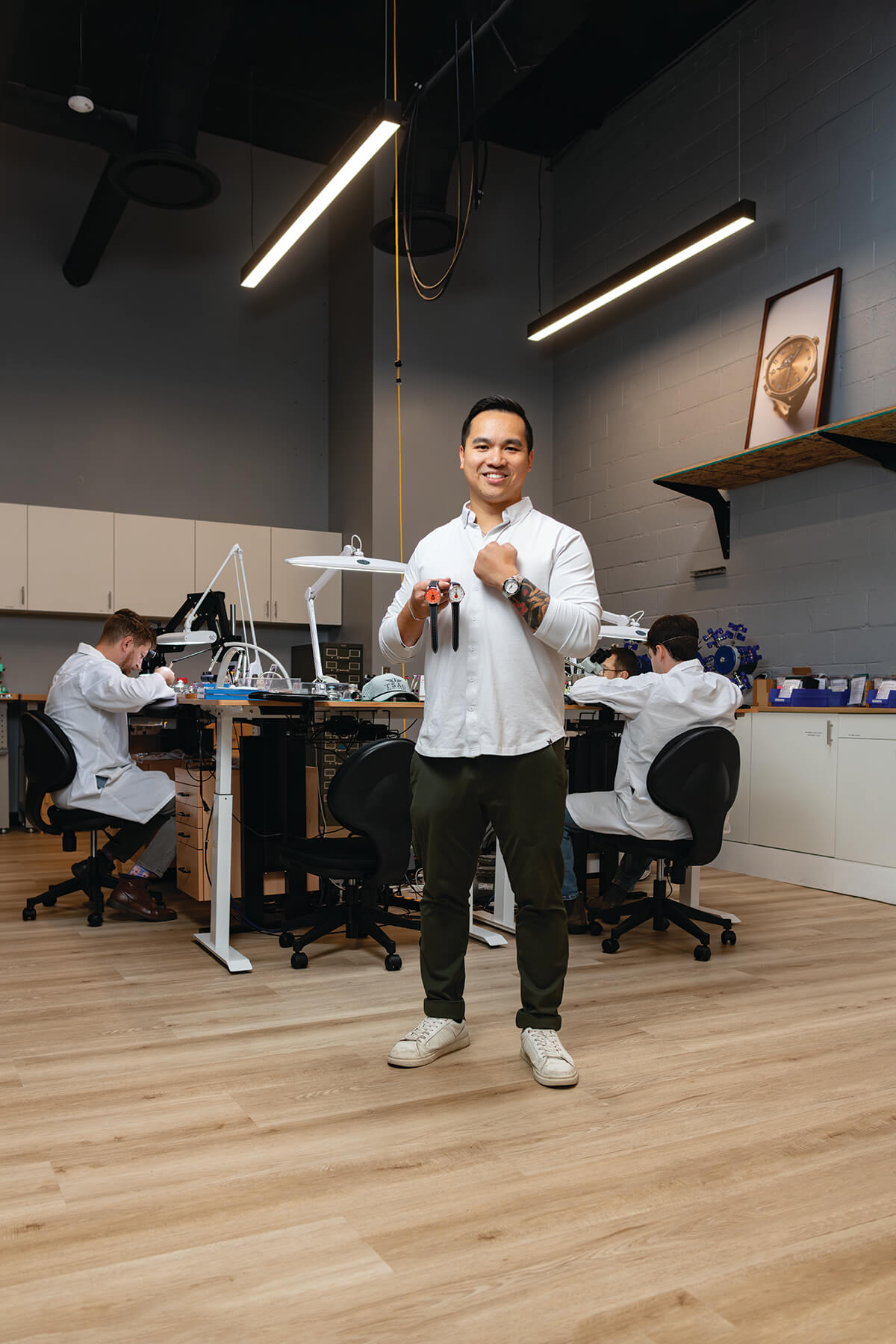
In the fall, he acquired Hagerstown-based Maryland Watch Works, a business he’d previously contracted for the assembly of his watches. Their head maker, Eugene Stohlman, now works at Tsao’s 7,100-square-foot headquarters in the Union Collective, joined by another new colleague, Antonio Vespoint, formerly of Towson Watch Company, plus three technicians who handle everything from vintage fixes to high-end builds. Together, they’ve formed a veritable local brain trust, bolstered by Stohlman’s development of an entirely Maryland-built “movement,” aka the actual clockwork of a watch.
While luxury watches usually use imported parts, Tsao’s Key Bridge edition will be almost entirely Maryland-made. In September, Tsao showed off the latest prototype.
“With watches, we’re thinking on the micron level—we need everything perfect,” he says.
Etched into deep gray metal on the dial are the initials “FSK”—for Francis Scott Key—where a rendering of the bridge will appear on final versions.
It feels weighty, because it is. A piece of Baltimore’s past, forged to keep time with its future.