Food & Drink
Meet the Down-to-Earth Wine Director Who Helped Charleston Win a James Beard Award
Lindsay Willey is a bona fide expert now, but the certified sommelier has maintained the same refreshing humility as the day she started in 2007.
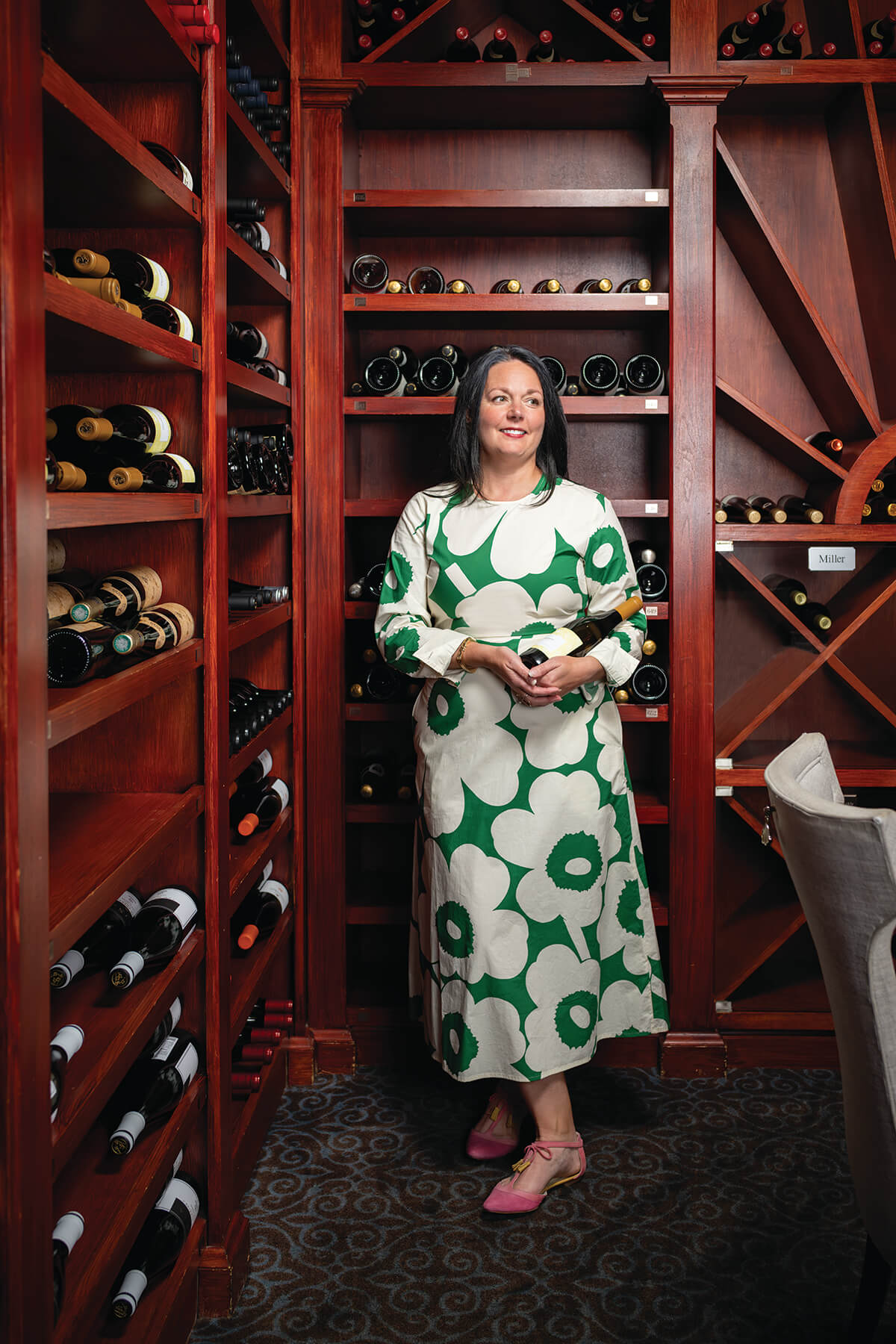
When Lindsay Willey was just beginning her career as assistant sommelier at Cinghiale, she had to fake it till she made it. With some 350 bottles and 40 glasses on the Harbor East restaurant’s wine list when it first opened in 2007, it boasted one of the most extensive exclusively Italian wine programs in Maryland.
“A lot of times when a guest would ask about a particular bottle, I would literally run in the office to look something up,” admits Willey, who was 28 at the time. “I’m not good at lying, I’m not good at schmoozing—I needed to be able to be honest about it.”
Now, some 18 years later, she’s the wine director of Charleston—Cindy Wolf’s famed Low Country restaurant that’s just a stone’s throw from Cinghiale—where she has complete command of the restaurant’s 7,000-strong inventory, one that includes a diverse range of important growing regions across the world, from the Southern Rhône Valley to Burgundy and Champagne.
In addition, she oversees the wine programs for the newly formed Tony Foreman+Co., whose properties include Cinghiale, The Milton Inn, Petit Louis Bistro, Johnny’s, and The Duchess. In total, she’s responsible for handling a staggering 20,000-plus bottles among the six cellars. She’s a bona fide expert now, but the 46-year-old veteran has maintained the same refreshing humility as the day she started.
As she gives a tour of Charleston’s 55-degree wine cellar—really just a tightly crowded room off the restaurant’s kitchen with wine organized numerically—her deep cellar knowledge about vintners, their prized products, and potential pairings is impressive. She pulls a random bottle—bin 2127—off the shelf and rattles off the tasting notes.
“This is a 2021 Châteauneuf-du-Pape,” she says, cradling the bottle in both hands. “It’s a current release from Clos des Pape; we had a great visit there last March. It leans more red fruit, but with a lot of floral and herbaceous notes.”
She’s just getting started. “It’s not uncommon to have lavender and rosemary and sage growing near the vineyards, so it can pick up some of those aromatics in the wine,” she continues. “That’s why it’s perfect for this time of year when chef does things with eggplant and tomatoes and herbs and black olives. It marries nicely with those Mediterranean flavors.”
Charleston has long been both a local and national dining darling, thanks to its peerless owner-chef Cindy Wolf, the well-curated wine list, and hospitality that comes from the heart. And there are awards galore to prove it—in a small, alley-like room behind the bar, and out of public view, an entire section is wallpapered with awards and nods that have poured in ever since Wolf and her then-business partner, Tony Foreman, opened the restaurant in 1997. (Wolf became the sole owner in Dec. 2024.) And yet, there is one award that has been elusive.
While Wolf has been nominated for Best Chef Mid-Atlantic nine times (the restaurant has garnered 24 nods in total), she has never won—earning her the nickname of the “Susan Lucci of chefs.” Lucci, famously, was nominated for 19 Daytime Emmys before she won on her 20th try. Wolf and Charleston didn’t have to wait quite that long to get culinary gold. In June, Charleston won the James Beard Award for Outstanding Wine and Other Beverages.
The medallion, slung on a simple satin ribbon and framed in silver leaf, hangs proudly inside the restaurant’s foyer. It’s very much a shared award: Willey shaped the cellar—and sommeliers and staff moved the bottles from cellar to table. But it’s Wolf’s daily changing seasonal menu, complete with 20 different pairings for each dish, that’s the inspiration behind Willey’s work.
When the restaurant was named a semi-finalist for its wine program last January, Willey was quietly excited. By April, when Charleston was named a finalist, her anticipation grew. “I was definitely hoping,” she admits, “but I was cautious, because I thought, ‘There’s no way.’ And then chef was like, ‘We’re going to the awards ceremony in Chicago!’” recalls Willey, sounding like a little kid. “And I got excited.”
WOLF’S DAILY CHANGING MENU IS THE INSPIRATION BEHIND WILLEY’S WORK.
Once seated at the awards ceremony, Willey’s partner, Patrick Weber, who used to work in event production, tried reading the tea leaves. The trio was seated on the end of a row, something he saw as a good sign.
“When we sat down, Patrick was like, ‘This is interesting,’” she recalls. “He said, ‘All the speakers are usually seated on the aisle because that way they don’t have to go through other people,’ But even then, I was like, ‘It’s probably just a coincidence.’”
It was not. When the restaurant’s name was called, Wolf and Willey—who says she let out a Beavis and Butt-Head laugh—stood up and embraced, then headed toward the stage at the Lyric Opera, where, at long last, they accepted the award, known as the Oscars of the food world.
At the podium, Wolf portrayed their partnership. “It is a joy to have a som who knows your cooking, understands your cooking, and knows how to pair—it’s the best thing you can ask for as a chef,” Wolf recalls saying to the crowds.
Willey never set out to be a certified sommelier. Growing up in a ramshackle 1800s home in Garrett County on some 30 acres, there were plenty of places for her, along with three siblings and various farm animals, to roam. It was a happy childhood, filled with family and good food. Her parents primed her palate. “My dad, Morris, was a really good cook; my mom, Pam, was a wonderful baker,” she says, “and we were always making jam in the summer.”
Her father’s signature dish was roast chicken with cippolini onions. He kept a vegetable garden. Her mother made strawberry-rhubarb pie. Wine was something that appeared on the table at special occasions. “At Christmas, if we had tenderloin, my mom would have a Cab or something like that out, but there wasn’t a big emphasis on wine.”
In her teen years, Willey wasn’t yet sure of her future. She earned a scholarship to attend college at North Carolina State to be a pulp and paper engineer, because it was the path of least resistance. “There was a big paper mill in Western Maryland,” she says, “and they liked to promote people to have careers in math and science. But after one semester I was like, ‘I cannot be a pulp and paper person.’ It was going to be a really dirty job. I love paper. I was like, ‘I want to be on the happy side of paper!’”
From there, she headed back to Maryland to Frostburg State, her parents’ alma mater, majoring in graphic design. And she worked at an Italian restaurant part-time, where she did wine tastings for the first time. “I loved food, and I loved the restaurant business,” she recalls. “I loved learning about things and talking with the guests. It helped me learn to talk to people as an adult, because I was always a little bit introverted, but I didn’t think I could make a career of it. I always thought, ‘I’ll be a server, I’ll make some money, and then I have to get my grown-up job.’”
At 22, after graduation in 2001, she moved to Mount Vernon for her “adult job,” working for Agora Publishing on newsletter design—and then came the light-bulb moment. “After six years, I needed to hit the reset button,” she says. “My dad had terminal cancer in 2007, and he passed away in 2008. It was eye-opening. Not to be corny, but life is short—so, I took that leap. I thought, ‘He was only 56 when he died—I want to find something that makes me happy.’”
On a lark, in 2007, she interviewed for a part-time job at Foreman’s Harbor East wine shop, Bin 604 Wine Sellers. But during the interview, Foreman saw something special in her and decided she was destined for bigger things.
“When we met, I recall that she had this curiosity about wine,” says Foreman. “I thought, ‘This is a person I want to teach.’ She had a lovely spirit, and I was impressed by her—we just vibed immediately.”
Willey started as a server at Cinghiale, Foreman’s recently opened Italian enoteca/osteria. But within a few months, she graduated from server to assistant dining room manager and assistant som. “She was exceptionally organized, a good taster, and paid attention,” says Foreman.
The massive wine list was daunting, but Willey was a dedicated student. “I committed myself to wholeheartedly learning that list so I could talk intelligently about the wine,” she says. “I kept this big file and would add tasting notes. I have a good way of connecting my senses to memory—I was like a sponge.”
Her strong sense of smell also helped sharpen her palate, the key, she says, to being a som. “I’ve always noticed smells and have often been transported by them—like some fruity perfume of a lip balm as a kid or picking berries in the summer,” she says. “I have a sensory curiosity that makes wine tasting engaging and challenging. If you aren’t interested in tuning in to smell and taste, then wine tasting is hard.”
The first time she really grew to appreciate wine was during the tasting of a 1997 Barolo in 2007. “I remember seeing the color of it—it almost looked like iced tea,” she says. “I didn’t even know that wine could taste like this, look like this, age like this—I was captivated.”
The following year, a wine trip with Foreman and other staffers to Northern Italy furthered her education and fueled her newfound passion—and there have been many trips since to Italy and other wine-growing regions, including ones to France and Spain.
“Seeing the vineyards, and meeting the people and understanding the processes and all the variables that go into it, was amazing,” she says. “The fact that you could make something that was somewhat consistent from year to year and the dedication to it boggled my mind.”
“I’VE ALWAYS NOTICED SMELLS AND HAVE OFTEN BEEN TRANSPORTED BY THEM—IF YOU AREN’T INTERESTED IN TUNING INTO SMELL AND TASTE, THEN WINE TASTING IS HARD.”
As a young woman in a mostly male-dominated field, she occasionally encounters sexism and ageism, though overall, she says, “I haven’t found it to be too frustrating.”
Still, there’ve been times when she’s been tested. “There was a guest who came in regularly to Cinghiale,” she says. “He either hated me or he had a crush on me. He would say things like, ‘Would you describe this wine as herbal or floral?’ And I’d be like, ‘Well, I don’t really think either.’ He’d be like, ‘Oh, okay, good. Because I read about it and it’s neither’—he would try to trick me.”
Of course, as a female chef, Wolf can relate. “I’m a woman in a male-dominated field and she is, too,” says Wolf. “But it doesn’t matter if she’s a woman or a man, she’s just really good at what she does.”
On a late summer day, Willey, who lives in Medfield with her partner, Patrick, and a rescue cat named Momo, meets the morning wearing a white cotton top and bright green pants. Green, which she wore to the Beards, is officially her lucky color. It’s also the color of her eyes, which stand out next to a mane of dark hair that settles just past her shoulders.
The work starts early at Charleston and Tony Foreman+Co. As wine director, Willey handles all the details and logistics of the restaurants, working with vendors, tracking inventory, ensuring wine gets delivered, updating and printing the wine lists (the happy side of paper, after all), working wine dinners, and spending time with staff to demystify wine. She even teaches them the intricacies and the art of opening a bottle at the table, everything from keeping the cork quiet by easing it out of the bottle slowly to always keeping the label facing the customer to decanting along the side of the decanter so “it doesn’t look like a science experiment,” she says. “It contributes to the overall feeling of being in the restaurant.”
Willey also decides what makes its way onto any one list, always considering if the wine presents properly. “I ask, ‘Is this what the wine is supposed to taste like?’” she says. “For example, if it’s 100-percent Nebbiolo, I’m looking for certain characteristics—usually some sort of rose, floral quality, usually cooler, darker fruit with some sort of anise, tarry taste, not incredibly heavy on the tannins, very aromatic—it might be really tasty but not what I’m looking for. And then I ask myself if the price is fair.”
Her responsibilities at Charleston, where she eventually started working part-time in 2010, are particularly daunting given Wolf’s daily rotating menu—with each menu item accompanied by suggested pairings. It’s those pairings—curated to complement the menu—she believes, that clinched the award.
“I don’t know what put us over the top,” says Willey, “but I think that maybe this award was focused on the pairings. What consistently sets Charleston apart is the number of options you have when you dine here. We have 20-some wines that are going to be paired with any offering on a given day. I have never seen a restaurant offer the number of choices and flexibility that we have. I don’t know if somebody noticed that this particular year, but I definitely think that makes it very special.”
As she stands near the entrance of the restaurant showing off the Beard, she beams. “Isn’t it beautiful?” she says. “I had it with me for three days—I put it next to my pillow and slept with it. But it really belongs to the restaurant. I wanted the staff to look at it every day and be reminded of the great work they’re doing.”
Still, the down-to-earth wine director is proud of her part.“I’ll never forget my place in this,” she says. “That’s etched in my brain—I had my time with him.”