
Día de los Muertos, or the Day of the Dead, is celebrated this weekend. It’s a holiday observed in Mexico and among those of Mexican heritage, as well as in places with a Mexican or Latino population—like Los Angeles, where I lived for two decades. There, the Día de los Muertos festival at Hollywood Forever Cemetery (the only cemetery in the country that opens its gates to celebrate the holiday) is spectacular.
It’s a day to honor those we’ve lost with marigolds, food, calaveras (sugar skulls), candles, and shrines or altars called ofrendas. Unlike Halloween, Día de los Muertos ghosts don’t haunt so much as visit, briefly returning to a living world of incense and bread, chocolate, flowers, and tacos.
This year is a poignant one for me, as it’s both the first anniversary of my father’s death and the 20th of my mother’s, so I’ve had a heightened interest in the ways Baltimore salutes the holiday.
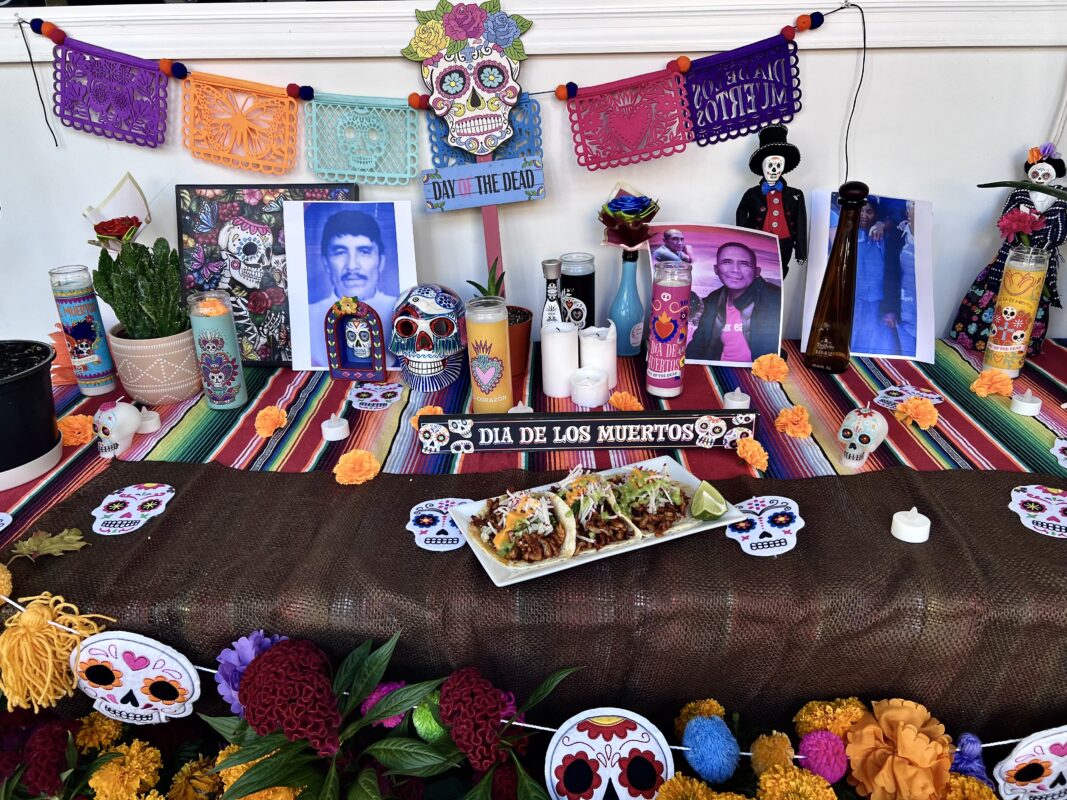
One place that does it up right is Bmore Taquería in Fells Point, where chef-owner Valentino Sandoval has constructed an impressive ofrenda in the entryway, which is pictured above. He has photographs of his late relatives, plenty of marigolds, and beautiful veladoras—the tall votive candles decorated specifically for the holiday. That plate of al pastor tacos, it should be noted, is not normally there—though food is usually part of the ofrenda.
Sandoval’s tacos are marvelous—with pork shaved from the trompo, presented on just-made tortillas, and thatched with perfectly julienned radishes and pours of house-made sauces. Sandoval also makes his own mole, from a family recipe, which is wonderful any time, but has added significance on this holiday, as it is one of the foods often placed on altars.
Another very traditional food for this event is pan de muerto, or bread of the dead, a pan-dulce bun formed into a shape meant to resemble a skull and crossbones, which is also a favorite ofrenda dish.
At Sacré Sucré, chef and co-owner Manny Sanchez, who is from Puerto Rico, honors the tradition with a spectacular iteration of the bread, only available for the next few days. His are ethereally light, infused with orange blossom, and topped with either pale sugar or, in a further creative tribute, sugar colored charcoal to resemble ashes.
Sandoval, though trained as a pastry chef, does not make pan de muerto (“It’s not hard, but it’s a lot of work”), so he says he gets his from Cinco de Mayo or Vargas Bakery. Given how much work he puts into his mole, and the fact that he’s often the one manning the trompo, this seems a logical trade-off.
Worth noting as well are the Día de los Muertos specials, running Friday through Sunday, at nearby La Calle, the upscale Mexican restaurant owned by Sandoval’s brothers. The family is from Puebla, a vibrant food city known for its mole poblano, so, unsurprisingly, La Calle’s mole is pretty spectacular.
And for a truly gorgeous ofrenda, head to Alma Cocina Latina in Station North, where co-owner Irena Stein has installed one near her bar that is both altar and art installation.
“It’s not Venezuelan at all,” says Stein, whose restaurant is inspired by her Venezuelan heritage, “but it is the best way to celebrate death.”
Lit up at night under colorful paper flags, when the restaurant is bustling with dinner service, there’s a tableau of lit candles; tiny ceramic vases of marigolds; small bowls filled with tomatillos, fresh chiles, chocolate pastilles, sugar skulls, and figurines; and framed photographs of lost pets, relatives, and dear friends.
It is a lovely artscape to appreciate alongside your plates of fried yucca with hot-sauce aioli and repeating caipirinas. It is also a marvelous tribute to tradition and culture, foodways and memory, and a public toast to all the living and the dead.